Gesamtpreis (1 Artikel Artikel):
Versandziel:

dumas alexandre 1802 1870 pere (29 Ergebnisse)
Direkt zu den wichtigsten Suchergebnissen
Suchfilter
Produktart
- Alle Product Types
- Bücher (5)
- Magazine & Zeitschriften (Keine weiteren Ergebnisse entsprechen dieser Verfeinerung)
- Comics (Keine weiteren Ergebnisse entsprechen dieser Verfeinerung)
- Noten (Keine weiteren Ergebnisse entsprechen dieser Verfeinerung)
- Kunst, Grafik & Poster (Keine weiteren Ergebnisse entsprechen dieser Verfeinerung)
- Fotografien (1)
- Karten (Keine weiteren Ergebnisse entsprechen dieser Verfeinerung)
- Manuskripte & Papierantiquitäten (23)
Zustand Mehr dazu
- Neu (Keine weiteren Ergebnisse entsprechen dieser Verfeinerung)
- Wie Neu, Sehr Gut oder Gut Bis Sehr Gut (2)
- Gut oder Befriedigend (3)
- Ausreichend oder Schlecht (Keine weiteren Ergebnisse entsprechen dieser Verfeinerung)
- Wie beschrieben (24)
Einband
Weitere Eigenschaften
- Erstausgabe (1)
- Signiert (4)
- Schutzumschlag (Keine weiteren Ergebnisse entsprechen dieser Verfeinerung)
- Angebotsfoto (26)
Sprache (4)
Gratisversand
Land des Verkäufers
Verkäuferbewertung
-

tapa blanda. Zustand: Bien. 1610-1643, Swordplay, Fiction., Ghost stories, English., Short stories, English., Short story, France, Novel Wordsworth Editions. Ware. 2001. 18 cm. xxviii, 564 pages. Encuadernación en tapa blanda de editorial ilustrada. Idioma Inglés. Alexandre Dumas ; with an introduction and notes by Keith Wren. [Trois mousquetaires. English ]. "First published 1993 by Wordsworth Editions Limited. New introduction and notes added in 2001"--Title page verso. Includes bibliographical references. Translation of: Les trois mousquetaires. selected by Rex Collings. [Classic Victorian and Edwardian ghost stories ][Classic Victorian and Edwardian ghost stories. ]. Wordsworth classics. Contents The tapestried chamber / Walter Scott -- The spectre of Tappington / Richard Harris Barham -- The Botathen ghost / R. S. Hawker -- The tell-tale heart / Edgar Allan Poe -- The Squire's story / Elizabeth Cleghorn Gaskell -- The story of Mary Ancel / William Makepeace Thackeray -- The story of the bagman's uncle [and] To be taken with a grain of salt / Charles Dickens -- Account of some strange disturbances in Aungier Street [and] Narrative of a ghost in hand / Joseph Sheridan Le Fanu -- Fisher's ghost / John Lang -- The traveller's story of a terribly strange bed / Wilkie Collinns -- The phantom coach / Amelia B. Edwards -- Eveline's visitant / Miss Braddon -- Markheim / Robert Louis Stevenson -- Man-size in marble / Edith Nesbit -- The Canterville ghost / Oscar Wilde -- The aunted doll's house [and] A school story / Montague Rhodes James -- Thurnley Abbey / Perceval Landon -- In the cliff land of the Dane / Howard Pease -- Laura / Saki (H. H. Munro) -- Appendix of three ghost stories: The story of Euphemia Hewit / James Hogg -- A ghostly manifestation [and] Correspondence in 'A ghostly manifestation' / A Clergyman -- Ghost in the tower / Edmund Lenthal Swifte. Alexandre Dumas . Cubierta deslucida. ISBN: 9781853260407; 1853260401 (=3269543=) LM166.
-

Les trois Mousquetaires [1843/44]. Avec une lettre d'Alexandre Dumas fils. Compositions de Maurice Leloir. Gravures sur bois de J. Huyot. 2 tomes. (Édition de grand luxe).
Verlag: Paris: Calman Lévy, éditeur, 1894, 1894
Sprache: Französisch
Anbieter: Antiquariat Lengelsen, Werdohl, Deutschland
Verkäuferbewertung 5 von 5 Sternen

4°. Hldr. d. Zt. m. goldgepr. Rt. u. Lederecken. Marmor. Vorsätze. XX, 479 u. 469 S. Titelkupfer. Kopfschnitt, sonst unbeschnitten. (Einbände etwas ber. u. best. Exlibris jew. auf d. vord. Innend. Papier teils l. braunfleckig, sonst innen nahezu sehr gut).
-
Eigenh. Manuskript mit Unterschrift Alex Dumas".
Verlag: ohne Ort, 1862, 1862
Anbieter: Kotte Autographs GmbH, Roßhaupten, Deutschland
Verkäuferbewertung 5 von 5 Sternen
Manuskript / Papierantiquität
EUR 4.500,00
EUR 20,00 für den Versand von Deutschland nach USAAnzahl: 1 verfügbar
In den Warenkorb4to. 5 1/2 pp. Interessante Chronik über die Lage in Frankreich und Europa, ein Artikel, am 2. Dezember 1862 in italienischer Sprache in Dumas' neapolitanischer Zeitung L'Indipendente veröffentlicht. Dumas bespricht verschiedene Nachrichten und Gerüchte aus Frankreich: eine gewisse Kühle zwischen Kaiser Napoléon III und seinem Vetter Prinz Napoléon im Zusammenhang mit Italien; die offizielle Reise des Marschalls und der Marschallin Randon nach Rom, gesehen im Licht des Protestantismus des Marschalls; die Kandidatur von Prinz Alfred von England für den griechischen Thron und die gegensätzlichen Haltungen des Morning Post und der Times dazu; sowie die von Napoléon III überraschend vorgeschlagene Kandidatur von Prinz Nikolaus August von Schweden, Sohn Bernadottes, für denselben Thron. Dumas schließt seine Betrachtung mit einem bissigen eigenen Kommentar: Un journal demande comment il se fait qu'à leur début les révolutions populaires ont ce grand et magnifique caractère qu'on cherche inutilement en elles au bout de trois mois. La réponse est bien facile. C'est le patriotisme qui fait les révolutions c'est l'intrigue qui les défait.".
-
Autograph letter signed.
Verlag: No place, [1847]., 1847
Anbieter: Antiquariat INLIBRIS Gilhofer Nfg. GmbH, Vienna, A, Österreich
Verbandsmitglied: ILAB VDA VDAO
Verkäuferbewertung 5 von 5 Sternen
Manuskript / Papierantiquität
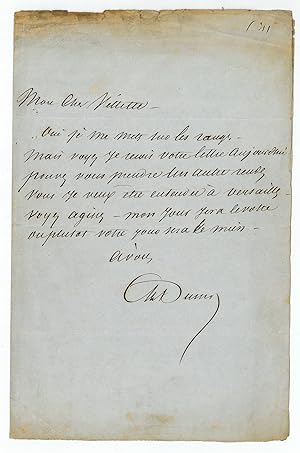
8vo. ½ p. on bifolium. - Together with three letters in relation to a magnetist séance organized by Alexandre Dumas. 8vo. Altogether 8 pp. Further includes a printed leaflet of the "Cercle Magnétique de Paris" from March 1882. Highly interesting collection of letters relating to a séance with the celebrated medium Alexis Didier, organized by Dumas on 10 October 1847. The autograph letter by Dumas is addressed to the Abbé Villette, chaplain at Saint-Cyr, who was present at the séance and is central to Dumas's description of the event in an article for La Presse from 17 October 1847 entitled "Magnétisme". Dumas asks the Abbé for a meeting in Versailles in response to a letter: "Oui je me mets sur les rangs. Mais voyez je reçois votre lettre aujourd'hui. Pouvez vous prendre un autre rendez-vous je veux être entendu à Versailles - voyez agréez - mon jour sera le votre où plutôt votre jour sera le mien". While the context of this undated letter is not specified, it may have been written in the aftermath of the publication of the article that had affected Villette greatly. On 24 October 1847, Villette wrote to the director of La Presse, Émile de Girardin, quoting an earlier letter that he had asked Girardin to publish in reply to Dumas's article and renewing this request: "In an article entitled 'Magnetism' my name appeared in your journal of the 17th inst.; immediately and for important reasons I appealed to your justice, objecting to this article. My request should have appeared on the 20th inst. and my letter has nevertheless not been seen among the columns of La Presse. [.] Here is a copy of my first letter: a friend of mine has just brought me the issue of your journal from the 17th inst., wherein I see, to my great astonishment, M. Alexandre Dumas in an article [on] Magnetism, citing my name in testimony to the facts that he articulates. Mere chance brought me to this séance of magnetism: I did not express my opinion either for or against the facts cited by M. Dumas; why then does he choose to stress my being a priest, who must remain a stranger to everything that is not religion? I have never liked to talk publicly about myself but today I am forced to overcome this repugnance because I cannot allow anyone to invoke my name to vouch for the facts he states and for the consequences that could be drawn from them" (transl.). - Indeed, Dumas' article from 17 October 1847 states that Villette joined the séance accidentally and more or less unsuspectingly. As Villette and Didier did not know each other and Villette was not dressed in his cassock, Dumas asked the "somnambulant" Didier about Villette's profession and his work as a chaplain at Saint-Cyr. To the great astonishment of the participants, Didier gave the correct answers, at least according to the article. - It is unclear whether Villette had to fear negative consequences from the clergy or his employer for being invoked in an article on magnetism. He did, however, receive at least two letters from readers of La Presse, who were eager to know more about the séance and attached great importance to Villette's opinion on magnetism; these letters form part of the collection. On 22 October 1847, Jules Bouly de Lesdain, a judge in Dunkerque, wrote in reference to the article, finally to ask Villette: "In spite of all the merit we all recognize in our great novelist as a writer, we are a little suspicious of the deviations of his imagination, and when it comes to serious matters, we need further testimony than his to assure us that he has not been mistaken, that he could not have been mistaken. I would like to believe in magnetism, but I shall still hesitate unless a respectable testimony such as yours, dear Sir, proves to me that my hesitation is unfounded, that my doubts are not reasonable. I do not have the honour of knowing you, dear Sir, but I have the confidence to address you, convinced that you will enlighten me and tell me whether I should believe or not" (transl.). - Eve.
-

Vierzeiliger, eigenhändiger, voll signierter Brief. Französische Handschrift auf Doppelblatt. Verso mit eigenhändiger Adressangabe.
Verlag: Paris
Anbieter: Versandantiquariat Bürck (VDA / ILAB), Berlin, Deutschland
Verbandsmitglied: GIAQ ILAB VDA
Verkäuferbewertung 5 von 5 Sternen
Hardcover. Zustand: Gut. undatiert. 218 x 140 mm. (etwas knitterspurig und fleckig, hinteres Blatt mit Spuren entfernter Montage, insgesamt ordentlich erhalten). Das Doppelblatt war wohl ursprünglich als Couvert gefaltet und verschlossen. Der Brief ist eine Kurzmitteilung an einen Bekannten ("Monsieur Bactron" ? ) über eine geplante Reise nach Aigues Mortes. Der Brief stammt wahrscheinlich aus dem Jahr 1834, am 15. Oktober 1834 verlies Alexandre Dumas Paris in Begleitung des Malers Godefroy Jadin für eine Reise nach Italien, die ihn auch über Arles, Les Beaux, Sainte-Marie de la mer und Marseille führte.
-

Photographie par Pierre Petit
Sprache: Französisch
Anbieter: Librairie Trois Plumes, Angers, Frankreich
Verbandsmitglied: ILAB
Verkäuferbewertung 5 von 5 Sternen
Couverture rigide. Zustand: Bon. Alexandre Dumas père (1802-1870), écrivain & Adah Isaacs Menken (1835-1868), actrice et poète américaine, maîtresse d'Alexandre Dumas. Photo CDV par Pierre Petit, ca.1865. [1].
-
[MONTE CRISTO IN KARAMANLIDIKA] Monte Hristo [i.e. Monte Cristo] [and] Lord Hop: Meshur Monte Hristo hikâyesinin zeyli. [i.e. Der Herr der Welt = The lord of the world].
Verlag: Grafikos Kosmos Printing House / A. Th. Nikolaidis Printing House., (1882-1885), Asitâne / Dersaadet (Constantinople - Istanbul), 1882
Sprache: Osmanisch
Anbieter: Khalkedon Rare Books ABA, ILAB, IOBA, ESA, Istanbul, Türkei
Verbandsmitglied: ABA ESA ILAB IOBA
Verkäuferbewertung 5 von 5 Sternen
Erstausgabe
Leather. Zustand: Very Good. 1st Edition. Original burgundy quarter calf, five raised bands to spine, ornaments in compartments. Demy 8vo. (22 x 15 cm). In Karamanlidika (Old Turkish with Greek alphabet). 1392 p., illustrated; [and] Lord Hop: Original black quarter calf, five raised bands to spine lettering title and volumes [as 1-6] in compartments. Demy 8vo. (22 x 15 cm). In Karamanlidika (Old Turkish with Greek alphabet). Six volumes in one (191, [1] p., 205, [3] p., 192, [1] p., 180 p., 185, [1] p.; 200, 6, [2] blank pages). Foxing on pages, slightly weak hinges, Lord Hop's boards are worn, slight chippings and weakness on extremities of pages. Overall good copies. Extremely rare first Karamanlidika (Old Turkish with Greek letters) and second Turkish edition of the most celebrated novel "Monte Cristo" by Alexandre Dumas père, who, with 43 translated novels, was the second-most translated author in the Ottoman Empire; with "Lord Hop", introduced as the sequel to Monte Cristo in Karamanlidika, is even wrongly attributed to Dumas père himself, and then also to the French author Jules Lermina, who wrote two sequels to the Count of Monte Cristo: "Le Fils de Monte-Cristo" (1881) and "Le Trésor de Monte-Cristo" (1885). However, the actual origin of Lord Hop is Adolf Mützelburg (1831-82)'s Der Herr der Welt (1856). The Karamanlidika edition might be a translation of the first Greek translation of "Lord Hop" published in 1871-74. The translator is not indicated. This rare and very early translation of Monte Cristo is deeply indebted to Kasap, who was a Greek - Turkish intellectual, who translated the Ottoman Turkish edition of Monte Cristo in 1872. The Turkish translator of Monte Cristo is typically deemed to be the famous Ottoman journalist, writer, and translator Teodoris Kasapis (known as Teodor Kasap), (1835-1897). Monte Cristo was initially serialized in Kasap's satirical newspaper, Diyojen, on November 11, 1871. Panosian (the publisher of the first Ottoman Turkish edition of Monte Cristo) published the sixth volume of the Turkish text that was based on Kasap's translation which was serialized in Diyojen. "Monte Hristo" also has features that provide insight into conventional practices in Karamanlidika publishing. These include the copyright notice and the dedication page, typical features in publishing in Turkish with Arabic letters, and the subscriber list at the back, an interesting feature of Karamanlidika book publishing for understanding the mechanisms of book circulation and production in the Turcophone Orthodox community. The copyright notice, invoking copyright laws on the first page, warns that: "Copies without the signatures of the publishers will be treated legally as fakes" (Nasirlerinin imzasi ile mümzî olmayan nüshalara nizamen sahte nazari ile bakilacaktir). This notice probably relates to the Ottoman state's Statute of Copyright (1857) and the Statute of Copyright and Translation (1870). (Sismanoglu). The copy we present is also signed. Lord Hop Meshur Monte Hristo Hikâyesinin Zeyli (1884), introduced as the sequel to Monte-Cristo in Karamanlidika, is even wrongly attributed to Dumas père himself. The translator is not mentioned, but I. M. Pontidis and P. S. Shanidis are described as its sahibi ("owners") on the front cover. Lord Hop's Karamanlidika edition printed between 1884-1885 has six volumes. Balta: Karamanlidika (1584-1900), Add., 66 (Balta indicates that "Monte Hristo" is 713 p. in three volumes.; Salaville & Dalleggio 212.; Not in Özege enlarged data.; Not in OCLC.
-
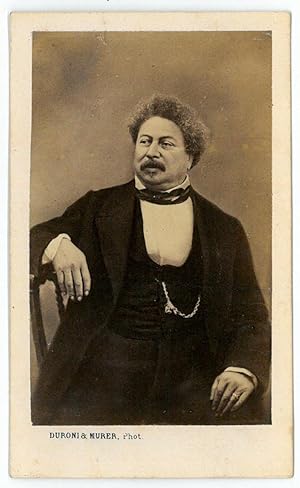
Originalportraitphotographie.
Verlag: [Turin, um 1850]., 1850
Anbieter: Antiquariat INLIBRIS Gilhofer Nfg. GmbH, Vienna, A, Österreich
Verbandsmitglied: ILAB VDA VDAO
Verkäuferbewertung 5 von 5 Sternen
Manuskript / Papierantiquität
87:54 mm (Carte de Visite) auf etwas größerem Untersatzkarton. Halbfigürliches Portrait im ¾-Profil. - Aus dem Atelier Duroni & Murer, Turin.
-
Carte-de-visite ohne Unterschrift.
Verlag: ohne Ort und Datum
Anbieter: Kotte Autographs GmbH, Roßhaupten, Deutschland
Verkäuferbewertung 5 von 5 Sternen
Manuskript / Papierantiquität
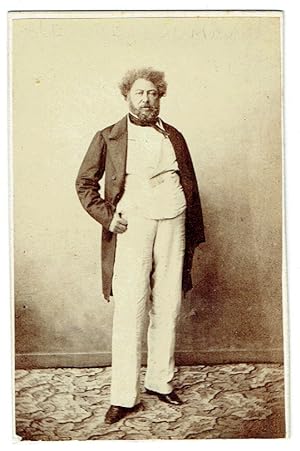
63 : 98 mm. Hübsche Aufnahme in ganzer Figur aus dem Haus Alophe Succ, Paris". Die Ränder leicht getrimmt.
-
Carte-de-visite ohne Unterschrift.
Verlag: ohne Ort und Datum
Anbieter: Kotte Autographs GmbH, Roßhaupten, Deutschland
Verkäuferbewertung 5 von 5 Sternen
Manuskript / Papierantiquität
65 : 103 mm. Hübsches und bekanntes Kniestück des Autors im Sitzen. Photographie: Nadar. - Photographie leicht berieben und mit kleiner Knickspur am oberen Rand.
-
Autograph manuscript signed Note en réponse aux plans de l'écriture de Mr Maquet".
Verlag: ohne Ort und Jahr
Anbieter: Kotte Autographs GmbH, Roßhaupten, Deutschland
Verkäuferbewertung 5 von 5 Sternen
Manuskript / Papierantiquität
EUR 1.500,00
EUR 20,00 für den Versand von Deutschland nach USAAnzahl: 1 verfügbar
In den Warenkorb8vo. 2 1/2 pp. Doppelblatt. Blaues Papier. In this fascinating autograph manuscript, Alexandre Dumas père defends himself against claims that his collaborator Auguste Maquet created the story outlines for his novels. Dumas insists that he alone conceived the plots and only dictated notes to Maquet to help him remember details. Written in Dumas's bold, lively hand, the letter reflects his pride, his creative authority, and his enduring dispute with Maquet over literary authorship.Les plans conservés par Mr Maquet sont une preuve que Mr Dumas faisait les plans et les lui dictait, pour qu'il s'en souvînt et n'oubliât rien. Si Mr Maquet eût composé les plans, il les eût en son atelier et n'eût pas eu besoin de les écrire. Mr Dumas travaillant seul n'a jamais eu l'idée d'écrire les plans des romans qu'il faisait voir la lettre ou le dit. Il n'y avait de plan. Si Mr Maquet eût fait les plans, je ne fus pas inquiet, qu'il n'y en eût plus, et je n'eus pas quitté St Germain pour aller coucher chez Maquet et lui faire du plan pendant toute la nuit Une preuve qu'une fois le travail de Mr Maquet payé, il ne souciait peu de rien, c'est ce qui en arriva à propos d'Angèle. Le sujet d'Angèle, fille de Retif de la Bretonne, la femme d'Auger, m'avait été donné par les Bibliophiles Jacob. Nous en fîmes le plan ensemble, et le plan fut oublié comme d'habitude. Dites par moi à Maquet retour pas nouveau du sujet. Comme moi, qui l'inventais, un plan lui était nécessaire, il eut oublié. Le fils d'Auger, le mari d'Angèle, fit un procès en diffamation contre son père, avec la veuve d'Ausanne, par Retif de la Bretonne, et j'avais depuis cette époque l'accusation croyant que personne ne ressortait de la famille. J'ai envoyé les preuves moyennant douze cents francs, dont Mr Maquet n'a pas même entendu parler. Il eût eu du devoir, pourquoi me le dire ? Il eût donné 600 francs, j'en donnai 1200.".
-
"Les vux de Lord Palmerston pour l'Italie et la Pologne". Autograph manuscript signed.
Verlag: [Naples, 1863]., 1863
Anbieter: Antiquariat INLIBRIS Gilhofer Nfg. GmbH, Vienna, A, Österreich
Verbandsmitglied: ILAB VDA VDAO
Verkäuferbewertung 5 von 5 Sternen
Manuskript / Papierantiquität
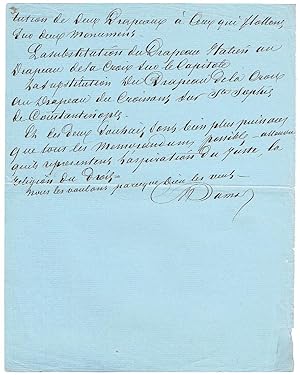
4to (218 x 278). 4½ pages on blue stationery. French manuscript of Dumas's article "I voti di Lord Palmerston", published in Italian in his Neapolitan newspaper, "L'Indépendent", on 8 April 1863. Dumas directly addresses Lord Palmerston, Prime Minister of the UK from 1859 to 1865, criticizing the United Kingdom's lack of support for the Italian and Polish causes and arguing that the existence of small countries should be supported to promote a healthy competition among the peoples. - Dumas attacks Palmerston by comparing the UK and France: unlike Britain, he writes, France (which had begun to back Italy in 1859) was not a country which acted upon its interests, but instead gave in to its passions. While revolutions were not in the French national interest, they benefitted humanity as a whole through achievements such as the constitutional system or universal suffrage, which he calls the last word in popular liberty. Dumas states that it was not England but France that had called for universal suffrage among the army, servants, and Black people: "Est-ce l'angleterre qui à appelle au vote universel, l'armée, les domestiques a la même les nègres - non, c'est la france". He criticises Palmerston's inaction with regard to Poland, wondering whether the UK thought that moral support was enough to rein in Russia: "Lord Palmerston espère que grace à l'appui moral quel angleterre donne a la pologne - les empereurs de Russie serons liberaux et magnanimes envers les polonais". He postulates that ultimately the causes of all countries were the same and that the ruin of any one of them would mean the loss of a champion in the struggle for the future: "[.] leur cause est la même et que chacun d'eux qui tombe enlève un athlète à lutte de l'avenir". - Alexandre Dumas, author of "Le Comte de Monte-Cristo" and "Les Trois Mousquetaires", founded the newspaper "L'Indépendent" in Naples in 1861, having left France ten years prior due to frictions with Louis-Napoléon Bonaparte. Published in Italian, "L'Indépendent" supported the cause of Giuseppe Garibaldi and the Risorgimento. Dumas was convinced that the function of writers in society was through politics, and attempted to enter the political sphere directly through publishing his own newspaper. - First leaf slightly frayed on one edge.
-
"Chroniques". Autograph manuscript signed.
Verlag: [Naples, ca. 1862]., 1862
Anbieter: Antiquariat INLIBRIS Gilhofer Nfg. GmbH, Vienna, A, Österreich
Verbandsmitglied: ILAB VDA VDAO
Verkäuferbewertung 5 von 5 Sternen
Manuskript / Papierantiquität
4to (218 x 278). 2½ pp. On blue stationery. A manuscript for Dumas's Neapolitan newspaper "L'Indépendent" in which he recorded several incidents about which he intended to write in the next issue. These include the report of a poor woman from the Pennino district who fell from the third floor while shaking out carpets from her window: "Hier une pauvre femme du quartier Perrino, secouant des tapis par la fenêtre, tomba du troisième étage, etre blessa grièvement sur le pave". Dumas further records a dagger fight, the arrest of a man who had insulted a guard "au par simple distraction", an accident caused by a carriage driver, the revenge of a jealous husband, and the stoning of a pretty girl. He concludes that it would be difficult to believe the lust for evil betrayed by these occurrences, were it not for the obliging reports of the police: "La vérité de nous lesions de pareils facts ailleurs que dans les rapports même que la police nous communiquéz avec une obligéance dans nous ne savions trop la remercier - nous ne croisions pas à une lettre luxure du mal .". - Alexandre Dumas, author of "Le Comte de Monte-Cristo" and "Les Trois Mousquetaires", founded the newspaper "L'Indépendent" in Naples in 1861, having left France ten years prior due to frictions with Louis-Napoléon Bonaparte. Published in Italian, "L'Indépendent" supported the cause of Giuseppe Garibaldi and the Risorgimento. Dumas was convinced that the function of writers in society was through politics, and attempted to enter the political sphere directly through publishing his own newspaper.
-
Autograph manuscript Tablettes d'un Misanthrope" signed Alceste".
Verlag: no place, [February 1854], 1854
Anbieter: Kotte Autographs GmbH, Roßhaupten, Deutschland
Verkäuferbewertung 5 von 5 Sternen
Manuskript / Papierantiquität
EUR 2.500,00
EUR 20,00 für den Versand von Deutschland nach USAAnzahl: 1 verfügbar
In den Warenkorb4to. 2 pp. Pasted on a slightly larger sheet of paper. Published in his newspaper Le Mousquetaire" in 1854, an adaption of Moritz Saphir aphorism about Max von Goritz": Une femme muette peut-elle contredire son mari? Oui en devenant sourde car elle ne l'écoute pas. Le mot Politique commence par un P parce que cette lettre pareille aux hommes politiques sait adopter toutes les positions: en la tournant de droite à gauche, elle devient un Q; en la plaçant debout, elle devient un D; et en la retournant de gauche à droite elle se transforme en B. [] Dieu, dans Sa Divine prévoyance n'a pas donné de barbe aux femmes parce qu'elles n'auraient pas su se taire pendant qu'on les eut rasées. [] Rougir est chez les Jeunes Filles tantôt la carte de visite, tantôt la lettre mortuaire de l'innocence".
-

Autograph manuscript.
Verlag: no place, no date.
Anbieter: Kotte Autographs GmbH, Roßhaupten, Deutschland
Verkäuferbewertung 5 von 5 Sternen
Manuskript / Papierantiquität
4to. 1/3 p. Autograph manuscript of an early version of a passage from Garibaldi's Memoirs in 1860. Here in the third person, it would be developed in the first person at the end of Chapter XIV of the second volume and recounts a moment during the siege of Rome against the French under General Oudinot (1849), evoking the towering figure of his chaplain Ugo Bassi.
-
Eigenh. Quittung mit Unterschrift.
Verlag: Paris, 28. Juni o.J.
Anbieter: Kotte Autographs GmbH, Roßhaupten, Deutschland
Verkäuferbewertung 5 von 5 Sternen
Manuskript / Papierantiquität
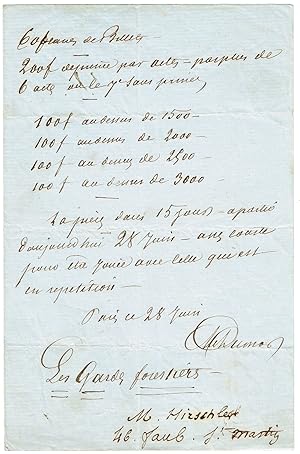
8vo. 1 p. Blaues Papier. Doppelblatt. Das Respektblatt alt von fremder Hand für Berechnungen benutzt. Zahlungsbestätigung für sein Drama Les gardes forestiers".
-
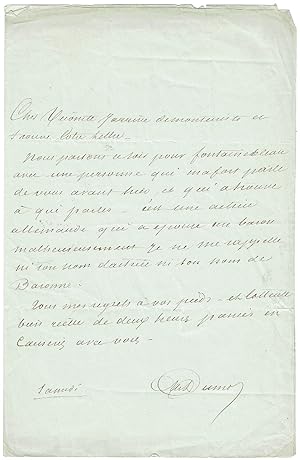
Eigenhändiger Brief mit Unterschrift.
Verlag: ohne Ort, samedi" [4. September 1847?], 1847
Anbieter: Kotte Autographs GmbH, Roßhaupten, Deutschland
Verkäuferbewertung 5 von 5 Sternen
Manuskript / Papierantiquität
EUR 1.500,00
EUR 20,00 für den Versand von Deutschland nach USAAnzahl: 1 verfügbar
In den Warenkorb8vo. 1 p. Mit Adresse. [] Cher Vicomte [Delphine de Girardin écrivait sous le pseudonyme du Vicomte de Launay] J'arrive de Montecristo et trouve votre lettre. Nous partons ce soir pour Fontainebleau avec une personne qui m'a fort parlé de vous avant-hier, et qui a trouvé à qui parler c'est une actrice allemande qui a épousé un baron Malheureusement je ne me rappelle ni son nom d'actrice ni son nom de baronne[]".
-
2 autograph letters signed.
Verlag: Paris and no place, 10 April 1847 and no date., 1847
Anbieter: Antiquariat INLIBRIS Gilhofer Nfg. GmbH, Vienna, A, Österreich
Verbandsmitglied: ILAB VDA VDAO
Verkäuferbewertung 5 von 5 Sternen
Manuskript / Papierantiquität
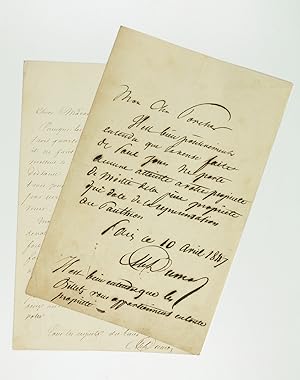
8vo. Together (1+1 =) 2 pp. To his friend, the theatrical agent Jean-Baptiste Porcher (1792-1864), concerning his play "Paul Jones": "Il est [.] entendu que la vente faite de Paul Jones ne porte aucune atteinte à votre propriété de moitié [.] Il est bien entendu que les billets vous appartiennent en toute propriété [.]" (Paris, 10 April 1847). In the other letter, probably written to Porcher's wife, he thanks for a souvenir: "Maintenant mille merci Madame de votre bon et cher souvenir - oui j'aime fort le pate de lapin [.]". - Enclosed is a printed circular "A ses concitoyens de Seine-et-Oise. Alexandre Dumas. Candidat a la représantation nationale".
-
Eigenh. Manuskript mit U. (Alex Dumas") La Rue de Tolède.
Verlag: [Neapel], Juli 1862., 1862
Anbieter: Kotte Autographs GmbH, Roßhaupten, Deutschland
Verkäuferbewertung 5 von 5 Sternen
Manuskript / Papierantiquität
EUR 4.500,00
EUR 20,00 für den Versand von Deutschland nach USAAnzahl: 1 verfügbar
In den Warenkorb4to. 5 pp. Blaues Papier. Interessante Kolumne in Italienisch, La Via di Toledo", am 22. Juli 1862 veröffentlicht in der neapolitanischen Zeitung L'Indipendente. Es handelt sich um den ersten von drei Beiträgen über die Via di Toledo, die beiden anderen Artikel erschienen am 24. und 25. Juli. Dabei handelt es sich um eine vehemente Kritik an der Verwaltung Neapels, der Dumas vorwirft, sie tue nichts für ihre Bewohner. Diese müssten schlechte Luft atmen und verschmutztes Wasser trinken.1860 hatte der italienische Freiheitskämpfer Giuseppe Garibaldi (1807-1882) den berühmten Schriftsteller und Dramaturg Alexandre Dumas gebeten, mit ihm nach Neapel zu kommen, wo Dumas bist 1864 blieb. Garibaldi hatte Neapel im Herbst 1860 im Rahmen des Zug der Tausend" kampflos besetzt. Er ernannte Dumas zum Museumsleiter und zum Direktor der Zeitung L'Indipendente. Dumas kannte Neapel bereits sehr gut, er hatte hier schon früher einige Zeit verbracht. Zu seinen Anliegen gehörte unter anderem er Kampf gegen das organisierte Verbrechen. Das ist auch in diesem Brief zu spüren, der in gewisser Weise nichts an Aktualität eingebüßt hat.Übersetzt aus dem Italienischen ins Französische: [] Il y a quelque chose comme sept ou huit ans que la rue de Tolède - la seule rue de Naples dans laquelle on puisse aller en voiture, et qui n'a pas été bâtie par les Napolitains mais par un vice-roi espagnol, est interrompue à partir del Mercatello, par des ruines à moitié tombées et par des batisses à moitié faites. C'est tout simplement hideux. La seule promenade de la ville aboutit à des décombres - à des buttes de terres écroulées - et l'on n'arrive au musée aux médiocres bâtiments lui-même, mais précieux pour les choses qu'il renferme qu'en faisant un détour par la Porta Alba, et par le fameux Couvent de Santa Maria di Costantinopoli dont le plus grand miracle a été de donner le choléra à Naples. Enfin aujourd'hui la municipalité se décide à mettre en vente les terrains plus encombrés de moellons, plus bosselés de pierres que les ruines de Babylonne et de Palmire. De ce Sahara sabloneux elle va faire un nouveau quartier. []"Er schreibt, es sei sieben oder acht Jahre her, dass die Via di Toledo - die einzige befahrbare Straße Neapels, die zudem nicht von Neapolitanern, sondern von einem Spanischen Vizekönig erbaut wurde, - dass eben diese Straße durch vom Mercatello herabgestürzte Ruinen versperrt sei. Es sei einfach lächerlich, spottet Dumas, dass der einzige Weg durch die Stadt in den Schutt führt und dass das Museum, das sich zwar in einem mediokren Gebäude befinde, aber große Schätze beherberge, nur durch einen Umweg über die Porta Alba erreicht werden könne oder über die berühmte Kirche Santa Maria di Costantinopoli, die das große Wunder vollbracht habe, Neapel die Cholera zu schenken. Am heutigen Tage habe die Stadtverwaltung beschlossen das Land, das noch mehr Geröll und Schutt lagere als die Ruinen von Babylon und Palmira, zu verkaufen. Aus dieser sandigen Sahara wollten sie einen neuen Stadtbezirk machen.[] Nous avons son projet sous les yeux. Ne croyez pas que la municipalité se soit préoccupé le moins du monde dans ce projet de la question d'art ou d'hygiène, - deux questions qui valent la peine d'être étudiées. Cependant. Ne croyez pas quelle se soit dit-les arbres manquent dans l'intérieur de la ville et par conséquent l'oxigène, de la viens peut être cette quantité de maladies de poitrines que dénonce la population de Naples-plantons des arbres a force, les arbres dégagent de l'oxigène le jour et du carbone la nuit, par conséquent ils fournissent un des éléments qui composent l'air respirable, aidons dieu dans ses oeuvres et faisons respirer à nos administrés un bon air non non la municipalité ne s'est point préoccupé de cela.[]"Dumas kritisiert, dass die Verwaltung dabei keinen Gedanken an Kunst oder Hygiene verschwende. Auch habe man sich dort nicht gesagt, dass in der Innenstadt Bäume fehlten, damit die Luft besser würde. Dumas erklärt das Prinzip, dass die Bäume tagsüber Sauerstoff und nachts Kohlenstoff abgeben und damit die Luftqualität verbessern. Dem Volk zu guter Luft zu verhelfen, nein, nein, darum kümmere sich die Verwaltung nicht.[] Ne croyez pas quelle se soit dit voici une occasion d'avoir une belle rue large et bien aérée- aboutissons à un Palais qui sans être d'une belle architecture et cependant de forme assez imposante tirons nos lignes de manière à ce que du dernier detour [] on en arrive à voir le Portique du Musée [] Londres avec ses brouillards éternels Paris avec ses alternatives de pluies et de soleil peuvent avoir besoin de square de parcs de jardins de boulevards [] mais nous avec notre climat torride nous n'avons besoin de rien de tout cela [] c'est un joli échiquier coupé par compartimens carrés Dont le roi est le choléra et la reine le fièvre [] avec de tels projets ce n'est pas dans cinquante ans que Naples sera une ville à la hauteur des autres capitales c'est dans trois cents ans [] Nous ne savons pas jusqu'à quel point la municipalité se préoccupe du pain quelle fait manger aux napolitains- mais ce que nous savons c'est qu'elle lui fait respirer un air infect et boire une eau impureSi le vin était bon au moins on boirait du vin [] Mais non les marchands peuvent frelater leurs vins y fourrer toutes les composition que leur suggèrent leurs imaginations méridionales vous empoisonner avec de la graine de sureau ou du jus de pures ; cela ne regarde pas la municipalité Ce quelle fait vous le voyez bien elle fait des projets de quartiers nouveaux dans lesquels il n'y a ni boulevards ni squares ni fontaines. La suite à Demain Alex Dumas"Dumas beklagt, dass die Chance, eine breite Prachtstraße zu bauen, die auf den architektonisch zwar nicht besonders schönen, aber imposanten Palast zuführt, nicht genutzt würde. Eine Stadt wie London, mit seinem Regen und Nebel, brauche vielleicht Parks, Gärten und Boulevards, Neapel aber mit seinem heißen Klima brauche das nicht, sp.
-
Autograph manuscript signed AD".
Verlag: no place, no date
Anbieter: Kotte Autographs GmbH, Roßhaupten, Deutschland
Verkäuferbewertung 5 von 5 Sternen
Manuskript / Papierantiquität
EUR 1.800,00
EUR 20,00 für den Versand von Deutschland nach USAAnzahl: 1 verfügbar
In den Warenkorb4to. 1 p. Blue paper. Handwritten manuscript about General La Maza.
-
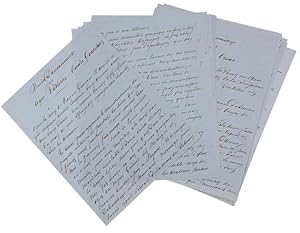
2 Autograph manuscripts signed Alex Dumas".
Verlag: Naples, 1862, 1862
Anbieter: Kotte Autographs GmbH, Roßhaupten, Deutschland
Verkäuferbewertung 5 von 5 Sternen
Manuskript / Papierantiquität Signiert
EUR 6.500,00
EUR 20,00 für den Versand von Deutschland nach USAAnzahl: 1 verfügbar
In den Warenkorb4to. 10 pp. on blue paper. Two autograph manuscripts signed Alex Dumas" [Naples June 1862]. The two historical articles on Antiquity appeared in Italian in L'Indipendente, a Neapolitan and Garibaldian journal Dumas founded in 1861. With the newspaper Dumas supported Italian unification, before returning to Paris in 1864. In March 1861, the kingdom of Italy was proclaimed, with Victor Emmanuel II as its king. Dumas participated in the movement for Italian unification.There, he befriended Giuseppe Garibaldi, whom he had long admired and with whom he shared a commitment to liberal republican principles as well as membership within Freemasonry.The articles seem unpublished in French (L'Indipendente, 2e année, nos 35 and 38, June 27 and July 1, 1862): Antichita '. - Ager publicus. Caio Gracco and Cesare. They are part of a series of seven articles devoted to state property (Beni demaniali) published between June 26 and July 4, 1862. The Ager Publicus in question here are the lands annexed during the conquest of Italy and which were part of the national domain, an important stake in Roman agricultural policy.]Ager Publicus. Caius Gracchus. Caius Gracchus, succeeding his murdered brother as tribune, made his public debut with "love at first sight for the rich." All contemporary speakers were defeated by this child opening his mouth for the first time and everyone understood that he had only tried his strength to realize what he could do []. The people also understood it and he stopped urging the Senate to execute the agrarian law, thinking that a day would come when Caius himself would demand its execution ". Indeed, Caius continued "the social work of his brother ": cheap wheat; distribution of land; establishment of colonies; affermages; employment of the poor in public works, etc. But his absence in Carthage opens a struggle for power, brings the confrontation between aristocrats and plebeians, the death of Caius (macabre details) and three thousand men. "Thus perished the last of the Gracches struck by the hands of the nobles. But as he exhaled he threw a handful of bloody dust against the sky. From this dust was born Marius []"Alexandre Dumas is also known as Alexandre Dumas père (French for 'father'). His works have been translated into many languages, and he is one of the most widely read French authors. Many of his historical novels of high adventure were originally published as serials, including The Count of Monte Cristo or The Three Musketeers.
-
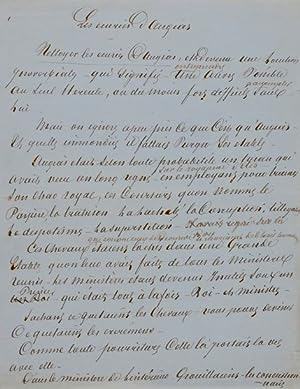
Autograph manuscript signed Alex Dumas".
Verlag: Naples, 1862, 1862
Anbieter: Kotte Autographs GmbH, Roßhaupten, Deutschland
Verkäuferbewertung 5 von 5 Sternen
Manuskript / Papierantiquität Signiert
EUR 7.500,00
EUR 20,00 für den Versand von Deutschland nach USAAnzahl: 1 verfügbar
In den Warenkorb4to. 6 pp. on blue paper. Good condition. The autograph manuscript signed Alex Dumas" [Naples July 1862] is a violent attack against François II, king of the Two Sicilies, and an appeal to Garibaldi. This article appeared in Italian under the title La Stalla d'Augia (The Augean Stables) in L'Indipendente, a Neapolitan and Garibaldian journal by Alexandre Dumas (2nd year, no. 61, July 30, 1862, chronicle dated July 28). Dumas founded L'Indipendente in 1861. With the newspaper Dumas supported Italian unification, before returning to Paris in 1864. In March 1861, the kingdom of Italy was proclaimed, with Victor Emmanuel II as its king. During his time in Italy, Dumas befriended Giuseppe Garibaldi, whom he had long admired and with whom he shared a commitment to liberal republican principles as well as membership within Freemasonry.La Stalla d'Augia seems unpublished in French. The manuscript presents erasures, corrections and additions. Dumas retraces the story of King Augia, a tyrant who used "to drag his royal chariot, those couriers called perjury, treason, cowardice, corruption, illegality, despotism, superstition. These horses, which like those of Diomedes feed on human flesh, were released in a large stable, which had been made for them of all the combined ministries, the ministries having become useless under a prince who was at the same time - King - and ministers. Knowing what the horses were, you can guess what the feces were "[] Each of the ministries is characterized by its own weaknesses or crimes; the overflow of rot is spreading to the population and is communicated [] And to finish with a disguised appeal to Garibaldi: "But in the end all the evil came from the stables of King Augias, the stables once cleaned, the capital became honest again. and its safe surroundings. Every tyrant who abandons his kingdom leaves there stables like those of Augias. We ask for a descendant of Hercules to clean the stables of Francis II []"Alexandre Dumas is also known as Alexandre Dumas père (French for 'father'). His works have been translated into many languages, and he is one of the most widely read French authors. Many of his historical novels of high adventure were originally published as serials, including The Count of Monte Cristo or The Three Musketeers.
-
Eigenh. Manuskript m. Unterschrift.
Verlag: o. O., Anfang 1862 / Ende 1863, 1863
Anbieter: Kotte Autographs GmbH, Roßhaupten, Deutschland
Verkäuferbewertung 5 von 5 Sternen
Manuskript / Papierantiquität
EUR 3.500,00
EUR 20,00 für den Versand von Deutschland nach USAAnzahl: 1 verfügbar
In den Warenkorb2 1/2 pp. gr.-4to. Blaues Papier. Kleine Läsuren. Le Memorandum anglais Remis par Lord Elliot au Gouvernement Provisoire de la GreÌce". Politischer Artikel über die Rolle Englands bei der Wahl eines neuen griechischen Königs nach dem Sturz Ottos I. Dumas, der die Wahl des Prinzen Amadeus von Savoyen (des späteren Königs von Spanien) favorisierte, kritisiert die Haltung der britischen Regierung, die sich bereit erklärt hatte, die unter ihrem Protektorat stehenden Ionischen Inseln Griechenland anzugliedern, jedoch unter der Bedingung, dass Griechenland einen ihr genehmen König wähle und Frieden mit der Türkei halte. . Langleterre qui offre de rendre 200 000 âmes aÌ la GreÌce mais aÌ la condition que trois millions de Grecs resteront esclaves .Ainsi voilaÌ L'angleterre qui a la pretention d'être tout aÌ la fois la liberteì et le progreÌs qui se deìclare haute- ment le champion du gouvernement turc qui est la repreìsentation du despotisme et de l'immobiliteì ." Ein eingangs in den Text montiertes Zitat (aus dem britischen Memorandum) wurde entfernt.
-
Autograph letter signed.
Verlag: n. p. n. d.
Anbieter: Kotte Autographs GmbH, Roßhaupten, Deutschland
Verkäuferbewertung 5 von 5 Sternen
Manuskript / Papierantiquität
EUR 2.500,00
EUR 20,00 für den Versand von Deutschland nach USAAnzahl: 1 verfügbar
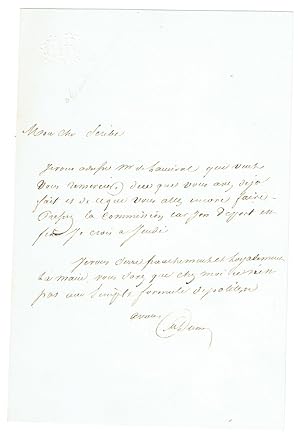
In den Warenkorb8vo. 1 page. Dumasasks the French writer and librettist Eugène Scribe (1791-1861) for a favour to assist his friendMr deLancival. "Mon cher Scribe, Je vous adresse Mr Lancival qui veut vous remercier de ce que vous allez encore faire.Pressez la commission car son départ est fixé je crois à jeudi. Je vous serre franchement loyalement la main, vous savez c que chez moi ce n'est pas une simple formalité de politesse.".
-
"Mizraël". Autograph manuscript poem.
Verlag: No place or date.
Anbieter: Antiquariat INLIBRIS Gilhofer Nfg. GmbH, Vienna, A, Österreich
Verbandsmitglied: ILAB VDA VDAO
Verkäuferbewertung 5 von 5 Sternen
Manuskript / Papierantiquität
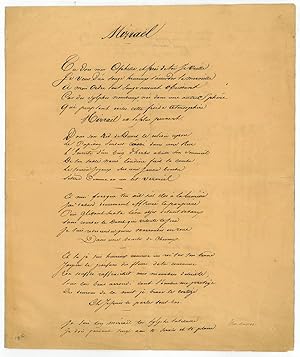
4to. 3 pp. on bifolium. 15 stanzas with 6 lines each. Together with an albumen silver print (85 x 54 mm, matted). Three pages on a bifolium, handwritten by Dumas entirely in French. "Alex. Dumas" is printed in an unknown hand at bottom right corner of top page. The albumen print pictures Dumas sitting down with his hands resting on cane. - Paper has been reinforced with archival material on verso at folds. Toning throughout, a bit darker at edges. "19B" has been written in pencil on the lower left corner of top page. Image has some speckling and slight buckling, but remains very attractive.
-
Eigenh. Manuskript, am Schluß paraphiert.
Verlag: O. O., [Anfang 1863]., 1863
Anbieter: Antiquariat INLIBRIS Gilhofer Nfg. GmbH, Vienna, A, Österreich
Verbandsmitglied: ILAB VDA VDAO
Verkäuferbewertung 5 von 5 Sternen
Manuskript / Papierantiquität
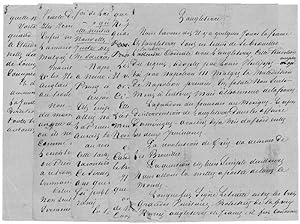
4¾ SS. auf 5 Bll. Gr.-4to. Vollständiges Feuilleton über das Verhältnis zwischen Frankreich und England im Vorfeld der Wahl eines neuen Königs für Griechenland nach dem Sturz Ottos I. Dumas macht sich stark für Amadeus von Savoyen, den jüngeren Sohn des italienischen Königs Viktor Emanuel II., und wirft England Vertragsbruch vor. - Der Artikel beginnt: "Nous lavons dit il y a quelques jours la France et langleterre sont en train de se brouiller. L'Entente Cordiale avec L'angleterre, cette tradition du regent, adoptée par Louis Philippe - acceptée par Napoleon III malgré la malediction de Napoleon premier, est fatale non seulement à linteret, mais à lhonneur de la France. Labandon des francais au Mexique - Le refus dintervention de Langleterre dans les affaires damérique - avaient deja mis du froid entre les deux puissances. La revolution de Grecs va achever de les brouiller []". - Bläuliches Papier; die Tinte leicht durchschlagend; teilweise leicht fleckig und stellenweise geringer Tintenfraß.
-
Signed and inscribed cabinet photograph.
Verlag: No place, [c. 1860s]., 1860
Anbieter: Antiquariat INLIBRIS Gilhofer Nfg. GmbH, Vienna, A, Österreich
Verbandsmitglied: ILAB VDA VDAO
Verkäuferbewertung 5 von 5 Sternen
Manuskript / Papierantiquität Signiert
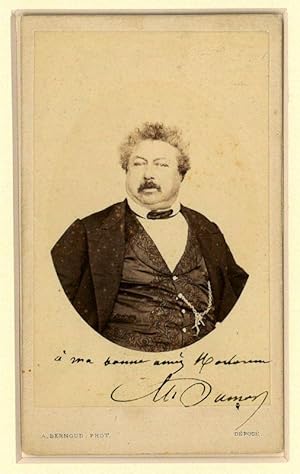
90:56 mm. An excellent signed and inscribed cabinet photograph. The A. Bernoud image, depicting the French poet in a half length formal pose. Signed and inscribed "A ma bonne amie [] Al. Dumas" in bold black ink, in French, to the lower clear area of the photograph. Matted in off-white to an overall size of 148: 110 mm.
-

Autograph document signed.
Verlag: N. p. o. d.
Anbieter: Antiquariat INLIBRIS Gilhofer Nfg. GmbH, Vienna, A, Österreich
Verbandsmitglied: ILAB VDA VDAO
Verkäuferbewertung 5 von 5 Sternen
Manuskript / Papierantiquität
150:150 mm. "Je donne à M Fechter mon Role de Daubigny dans Mlle de Bellisle, et M'opposerai formellement à cequil fut joué pas un autre que par lui []".
-
Carte de visite photograph signed
Anbieter: Andreas Wiemer Historical Autographs, Allendorf an der Lumda, Deutschland
Verkäuferbewertung 5 von 5 Sternen
Fotografie Signiert
EUR 2.129,70
Kostenlos für den Versand von Deutschland nach USAAnzahl: 1 verfügbar
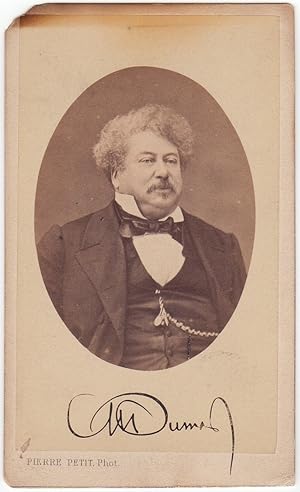
In den WarenkorbKein Einband. Zustand: Gut bis sehr gut. Dumas (père), Alexandre (1802-1870) - Carte de visite photograph signed - French novelist of such historical classics as The Count of Monte Cristo, The Three Musketeers and The Man in the Iron Mask. Carte de visite photograph signed "Al. Dumas". 2.5 x 4.5 inch, n.p., n.d. Photograph featuring an oval image of Dumas in a head and shoulders pose. Photograph by Pierre Petit, Paris as printed on verso. Signed in bold black fountain pen ink to the lower border. Upper left corner very slightly clipped with small toning stain to the upper edge, otherwise good condition. COMES WITH A CERTIFICATE OF AUTHENTICITY BY ANDREAS WIEMER HISTORICAL AUTOGRAPHS. Please do not hesitate to contact me with any questions. Signatur des Verfassers.


![Bild des Verkäufers für [MONTE CRISTO IN KARAMANLIDIKA] Monte Hristo [i.e. Monte Cristo] [and] Lord Hop: Meshur Monte Hristo hikâyesinin zeyli. [i.e. Der Herr der Welt = The lord of the world]. zum Verkauf von Khalkedon Rare Books ABA, ILAB, IOBA, ESA](https://pictures.abebooks.com/inventory/md/md31453210324.jpg)