
Gesamtpreis (1 Artikel Artikel):
Versandziel:

dragan ga¿evic (6 Ergebnisse)
Direkt zu den wichtigsten Suchergebnissen
Suchfilter
Produktart
- Alle Product Types
- Bücher (6)
- Magazine & Zeitschriften (Keine weiteren Ergebnisse entsprechen dieser Verfeinerung)
- Comics (Keine weiteren Ergebnisse entsprechen dieser Verfeinerung)
- Noten (Keine weiteren Ergebnisse entsprechen dieser Verfeinerung)
- Kunst, Grafik & Poster (Keine weiteren Ergebnisse entsprechen dieser Verfeinerung)
- Fotografien (Keine weiteren Ergebnisse entsprechen dieser Verfeinerung)
- Karten (Keine weiteren Ergebnisse entsprechen dieser Verfeinerung)
- Manuskripte & Papierantiquitäten (Keine weiteren Ergebnisse entsprechen dieser Verfeinerung)
Zustand Mehr dazu
- Neu (6)
- Wie Neu, Sehr Gut oder Gut Bis Sehr Gut (Keine weiteren Ergebnisse entsprechen dieser Verfeinerung)
- Gut oder Befriedigend (Keine weiteren Ergebnisse entsprechen dieser Verfeinerung)
- Ausreichend oder Schlecht (Keine weiteren Ergebnisse entsprechen dieser Verfeinerung)
- Wie beschrieben (Keine weiteren Ergebnisse entsprechen dieser Verfeinerung)
Einband
Weitere Eigenschaften
- Erstausgabe (Keine weiteren Ergebnisse entsprechen dieser Verfeinerung)
- Signiert (Keine weiteren Ergebnisse entsprechen dieser Verfeinerung)
- Schutzumschlag (Keine weiteren Ergebnisse entsprechen dieser Verfeinerung)
- Angebotsfoto (6)
Sprache (1)
Preis
- Beliebiger Preis
- Weniger als EUR 20 (Keine weiteren Ergebnisse entsprechen dieser Verfeinerung)
- EUR 20 bis EUR 45 (Keine weiteren Ergebnisse entsprechen dieser Verfeinerung)
- Mehr als EUR 45
Gratisversand
- Kostenloser Versand nach USA (Keine weiteren Ergebnisse entsprechen dieser Verfeinerung)
Land des Verkäufers
Verkäuferbewertung
-

Software Language Engineering
Sprache: Englisch
Verlag: Springer Berlin Heidelberg, Springer Berlin Heidelberg Apr 2009, 2009
ISBN 10: 3642004334 ISBN 13: 9783642004339
Anbieter: buchversandmimpf2000, Emtmannsberg, BAYE, Deutschland
Verkäuferbewertung 5 von 5 Sternen

Taschenbuch. Zustand: Neu. Neuware -This book constitutes the thoroughly refereed post-conference proceedings of the First International Conference on Software Language Engineering, SLE 2008, held in Toulouse, France, in September 2008. The 16 revised full papers and 1 revised short paper presented together with 1 tool demonstration paper and 2 keynote lectures were carefully reviewed and selected from 106 initial submissions. The papers are organized in topical sections on language and tool analysis and evaluation, concrete and abstract syntax, language engineering techniques, language integration and transformation, language implementation and analysis, as well as language engineering pearls.Springer Verlag GmbH, Tiergartenstr. 17, 69121 Heidelberg 360 pp. Englisch.
-

Software Language Engineering : First International Conference, SLE 2008 Toulouse, France, September 29-30, 2008, Revised Selected Papers
Sprache: Englisch
Verlag: Springer Berlin Heidelberg, 2009
ISBN 10: 3642004334 ISBN 13: 9783642004339
Anbieter: AHA-BUCH GmbH, Einbeck, Deutschland
Verkäuferbewertung 5 von 5 Sternen
Taschenbuch. Zustand: Neu. Druck auf Anfrage Neuware - Printed after ordering - This book constitutes the thoroughly refereed post-conference proceedings of the First International Conference on Software Language Engineering, SLE 2008, held in Toulouse, France, in September 2008. The 16 revised full papers and 1 revised short paper presented together with 1 tool demonstration paper and 2 keynote lectures were carefully reviewed and selected from 106 initial submissions. The papers are organized in topical sections on language and tool analysis and evaluation, concrete and abstract syntax, language engineering techniques, language integration and transformation, language implementation and analysis, as well as language engineering pearls.
-

Model Driven Engineering and Ontology Development
Sprache: Englisch
Verlag: Springer Berlin Heidelberg, Springer Berlin Heidelberg Mai 2009, 2009
ISBN 10: 3642002811 ISBN 13: 9783642002816
Anbieter: buchversandmimpf2000, Emtmannsberg, BAYE, Deutschland
Verkäuferbewertung 5 von 5 Sternen
Buch. Zustand: Neu. Neuware -Defining a formal domain ontology is generally considered a useful, not to say necessary step in almost every software project. This is because software deals with ideas rather than with self-evident physical artefacts. However, this development step is hardly ever done, as ontologies rely on well-defined and semantically powerful AI concepts such as description logics or rule-based systems, and most software engineers are largely unfamiliar with these.Gäevic and his co-authors try to fill this gap by detailing how to use model-driven engineering for ontology development on the Semantic Web. Part I of their book describes existing technologies, tools, and standards like XML, RDF, OWL, MDA, and UML. Part II presents the first detailed description of OMG's new ODM (Ontology Definition Metamodel) initiative, a specification which is expected to be in the form of an OMG language like UML. Finally, Part III is dedicated to applications and practical aspects of developing ontologies using MDA-based languages.For this second edition, the descriptions of the related standards (like MOF, ODM, OCL, and OWL) have been revised and updated; new chapters introducing the basic principles of model-driven engineering, recent research results on metamodeling Semantic Web rule languages, an introduction to the Atlas Transformation Language (ATL) and its tool support, and, last but not least, many new examples have been added.Springer Verlag GmbH, Tiergartenstr. 17, 69121 Heidelberg 400 pp. Englisch.
-

Model Driven Engineering and Ontology Development
Sprache: Englisch
Verlag: Springer Berlin Heidelberg, Springer Berlin Heidelberg Okt 2010, 2010
ISBN 10: 3642101348 ISBN 13: 9783642101342
Anbieter: buchversandmimpf2000, Emtmannsberg, BAYE, Deutschland
Verkäuferbewertung 5 von 5 Sternen
Taschenbuch. Zustand: Neu. Neuware -Defining a formal domain ontology is generally considered a useful, not to say necessary step in almost every software project. This is because software deals with ideas rather than with self-evident physical artefacts. However, this development step is hardly ever done, as ontologies rely on well-defined and semantically powerful AI concepts such as description logics or rule-based systems, and most software engineers are largely unfamiliar with these.Gäevic and his co-authors try to fill this gap by detailing how to use model-driven engineering for ontology development on the Semantic Web. Part I of their book describes existing technologies, tools, and standards like XML, RDF, OWL, MDA, and UML. Part II presents the first detailed description of OMG's new ODM (Ontology Definition Metamodel) initiative, a specification which is expected to be in the form of an OMG language like UML. Finally, Part III is dedicated to applications and practical aspects of developing ontologies using MDA-based languages.For this second edition, the descriptions of the related standards (like MOF, ODM, OCL, and OWL) have been revised and updated; new chapters introducing the basic principles of model-driven engineering, recent research results on metamodeling Semantic Web rule languages, an introduction to the Atlas Transformation Language (ATL) and its tool support, and, last but not least, many new examples have been added.Springer Verlag GmbH, Tiergartenstr. 17, 69121 Heidelberg 400 pp. Englisch.
-
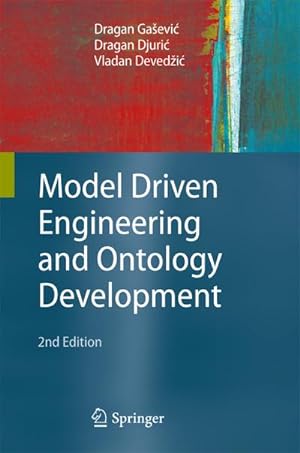
Model Driven Engineering and Ontology Development
Sprache: Englisch
Verlag: Springer Berlin Heidelberg, 2010
ISBN 10: 3642101348 ISBN 13: 9783642101342
Anbieter: AHA-BUCH GmbH, Einbeck, Deutschland
Verkäuferbewertung 5 von 5 Sternen
Taschenbuch. Zustand: Neu. Druck auf Anfrage Neuware - Printed after ordering - Defining a formal domain ontology is generally considered a useful, not to say necessary step in almost every software project. This is because software deals with ideas rather than with self-evident physical artefacts. However, this development step is hardly ever done, as ontologies rely on well-defined and semantically powerful AI concepts such as description logics or rule-based systems, and most software engineers are largely unfamiliar with these. Gasevic and his co-authors try to fill this gap by detailing how to use model-driven engineering for ontology development on the Semantic Web. Part I of their book describes existing technologies, tools, and standards like XML, RDF, OWL, MDA, and UML. Part II presents the first detailed description of OMG's new ODM (Ontology Definition Metamodel) initiative, a specification which is expected to be in the form of an OMG language like UML. Finally, Part III is dedicated to applications and practical aspects of developing ontologies using MDA-based languages. For this second edition, the descriptions of the related standards (like MOF, ODM, OCL, and OWL) have been revised and updated; new chapters introducing the basic principles of model-driven engineering, recent research results on metamodeling Semantic Web rule languages, an introduction to the Atlas Transformation Language (ATL) and its tool support, and, last but not least, many new examples have been added.
-
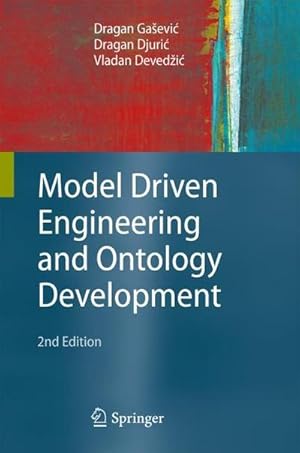
Model Driven Engineering and Ontology Development
Sprache: Englisch
Verlag: Springer Berlin Heidelberg, 2009
ISBN 10: 3642002811 ISBN 13: 9783642002816
Anbieter: AHA-BUCH GmbH, Einbeck, Deutschland
Verkäuferbewertung 5 von 5 Sternen
Buch. Zustand: Neu. Druck auf Anfrage Neuware - Printed after ordering - Defining a formal domain ontology is generally considered a useful, not to say necessary step in almost every software project. This is because software deals with ideas rather than with self-evident physical artefacts. However, this development step is hardly ever done, as ontologies rely on well-defined and semantically powerful AI concepts such as description logics or rule-based systems, and most software engineers are largely unfamiliar with these. Gasevic and his co-authors try to fill this gap by detailing how to use model-driven engineering for ontology development on the Semantic Web. Part I of their book describes existing technologies, tools, and standards like XML, RDF, OWL, MDA, and UML. Part II presents the first detailed description of OMG's new ODM (Ontology Definition Metamodel) initiative, a specification which is expected to be in the form of an OMG language like UML. Finally, Part III is dedicated to applications and practical aspects of developing ontologies using MDA-based languages. For this second edition, the descriptions of the related standards (like MOF, ODM, OCL, and OWL) have been revised and updated; new chapters introducing the basic principles of model-driven engineering, recent research results on metamodeling Semantic Web rule languages, an introduction to the Atlas Transformation Language (ATL) and its tool support, and, last but not least, many new examples have been added.
