

Gesamtpreis (1 Artikel Artikel):
Versandziel:

dmitry chernov (18 Ergebnisse)
Direkt zu den wichtigsten Suchergebnissen
Suchfilter
Produktart
- Alle Product Types
- Bücher (18)
- Magazine & Zeitschriften (Keine weiteren Ergebnisse entsprechen dieser Verfeinerung)
- Comics (Keine weiteren Ergebnisse entsprechen dieser Verfeinerung)
- Noten (Keine weiteren Ergebnisse entsprechen dieser Verfeinerung)
- Kunst, Grafik & Poster (Keine weiteren Ergebnisse entsprechen dieser Verfeinerung)
- Fotografien (Keine weiteren Ergebnisse entsprechen dieser Verfeinerung)
- Karten (Keine weiteren Ergebnisse entsprechen dieser Verfeinerung)
- Manuskripte & Papierantiquitäten (Keine weiteren Ergebnisse entsprechen dieser Verfeinerung)
Zustand Mehr dazu
- Neu (18)
- Wie Neu, Sehr Gut oder Gut Bis Sehr Gut (Keine weiteren Ergebnisse entsprechen dieser Verfeinerung)
- Gut oder Befriedigend (Keine weiteren Ergebnisse entsprechen dieser Verfeinerung)
- Ausreichend oder Schlecht (Keine weiteren Ergebnisse entsprechen dieser Verfeinerung)
- Wie beschrieben (Keine weiteren Ergebnisse entsprechen dieser Verfeinerung)
Einband
Weitere Eigenschaften
- Erstausgabe (Keine weiteren Ergebnisse entsprechen dieser Verfeinerung)
- Signiert (Keine weiteren Ergebnisse entsprechen dieser Verfeinerung)
- Schutzumschlag (Keine weiteren Ergebnisse entsprechen dieser Verfeinerung)
- Angebotsfoto (8)
Sprache (1)
Preis
- Beliebiger Preis
- Weniger als EUR 20 (Keine weiteren Ergebnisse entsprechen dieser Verfeinerung)
- EUR 20 bis EUR 40
- Mehr als EUR 40
Gratisversand
- Kostenloser Versand nach USA (Keine weiteren Ergebnisse entsprechen dieser Verfeinerung)
Land des Verkäufers
Verkäuferbewertung
-
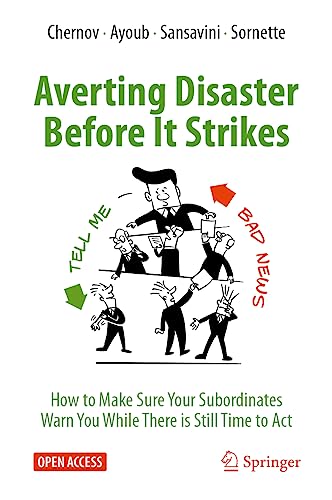
Averting Disaster Before It Strikes: How to Make Sure Your Subordinates Warn You While There is Still Time to Act (Open Access)
Anbieter: Zubal-Books, Since 1961, Cleveland, OH, USA
Verkäuferbewertung 5 von 5 Sternen

Zustand: New. *Price HAS BEEN REDUCED by 10% until Monday, Feb. 16 (Sale item)* 376 pp., Hardcover, new. - If you are reading this, this item is actually (physically) in our stock and ready for shipment once ordered. We are not bookjackers. Buyer is responsible for any additional duties, taxes, or fees required by recipient's country.
-

Don't Tell the Boss!: How Poor Communication on Risks Within Organizations Causes Major Catastrophes
Anbieter: Revaluation Books, Exeter, Vereinigtes Königreich
Verkäuferbewertung 5 von 5 Sternen
EUR 47,16
EUR 14,37 Versand
Versand von Vereinigtes Königreich nach USAAnzahl: 2 verfügbar
In den WarenkorbPaperback. Zustand: Brand New. 497 pages. 9.25x6.10x1.01 inches. In Stock.
-

Don t Tell The Boss! : How Poor Communic
Anbieter: Kennys Bookstore, Olney, MD, USA
Verkäuferbewertung 4 von 5 Sternen

Zustand: New.
-
Don't Tell the Boss!: How Poor Communication on Risks Within Organizations Causes Major Catastrophes
Anbieter: Revaluation Books, Exeter, Vereinigtes Königreich
Verkäuferbewertung 5 von 5 Sternen
EUR 49,16
EUR 14,37 Versand
Versand von Vereinigtes Königreich nach USAAnzahl: 2 verfügbar
In den WarenkorbHardcover. Zustand: Brand New. 481 pages. 9.25x6.25x1.25 inches. In Stock.
-

Averting Disaster Before It Strikes: How to Make Sure Your Subordinates Warn You While There Is Still Time to Act
Anbieter: Revaluation Books, Exeter, Vereinigtes Königreich
Verkäuferbewertung 5 von 5 Sternen
EUR 71,92
EUR 14,37 Versand
Versand von Vereinigtes Königreich nach USAAnzahl: 2 verfügbar
In den WarenkorbPaperback. Zustand: Brand New. 398 pages. 9.25x6.10x0.83 inches. In Stock.
-
Averting Disaster Before It Strikes: How to Make Sure Your Subordinates Warn You While There Is Still Time to Act
Anbieter: Revaluation Books, Exeter, Vereinigtes Königreich
Verkäuferbewertung 5 von 5 Sternen
EUR 87,03
EUR 14,37 Versand
Versand von Vereinigtes Königreich nach USAAnzahl: 2 verfügbar
In den WarenkorbHardcover. Zustand: Brand New. 376 pages. 9.25x6.25x1.00 inches. In Stock.
-

Averting Disaster Before It Strikes
Sprache: Englisch
Verlag: Springer International Publishing, Springer International Publishing Jun 2023, 2023
ISBN 10: 3031307747 ISBN 13: 9783031307744
Anbieter: buchversandmimpf2000, Emtmannsberg, BAYE, Deutschland
Verkäuferbewertung 5 von 5 Sternen
Taschenbuch. Zustand: Neu. Neuware -Some of the major industrial disasters could have been prevented. When the facts of what happened are established, their stories share a common thread: before things spiralled out of control, there were workers at the affected sites who knew that the situation was dangerous, and could become catastrophic unless immediate action was taken. But tragically, nobody dared to tell the decision-makers who could have authorized that action. With no idea of the risks they were taking, the people in charge continued as normal¿ and disaster struck. Because vital information about risks could not flow freely from the shop floor to the director¿s office, the crucial decisions were not made in time. This observation has been documented in the following major technological accidents: Challenger space shuttle explosion (USA, 1986); Chernobyl nuclear plant disaster (USSR, 1986); Deepwater Horizon oil spill (USA, 2010); Fukushima-1 nuclear power plant disaster (Japan, 2011); and numerous other industrial disasters. After accidents like these, losses and costs for dealing with the consequences are often hundreds ¿ or even thousands ¿ of times greater than the finances that would have been required to deal with the risks when they were first recognized.This handbook is about how to transform the way large critical infrastructure companies communicate about safety and technological risks. It aims to support senior managers to get the information they need from their subordinates concerning the risks they are facing, in order to prevent accidents before it is too late.The recommendations in this handbook are based on interviews with 100 executives at various levels, working in 65 critical infrastructure companies around the world, in power, oil and gas, metals, chemicals and petrochemicals, mining and other industries.The recommendations of these leaders were also tested in the pilot project, in an industrial company which is the world leader in its sector. More than 400 managers at various levels of the corporate hierarchy, and employees at several of the company¿s industrial plants, took part in the project.This open access handbook is written for the owners, senior managers, and industrial safety directors of critical infrastructure companies.Springer Verlag GmbH, Tiergartenstr. 17, 69121 Heidelberg 404 pp. Englisch.
-

Averting Disaster Before It Strikes : How to Make Sure Your Subordinates Warn You While There is Still Time to Act
Sprache: Englisch
Verlag: Springer International Publishing, 2023
ISBN 10: 3031307747 ISBN 13: 9783031307744
Anbieter: AHA-BUCH GmbH, Einbeck, Deutschland
Verkäuferbewertung 5 von 5 Sternen
Taschenbuch. Zustand: Neu. Druck auf Anfrage Neuware - Printed after ordering - Some of the major industrial disasters could have been prevented. When the facts of what happened are established, their stories share a common thread: before things spiralled out of control, there were workers at the affected sites who knew that the situation was dangerous, and could become catastrophic unless immediate action was taken. But tragically, nobody dared to tell the decision-makers who could have authorized that action. With no idea of the risks they were taking, the people in charge continued as normal. and disaster struck. Because vital information about risks could not flow freely from the shop floor to the director's office, the crucial decisions were not made in time. This observation has been documented in the following major technological accidents: Challenger space shuttle explosion (USA, 1986); Chernobyl nuclear plant disaster (USSR, 1986); Deepwater Horizon oil spill (USA, 2010); Fukushima-1 nuclear power plant disaster (Japan, 2011); and numerous other industrial disasters. After accidents like these, losses and costs for dealing with the consequences are often hundreds - or even thousands - of times greater than the finances that would have been required to deal with the risks when they were first recognized.This handbook is about how to transform the way large critical infrastructure companies communicate about safety and technological risks. It aims to support senior managers to get the information they need from their subordinates concerning the risks they are facing, in order to prevent accidents before it is too late.The recommendations in this handbook are based on interviews with 100 executives at various levels, working in 65 critical infrastructure companies around the world, in power, oil and gas, metals, chemicals and petrochemicals, mining and other industries.The recommendations of these leaders were also tested in the pilot project, in an industrial company which is the world leader in its sector. More than 400 managers at various levels of the corporate hierarchy, and employees at several of the company's industrial plants, took part in the project.This open access handbook is written for the owners, senior managers, and industrial safety directors of critical infrastructure companies.
-

Don't Tell the Boss!
Sprache: Englisch
Verlag: Springer International Publishing, Springer Nature Switzerland Jan 2024, 2024
ISBN 10: 3031052080 ISBN 13: 9783031052088
Anbieter: buchversandmimpf2000, Emtmannsberg, BAYE, Deutschland
Verkäuferbewertung 5 von 5 Sternen
Taschenbuch. Zustand: Neu. Neuware -After a major disaster, when investigators are piecing together the story of what happened, a striking fact often emerges: before disaster struck, some people in the organization involved were aware of dangerous conditions that had the potential to escalate to a critical level. But for a variety of reasons, this crucial information did not reach decision-makers. So, the organization moved ever closer to catastrophe, effectively unaware of the possible threat¿despite the fact that some of its employees could see it coming.What is the problem with communication about risk in an organization, and why does this problem exist What stops people in organizations or project teams from freely reporting and discussing critical risks This book seeks to answer these questions, starting from a deep analysis of 20 disasters where the concealment of risks played a major part.These case studies are drawn from around the world and span a range of industries: civil nuclear power,coal, oil and gas production, hydropower energy, metals and mining, space exploration, transport, finance, retail manufacturing and even the response of governments to wars, famines and epidemics.Together, case studies give an insight into why people hesitate to report risks¿and even when they do, why their superiors often prefer to ignore the news.The book reviews existing research on the challenges of voice and silence in organizations.This helps to explain more generally why people dread passing on bad news to others¿and why in the workplace they prefer to keep quiet about unpleasant facts or potential risks when they are talking to superiors and colleagues.The discussion section of the book includes important examples of concealment within the Chinese state hierarchy as well as by leading epidemiologists and governments in the West during the novel coronavirus outbreak in Wuhan in 2019-2020. The full picture of the very early stage of the COVID-19 pandemic remains unclear, and further research is obviously needed to better understand what motivated some municipal, provincial and national officials in China as well as Western counterparts to obfuscate facts in their internal communications about many issues associated with the outbreak.Springer Verlag GmbH, Tiergartenstr. 17, 69121 Heidelberg 500 pp. Englisch.
-

Don't Tell the Boss!
Sprache: Englisch
Verlag: Springer International Publishing, Springer Nature Switzerland Jan 2023, 2023
ISBN 10: 3031052056 ISBN 13: 9783031052057
Anbieter: buchversandmimpf2000, Emtmannsberg, BAYE, Deutschland
Verkäuferbewertung 5 von 5 Sternen
Buch. Zustand: Neu. Neuware -After a major disaster, when investigators are piecing together the story of what happened, a striking fact often emerges: before disaster struck, some people in the organization involved were aware of dangerous conditions that had the potential to escalate to a critical level. But for a variety of reasons, this crucial information did not reach decision-makers. So, the organization moved ever closer to catastrophe, effectively unaware of the possible threat¿despite the fact that some of its employees could see it coming.What is the problem with communication about risk in an organization, and why does this problem exist What stops people in organizations or project teams from freely reporting and discussing critical risks This book seeks to answer these questions, starting from a deep analysis of 20 disasters where the concealment of risks played a major part.These case studies are drawn from around the world and span a range of industries: civil nuclear power,coal, oil and gas production, hydropower energy, metals and mining, space exploration, transport, finance, retail manufacturing and even the response of governments to wars, famines and epidemics.Together, case studies give an insight into why people hesitate to report risks¿and even when they do, why their superiors often prefer to ignore the news.The book reviews existing research on the challenges of voice and silence in organizations.This helps to explain more generally why people dread passing on bad news to others¿and why in the workplace they prefer to keep quiet about unpleasant facts or potential risks when they are talking to superiors and colleagues.The discussion section of the book includes important examples of concealment within the Chinese state hierarchy as well as by leading epidemiologists and governments in the West during the novel coronavirus outbreak in Wuhan in 2019-2020. The full picture of the very early stage of the COVID-19 pandemic remains unclear, and further research is obviously needed to better understand what motivated some municipal, provincial and national officials in China as well as Western counterparts to obfuscate facts in their internal communications about many issues associated with the outbreak.Springer Verlag GmbH, Tiergartenstr. 17, 69121 Heidelberg 500 pp. Englisch.
-

MAN-MADE CATASTROPHES AND RISK INFORMATI
Anbieter: Speedyhen, Hertfordshire, Vereinigtes Königreich
Verkäuferbewertung 5 von 5 Sternen
EUR 58,46
EUR 47,15 Versand
Versand von Vereinigtes Königreich nach USAAnzahl: 1 verfügbar
In den WarenkorbZustand: NEW.
-

Don't Tell the Boss! : How Poor Communication on Risks within Organizations Causes Major Catastrophes
Sprache: Englisch
Verlag: Springer International Publishing, Springer International Publishing, 2024
ISBN 10: 3031052080 ISBN 13: 9783031052088
Anbieter: AHA-BUCH GmbH, Einbeck, Deutschland
Verkäuferbewertung 5 von 5 Sternen
Taschenbuch. Zustand: Neu. Druck auf Anfrage Neuware - Printed after ordering - After a major disaster, when investigators are piecing together the story of what happened, a striking fact often emerges: before disaster struck, some people in the organization involved were aware of dangerous conditions that had the potential to escalate to a critical level. But for a variety of reasons, this crucial information did not reach decision-makers. So, the organization moved ever closer to catastrophe, effectively unaware of the possible threat-despite the fact that some of its employees could see it coming.What is the problem with communication about risk in an organization, and why does this problem exist What stops people in organizations or project teams from freely reporting and discussing critical risks This book seeks to answer these questions, starting from a deep analysis of 20 disasters where the concealment of risks played a major part.These case studies are drawn from around the world and span a range of industries: civil nuclear power,coal, oil and gas production, hydropower energy, metals and mining, space exploration, transport, finance, retail manufacturing and even the response of governments to wars, famines and epidemics.Together, case studies give an insight into why people hesitate to report risks-and even when they do, why their superiors often prefer to ignore the news.The book reviews existing research on the challenges of voice and silence in organizations.This helps to explain more generally why people dread passing on bad news to others-and why in the workplace they prefer to keep quiet about unpleasant facts or potential risks when they are talking to superiors and colleagues.The discussion section of the book includes important examples of concealment within the Chinese state hierarchy as well as by leading epidemiologists and governments in the West during the novel coronavirus outbreak in Wuhan in 2019-2020. The full picture of the very early stage of the COVID-19 pandemic remains unclear, and further research is obviously needed to better understand what motivated some municipal, provincial and national officials in China as well as Western counterparts to obfuscate facts in their internal communications about many issues associated with the outbreak.
-
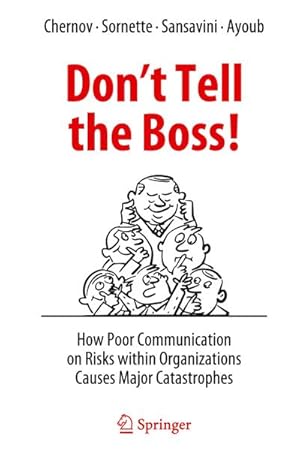
Don't Tell the Boss! : How Poor Communication on Risks within Organizations Causes Major Catastrophes
Sprache: Englisch
Verlag: Springer International Publishing, 2023
ISBN 10: 3031052056 ISBN 13: 9783031052057
Anbieter: AHA-BUCH GmbH, Einbeck, Deutschland
Verkäuferbewertung 5 von 5 Sternen
Buch. Zustand: Neu. Druck auf Anfrage Neuware - Printed after ordering - After a major disaster, when investigators are piecing together the story of what happened, a striking fact often emerges: before disaster struck, some people in the organization involved were aware of dangerous conditions that had the potential to escalate to a critical level. But for a variety of reasons, this crucial information did not reach decision-makers. So, the organization moved ever closer to catastrophe, effectively unaware of the possible threat-despite the fact that some of its employees could see it coming.What is the problem with communication about risk in an organization, and why does this problem exist What stops people in organizations or project teams from freely reporting and discussing critical risks This book seeks to answer these questions, starting from a deep analysis of 20 disasters where the concealment of risks played a major part.These case studies are drawn from around the world and span a range of industries: civil nuclear power,coal, oil and gas production, hydropower energy, metals and mining, space exploration, transport, finance, retail manufacturing and even the response of governments to wars, famines and epidemics.Together, case studies give an insight into why people hesitate to report risks-and even when they do, why their superiors often prefer to ignore the news.The book reviews existing research on the challenges of voice and silence in organizations.This helps to explain more generally why people dread passing on bad news to others-and why in the workplace they prefer to keep quiet about unpleasant facts or potential risks when they are talking to superiors and colleagues.The discussion section of the book includes important examples of concealment within the Chinese state hierarchy as well as by leading epidemiologists and governments in the West during the novel coronavirus outbreak in Wuhan in 2019-2020. The full picture of the very early stage of the COVID-19 pandemic remains unclear, and further research is obviously needed to better understand what motivated some municipal, provincial and national officials in China as well as Western counterparts to obfuscate facts in their internal communications about many issues associated with the outbreak.
-

Man-made Catastrophes and Risk Information Concealment
Sprache: Englisch
Verlag: Springer International Publishing, 2016
ISBN 10: 3319370987 ISBN 13: 9783319370989
Zustand: New.
-

Averting Disaster Before It Strikes : How to Make Sure Your Subordinates Warn You While There is Still Time to Act
Sprache: Englisch
Verlag: Springer International Publishing, 2023
ISBN 10: 3031307712 ISBN 13: 9783031307713
Anbieter: AHA-BUCH GmbH, Einbeck, Deutschland
Verkäuferbewertung 5 von 5 Sternen
Buch. Zustand: Neu. Druck auf Anfrage Neuware - Printed after ordering - Some of the major industrial disasters could have been prevented. When the facts of what happened are established, their stories share a common thread: before things spiralled out of control, there were workers at the affected sites who knew that the situation was dangerous, and could become catastrophic unless immediate action was taken. But tragically, nobody dared to tell the decision-makers who could have authorized that action. With no idea of the risks they were taking, the people in charge continued as normal. and disaster struck. Because vital information about risks could not flow freely from the shop floor to the director's office, the crucial decisions were not made in time. This observation has been documented in the following major technological accidents: Challenger space shuttle explosion (USA, 1986); Chernobyl nuclear plant disaster (USSR, 1986); Deepwater Horizon oil spill (USA, 2010); Fukushima-1 nuclear power plant disaster (Japan, 2011); and numerous other industrial disasters. After accidents like these, losses and costs for dealing with the consequences are often hundreds - or even thousands - of times greater than the finances that would have been required to deal with the risks when they were first recognized.This handbook is about how to transform the way large critical infrastructure companies communicate about safety and technological risks. It aims to support senior managers to get the information they need from their subordinates concerning the risks they are facing, in order to prevent accidents before it is too late.The recommendations in this handbook are based on interviews with 100 executives at various levels, working in 65 critical infrastructure companies around the world, in power, oil and gas, metals, chemicals and petrochemicals, mining and other industries.The recommendations of these leaders were also tested in the pilot project, in an industrial company which is the world leader in its sector. More than 400 managers at various levels of the corporate hierarchy, and employees at several of the company's industrial plants, took part in the project.This open access handbook is written for the owners, senior managers, and industrial safety directors of critical infrastructure companies.
-
Man-made Catastrophes and Risk Information Concealment: Case Studies of Major Disasters and Human Fallibility
Anbieter: Revaluation Books, Exeter, Vereinigtes Königreich
Verkäuferbewertung 5 von 5 Sternen
EUR 77,88
EUR 40,25 Versand
Versand von Vereinigtes Königreich nach USAAnzahl: 2 verfügbar
In den WarenkorbPaperback. Zustand: Brand New. reprint edition. 342 pages. 9.25x6.10x0.82 inches. In Stock.
-
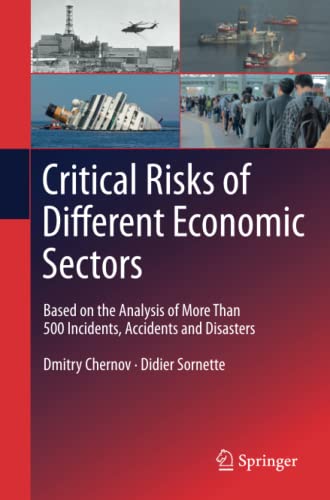
Critical Risks of Different Economic Sectors: Based on the Analysis of More Than 500 Incidents, Accidents and Disasters
Anbieter: Revaluation Books, Exeter, Vereinigtes Königreich
Verkäuferbewertung 5 von 5 Sternen
EUR 122,53
EUR 11,50 Versand
Versand von Vereinigtes Königreich nach USAAnzahl: 2 verfügbar
In den WarenkorbPaperback. Zustand: Brand New. 271 pages. 9.00x6.25x0.75 inches. In Stock.
-
Critical Risks Of Different Economic Sec
Anbieter: Kennys Bookstore, Olney, MD, USA
Verkäuferbewertung 4 von 5 Sternen
Zustand: New.

