
Gesamtpreis (1 Artikel Artikel):
Versandziel:

description legypte (116 Ergebnisse)
Direkt zu den wichtigsten Suchergebnissen
Suchfilter
Produktart
- Alle Product Types
- Bücher (1)
- Magazine & Zeitschriften (Keine weiteren Ergebnisse entsprechen dieser Verfeinerung)
- Comics (Keine weiteren Ergebnisse entsprechen dieser Verfeinerung)
- Noten (Keine weiteren Ergebnisse entsprechen dieser Verfeinerung)
- Kunst, Grafik & Poster (115)
- Fotografien (Keine weiteren Ergebnisse entsprechen dieser Verfeinerung)
- Karten (Keine weiteren Ergebnisse entsprechen dieser Verfeinerung)
- Manuskripte & Papierantiquitäten (Keine weiteren Ergebnisse entsprechen dieser Verfeinerung)
Zustand Mehr dazu
- Neu (Keine weiteren Ergebnisse entsprechen dieser Verfeinerung)
- Wie Neu, Sehr Gut oder Gut Bis Sehr Gut (Keine weiteren Ergebnisse entsprechen dieser Verfeinerung)
- Gut oder Befriedigend (98)
- Ausreichend oder Schlecht (Keine weiteren Ergebnisse entsprechen dieser Verfeinerung)
- Wie beschrieben (18)
Einband
- alle Einbände
- Hardcover (Keine weiteren Ergebnisse entsprechen dieser Verfeinerung)
- Softcover (Keine weiteren Ergebnisse entsprechen dieser Verfeinerung)
Weitere Eigenschaften
- Erstausgabe (10)
- Signiert (Keine weiteren Ergebnisse entsprechen dieser Verfeinerung)
- Schutzumschlag (Keine weiteren Ergebnisse entsprechen dieser Verfeinerung)
- Angebotsfoto (116)
Sprache (1)
Gratisversand
- Kostenloser Versand nach USA (Keine weiteren Ergebnisse entsprechen dieser Verfeinerung)
Land des Verkäufers
Verkäuferbewertung
-

Le Kaire. Vue Perspective d'une Partie de la Ville des Tombeaux. É(tat) M(oderne). Vol. I. Pl. 66.
Verlag: Paris C.L.F. Panckoucke -1830., 1821
Anbieter: Robert Frew Ltd. ABA ILAB, London, Vereinigtes Königreich
Verbandsmitglied: ABA ILAB PBFA
Verkäuferbewertung 5 von 5 Sternen

Kunst / Grafik / Poster
EUR 147,30
EUR 11,44 shipping
Ships from Vereinigtes Königreich to USAAnzahl: 1 verfügbar
In den WarenkorbOriginal uncoloured copper engraving (plate mark 43 x 60 cm, sheet size 52 x 169.5 cm) by Réville after the drawing by Protain from volume 1 of the Description de l'Égypte (2nd edition). Publisher's blindstamp to upper right margin. Some spotting and toning mainly to margins. The Description de l'Égypte was the first scientific survey of all Egypt, from its antiquities to its agriculture including language, music, costume, and natural history, and it concludes with a detailed and accurate map of the region. The numerous plates depicting the antiquities provide a comprehensive record of the richness of ancient Egyptian culture. At the time of publication, the Description de l'Égypte was the largest printed work ever produced. Its influence was enormous, establishing Egyptology as an intellectual discipline and nurturing a passion for Egyptian art throughout the Western World. Edited by some of the leading intellectual figures in France, the Description also includes contributions from celebrated artists such as Jacques Barraband, Pierre-Joseph Redouté, Geoffrey Saint-Hilaire, Jules-César Savigny and others. The combined work of several dozen scholars, this "living archive" of Napoleon's expedition took over twenty years to complete. The huge undertaking was co-ordinated by the Institut de l'Egypte, founded by Napoleon and with Gaspar Monge, the mathematician, as its president. Monge and the chemist Berthollet recruited leading academic figures to join the expedition, including Geoffrey Saint-Hilaire, Savigny, Méchain, Quesnot Nouet, René Desgenettes and the surgeon Dominique Jean Larrey. Of their many achievements, the discovery of the Rosetta Stone must rank amongst the most important. It was only after Napoleon's invasion of Egypt in 1798 that Europe came to know the Orient more scientifically. In the preface to the work, Fourier explains that scholars were grappling with the mysteries of Egypt in order to restore the country from what he sees as its current state of "barbarism" to its former greatness. By engulfing Egypt with the instruments of Western knowledge and power, Fourier maintained that history would recall how "Egypte fut le thêatre de sa [Napoleon's] gloire, et préserve de l'oubli toutes les circonstances de cet événement extraordinaire". With the publication of this monumental work, Fourier's ambition was certainly achieved.
-
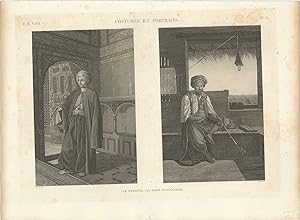
Costumes et Portraits. 1. Le Mamlouk. 2. Le Marin d'Alexandrie. Plate D.
Verlag: ParisC.L.F. Panckoucke -30., 1821
Anbieter: Robert Frew Ltd. ABA ILAB, London, Vereinigtes Königreich
Verbandsmitglied: ABA ILAB PBFA
Verkäuferbewertung 5 von 5 Sternen
Kunst / Grafik / Poster
EUR 176,75
EUR 11,44 shipping
Ships from Vereinigtes Königreich to USAAnzahl: 1 verfügbar
In den WarenkorbOriginal uncoloured copper engraving (plate mark 43 x 61 cm, overall sheet size 53 x 70 cm) by Delaunay after the drawing by Dutertre from the Description de l'Égypte (2nd edition). Unobtrusive publisher's blindstamp to top right margin. Small loss at bottom margin not affecting image, some light spotting and tanning.
-
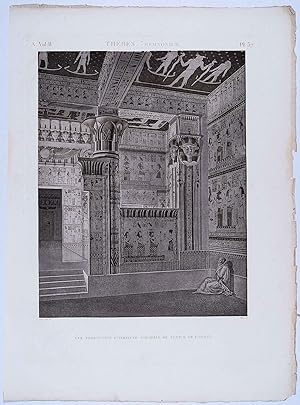
Thèbes. Memnonium. Vue Perspective Intérieure Coloriée du Temple de l'Ouest. A(ntiquités). Vol. II. Pl. 37.
Verlag: Paris C.L.F. Panckoucke -1830., 1821
Anbieter: Robert Frew Ltd. ABA ILAB, London, Vereinigtes Königreich
Verbandsmitglied: ABA ILAB PBFA
Verkäuferbewertung 5 von 5 Sternen
Kunst / Grafik / Poster
EUR 235,67
EUR 11,44 shipping
Ships from Vereinigtes Königreich to USAAnzahl: 1 verfügbar
In den WarenkorbOriginal uncoloured copper engraving (plate mark 58.5 x 42 cm, sheet size 71 x 52 cm) by Allais after the drawing by Le Père from volume 2 of the Description de l'Égypte (2nd edition). Publisher's blindstamp to upper right margin. Some wear, small chips and toning to upper and right margin, generally very good. The Description de l'Égypte was the first scientific survey of all Egypt, from its antiquities to its agriculture including language, music, costume, and natural history, and it concludes with a detailed and accurate map of the region. The numerous plates depicting the antiquities provide a comprehensive record of the richness of ancient Egyptian culture. At the time of publication, the Description de l'Égypte was the largest printed work ever produced. Its influence was enormous, establishing Egyptology as an intellectual discipline and nurturing a passion for Egyptian art throughout the Western World. Edited by some of the leading intellectual figures in France, the Description also includes contributions from celebrated artists such as Jacques Barraband, Pierre-Joseph Redouté, Geoffrey Saint-Hilaire, Jules-César Savigny and others. The combined work of several dozen scholars, this "living archive" of Napoleon's expedition took over twenty years to complete. The huge undertaking was co-ordinated by the Institut de l'Egypte, founded by Napoleon and with Gaspar Monge, the mathematician, as its president. Monge and the chemist Berthollet recruited leading academic figures to join the expedition, including Geoffrey Saint-Hilaire, Savigny, Méchain, Quesnot Nouet, René Desgenettes and the surgeon Dominique Jean Larrey. Of their many achievements, the discovery of the Rosetta Stone must rank amongst the most important. It was only after Napoleon's invasion of Egypt in 1798 that Europe came to know the Orient more scientifically. In the preface to the work, Fourier explains that scholars were grappling with the mysteries of Egypt in order to restore the country from what he sees as its current state of "barbarism" to its former greatness. By engulfing Egypt with the instruments of Western knowledge and power, Fourier maintained that history would recall how "Egypte fut le thêatre de sa [Napoleon's] gloire, et préserve de l'oubli toutes les circonstances de cet événement extraordinaire". With the publication of this monumental work, Fourier's ambition was certainly achieved.
-

Environs d'esne(Latopolis) A.Vol.I- pl.87-zodiaque sculpte au plafond du temple au nord d'esne.
Verlag: Paris, 1809
Kunst / Grafik / Poster
Zustand: ACEPTABLE. Estupendo grabado de la obra monumental de Description de l,Egypte, realizadas por cientos de artistas y científicos bajo el patrocinio de Napoleón durante expedición con mas de 35000 soldados para conquistar Egipto.(1798 1801). Durante la campaña se descubrió el valle de los Reyes, cerca de Tebas, se encontró la piedra Rosetta y se catalogaron miles de edificios, monumentos, ruinas, detalles, jeroglíficos además de catalogar toda la Historia Natural. La obra completa se empezó en 1809 y ocupaba 10 volúmenes de gran folio de grabados y otros 10 volúmenes de texto y su segunda edición no se termino hasta 1830. Ejemplares completos son muy raros de encontrar. Aquí tenemos unos cuantos grabados pertenecientes al apartado de "Antiquities" estampados en Paris, 1809-1830. Formato (cm): 52x68.
-
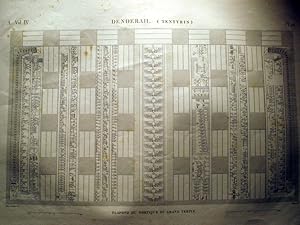
Denderah(Tentyris) A.Vol.IV-Pl.18-Plafond du portique du grand temple
Verlag: Paris, 1809
Kunst / Grafik / Poster
Zustand: ACEPTABLE. Estupendo grabado de la obra monumental de Description de l,Egypte, realizadas por cientos de artistas y científicos bajo el patrocinio de Napoleón durante expedición con mas de 35000 soldados para conquistar Egipto.(1798 1801). Durante la campaña se descubrió el valle de los Reyes, cerca de Tebas, se encontró la piedra Rosetta y se catalogaron miles de edificios, monumentos, ruinas, detalles, jeroglíficos además de catalogar toda la Historia Natural. La obra completa se empezó en 1809 y ocupaba 10 volúmenes de gran folio de grabados y otros 10 volúmenes de texto y su segunda edición no se termino hasta 1830. Ejemplares completos son muy raros de encontrar. Aquí tenemos unos cuantos grabados pertenecientes al apartado de "Antiquities" estampados en Paris, 1809-1830. Formato (cm): 52x68.
-

THÈBES. A.Vol.III-Pl.69 - Collection de Légendes Hiéroglyphiques Recueillies dans les Édifices
Verlag: Paris, 1809
Kunst / Grafik / Poster
Zustand: ACEPTABLE. Estupendo grabado de la obra monumental de "Description de l'Egypte" / "Descripción de Egipto", realizadas por cientos de artistas y científicos bajo el patrocinio de Napoleón durante expedición con más de 35000 soldados para conquistar Egipto (1798 1801). Durante la campaña se descubrió el valle de los Reyes, cerca de Tebas, se encontró la piedra Rosetta y se catalogaron miles de edificios, monumentos, ruinas, detalles, jeroglíficos además de catalogar toda la Historia Natural. La obra completa se empezó en 1809 y ocupaba 10 volúmenes de gran folio de grabados y otros 10 volúmenes de texto y su segunda edición no se terminó hasta 1830. Ejemplares completos son muy raros de encontrar. Aquí tenemos unos cuantos grabados pertenecientes al apartado de "Antiquities" estampados en Paris, 1809-1830. Formato (cm): 68x52.
-

Denderah. (Tentyris) / Vue Générale Des Ruines Prise De L'Ouest. A(antiquités). Vol. IV. Pl. 3.
Verlag: ParisC.L.F. Panckoucke -1830., 1821
Anbieter: Robert Frew Ltd. ABA ILAB, London, Vereinigtes Königreich
Verbandsmitglied: ABA ILAB PBFA
Verkäuferbewertung 5 von 5 Sternen
Kunst / Grafik / Poster
EUR 294,59
EUR 11,44 shipping
Ships from Vereinigtes Königreich to USAAnzahl: 1 verfügbar
In den WarenkorbOriginal uncoloured copper engraving (plate mark 53.5 x 93 cm, sheet size 71 x 134 cm) by Lorieux after the drawing by Dutertre from volume 4 of the Description de l'Égypte (2nd edition). Publisher's blindstamp to upper right margin. Folding page view. Light soiling to upper right margin, otherwise in very good condition. The Description de l'Égypte was the first scientific survey of all Egypt, from its antiquities to its agriculture including language, music, costume, and natural history, and it concludes with a detailed and accurate map of the region. The numerous plates depicting the antiquities provide a comprehensive record of the richness of ancient Egyptian culture. At the time of publication, the Description de l'Égypte was the largest printed work ever produced. Its influence was enormous, establishing Egyptology as an intellectual discipline and nurturing a passion for Egyptian art throughout the Western World. Edited by some of the leading intellectual figures in France, the Description also includes contributions from celebrated artists such as Jacques Barraband, Pierre-Joseph Redouté, Geoffrey Saint-Hilaire, Jules-César Savigny and others. The combined work of several dozen scholars, this "living archive" of Napoleon's expedition took over twenty years to complete. The huge undertaking was co-ordinated by the Institut de l'Egypte, founded by Napoleon and with Gaspar Monge, the mathematician, as its president. Monge and the chemist Berthollet recruited leading academic figures to join the expedition, including Geoffrey Saint-Hilaire, Savigny, Méchain, Quesnot Nouet, René Desgenettes and the surgeon Dominique Jean Larrey. Of their many achievements, the discovery of the Rosetta Stone must rank amongst the most important. It was only after Napoleon's invasion of Egypt in 1798 that Europe came to know the Orient more scientifically. In the preface to the work, Fourier explains that scholars were grappling with the mysteries of Egypt in order to restore the country from what he sees as its current state of "barbarism" to its former greatness. By engulfing Egypt with the instruments of Western knowledge and power, Fourier maintained that history would recall how "Egypte fut le thêatre de sa [Napoleon's] gloire, et préserve de l'oubli toutes les circonstances de cet événement extraordinaire". With the publication of this monumental work, Fourier's ambition was certainly achieved.
-
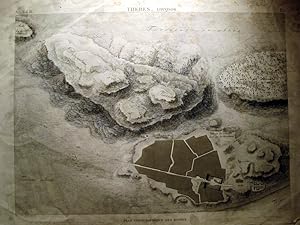
Thebes, LOUQSOR. A.vol.III- Pl.1- plan topographique des ruines.
Verlag: Paris, 1809
Kunst / Grafik / Poster
Zustand: ACEPTABLE. Estupendo grabado de la obra monumental de Description de l,Egypte, realizadas por cientos de artistas y científicos bajo el patrocinio de Napoleón durante expedición con mas de 35000 soldados para conquistar Egipto.(1798 1801). Durante la campaña se descubrió el valle de los Reyes, cerca de Tebas, se encontró la piedra Rosetta y se catalogaron miles de edificios, monumentos, ruinas, detalles, jeroglíficos además de catalogar toda la Historia Natural. La obra completa se empezó en 1809 y ocupaba 10 volúmenes de gran folio de grabados y otros 10 volúmenes de texto y su segunda edición no se termino hasta 1830. Ejemplares completos son muy raros de encontrar. Aquí tenemos unos cuantos grabados pertenecientes al apartado de "Antiquities" estampados en Paris, 1809-1830. Formato (cm): 52x68.
-

Koum Ombou(ombos) A.Vol.I-Pl.39-plan general des ruins et des environs.
Verlag: Paris, 1809
Kunst / Grafik / Poster
Zustand: ACEPTABLE. Estupendo grabado de la obra monumental de Description de l,Egypte, realizadas por cientos de artistas y científicos bajo el patrocinio de Napoleón durante expedición con mas de 35000 soldados para conquistar Egipto.(1798 1801). Durante la campaña se descubrió el valle de los Reyes, cerca de Tebas, se encontró la piedra Rosetta y se catalogaron miles de edificios, monumentos, ruinas, detalles, jeroglíficos además de catalogar toda la Historia Natural. La obra completa se empezó en 1809 y ocupaba 10 volúmenes de gran folio de grabados y otros 10 volúmenes de texto y su segunda edición no se termino hasta 1830. Ejemplares completos son muy raros de encontrar. Aquí tenemos unos cuantos grabados pertenecientes al apartado de "Antiquities" estampados en Paris, 1809-1830. Formato (cm): 52x68.
-

Heptanomide A.Vol.IV- Pl.62 -vues de gebel abou fedah et des environs.
Verlag: Paris, 1809
Kunst / Grafik / Poster
Zustand: ACEPTABLE. Estupendo grabado de la obra monumental de Description de l,Egypte, realizadas por cientos de artistas y científicos bajo el patrocinio de Napoleón durante expedición con mas de 35000 soldados para conquistar Egipto.(1798 1801). Durante la campaña se descubrió el valle de los Reyes, cerca de Tebas, se encontró la piedra Rosetta y se catalogaron miles de edificios, monumentos, ruinas, detalles, jeroglíficos además de catalogar toda la Historia Natural. La obra completa se empezó en 1809 y ocupaba 10 volúmenes de gran folio de grabados y otros 10 volúmenes de texto y su segunda edición no se termino hasta 1830. Ejemplares completos son muy raros de encontrar. Aquí tenemos unos cuantos grabados pertenecientes al apartado de "Antiquities" estampados en Paris, 1809-1830. Formato (cm): 52x68.
-
![Bild des Verkäufers für Environs d'Esné (LATOPOLIS). A.Vol.I-Pl.87 - Zodiaque Sculpté au Plafond du Temple au Nord d'Esné [Fondo gris] zum Verkauf von Frame](https://pictures.abebooks.com/inventory/md/md30644559300.jpg)
Environs d'Esné (LATOPOLIS). A.Vol.I-Pl.87 - Zodiaque Sculpté au Plafond du Temple au Nord d'Esné [Fondo gris]
Verlag: Paris, 1809
Kunst / Grafik / Poster
Zustand: ACEPTABLE. Estupendo grabado de la obra monumental de "Description de l'Egypte" / "Descripción de Egipto", realizadas por cientos de artistas y científicos bajo el patrocinio de Napoleón durante expedición con más de 35000 soldados para conquistar Egipto (1798 1801). Durante la campaña se descubrió el valle de los Reyes, cerca de Tebas, se encontró la piedra Rosetta y se catalogaron miles de edificios, monumentos, ruinas, detalles, jeroglíficos además de catalogar toda la Historia Natural. La obra completa se empezó en 1809 y ocupaba 10 volúmenes de gran folio de grabados y otros 10 volúmenes de texto y su segunda edición no se terminó hasta 1830. Ejemplares completos son muy raros de encontrar. Aquí tenemos unos cuantos grabados pertenecientes al apartado de "Antiquities" estampados en Paris, 1809-1830. Formato (cm): 62x58.
-
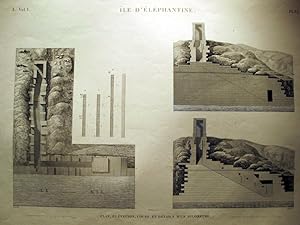
ÎLE D'ÉLÉPHANTINE. A.Vol.I-Pl.33 - Plan, Élévation, Coupe et Détails d'un Nilometre
Verlag: Paris, 1809
Kunst / Grafik / Poster
Zustand: ACEPTABLE. Estupendo grabado de la obra monumental de "Description de l'Egypte" / "Descripción de Egipto", realizadas por cientos de artistas y científicos bajo el patrocinio de Napoleón durante expedición con más de 35000 soldados para conquistar Egipto (1798 1801). Durante la campaña se descubrió el valle de los Reyes, cerca de Tebas, se encontró la piedra Rosetta y se catalogaron miles de edificios, monumentos, ruinas, detalles, jeroglíficos además de catalogar toda la Historia Natural. La obra completa se empezó en 1809 y ocupaba 10 volúmenes de gran folio de grabados y otros 10 volúmenes de texto y su segunda edición no se terminó hasta 1830. Ejemplares completos son muy raros de encontrar. Aquí tenemos unos cuantos grabados pertenecientes al apartado de "Antiquities" estampados en Paris, 1809-1830. Formato (cm): 52x68.
-

DENDERAH (Tentyris). A.Vol.IV-Pl.2 - Plan Topographique des Ruines
Verlag: Paris, 1809
Kunst / Grafik / Poster
Zustand: ACEPTABLE. Estupendo grabado de la obra monumental de "Description de l'Egypte" / "Descripción de Egipto", realizadas por cientos de artistas y científicos bajo el patrocinio de Napoleón durante expedición con más de 35000 soldados para conquistar Egipto (1798 1801). Durante la campaña se descubrió el valle de los Reyes, cerca de Tebas, se encontró la piedra Rosetta y se catalogaron miles de edificios, monumentos, ruinas, detalles, jeroglíficos además de catalogar toda la Historia Natural. La obra completa se empezó en 1809 y ocupaba 10 volúmenes de gran folio de grabados y otros 10 volúmenes de texto y su segunda edición no se terminó hasta 1830. Ejemplares completos son muy raros de encontrar. Aquí tenemos unos cuantos grabados pertenecientes al apartado de "Antiquities" estampados en Paris, 1809-1830. Formato (cm): 68x52.
-
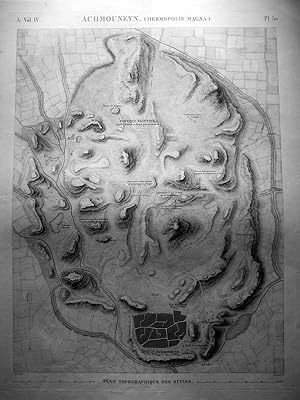
ACHMOUNEYN (Hermopolis Magna). A.Vol.IV-Pl.50 - PlanTopographique des Ruines
Verlag: Paris, 1809
Kunst / Grafik / Poster
Zustand: ACEPTABLE. Estupendo grabado de la obra monumental de "Description de l'Egypte" / "Descripción de Egipto", realizadas por cientos de artistas y científicos bajo el patrocinio de Napoleón durante expedición con más de 35000 soldados para conquistar Egipto (1798 1801). Durante la campaña se descubrió el valle de los Reyes, cerca de Tebas, se encontró la piedra Rosetta y se catalogaron miles de edificios, monumentos, ruinas, detalles, jeroglíficos además de catalogar toda la Historia Natural. La obra completa se empezó en 1809 y ocupaba 10 volúmenes de gran folio de grabados y otros 10 volúmenes de texto y su segunda edición no se terminó hasta 1830. Ejemplares completos son muy raros de encontrar. Aquí tenemos unos cuantos grabados pertenecientes al apartado de "Antiquities" estampados en Paris, 1809-1830. Formato (cm): 68x52.
-

SYOUT (Lycopolis). A.Vol.I-Pl.44 - Plan, Coupes et Élévation de l'Hypogée Principal
Verlag: Paris, 1809
Kunst / Grafik / Poster
Zustand: ACEPTABLE. Estupendo grabado de la obra monumental de "Description de l'Egypte" / "Descripción de Egipto", realizadas por cientos de artistas y científicos bajo el patrocinio de Napoleón durante expedición con más de 35000 soldados para conquistar Egipto (1798 1801). Durante la campaña se descubrió el valle de los Reyes, cerca de Tebas, se encontró la piedra Rosetta y se catalogaron miles de edificios, monumentos, ruinas, detalles, jeroglíficos además de catalogar toda la Historia Natural. La obra completa se empezó en 1809 y ocupaba 10 volúmenes de gran folio de grabados y otros 10 volúmenes de texto y su segunda edición no se terminó hasta 1830. Ejemplares completos son muy raros de encontrar. Aquí tenemos unos cuantos grabados pertenecientes al apartado de "Antiquities" estampados en Paris, 1809-1830. Formato (cm): 52x68.
-

Syout (LYCOPOLIS). A.Vol.IV-Pl.49 - Décorations Hiéroglyphiques et Bas-Reliefs Recueillis dans les Hypogées
Verlag: Paris, 1809
Kunst / Grafik / Poster
Zustand: ACEPTABLE. Estupendo grabado de la obra monumental de "Description de l'Egypte" / "Descripción de Egipto", realizadas por cientos de artistas y científicos bajo el patrocinio de Napoleón durante expedición con más de 35000 soldados para conquistar Egipto (1798 1801). Durante la campaña se descubrió el valle de los Reyes, cerca de Tebas, se encontró la piedra Rosetta y se catalogaron miles de edificios, monumentos, ruinas, detalles, jeroglíficos además de catalogar toda la Historia Natural. La obra completa se empezó en 1809 y ocupaba 10 volúmenes de gran folio de grabados y otros 10 volúmenes de texto y su segunda edición no se terminó hasta 1830. Ejemplares completos son muy raros de encontrar. Aquí tenemos unos cuantos grabados pertenecientes al apartado de "Antiquities" estampados en Paris, 1809-1830. Formato (cm): 52x68.
-
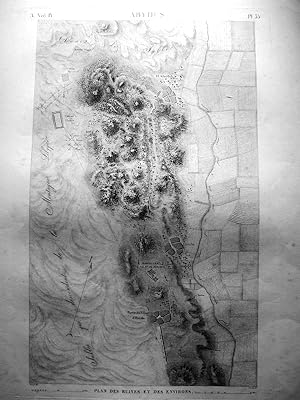
ABYDUS. A.Vol.IV-Pl.35 - Plas des Ruines et des Environs
Verlag: Paris, 1809
Kunst / Grafik / Poster
Zustand: ACEPTABLE. Estupendo grabado de la obra monumental de "Description de l'Egypte" / "Descripción de Egipto", realizadas por cientos de artistas y científicos bajo el patrocinio de Napoleón durante expedición con más de 35000 soldados para conquistar Egipto (1798 1801). Durante la campaña se descubrió el valle de los Reyes, cerca de Tebas, se encontró la piedra Rosetta y se catalogaron miles de edificios, monumentos, ruinas, detalles, jeroglíficos además de catalogar toda la Historia Natural. La obra completa se empezó en 1809 y ocupaba 10 volúmenes de gran folio de grabados y otros 10 volúmenes de texto y su segunda edición no se terminó hasta 1830. Ejemplares completos son muy raros de encontrar. Aquí tenemos unos cuantos grabados pertenecientes al apartado de "Antiquities" estampados en Paris, 1809-1830. Formato (cm): 68x52.
-

Environs du Kaire. / Vue de l'Aqueduc Situé Près le Vieux Kaire, Prise de L'Ile de Roudah. É(tat). M(oderne). Vol. I. Pl. 20.
Verlag: ParisC.L.F. Panckoucke -1830., 1821
Anbieter: Robert Frew Ltd. ABA ILAB, London, Vereinigtes Königreich
Verbandsmitglied: ABA ILAB PBFA
Verkäuferbewertung 5 von 5 Sternen
Kunst / Grafik / Poster
EUR 324,05
EUR 11,44 shipping
Ships from Vereinigtes Königreich to USAAnzahl: 1 verfügbar
In den WarenkorbOriginal uncoloured copper engraving (plate mark 44 x 61 cm, overall sheet size 53 x 70 cm) by Legrand after the drawing by Balzac from the Description de l'Égypte (2nd edition). Unobtrusive publisher's blindstamp to top right margin. Light spotting mainly to upper margins, else good. The Description de l'Égypte was the first scientific survey of all Egypt, from its antiquities to its agriculture including language, music, costume, and natural history, and it concludes with a detailed and accurate map of the region. The numerous plates depicting the antiquities provide a comprehensive record of the richness of ancient Egyptian culture. At the time of publication, the Description de l'Égypte was the largest printed work ever produced. Its influence was enormous, establishing Egyptology as an intellectual discipline and nurturing a passion for Egyptian art throughout the Western World. Edited by some of the leading intellectual figures in France, the Description also includes contributions from celebrated artists such as Jacques Barraband, Pierre-Joseph Redouté, Geoffrey Saint-Hilaire, Jules-César Savigny and others. The combined work of several dozen scholars, this "living archive" of Napoleon's expedition took over twenty years to complete. The huge undertaking was co-ordinated by the Institut de l'Egypte, founded by Napoleon and with Gaspar Monge, the mathematician, as its president. Monge and the chemist Berthollet recruited leading academic figures to join the expedition, including Geoffrey Saint-Hilaire, Savigny, Méchain, Quesnot Nouet, René Desgenettes and the surgeon Dominique Jean Larrey. Of their many achievements, the discovery of the Rosetta Stone must rank amongst the most important. It was only after Napoleon's invasion of Egypt in 1798 that Europe came to know the Orient more scientifically. In the preface to the work, Fourier explains that scholars were grappling with the mysteries of Egypt in order to restore the country from what he sees as its current state of "barbarism" to its former greatness. By engulfing Egypt with the instruments of Western knowledge and power, Fourier maintained that history would recall how "Egypte fut le thêatre de sa [Napoleon's] gloire, et préserve de l'oubli toutes les circonstances de cet événement extraordinaire". With the publication of this monumental work, Fourier's ambition was certainly achieved.
-
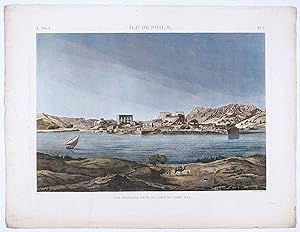
Ìle de Philæ. / Vue Générale Prise du CÔté du Nord Est. A(ntiquités). Vol. I. Pl. 3.
Verlag: ParisC.L.F. Panckoucke -1830., 1821
Anbieter: Robert Frew Ltd. ABA ILAB, London, Vereinigtes Königreich
Verbandsmitglied: ABA ILAB PBFA
Verkäuferbewertung 5 von 5 Sternen
Kunst / Grafik / Poster
EUR 353,51
EUR 11,44 shipping
Ships from Vereinigtes Königreich to USAAnzahl: 1 verfügbar
In den WarenkorbOriginal copper engraving with later hand colouring (plate mark 45.5 x 58.5 cm, overall sheet size 52.5 x 69.5 cm) by Dutertre after the drawing by Dutertre and Beaugean from volume 1 of the Description de l'Égypte (2nd edition). Unobtrusive publisher's blindstamp to top right corner. Light toning and smudging along with small nicks to margins not affecting image, else good. The Description de l'Égypte was the first scientific survey of all Egypt, from its antiquities to its agriculture including language, music, costume, and natural history, and it concludes with a detailed and accurate map of the region. The numerous plates depicting the antiquities provide a comprehensive record of the richness of ancient Egyptian culture. At the time of publication, the Description de l'Égypte was the largest printed work ever produced. Its influence was enormous, establishing Egyptology as an intellectual discipline and nurturing a passion for Egyptian art throughout the Western World. Edited by some of the leading intellectual figures in France, the Description also includes contributions from celebrated artists such as Jacques Barraband, Pierre-Joseph Redouté, Geoffrey Saint-Hilaire, Jules-César Savigny and others. The combined work of several dozen scholars, this "living archive" of Napoleon's expedition took over twenty years to complete. The huge undertaking was co-ordinated by the Institut de l'Egypte, founded by Napoleon and with Gaspar Monge, the mathematician, as its president. Monge and the chemist Berthollet recruited leading academic figures to join the expedition, including Geoffrey Saint-Hilaire, Savigny, Méchain, Quesnot Nouet, René Desgenettes and the surgeon Dominique Jean Larrey. Of their many achievements, the discovery of the Rosetta Stone must rank amongst the most important. It was only after Napoleon's invasion of Egypt in 1798 that Europe came to know the Orient more scientifically. In the preface to the work, Fourier explains that scholars were grappling with the mysteries of Egypt in order to restore the country from what he sees as its current state of "barbarism" to its former greatness. By engulfing Egypt with the instruments of Western knowledge and power, Fourier maintained that history would recall how "Egypte fut le thêatre de sa [Napoleon's] gloire, et préserve de l'oubli toutes les circonstances de cet événement extraordinaire". With the publication of this monumental work, Fourier's ambition was certainly achieved.
-

Thèbes. Karnak. / Coupes Longitudinales et Transversales. Détails de Chapiteaux du Grand Temple du Sud. A(ntiquités). Vol. III. Pl. 55.
Verlag: ParisC.L.F. Panckoucke -1830., 1821
Anbieter: Robert Frew Ltd. ABA ILAB, London, Vereinigtes Königreich
Verbandsmitglied: ABA ILAB PBFA
Verkäuferbewertung 5 von 5 Sternen
Kunst / Grafik / Poster
EUR 353,51
EUR 11,44 shipping
Ships from Vereinigtes Königreich to USAAnzahl: 1 verfügbar
In den WarenkorbOriginal uncoloured copper engraving (plate mark 49 x 92 cm, overall sheet size 70 x 109 cm) by Boutelou after the drawing by Lepere from volume 3 of the Description de l'Égypte (2nd edition). Unobtrusive publisher's blindstamp to top right margin. Faint toning and small nicks to extremities not affecting image, generally very good. The Description de l'Égypte was the first scientific survey of all Egypt, from its antiquities to its agriculture including language, music, costume, and natural history, and it concludes with a detailed and accurate map of the region. The numerous plates depicting the antiquities provide a comprehensive record of the richness of ancient Egyptian culture. At the time of publication, the Description de l'Égypte was the largest printed work ever produced. Its influence was enormous, establishing Egyptology as an intellectual discipline and nurturing a passion for Egyptian art throughout the Western World. Edited by some of the leading intellectual figures in France, the Description also includes contributions from celebrated artists such as Jacques Barraband, Pierre-Joseph Redouté, Geoffrey Saint-Hilaire, Jules-César Savigny and others. The combined work of several dozen scholars, this "living archive" of Napoleon's expedition took over twenty years to complete. The huge undertaking was co-ordinated by the Institut de l'Egypte, founded by Napoleon and with Gaspar Monge, the mathematician, as its president. Monge and the chemist Berthollet recruited leading academic figures to join the expedition, including Geoffrey Saint-Hilaire, Savigny, Méchain, Quesnot Nouet, René Desgenettes and the surgeon Dominique Jean Larrey. Of their many achievements, the discovery of the Rosetta Stone must rank amongst the most important. It was only after Napoleon's invasion of Egypt in 1798 that Europe came to know the Orient more scientifically. In the preface to the work, Fourier explains that scholars were grappling with the mysteries of Egypt in order to restore the country from what he sees as its current state of "barbarism" to its former greatness. By engulfing Egypt with the instruments of Western knowledge and power, Fourier maintained that history would recall how "Egypte fut le thêatre de sa [Napoleon's] gloire, et préserve de l'oubli toutes les circonstances de cet événement extraordinaire". With the publication of this monumental work, Fourier's ambition was certainly achieved.
-

Thèbes. Memnonium. Détails de la Statue Colossalle de Memnon. A(ntiquités). Vol. II. Pl. 22.
Verlag: ParisC.L.F. Panckoucke -1830., 1821
Anbieter: Robert Frew Ltd. ABA ILAB, London, Vereinigtes Königreich
Verbandsmitglied: ABA ILAB PBFA
Verkäuferbewertung 5 von 5 Sternen
Kunst / Grafik / Poster
EUR 353,51
EUR 11,44 shipping
Ships from Vereinigtes Königreich to USAAnzahl: 1 verfügbar
In den WarenkorbOriginal uncoloured copper plate engraving (print 46 x 62 cm, overall 50.5 x 71 cm) by Cain after the drawing byJollois and Devilliers from volume 2 of the Description de l'Égypte (2nd edition). Publisher's blindstamp at top right. Top edge shaved not affecting image, else good. The Description de l'Égypte was the first scientific survey of all Egypt, from its antiquities to its agriculture including language, music, costume, and natural history, and it concludes with a detailed and accurate map of the region. The numerous plates depicting the antiquities provide a comprehensive record of the richness of ancient Egyptian culture. At the time of publication, the Description de l'Égypte was the largest printed work ever produced. Its influence was enormous, establishing Egyptology as an intellectual discipline and nurturing a passion for Egyptian art throughout the Western World. Edited by some of the leading intellectual figures in France, the Description also includes contributions from celebrated artists such as Jacques Barraband, Pierre-Joseph Redouté, Geoffrey Saint-Hilaire, Jules-César Savigny and others. The combined work of several dozen scholars, this "living archive" of Napoleon's expedition took over twenty years to complete. The huge undertaking was co-ordinated by the Institut de l'Egypte, founded by Napoleon and with Gaspar Monge, the mathematician, as its president. Monge and the chemist Berthollet recruited leading academic figures to join the expedition, including Geoffrey Saint-Hilaire, Savigny, Méchain, Quesnot Nouet, René Desgenettes and the surgeon Dominique Jean Larrey. Of their many achievements, the discovery of the Rosetta Stone must rank amongst the most important. It was only after Napoleon's invasion of Egypt in 1798 that Europe came to know the Orient more scientifically. In the preface to the work, Fourier explains that scholars were grappling with the mysteries of Egypt in order to restore the country from what he sees as its current state of "barbarism" to its former greatness. By engulfing Egypt with the instruments of Western knowledge and power, Fourier maintained that history would recall how "Egypte fut le thêatre de sa [Napoleon's] gloire, et préserve de l'oubli toutes les circonstances de cet événement extraordinaire". With the publication of this monumental work, Fourier's ambition was certainly achieved.
-
![Bild des Verkäufers für Île de Philæ. Vue Générale Prise de Coté du Nord Est. A[ntiquités]. Vol. 1. Pl. 3. zum Verkauf von Robert Frew Ltd. ABA ILAB](https://pictures.abebooks.com/inventory/md/md30861958323.jpg)
Île de Philæ. Vue Générale Prise de Coté du Nord Est. A[ntiquités]. Vol. 1. Pl. 3.
Verlag: ParisPanckoucke -1830., 1821
Anbieter: Robert Frew Ltd. ABA ILAB, London, Vereinigtes Königreich
Verbandsmitglied: ABA ILAB PBFA
Verkäuferbewertung 5 von 5 Sternen
Kunst / Grafik / Poster
EUR 353,51
EUR 11,44 shipping
Ships from Vereinigtes Königreich to USAAnzahl: 1 verfügbar
In den WarenkorbOriginal uncoloured copper plate engraving (print 38.5 x 56 cm, overall 52 x 71 cm) by Dutertre and Beaugean after the drawing by Dutertre from volume 1 of the Description de l'Égypte (2nd edition). Publisher's blindstamp at top right. Light wear and minor spotting mainly to extremities, generally very good. The Description de l'Égypte was the first scientific survey of all Egypt, from its antiquities to its agriculture including language, music, costume, and natural history, and it concludes with a detailed and accurate map of the region. The numerous plates depicting the antiquities provide a comprehensive record of the richness of ancient Egyptian culture. At the time of publication, the Description de l'Égypte was the largest printed work ever produced. Its influence was enormous, establishing Egyptology as an intellectual discipline and nurturing a passion for Egyptian art throughout the Western World. Edited by some of the leading intellectual figures in France, the Description also includes contributions from celebrated artists such as Jacques Barraband, Pierre-Joseph Redouté, Geoffrey Saint-Hilaire, Jules-César Savigny and others. The combined work of several dozen scholars, this "living archive" of Napoleon's expedition took over twenty years to complete. The huge undertaking was co-ordinated by the Institut de l'Egypte, founded by Napoleon and with Gaspar Monge, the mathematician, as its president. Monge and the chemist Berthollet recruited leading academic figures to join the expedition, including Geoffrey Saint-Hilaire, Savigny, Méchain, Quesnot Nouet, René Desgenettes and the surgeon Dominique Jean Larrey. Of their many achievements, the discovery of the Rosetta Stone must rank amongst the most important. It was only after Napoleon's invasion of Egypt in 1798 that Europe came to know the Orient more scientifically. In the preface to the work, Fourier explains that scholars were grappling with the mysteries of Egypt in order to restore the country from what he sees as its current state of "barbarism" to its former greatness. By engulfing Egypt with the instruments of Western knowledge and power, Fourier maintained that history would recall how "Egypte fut le thêatre de sa [Napoleon's] gloire, et préserve de l'oubli toutes les circonstances de cet événement extraordinaire". With the publication of this monumental work, Fourier's ambition was certainly achieved.
-

Qâou el Kebyreh. (Antæopolis) / Vue Perspective du Temple. A(ntiquités). Vol. IV. Pl. 40.
Verlag: ParisC.L.F. Panckoucke -1830., 1821
Anbieter: Robert Frew Ltd. ABA ILAB, London, Vereinigtes Königreich
Verbandsmitglied: ABA ILAB PBFA
Verkäuferbewertung 5 von 5 Sternen
Kunst / Grafik / Poster
EUR 353,51
EUR 11,44 shipping
Ships from Vereinigtes Königreich to USAAnzahl: 1 verfügbar
In den WarenkorbOriginal uncoloured copper engraving (plate mark 38 x 54 cm, overall sheet size 54.5 x 71.5 cm) by Duhamel after the drawing by Cécile from volume 4 of the Description de l'Égypte (2nd edition). Unobtrusive publisher's blindstamp to top right corner. Some light spotting, else very good. The Description de l'Égypte was the first scientific survey of all Egypt, from its antiquities to its agriculture including language, music, costume, and natural history, and it concludes with a detailed and accurate map of the region. The numerous plates depicting the antiquities provide a comprehensive record of the richness of ancient Egyptian culture. At the time of publication, the Description de l'Égypte was the largest printed work ever produced. Its influence was enormous, establishing Egyptology as an intellectual discipline and nurturing a passion for Egyptian art throughout the Western World. Edited by some of the leading intellectual figures in France, the Description also includes contributions from celebrated artists such as Jacques Barraband, Pierre-Joseph Redouté, Geoffrey Saint-Hilaire, Jules-César Savigny and others. The combined work of several dozen scholars, this "living archive" of Napoleon's expedition took over twenty years to complete. The huge undertaking was co-ordinated by the Institut de l'Egypte, founded by Napoleon and with Gaspar Monge, the mathematician, as its president. Monge and the chemist Berthollet recruited leading academic figures to join the expedition, including Geoffrey Saint-Hilaire, Savigny, Méchain, Quesnot Nouet, René Desgenettes and the surgeon Dominique Jean Larrey. Of their many achievements, the discovery of the Rosetta Stone must rank amongst the most important. It was only after Napoleon's invasion of Egypt in 1798 that Europe came to know the Orient more scientifically. In the preface to the work, Fourier explains that scholars were grappling with the mysteries of Egypt in order to restore the country from what he sees as its current state of "barbarism" to its former greatness. By engulfing Egypt with the instruments of Western knowledge and power, Fourier maintained that history would recall how "Egypte fut le thêatre de sa [Napoleon's] gloire, et préserve de l'oubli toutes les circonstances de cet événement extraordinaire". With the publication of this monumental work, Fourier's ambition was certainly achieved.
-

Ìle de Philæ. / Vue Générale Prise du CÔté du Nord Est. A(ntiquités). Vol. I. Pl. 3.
Verlag: ParisC.L.F. Panckoucke -1830., 1821
Anbieter: Robert Frew Ltd. ABA ILAB, London, Vereinigtes Königreich
Verbandsmitglied: ABA ILAB PBFA
Verkäuferbewertung 5 von 5 Sternen
Kunst / Grafik / Poster
EUR 353,51
EUR 11,44 shipping
Ships from Vereinigtes Königreich to USAAnzahl: 1 verfügbar
In den WarenkorbOriginal uncoloured copper engraving (plate mark 45.5 x 58.5 cm, overall sheet size 52.5 x 69.5 cm) by Dutertre after the drawing by Dutertre and Beaugean from volume 1 of the Description de l'Égypte (2nd edition). Unobtrusive publisher's blindstamp to top right corner. Some light spotting to margins and scattered light foxing, though generally in good condition. The Description de l'Égypte was the first scientific survey of all Egypt, from its antiquities to its agriculture including language, music, costume, and natural history, and it concludes with a detailed and accurate map of the region. The numerous plates depicting the antiquities provide a comprehensive record of the richness of ancient Egyptian culture. At the time of publication, the Description de l'Égypte was the largest printed work ever produced. Its influence was enormous, establishing Egyptology as an intellectual discipline and nurturing a passion for Egyptian art throughout the Western World. Edited by some of the leading intellectual figures in France, the Description also includes contributions from celebrated artists such as Jacques Barraband, Pierre-Joseph Redouté, Geoffrey Saint-Hilaire, Jules-César Savigny and others. The combined work of several dozen scholars, this "living archive" of Napoleon's expedition took over twenty years to complete. The huge undertaking was co-ordinated by the Institut de l'Egypte, founded by Napoleon and with Gaspar Monge, the mathematician, as its president. Monge and the chemist Berthollet recruited leading academic figures to join the expedition, including Geoffrey Saint-Hilaire, Savigny, Méchain, Quesnot Nouet, René Desgenettes and the surgeon Dominique Jean Larrey. Of their many achievements, the discovery of the Rosetta Stone must rank amongst the most important. It was only after Napoleon's invasion of Egypt in 1798 that Europe came to know the Orient more scientifically. In the preface to the work, Fourier explains that scholars were grappling with the mysteries of Egypt in order to restore the country from what he sees as its current state of "barbarism" to its former greatness. By engulfing Egypt with the instruments of Western knowledge and power, Fourier maintained that history would recall how "Egypte fut le thêatre de sa [Napoleon's] gloire, et préserve de l'oubli toutes les circonstances de cet événement extraordinaire". With the publication of this monumental work, Fourier's ambition was certainly achieved.
-

Qâou el Kebyreh. (Antæopolis) / Vue Perspective du Temple. A(ntiquités). Vol. IV. Pl. 42.
Verlag: ParisC.L.F. Panckoucke -1830., 1821
Anbieter: Robert Frew Ltd. ABA ILAB, London, Vereinigtes Königreich
Verbandsmitglied: ABA ILAB PBFA
Verkäuferbewertung 5 von 5 Sternen
Kunst / Grafik / Poster
EUR 382,97
EUR 11,44 shipping
Ships from Vereinigtes Königreich to USAAnzahl: 1 verfügbar
In den WarenkorbOriginal uncoloured copper engraving (plate mark 54 x 84 cm, overall sheet size 70.5 x 109 cm) by Dupare after the drawing by Chabrol and Jomard from volume 4 of the Description de l'Égypte (2nd edition). Unobtrusive publisher's blindstamp at top right corner. Small tears to lower margin not affecting image, some faint spotting, generally very good. The Description de l'Égypte was the first scientific survey of all Egypt, from its antiquities to its agriculture including language, music, costume, and natural history, and it concludes with a detailed and accurate map of the region. The numerous plates depicting the antiquities provide a comprehensive record of the richness of ancient Egyptian culture. At the time of publication, the Description de l'Égypte was the largest printed work ever produced. Its influence was enormous, establishing Egyptology as an intellectual discipline and nurturing a passion for Egyptian art throughout the Western World. Edited by some of the leading intellectual figures in France, the Description also includes contributions from celebrated artists such as Jacques Barraband, Pierre-Joseph Redouté, Geoffrey Saint-Hilaire, Jules-César Savigny and others. The combined work of several dozen scholars, this "living archive" of Napoleon's expedition took over twenty years to complete. The huge undertaking was co-ordinated by the Institut de l'Egypte, founded by Napoleon and with Gaspar Monge, the mathematician, as its president. Monge and the chemist Berthollet recruited leading academic figures to join the expedition, including Geoffrey Saint-Hilaire, Savigny, Méchain, Quesnot Nouet, René Desgenettes and the surgeon Dominique Jean Larrey. Of their many achievements, the discovery of the Rosetta Stone must rank amongst the most important. It was only after Napoleon's invasion of Egypt in 1798 that Europe came to know the Orient more scientifically. In the preface to the work, Fourier explains that scholars were grappling with the mysteries of Egypt in order to restore the country from what he sees as its current state of "barbarism" to its former greatness. By engulfing Egypt with the instruments of Western knowledge and power, Fourier maintained that history would recall how "Egypte fut le thêatre de sa [Napoleon's] gloire, et préserve de l'oubli toutes les circonstances de cet événement extraordinaire". With the publication of this monumental work, Fourier's ambition was certainly achieved.
-

Thèbes. Karnak. Vue Générale des Propylées et des Ruines du Palais prise du Nord-Est. A(ntiquités). Vol. III. Pl. 43.
Verlag: ParisC.L.F. Panckoucke -1830., 1821
Anbieter: Robert Frew Ltd. ABA ILAB, London, Vereinigtes Königreich
Verbandsmitglied: ABA ILAB PBFA
Verkäuferbewertung 5 von 5 Sternen
Kunst / Grafik / Poster
EUR 382,97
EUR 11,44 shipping
Ships from Vereinigtes Königreich to USAAnzahl: 1 verfügbar
In den WarenkorbOriginal uncoloured copper engraving (print 42 x 58.5 cm, overall 55 x 72 cm) by Liénard after the drawing by Cécile from volume 3 of the Description de l'Égypte (2nd edition). Publisher's blindstamp at top right. Very faint occasional spotting, generally very good. The Description de l'Égypte was the first scientific survey of all Egypt, from its antiquities to its agriculture including language, music, costume, and natural history, and it concludes with a detailed and accurate map of the region. The numerous plates depicting the antiquities provide a comprehensive record of the richness of ancient Egyptian culture. At the time of publication, the Description de l'Égypte was the largest printed work ever produced. Its influence was enormous, establishing Egyptology as an intellectual discipline and nurturing a passion for Egyptian art throughout the Western World. Edited by some of the leading intellectual figures in France, the Description also includes contributions from celebrated artists such as Jacques Barraband, Pierre-Joseph Redouté, Geoffrey Saint-Hilaire, Jules-César Savigny and others. The combined work of several dozen scholars, this "living archive" of Napoleon's expedition took over twenty years to complete. The huge undertaking was co-ordinated by the Institut de l'Egypte, founded by Napoleon and with Gaspar Monge, the mathematician, as its president. Monge and the chemist Berthollet recruited leading academic figures to join the expedition, including Geoffrey Saint-Hilaire, Savigny, Méchain, Quesnot Nouet, René Desgenettes and the surgeon Dominique Jean Larrey. Of their many achievements, the discovery of the Rosetta Stone must rank amongst the most important. It was only after Napoleon's invasion of Egypt in 1798 that Europe came to know the Orient more scientifically. In the preface to the work, Fourier explains that scholars were grappling with the mysteries of Egypt in order to restore the country from what he sees as its current state of "barbarism" to its former greatness. By engulfing Egypt with the instruments of Western knowledge and power, Fourier maintained that history would recall how "Egypte fut le thêatre de sa [Napoleon's] gloire, et préserve de l'oubli toutes les circonstances de cet événement extraordinaire". With the publication of this monumental work, Fourier's ambition was certainly achieved.
-

Thèbes. Memnonium. / Détails de la Statue Colossalle de Memnon. A(ntiquités). Vol. II. Pl. 22.
Verlag: ParisC.L.F. Panckoucke -1830., 1821
Anbieter: Robert Frew Ltd. ABA ILAB, London, Vereinigtes Königreich
Verbandsmitglied: ABA ILAB PBFA
Verkäuferbewertung 5 von 5 Sternen
Kunst / Grafik / Poster
EUR 412,43
EUR 11,44 shipping
Ships from Vereinigtes Königreich to USAAnzahl: 1 verfügbar
In den WarenkorbOriginal uncoloured copper engraving (plate mark 45 x 62 cm, overall sheet size 53.5 x 69.5 cm) by Cain after the drawing by Jollois and Devilliers from volume 2 of the Description de l'Égypte (2nd edition). Unobtrusive publisher's blindstamp to top right corner. Some toning along margins not affecting image, scattered light spotting. The Description de l'Égypte was the first scientific survey of all Egypt, from its antiquities to its agriculture including language, music, costume, and natural history, and it concludes with a detailed and accurate map of the region. The numerous plates depicting the antiquities provide a comprehensive record of the richness of ancient Egyptian culture. At the time of publication, the Description de l'Égypte was the largest printed work ever produced. Its influence was enormous, establishing Egyptology as an intellectual discipline and nurturing a passion for Egyptian art throughout the Western World. Edited by some of the leading intellectual figures in France, the Description also includes contributions from celebrated artists such as Jacques Barraband, Pierre-Joseph Redouté, Geoffrey Saint-Hilaire, Jules-César Savigny and others. The combined work of several dozen scholars, this "living archive" of Napoleon's expedition took over twenty years to complete. The huge undertaking was co-ordinated by the Institut de l'Egypte, founded by Napoleon and with Gaspar Monge, the mathematician, as its president. Monge and the chemist Berthollet recruited leading academic figures to join the expedition, including Geoffrey Saint-Hilaire, Savigny, Méchain, Quesnot Nouet, René Desgenettes and the surgeon Dominique Jean Larrey. Of their many achievements, the discovery of the Rosetta Stone must rank amongst the most important. It was only after Napoleon's invasion of Egypt in 1798 that Europe came to know the Orient more scientifically. In the preface to the work, Fourier explains that scholars were grappling with the mysteries of Egypt in order to restore the country from what he sees as its current state of "barbarism" to its former greatness. By engulfing Egypt with the instruments of Western knowledge and power, Fourier maintained that history would recall how "Egypte fut le thêatre de sa [Napoleon's] gloire, et préserve de l'oubli toutes les circonstances de cet événement extraordinaire". With the publication of this monumental work, Fourier's ambition was certainly achieved.
-
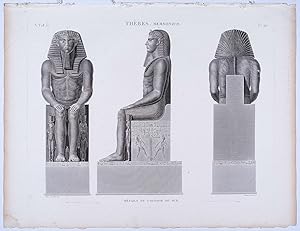
Thèbes. Memnonium. / Détails du Colosse du Sud. A(ntiquités). Vol. II. Pl. 21.
Verlag: ParisC.L.F. Panckoucke -1830., 1821
Anbieter: Robert Frew Ltd. ABA ILAB, London, Vereinigtes Königreich
Verbandsmitglied: ABA ILAB PBFA
Verkäuferbewertung 5 von 5 Sternen
Kunst / Grafik / Poster
EUR 412,43
EUR 11,44 shipping
Ships from Vereinigtes Königreich to USAAnzahl: 1 verfügbar
In den WarenkorbOriginal uncoloured copper engraving (plate mark 45 x 59 cm, overall sheet size 53.5 x 69.5 cm) by Thomas and Aubert after the drawing by Jollois and Devilliers from volume 2 of the Description de l'Égypte (2nd edition). Unobtrusive publisher's blindstamp to top right corner. Some toning to outer margins not affecting image, small dampstain to bottom left margin not affecting image, faint light spotting, generally very good. The Description de l'Égypte was the first scientific survey of all Egypt, from its antiquities to its agriculture including language, music, costume, and natural history, and it concludes with a detailed and accurate map of the region. The numerous plates depicting the antiquities provide a comprehensive record of the richness of ancient Egyptian culture. At the time of publication, the Description de l'Égypte was the largest printed work ever produced. Its influence was enormous, establishing Egyptology as an intellectual discipline and nurturing a passion for Egyptian art throughout the Western World. Edited by some of the leading intellectual figures in France, the Description also includes contributions from celebrated artists such as Jacques Barraband, Pierre-Joseph Redouté, Geoffrey Saint-Hilaire, Jules-César Savigny and others. The combined work of several dozen scholars, this "living archive" of Napoleon's expedition took over twenty years to complete. The huge undertaking was co-ordinated by the Institut de l'Egypte, founded by Napoleon and with Gaspar Monge, the mathematician, as its president. Monge and the chemist Berthollet recruited leading academic figures to join the expedition, including Geoffrey Saint-Hilaire, Savigny, Méchain, Quesnot Nouet, René Desgenettes and the surgeon Dominique Jean Larrey. Of their many achievements, the discovery of the Rosetta Stone must rank amongst the most important. It was only after Napoleon's invasion of Egypt in 1798 that Europe came to know the Orient more scientifically. In the preface to the work, Fourier explains that scholars were grappling with the mysteries of Egypt in order to restore the country from what he sees as its current state of "barbarism" to its former greatness. By engulfing Egypt with the instruments of Western knowledge and power, Fourier maintained that history would recall how "Egypte fut le thêatre de sa [Napoleon's] gloire, et préserve de l'oubli toutes les circonstances de cet événement extraordinaire". With the publication of this monumental work, Fourier's ambition was certainly achieved.
-

Edfou(Apollinopolis Magna.) A.Vol.I- Pl.64- Frise sculptee sous la galerie nord.
Verlag: Paris, 1809
Kunst / Grafik / Poster
Zustand: ACEPTABLE. Estupendo grabado de la obra monumental de Description de l,Egypte, realizadas por cientos de artistas y científicos bajo el patrocinio de Napoleón durante expedición con mas de 35000 soldados para conquistar Egipto.(1798 1801). Durante la campaña se descubrió el valle de los Reyes, cerca de Tebas, se encontró la piedra Rosetta y se catalogaron miles de edificios, monumentos, ruinas, detalles, jeroglíficos además de catalogar toda la Historia Natural. La obra completa se empezó en 1809 y ocupaba 10 volúmenes de gran folio de grabados y otros 10 volúmenes de texto y su segunda edición no se termino hasta 1830. Ejemplares completos son muy raros de encontrar. Aquí tenemos unos cuantos grabados pertenecientes al apartado de "Antiquities" estampados en Paris, 1809-1830. Formato (cm): 52x68.
-

KOUM OMBOÛ (Ombos). A.Vol.I-Pl.44 - Sculptures et Détails du Grand Temple
Verlag: Paris, 1809
Kunst / Grafik / Poster
Zustand: ACEPTABLE. Estupendo grabado de la obra monumental de "Description de l'Egypte" / "Descripción de Egipto", realizadas por cientos de artistas y científicos bajo el patrocinio de Napoleón durante expedición con más de 35000 soldados para conquistar Egipto (1798 1801). Durante la campaña se descubrió el valle de los Reyes, cerca de Tebas, se encontró la piedra Rosetta y se catalogaron miles de edificios, monumentos, ruinas, detalles, jeroglíficos además de catalogar toda la Historia Natural. La obra completa se empezó en 1809 y ocupaba 10 volúmenes de gran folio de grabados y otros 10 volúmenes de texto y su segunda edición no se terminó hasta 1830. Ejemplares completos son muy raros de encontrar. Aquí tenemos unos cuantos grabados pertenecientes al apartado de "Antiquities" estampados en Paris, 1809-1830. Formato (cm): 52x68.

