
Gesamtpreis (1 Artikel Artikel):
Versandziel:

dejong gerald (7 Ergebnisse)
Direkt zu den wichtigsten Suchergebnissen
Suchfilter
Produktart
- Alle Product Types
- Bücher (7)
- Magazine & Zeitschriften (Keine weiteren Ergebnisse entsprechen dieser Verfeinerung)
- Comics (Keine weiteren Ergebnisse entsprechen dieser Verfeinerung)
- Noten (Keine weiteren Ergebnisse entsprechen dieser Verfeinerung)
- Kunst, Grafik & Poster (Keine weiteren Ergebnisse entsprechen dieser Verfeinerung)
- Fotografien (Keine weiteren Ergebnisse entsprechen dieser Verfeinerung)
- Karten (Keine weiteren Ergebnisse entsprechen dieser Verfeinerung)
- Manuskripte & Papierantiquitäten (Keine weiteren Ergebnisse entsprechen dieser Verfeinerung)
Zustand Mehr dazu
- Neu (4)
- Wie Neu, Sehr Gut oder Gut Bis Sehr Gut (1)
- Gut oder Befriedigend (2)
- Ausreichend oder Schlecht (Keine weiteren Ergebnisse entsprechen dieser Verfeinerung)
- Wie beschrieben (Keine weiteren Ergebnisse entsprechen dieser Verfeinerung)
Einband
Weitere Eigenschaften
- Erstausgabe (1)
- Signiert (Keine weiteren Ergebnisse entsprechen dieser Verfeinerung)
- Schutzumschlag (Keine weiteren Ergebnisse entsprechen dieser Verfeinerung)
- Angebotsfoto (3)
Sprache (2)
Gratisversand
Land des Verkäufers
Verkäuferbewertung
-

The Reformed Church in China, 1842-1951
Sprache: Englisch
Verlag: Eerdmans Publishing Company, William B., 1992
ISBN 10: 0802806619 ISBN 13: 9780802806611
Anbieter: Better World Books, Mishawaka, IN, USA
Verkäuferbewertung 5 von 5 Sternen

Zustand: Good. Used book that is in clean, average condition without any missing pages.
-
The Dutch in America, Sixteen Nine to Nineteen Seventy-Four
Anbieter: Better World Books, Mishawaka, IN, USA
Verkäuferbewertung 5 von 5 Sternen
Zustand: Good. Former library book; may include library markings. Used book that is in clean, average condition without any missing pages.
-

Investigating Explanation-Based Learning
Sprache: Englisch
Verlag: Springer US, Springer New York, 2012
ISBN 10: 1461366003 ISBN 13: 9781461366003
Anbieter: AHA-BUCH GmbH, Einbeck, Deutschland
Verkäuferbewertung 5 von 5 Sternen
Taschenbuch. Zustand: Neu. Druck auf Anfrage Neuware - Printed after ordering - Explanation-Based Learning (EBL) can generally be viewed as substituting background knowledge for the large training set of exemplars needed by conventional or empirical machine learning systems. The background knowledge is used automatically to construct an explanation of a few training exemplars. The learned concept is generalized directly from this explanation. The first EBL systems of the modern era were Mitchell's LEX2, Silver's LP, and De Jong's KIDNAP natural language system. Two of these systems, Mitchell's and De Jong's, have led to extensive follow-up research in EBL. This book outlines the significant steps in EBL research of the Illinois group under De Jong. This volume describes theoretical research and computer systems that use a broad range of formalisms: schemas, production systems, qualitative reasoning models, non-monotonic logic, situation calculus, and some home-grown ad hoc representations. This has been done consciously to avoid sacrificing the ultimate research significance in favor of the expediency of any particular formalism. The ultimate goal, of course, is to adopt (or devise) the right formalism.
-

Investigating Explanation-Based Learning
Sprache: Englisch
Verlag: Springer New York, Springer US, 1992
ISBN 10: 079239125X ISBN 13: 9780792391258
Anbieter: AHA-BUCH GmbH, Einbeck, Deutschland
Verkäuferbewertung 5 von 5 Sternen
Buch. Zustand: Neu. Druck auf Anfrage Neuware - Printed after ordering - Explanation-Based Learning (EBL) can generally be viewed as substituting background knowledge for the large training set of exemplars needed by conventional or empirical machine learning systems. The background knowledge is used automatically to construct an explanation of a few training exemplars. The learned concept is generalized directly from this explanation. The first EBL systems of the modern era were Mitchell's LEX2, Silver's LP, and De Jong's KIDNAP natural language system. Two of these systems, Mitchell's and De Jong's, have led to extensive follow-up research in EBL. This book outlines the significant steps in EBL research of the Illinois group under De Jong. This volume describes theoretical research and computer systems that use a broad range of formalisms: schemas, production systems, qualitative reasoning models, non-monotonic logic, situation calculus, and some home-grown ad hoc representations. This has been done consciously to avoid sacrificing the ultimate research significance in favor of the expediency of any particular formalism. The ultimate goal, of course, is to adopt (or devise) the right formalism.
-

Investigating Explanation-Based Learning
Anbieter: Kennys Bookstore, Olney, MD, USA
Verkäuferbewertung 4 von 5 Sternen

Zustand: New. 2012. 1993rd Edition. paperback. . . . . . Books ship from the US and Ireland.
-

Investigating Explanation-Based Learning
Anbieter: Kennys Bookstore, Olney, MD, USA
Verkäuferbewertung 4 von 5 Sternen
Zustand: New. 1992. Hardcover. . . . . . Books ship from the US and Ireland.
-
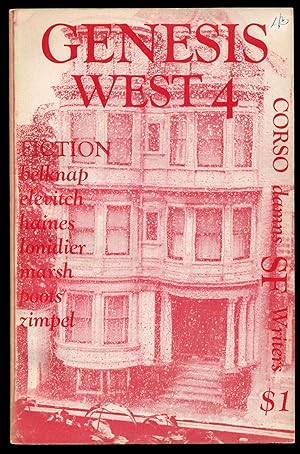
Genesis West Vol. 1 No. 4
Verlag: The Chrysalis West Foundation, Burlington, California, 1963
Anbieter: Between the Covers-Rare Books, Inc. ABAA, Gloucester City, NJ, USA
Verbandsmitglied: ABAA ESA ILAB IOBA
Verkäuferbewertung 5 von 5 Sternen
Erstausgabe
Softcover. Zustand: Near Fine. Magazine. Octavo. 291-380pp. Pictorial wrappers. Tiny ink initials on cover, lightly toned spine, near fine. Order form laid in. The issue also includes interviews, poems, stories, art and photography from M.D. Elevitch, Paul Haines, Lynn Lonidier, Willard Marsh, Tom Poots, Lloyd Zimpel, Ann Halprin, Carol Berge, Gregory Corso, Robert Duncan, Jack Gilbert, Gerald Stern, Melville Abbett, David Cornel DeJong, David Pearson Etter, Mimi Goldberg, Jacob Leed, Jackson MacLow, Philip Murray, Vern Rutsala, Robert Sward, Barney Childs, Tuli Kepferberg, Bernice Kussoy, Ruthe Bernhard, and Edward Loomis.

