

Gesamtpreis (1 Artikel Artikel):
Versandziel:

cotgrove box (6 Ergebnisse)
Direkt zu den wichtigsten Suchergebnissen
Suchfilter
Produktart
- Alle Product Types
- Bücher (6)
- Magazine & Zeitschriften (Keine weiteren Ergebnisse entsprechen dieser Verfeinerung)
- Comics (Keine weiteren Ergebnisse entsprechen dieser Verfeinerung)
- Noten (Keine weiteren Ergebnisse entsprechen dieser Verfeinerung)
- Kunst, Grafik & Poster (Keine weiteren Ergebnisse entsprechen dieser Verfeinerung)
- Fotografien (Keine weiteren Ergebnisse entsprechen dieser Verfeinerung)
- Karten (Keine weiteren Ergebnisse entsprechen dieser Verfeinerung)
- Manuskripte & Papierantiquitäten (Keine weiteren Ergebnisse entsprechen dieser Verfeinerung)
Zustand Mehr dazu
- Neu (3)
- Wie Neu, Sehr Gut oder Gut Bis Sehr Gut (2)
- Gut oder Befriedigend (1)
- Ausreichend oder Schlecht (Keine weiteren Ergebnisse entsprechen dieser Verfeinerung)
- Wie beschrieben (Keine weiteren Ergebnisse entsprechen dieser Verfeinerung)
Einband
Weitere Eigenschaften
- Erstausgabe (Keine weiteren Ergebnisse entsprechen dieser Verfeinerung)
- Signiert (Keine weiteren Ergebnisse entsprechen dieser Verfeinerung)
- Schutzumschlag (1)
- Angebotsfoto (3)
Sprache (1)
Gratisversand
- Kostenloser Versand nach USA (Keine weiteren Ergebnisse entsprechen dieser Verfeinerung)
Land des Verkäufers
Verkäuferbewertung
-
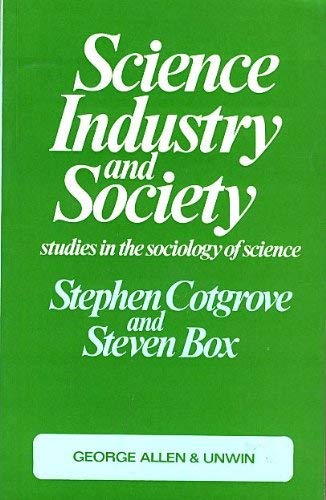
Science, Industry and Society: Studies in the Sociology of Science
Buch 24 von 33: Routledge Library Editions: History & Philosophy of ScienceAnbieter: Anybook.com, Lincoln, Vereinigtes Königreich
Verkäuferbewertung 5 von 5 Sternen

EUR 3,67
EUR 15,53 Versand
Versand von Vereinigtes Königreich nach USAAnzahl: 1 verfügbar
In den WarenkorbZustand: Good. This is an ex-library book and may have the usual library/used-book markings inside.This book has hardback covers. Clean from markings. In good all round condition. No dust jacket. Please note the Image in this listing is a stock photo and may not match the covers of the actual item,450grams, ISBN:0043010210.
-

Science, industry, and society;: Studies in the sociology of science,
Buch 24 von 33: Routledge Library Editions: History & Philosophy of ScienceAnbieter: A Squared Books (Don Dewhirst), South Lyon, MI, USA
Verkäuferbewertung 5 von 5 Sternen
Hardcover. Zustand: As New. Zustand des Schutzumschlags: Very Good. New York, 1970; blue/gray cloth covered boards; minimal shelf wear; green jacket with mild edge wear; 8vo - over 7 3/4" to 9 3/4" tall; interior clean and unmarked; 211 pages.
-

Science, Industry and Society. Studies in the sociology of sience.
Buch 24 von 33: Routledge Library Editions: History & Philosophy of ScienceSprache: Englisch
Verlag: London, Allen and Unwin. 1970., 1970
ISBN 10: 0043010210 ISBN 13: 9780043010211
Anbieter: Fundus-Online GbR Borkert Schwarz Zerfaß, Berlin, Deutschland
Verkäuferbewertung 5 von 5 Sternen
Zustand: Wie neu. XII, 211 Seiten. Broschiert. Two major changes have characterised science in the twentieth century. Firstly, there has been its rapid growth. Indeed, most scientists who have ever lived are alive today. Secondly- and central to the theme of this book - science is no longer mainly an academic activity carried on in universities. Industry will soon be the largest single employer of scientists. Such changes have generated a series of problems. There is growing anxiety lest the bureaucratisation of science threaten creativity. And, during the period of the researches reported in this study, there has been much debate about the drift from science and the failure of industry to recruit the best graduates. Such are the issues with which this book deals.Does science attract first-born children who have experienced early isolation ? Do universities produce 'academics' who find the prospect of industry uncongenial ? Does industry fail to make the most of the skills and capacities of its highly qualified graduates ? These are some of the issues investigated in this study, which reports on some pioneering researches carried out by the authors in this country.This book should be widely read by all in industry, government and universities who are concerned with the changing role of science, and particularly by those who are involved in the administration of research and development. But it also makes a major contribution to the sociology of science, offering an invaluable guide to the extensive literature in this rapidly growing field of interest, and so should find a place in courses in industrial sociology, and, indeed, in any studies of contemporary industrial societies in which science plays so great a part. Stephen Cotgrove, Professor of Sociology at Bath University of Technology, is author of Technical Education and Social Change and The Science of Society. Steven Box, Lecturer in Sociology at the University of Kent, has written articles on the education and employment of scientists, and on sociological theory. Sprache: Englisch Gewicht in Gramm: 550.
-

Science Industry and Society: Studies in the Sociology of Science
Buch 24 von 33: Routledge Library Editions: History & Philosophy of ScienceAnbieter: Revaluation Books, Exeter, Vereinigtes Königreich
Verkäuferbewertung 5 von 5 Sternen
EUR 46,58
EUR 11,59 Versand
Versand von Vereinigtes Königreich nach USAAnzahl: 2 verfügbar
In den WarenkorbPaperback. Zustand: Brand New. 1st edition. 224 pages. 9.00x6.00x0.50 inches. In Stock.
-

Box, S: Science Industry and Society
Buch 24 von 33: Routledge Library Editions: History & Philosophy of ScienceEUR 76,74
EUR 48,99 Versand
Versand von Deutschland nach USAAnzahl: Mehr als 20 verfügbar
In den WarenkorbGebunden. Zustand: New. Cotgrove & Box, Stephen and StevenCotgrove & Box, Stephen and StevenOriginally published in 1970. Two major changes have characterised science in the twentieth century. Firstly, there has been its rapid growth. Secondly, and central to.
-

Science Industry and Society : Studies in the Sociology of Science
Buch 24 von 33: Routledge Library Editions: History & Philosophy of ScienceSprache: Englisch
Verlag: Taylor & Francis Ltd Aug 2008, 2008
ISBN 10: 0415474469 ISBN 13: 9780415474467
Anbieter: AHA-BUCH GmbH, Einbeck, Deutschland
Verkäuferbewertung 5 von 5 Sternen
Buch. Zustand: Neu. Neuware - Originally published in 1970. Two major changes have characterised science in the twentieth century. Firstly, there has been its rapid growth. Secondly, and central to the theme his book - science is no longer mainly an academic activity carried on in universities. Industry will soon be the largest employer of scientists. This book deals with issues of bureaucracy in science threatening its creativity and the failure of industry to recruit the best graduates, as well as what attracts people to study science.

