Gesamtpreis (1 Artikel Artikel):
Versandziel:

cosway style binding (27 Ergebnisse)
Direkt zu den wichtigsten Suchergebnissen
Suchfilter
Produktart
- Alle Product Types
- Bücher (27)
- Magazine & Zeitschriften (Keine weiteren Ergebnisse entsprechen dieser Verfeinerung)
- Comics (Keine weiteren Ergebnisse entsprechen dieser Verfeinerung)
- Noten (Keine weiteren Ergebnisse entsprechen dieser Verfeinerung)
- Kunst, Grafik & Poster (Keine weiteren Ergebnisse entsprechen dieser Verfeinerung)
- Fotografien (Keine weiteren Ergebnisse entsprechen dieser Verfeinerung)
- Karten (Keine weiteren Ergebnisse entsprechen dieser Verfeinerung)
- Manuskripte & Papierantiquitäten (Keine weiteren Ergebnisse entsprechen dieser Verfeinerung)
Zustand Mehr dazu
- Neu (Keine weiteren Ergebnisse entsprechen dieser Verfeinerung)
- Wie Neu, Sehr Gut oder Gut Bis Sehr Gut (19)
- Gut oder Befriedigend (Keine weiteren Ergebnisse entsprechen dieser Verfeinerung)
- Ausreichend oder Schlecht (Keine weiteren Ergebnisse entsprechen dieser Verfeinerung)
- Wie beschrieben (8)
Einband
- alle Einbände
- Hardcover (1)
- Softcover (Keine weiteren Ergebnisse entsprechen dieser Verfeinerung)
Weitere Eigenschaften
- Erstausgabe (17)
- Signiert (1)
- Schutzumschlag (Keine weiteren Ergebnisse entsprechen dieser Verfeinerung)
- Angebotsfoto (27)
Sprache (1)
Preis
- Beliebiger Preis
- Weniger als EUR 20 (Keine weiteren Ergebnisse entsprechen dieser Verfeinerung)
- EUR 20 bis EUR 45 (Keine weiteren Ergebnisse entsprechen dieser Verfeinerung)
- Mehr als EUR 45
Gratisversand
- Kostenloser Versand nach USA (Keine weiteren Ergebnisse entsprechen dieser Verfeinerung)
Land des Verkäufers
Verkäuferbewertung
-
The Posthumous Papers of The Pickwick Club; with Forty-Three Illustrations, by R. Seymour and Phiz
Verlag: Chapman and Hall, London, 1837
Anbieter: The First Edition Rare Books, LLC, Cincinnati, OH, USA
Verbandsmitglied: ABAA ILAB IOBA MWABA
Verkäuferbewertung 5 von 5 Sternen

Erstausgabe
Full leather. Zustand: Near fine. First edition of The Posthumous Papers of The Pickwick Club by Charles Dickens, in a stunning Cosway-Style Binding. (illustrator). First Edition, Second State. Octavo, xiv, [2], 609pp, [7]. Full green morocco over beveled boards, title in gilt on the spine. All edges gilt. Five decorative raised bands, gilt lettering and decorative compartments. Doublures with inlaid red morocco and gilt dentelles. Inset hand-colored portrait of Dickens after paintings by Daniel Maclise, under glass with brass frame, in front doublure. Bound by Sangorski & Sutcliffe for Charles J. Sawyer, LTD of London. Front hinge reinforced with archival leather restoration, almost indistinguishable. This work is the second issue of the text, with the half-title, the corrected "W" in Weller on the vignette title, "loud knocking" on page 18 is slightly mutilated, signature "E" present on pages 25 and 27, and pagination present for page 26. Solid text block, light wear to edges of some leaves, faint foxing. Complete with vignette title page, frontispiece portrait and 41 illustrated plates by Robert Seymour and H.K. Brown ("Phiz"). (Smith I, 3) (Hatton & Cleaver 3-88pp) A beautiful Cosway-Style binding. The Cosway-style binding originated in London in the early 20th Century, created by bookseller and Dickens scholar, John Harrison Stonehouse. The style was named after Richard Cosway (17421821), the celebrated English miniaturist painter, known for his delicate portrait work. Stonehouse commissioned Sangorski & Sutcliffe to create bindings that incorporated miniature watercolor portraits set into the covers under glass. These miniaturespainted on ivory by artists such as Miss C.B. Curriewere often portraits of the book's author, a key character, or a historical figure related to the text. Each was framed within the leather cover, usually of richly gilt morocco, and accompanied by elaborate tooling and jeweled ornamentation. The style became a hallmark of Edwardian luxury bookbinding. After the deaths of Sangorski (1912) and later Currie, the tradition continued under Sutcliffe and later firms, and "Cosway-style" came to denote any binding featuring such inset miniatures, even when produced elsewhere.
-
Venus and Adonis; Lucrece; The Passionate Pilgrim; Pericles; Sonnets.
Verlag: Oxford: at the Clarendon Press, 1905, 1905
Anbieter: Peter Harrington. ABA/ ILAB., London, Vereinigtes Königreich
Verbandsmitglied: ABA ILAB PBFA
Verkäuferbewertung 5 von 5 Sternen
Signiert
EUR 6.802,91
EUR 25,27 Versand
Versand von Vereinigtes Königreich nach USAAnzahl: 1 verfügbar
In den WarenkorbSigned limited edition of Venus and Adonis, number 634 of 1,000 copies signed by the editor Sidney Lee. This facsimile of the first edition of 1593 is finely bound together with facsimiles of the first editions of Lucrece (1594), The Passionate Pilgrim (1599), and the Sonnets (1609). The facsimiles are taken from copies held at the Bodleian Library and the Christie Miller Library at Britwell. For each of the four works, Lee (1859-1926) provided a bibliography and "a full and learned introduction incorporating a detailed account of its publication history and a descriptive census of copies, as well as a full survey of literary sources and analogues" (ODNB). Such bindings are named in honour of the famous Regency miniaturist Richard Cosway. They were initially executed in the first decade of the 20th century by Rivière & Son for Henry Sotheran, with the miniatures by Carolin Billin Currie. The Bayntun bindery, which acquired Rivière in 1939, continued to bind books in this style until the late 20th century. 5 works bound in 1, quarto (245 x 193 mm). Later 20th-century blue crushed morocco by Bayntun-Rivière, spine lettered in gilt, gilt rose motif to compartments and framing boards, enclosing central inset hand-coloured miniature of Shakespeare under glass surrounded by gilt frame, wide turn-ins with gilt rules, roll, and corner piece, cream silk doublures and flyleaves, fore edge gilt. Housed in a blue cloth slipcase. A fine copy.
-
Dombey and Son.
Verlag: London: Bradbury and Evans, 1848, 1848
Anbieter: Peter Harrington. ABA/ ILAB., London, Vereinigtes Königreich
Verbandsmitglied: ABA ILAB PBFA
Verkäuferbewertung 5 von 5 Sternen
Erstausgabe
EUR 6.802,91
EUR 25,27 Versand
Versand von Vereinigtes Königreich nach USAAnzahl: 1 verfügbar
In den WarenkorbFirst edition, finely bound in an exquisite Cosway-style binding by Bayntun. Named after the famous Regency miniaturist Richard Cosway, such elaborate bindings feature a delicate miniature portrait set under glass on the front cover. They have long been sought after by collectors as outstanding examples of the binder's craft. Cosway bindings were originally executed by Rivière & Son for Henry Sotheran, employing Carolin Billin Currie as the miniaturist, in the first decade of the 20th century. The Bayntun bindery, which acquired Rivière in 1939, continued to bind books in the Cosway style until the late 20th century. This novel was Dickens's first in an explicitly contemporary setting. It also contains "the first published example of a so-called dark plate ["On the Dark Road", p. 547]. The smooth blending of light and shadow on this illustration vividly contrasts it with the other illustrations in the novel and is a fine example of the dark plate process" (Smith). It was serialized from October 1846 to April 1848 prior to publication in book form. Eckel, pp. 74-6; Smith I, 8. Octavo (209 x 130 mm). Engraved frontispiece and vignette title page, 38 plates after H. K. Browne (Phiz). Bound with the two-line errata leaf (first state). Bound without half-title. Mid-20th-century dark blue morocco by Bayntun, hand-coloured miniature of Dickens under glass within gilt frame on front cover, spine lettered in gilt, large gilt floral decorations in compartments and corners of sides, turn-ins decorated in gilt, marbled doublures and free endpapers, edges gilt. Light oxidization of plates as usual, handful of small marks and repaired closed tears, externally a fine copy.
-
The Personal History of David Copperfield.
Verlag: London: Bradbury & Evans, 1850, 1850
Anbieter: Peter Harrington. ABA/ ILAB., London, Vereinigtes Königreich
Verbandsmitglied: ABA ILAB PBFA
Verkäuferbewertung 5 von 5 Sternen
Erstausgabe
EUR 5.915,57
EUR 25,27 Versand
Versand von Vereinigtes Königreich nach USAAnzahl: 1 verfügbar
In den WarenkorbFirst edition, finely bound in an exquisite Cosway-style binding by Bayntun. Named after the famous Regency miniaturist Richard Cosway, such elaborate bindings feature a delicate miniature portrait set under glass on the front cover. They have long been sought after by collectors as outstanding examples of the binder's craft. Cosway bindings were originally executed by Rivière & Son for Henry Sotheran, employing Carolin Billin Currie as the miniaturist, in the first decade of the 20th century. The Bayntun bindery, which acquired Rivière in 1939, continued to bind books in the Cosway style until the late 20th century. "Copperfield received considerable critical acclaim and before long was widely held to be his greatest work. Undoubtedly it became for very many readers, then as now, his best-loved novel, an opinion in which Dickens himself coincided, calling it in a preface to the book of 1867 his 'favourite child'" (ODNB). The novel was serialized from May 1849 to November 1850 prior to publication in book form. This copy has the first state engraved title page dated 1850, and the second state reading "screwed" rather than "screamed" (p. 132). Eckel, pp. 77-8; Smith I 9. Octavo (231 x 122 mm). Engraved frontispiece and vignette title, 38 engraved plates, all after H. K. Browne (Phiz). Mid-20th-century blue morocco by Bayntun, hand-coloured miniature of Dickens under glass within floral diamond frame on front cover, spine lettered in gilt, compartments and cover borders decorated in gilt, turn-ins with gilt fillets, dog-tooth roll, and cornerpiece, pale yellow moiré silk doublures and free endpapers, edges gilt. Housed in custom blue cloth slipcase. Spine mildly darkened, gilt bright, occasional tide marks to plates, else generally clean. Overall, a fine copy.
-
Poems, Chiefly in the Scottish Dialect
Verlag: Printed for the Author, and sold by William Creech, Edinburgh, 1787
Anbieter: Whitmore Rare Books, Inc. -- ABAA, ILAB, Pasadena, CA, USA
Verkäuferbewertung 5 von 5 Sternen
Zustand: Near Fine. Second edition. Edinburgh: Printed for the Author, and sold by William Creech, 1787. Second edition. First Edinburgh edition (first published in Kilmarnock in 1786). First issue, with "Roxburgh" misprinted "Boxburgh" on p. xxxvii in the list of subscribers and "skinking" on p. 263, line 13 (in later issues, the word was misprinted as "stinking"). In a fine and exceptionally beautiful jeweled Cosway-style binding by Sangorski & Sutcliffe at their very best, ca. 1925 (stamp-signed in gilt on rear turn-in). Octavo (212 x 127 mm). xlviii, [9]-368 pp. Complete with half-title and engraved frontispiece by John Buego after Alexander Nasmyth, with tissue guard. The contents occasionally foxed with a few faint marks, discreet professional repairs to small closed tears at fore-edge of A1, 2Y2, and 2Y3. Internally a Near Fine copy, crisp and wide-margined. Bound in full purple crushed levant morocco, both covers triple-ruled in gilt and elaborately tooled in gilt. Twenty-four large flowers on each cover done in cream and yellow morocco onlays. Large circular device in the center of both boards with a different quote by the poet on each. Spine with five raised bands, elaborately decorated and lettered in gilt in compartments. Five of the compartments further decorated with large leaf sprays, each with nine onlaid violet flowers. Double-ruled gilt board edges, elaborate gilt turn-ins with another two quotes from the Poet, including the immortal "Should Auld Acquaintance Be Forgot And Never Brought To Min' We'll Take A Cup O'Kindness Yet For Auld Lang Syne." The inside front cover in full brown crushed levant morocco with a very fine recessed oval hand-painted portrait miniature under glass, surrounded by a double leaf design in gilt set with four amethyst and two opal gemstones. The rear inside cover in full brown crushed levant morocco, purple silk endleaves, all edges gilt. Housed in the original cream watered silk lined dark red morocco clamshell case. Case expertly repaired and a little rubbed. Preceded by only the rare Kilmarnock edition of 1786, this second edition was published in an edition of approximately 3,250 copies on April 17, 1787. Two printers were used, resulting in variations in some sheets of the edition. This edition includes twenty-two new pieces, including "To a Haggis," and the first appearance in print of "Death and Doctor Hornbook," which had been omitted from the Kilmarnock edition. Egerer 2; Lamont 2; Rothschild 556. Near Fine.
-
My Early Life: A Roving Commission.
Verlag: London: Thornton Butterworth Limited, 1930, 1930
Anbieter: Peter Harrington. ABA/ ILAB., London, Vereinigtes Königreich
Verbandsmitglied: ABA ILAB PBFA
Verkäuferbewertung 5 von 5 Sternen
Erstausgabe
EUR 5.915,57
EUR 25,27 Versand
Versand von Vereinigtes Königreich nach USAAnzahl: 1 verfügbar
In den WarenkorbFirst edition, in a handsome Cosway-style binding executed for the British luxury purveyors, Asprey, of Churchill's only volume of sustained autobiography, covering his formative years from his birth in 1874 until his election as MP for Oldham in 1900. Overall, it gives a "witty and elegiac account of his youth shot through with regret at the decline of the social and imperial order in which he had grown up" (ODNB). Cohen A91.1; Woods A37(a). Andrew Roberts, Churchill, 2019. Octavo (208 x 134 mm). Half-tone frontispiece, 15 plates, folding map, maps to text. Cosway-style binding, late 20th-century red morocco by Bayntun-Riviere for Asprey, spine lettered and tooled in gilt, hand-coloured miniature of Churchill under glass to front cover, gilt facsimile signature to rear cover, gilt border to covers, gilt turn-ins, red silk endpapers, gilt edges. Housed in Asprey's red cloth slipcase. Joints repaired, light foxing to contents, slipcase a little rubbed. A very good copy.
-
Seven Pillars of Wisdom. A Triumph.
Verlag: London: Jonathan Cape, 1935, 1935
Anbieter: Peter Harrington. ABA/ ILAB., London, Vereinigtes Königreich
Verbandsmitglied: ABA ILAB PBFA
Verkäuferbewertung 5 von 5 Sternen
EUR 5.915,57
EUR 25,27 Versand
Versand von Vereinigtes Königreich nach USAAnzahl: 1 verfügbar
In den WarenkorbFirst trade edition of Lawrence of Arabia's narrative of the Arab Revolt, in a handsome Cosway-style binding executed for the British luxury purveyors, Asprey. "Lawrence had taken part in the preliminary planning of the Arab uprising and, in October 1916, was ordered to Jiddah to assess the military situation. What followed is recorded in Seven Pillars of Wisdom, a personal, emotional narrative of the Arab revolt in which Lawrence reveals how by sheer willpower he made history. It was a testimony to his vision and persistence and a fulfilment of his desire to write an epic which might stand comparison in scale and linguistic elegance with his beloved Morte d'Arthur and C. M. Doughty's Arabia Deserta. Subtitled 'A triumph', its climax is the Arab liberation of Damascus, a victory which successfully concludes a gruelling campaign and vindicates Lawrence's faith in the Arabs" (ODNB). This trade edition followed the unprocurable Oxford Times edition of 1922, of which there were just 8 copies printed, and the 1926 Cranwell edition, of which only 170 copies were designated complete for subscribers. O'Brien A042. Quarto (243 x 186 mm). Photogravure portrait frontispiece of Lawrence from the plaster bust, 47 plates (4 colour with tissue guards), 3 facsimiles, 4 maps in red and black, illustrations in text. Bound in the latter 20th century for Asprey in the Cosway style in brown morocco, spine lettered and tooled in gilt, hand-coloured miniature of Lawrence under glass to front cover, gilt border to covers, gilt turn-ins, marbled endpapers, gilt edges. Housed in Asprey's brown quarter morocco solander box. A fine copy.
-
Marie Antoinette
Verlag: Arthur L. Humphreys, London, 1905
Anbieter: Whitmore Rare Books, Inc. -- ABAA, ILAB, Pasadena, CA, USA
Verkäuferbewertung 5 von 5 Sternen
Zustand: Fine. Later printing. A Fine copy. Octavo (8 1/8 x 5 3/4 inches; 208 x 146 mm.). [viii], 268 pp. Title-page printed in red & black. A most unusual Cosway-Style Binding ca. 1920 believed to be by Cedric Chivers for the London Bookseller Chas. J. Sawyer, stamp signed in gilt on rear turn-in. Full vellum over beveled boards, front cover richly decorated with a swirling floral gilt design with the flowers hand painted in red and green (colors faded). In the lower right-hand corner is an oval inlay of black morocco with the monogram of Marie Antoinette in gilt surrounded by leaves and the Queen's crown in gilt. At the top left-hand corner is a very fine hand-painted portrait miniature of Marie Antoinette, set under glass within a gilt metal frame surrounded by gilt dots and four sets of three red semi-precious stones (one stone missing). The rear cover with a similar floral design and the arms of Marie Antoinette in gilt. Smooth spine with similar gilt floral design, black morocco label lettered in gilt. Decorative gilt board edges and turn-ins, cream watered silk liners and endleaves, all edges rough gilt. Housed in the original velvet-lined blue buckram clamshell case, spine with black morocco label lettered in gilt. Marie-Antoinette (1755-1793) was the infamous last queen of France before the French Revolution. The youngest daughter of Empress Maria Theresa and Emperor Francis I, the archduchess of Austria became dauphine of France in May 1770 at age 14 upon her marriage to the Dauphin Louis-Auguste (the future King Louis XVI). Celebrated and criticized for her extravagant fashion (among many other things), her life continues to fascinate. An unusual Cosway-Style binding, apparently by Cedric Chivers; an exciting addition to his usual style. Patented in 1898, Chivers's "vellucent" bindings departed from traditional methods of creating hand-painted vellum bindings. The usual approach was to merely bind a book in vellum and then paint on a design, but this is prone to rubbing and flaking and such examples are often now found chipped and deteriorated. In the 18th century Chivers's great predecessor, Edwards of Halifax, painted in reverse on the underside of translucent vellum, thereby providing a layer of protection for the design. His technique was not widely copied and almost vanished with his death, and it was not until the 1890s that Chivers developed his own similar method for protecting the design underneath the vellum itself - the backing sheet of the vellum was painted, which was then covered in vellum which had been shaved to transparency. The vellum was then tooled in gilt, on occasion incorporating additional mother-of-pearl and onlays. The books which Chivers thus bound have always been a favorite of collectors, and usually still present well, the vellum having served its purpose of protecting the design for many decades, as Chivers intended. Chivers was also known to have employed a great many craftswomen at his bindery in Portway: "forty women for folding, sewing, mending, and collating work, and in addition, five more women worked in a separate department, to design, illuminate, and colour vellum for book decoration, and to work on embossed leather. These five were Dorothy Carleton Smyth, Alice Shepherd, Miss J.D. Dunn, Muriel Taylor, and Agatha Gales" (Tidcombe). Chas J. Sawyer (1906-1990) was a London bookselling firm specializing in the finest books. It is most likely that they supplied the miniature to Cedric Chivers when placing the binding order Although named after the English miniaturist Richard Cosway (1742-1821), the desirable "Cosway Binding" with its jewel-like portrait miniature set into a fine binding was first developed at the turn of the century by J.H. Stonehouse, director of London's Henry Sotheran Booksellers. Their miniatures were painstakingly crafted by the talented painter Miss C. B. Currie (1849-1940). As the style grew in popularity, other publishing houses quickly began to reproduce this techniqueeach developing their own desirable take on the aestheticreferred to as "Cosway style." The quality of the miniature is quite superb. Fine.
-
Sir Walter Scott (Extra-illustrated)
Verlag: Cassell and Company Ltd, London, 1932
Anbieter: Whitmore Rare Books, Inc. -- ABAA, ILAB, Pasadena, CA, USA
Verkäuferbewertung 5 von 5 Sternen
Erstausgabe
Zustand: Fine. First edition. Octavo (8 5/8 x 6 inches; 219 x 152 mm.). 388 pp. Extra illustrated by the insertion of twelve plates, three of which are hand colored. A fine Cosway-Style binding by Bayntun (Rivière) ca. 1940, stamp signed in gilt on front turn-in. Full sangria red morocco, covers elaborately tooled in gilt in a fine thistle design. Front cover with a fine hand-painted oval portrait miniature (3 1/4 x 2 1/2 inches; 82 x 63 mm.) of a young Sir Walter Scott, set under glass and surrounded by a fine thistle design in gilt. Spine with five raised bands, decoratively tooled with a thistle design and lettered in gilt in compartments. Decorative gilt board edges and wide turn-ins. Marbled liners and endleaves, all edges gilt. Housed in the original felt-lined purple cloth clamshell case, spine lettered in gilt. Sir Walter Scott was a preeminent Scottish author, historian, and biographer famed for his historical fiction and poetry. "Waverley, which he published anonymously in 1814, is now considered the first historical novel in Western literature. This story revolves around the Jacobite Rebellion of 1745" (Poetry Foundation). This biography was written by John Buchan (1875-1940) another prolific Scottish novelist and historian, whose works include The Thirty-Nine Steps and Greenmantle. He was also a Unionist politician who served as Governor General of Canada and studied classics at the University of Glasgow. George Bayntun (1873-1940) was the founder of Bayntun Bindery (1894) dedicated to using traditional hand-crafted techniques and high-quality materials. "The Riviere Bindery was one of the most notable and prolific shops in London's West End from about 1840 through 1939" (Princeton). Bath-based Bayntun Bindery acquired the firm in 1939, transforming into the "Bayntun-Riviere bindery," which is still in existence and family owned. Although named after the English miniaturist Richard Cosway (1742-1821), the desirable "Cosway Binding" with its jewel-like portrait miniature set into a fine binding was first developed at the turn of the century by J.H. Stonehouse, director of London's Henry Sotheran Booksellers. Their miniatures were painstakingly crafted by the talented painter Miss C. B. Currie (1849-1940). As the style grew in popularity, other publishing houses quickly began to reproduce this techniqueeach developing their own desirable take on the aestheticreferred to as "Cosway style.". Fine.
-
James Francis Edward - The Old Chevalier
Verlag: J.M. Dent & Co, London, 1907
Anbieter: Whitmore Rare Books, Inc. -- ABAA, ILAB, Pasadena, CA, USA
Verkäuferbewertung 5 von 5 Sternen
Erstausgabe
Zustand: Fine. First edition. Octavo (9 5/8 x 6 inches; 218 x 152 mm.). [i]-xii, [xiii, list of illustrations], [xiv, blank], 1-479, [1, printers imprint] pp. Title-page printed in black and red. Eleven (on ten) photogravure plates, extra-illustrated by the insertion of twelve engraved plates, three of which are hand-colored. Bound ca. 1940 by Bayntun-Rivière, stamp-signed in gilt on front turn-in. Full brown crushed levant morocco, both covers with single gilt fillet around a double-ruled and gilt-dotted inner border. Front cover with a broad panel border of gilt-tooled thistles and gilt dots, portions of the background with leather dyed black. In the center a large gilt arabesque lozenge framing a fine oval portrait miniature set under glass (measuring 3 1/4 x 2 1/2 inches; 82 x 63 mm.) of Clementina Walkinshaw. Spine with five raised bands elaborately decorated in gilt in a repeated thistle and dot design, lettered in gilt in two compartments. Gilt-dotted board edges, decorative gilt turn-ins with thistle corner pieces, brown watered silk liners and endleaves. Housed in the original felt-lined brown cloth slipcase, spine with two black morocco labels lettered in gilt. A superb example of a Bayntun-Rivière Cosway-Style binding. From the renowned collections of J.F.D. Tutt and Paul Edward Chevalier with their bookplates on verso of front endleaf. Prince James Francis Edward Stuart (1688-1766) was the "only son of James II and Mary of Modena, he was raised in exile in France after his father was deposed in 1688 in favour of the Protestant William of Orange. Known as the 'Old Pretender', he became the focus of Jacobite resistance and mounted several unsuccessful campaigns to reclaim the throne in 1706, 1708 and finally in 1715 when he landed at Peterhead in Scotland. He married the Polish Princess Maria Clementina Sobieska in 1719 and spent much of the remainder of his life in exile in Rome" (Early Georgian Portraits). A final attempt at rebellion, led by his son Charles Edward Stuart, aka Bonnie Prince Charlie, was made in the Jacobite rising of 1745. The portrait medallion on the front cover depicts, not an image of the titular character, but one of Clementina Maria Sophia Walkinshaw (1720-1802) was the Glaswegian mistress of Bonnie Prince Charlie. The book was owned by John Francis Donald Tutt (1893-1971) a renowned veterinary surgeon and collector of fine bindings, whose library (including the present binding) was sold at Sotheby's London in October 1983. It was also in the library of Paul Edward Chevalier (born 1939), who collected fine bindings including jeweled and Cosway styles. Over twelve years he assembled what was possibly America's finest private collection of British, American and European bindings from the late 19th and early 20th centuries. The collection was sold at Christie's New York, November 9th, 1990. George Bayntun (1873-1940) was the founder of Bayntun Bindery (1894) dedicated to using traditional hand-crafted techniques and high-quality materials. "The Riviere Bindery was one of the most notable and prolific shops in London's West End from about 1840 through 1939" (Princeton). Bath-based Bayntun Bindery acquired the firm in 1939, transforming into the "Bayntun-Riviere bindery," which is still in existence and family owned. Although named after the English miniaturist Richard Cosway (1742-1821), the desirable "Cosway Binding" with its jewel-like portrait miniature set into a fine binding was first developed at the turn of the century by J.H. Stonehouse, director of London's Henry Sotheran Booksellers. Their miniatures were painstakingly crafted by the talented painter Miss C. B. Currie (1849-1940). As the style grew in popularity, other publishing houses quickly began to reproduce this techniqueeach developing their own desirable take on the aestheticreferred to as "Cosway style.". Fine.
-
An Outcast of the Islands
Verlag: T. Fisher Unwin, London, 1896
Anbieter: Whitmore Rare Books, Inc. -- ABAA, ILAB, Pasadena, CA, USA
Verkäuferbewertung 5 von 5 Sternen
Erstausgabe
Zustand: Fine. First edition. Octavo (7 3/4 x 4 7/8 inches; 197 x 124 mm.). [ii, ads], [vi], 391, [1] pp. First issue, with "this" for "their" on p. 26, line 31; "Absolution" for "ablution" p. 110, line 12; "9" missing on p. 129; and "hate" for "fate" on p. 356, line 26. Title-page in red and black. Bound ca, 1940 by Sangorski & Sutcliffe, stamp-signed in gilt on rear turn-in. A Fine copy, bound in full dark blue crushed levant morocco over beveled boards, covers elaborately bordered in gilt with decorative anchor corner-pieces, front cover with a sailing ship in gilt. Spine with five raised bands, decoratively tooled and lettered in gilt in compartments, gilt-ruled board-edges and turn-ins, blue watered silk endleaves. Inside front cover with a large rectangular panel of green morocco with a superb and exquisite oval portrait miniature of Joseph Conrad (3 x 2 3/8 inches) under glass and surrounded by a gilt metal frame. Original green cloth covers and spine bound in at end. Housed in the original fleece-lined blue cloth clamshell case, spine lettered in gilt. Front hinge of clamshell case neatly repaired, rear hinge starting. Joseph Conrad (1857-1924) was a Polish-British writer whose reputation as one of the greatest English-language novelists holds true today. Conrad's prose is infused with a unique sensibility blurring the boundaries between modernism and realism; he was never afraid to depict the darkness of the humanity. In much of his fiction Conrad drew from his experiences as a sailor, such as in his second novel An Outcast of the Islands (1896), which recounts the downfall of Peter Willems. As in his more famous Heart of Darkness, Conrad relishes in this jungle setting. The story of the Sangorski & Sutcliffe Bindery reads like something out of a novelwhen two of Douglas Cockrell's talented apprentices, Frances Sangorski and George Sutcliffe, were laid off during an economic downturn they began working out of an attic. Eventually their bindery would be famous for its intricate multicolored leather inlays and elaborate gold and jeweled bindings. Although named after the English miniaturist Richard Cosway (1742-1821), the desirable "Cosway Binding" with its jewel-like portrait miniature set into a fine binding was first developed at the turn of the century by J.H. Stonehouse, director of London's Henry Sotheran Booksellers. Their miniatures were painstakingly crafted by the talented painter Miss C. B. Currie (1849-1940). As the style grew in popularity, other publishing houses quickly began to reproduce this techniqueeach developing their own desirable take on the aestheticreferred to as "Cosway style.". Fine.
-
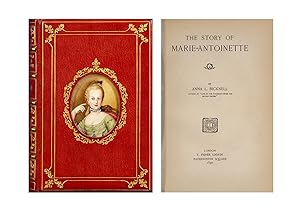
The Story of Marie-Antoinette
Verlag: T. Fisher Unwin, London, 1897
Anbieter: Whitmore Rare Books, Inc. -- ABAA, ILAB, Pasadena, CA, USA
Verkäuferbewertung 5 von 5 Sternen
Erstausgabe
Zustand: Fine. First edition. Octavo (8 3/8 x 5 3/4 inches; 212 x 146 mm.). [i]-xiv, [2], 334, [2, blank] pp, twenty-seven photogravure plates. Bound ca 1960 in full red crushed levant morocco, covers decoratively bordered in gilt, front cover with a central gilt design surrounding a fine oval hand-painted portrait miniature of Marie-Antoinette (3 1/4 x 2 1/2 inches; 82 x 63 mm.), set under glass. Spine with five raised bands elaborately tooled and lettered in gilt in compartments. Double-ruled gilt board edges and wide turn-ins, red silk liners and endleaves, all edges gilt. A Fine copy overall. Housed in the original fleece-lined, red cloth clamshell case, spine lettered in gilt. The binding is unsigned but is very similar to the Cosway-Style bindings that were done by Sangorski & Sutcliffe for Asprey's. Marie-Antoinette (1755-1793) was the infamous last queen of France before the French Revolution. The youngest daughter of Empress Maria Theresa and Emperor Francis I, the archduchess of Austria became dauphine of France in May 1770 at age 14 upon her marriage to the Dauphin Louis-Auguste (the future King Louis XVI). Celebrated and criticized for her extravagant fashion (among many other things), her life continues to fascinate. Anna Louise Bicknell (1835?-), was an author and historian who published extensively on French history. In addition to her biography on Marie-Antoinette, she published the book Life in the Tuleries under the Second Empire (1894) and wrote several Century Magazine and National Geographic including: The Pretenders to the Throne of France (1883); Marie-Antoinette as Dauphine (1897), The Last Days of Louis XVI and Marie-Antoinette (1897); French Wives and Mothers (1898). The story of the Sangorski & Sutcliffe Bindery reads like something out of a novelwhen two of Douglas Cockrell's talented apprentices, Frances Sangorski and George Sutcliffe, were laid off during an economic downturn they began working out of an attic. Eventually their bindery would be famous for its intricate multicolored leather inlays and elaborate gold and jeweled bindings. Although named after the English miniaturist Richard Cosway (1742-1821), the desirable "Cosway Binding" with its jewel-like portrait miniature set into a fine binding was first developed at the turn of the century by J.H. Stonehouse, director of London's Henry Sotheran Booksellers. Their miniatures were painstakingly crafted by the talented painter Miss C. B. Currie (1849-1940). As the style grew in popularity, other publishing houses quickly began to reproduce this techniqueeach developing their own desirable take on the aestheticreferred to as "Cosway style.". Fine.
-
India. A Birds-Eye View by the Earl of Ronaldshay
Verlag: Constable and Company Limited, London, 1931
Anbieter: Whitmore Rare Books, Inc. -- ABAA, ILAB, Pasadena, CA, USA
Verkäuferbewertung 5 von 5 Sternen
Zustand: Fine. Later printing. (First published in 1924). Octavo (8 3/16 x 5 inches; 208 x 127 mm.). [ii], xiii, [xiv, blank], 322 pp. Twenty-four photographic plates and large folding map at end. Beautifully bound ca. 1931 by Sangorski & Sutcliffe, stamp-signed in gilt on front turn-in. Full brown crushed levant morocco, covers elaborately paneled in gilt, decoratively gilt-ruled board edges, elaborate gilt turn-ins. Spine with five raised bands, decoratively tooled and lettered in gilt in compartments. Purple morocco liners decoratively stamped with gilt stars, ochre watered silk end papers. Inside front cover with large rectangular sunken panel with three very fine gold-framed oval miniatures under glass of Shah Jahan (2 x 1 1/2 inches), Mumtaz Mahal (2 x 1 1/2 inches) and a painting of the Taj Mahal (1 x 1 3/8 inches). A very fine example of a Sangorski & Sutcliffe Cosway-Style binding. From the library of Ohio book collector B. C. Hoffman, with his initials in gilt at foot of spine. Housed in the original fleece-lined, brown morocco-edged, tan cloth clip case. Lawrence John Lumley Dundas, 2nd Marquess of Zetland (1876-1961), also called the Earl of Ronaldshay, was a British Conservative politician, who served British colonial interests in India for more than twenty years, notably as Governor of Bengal and Secretary of State for India. Lord Ronaldshay's India, A Birds-Eye View was written for British citizens who "want more than a mere narrative of travel" but "something less than the studies of specialists" designed as a series of "historical, pictorial, statistical, and ethnographical vignettes" interspersed with photographic plates of Indian geography and architecture taken by the author himself. Ronaldshay's goal was to "construct a mosaic which will present to the man who wishes to know something of this huge and varied land, whose recent history has been bound up so intimately with his own, an intelligible conspectus" (Preface). The story of the Sangorski & Sutcliffe Bindery reads like something out of a novelwhen two of Douglas Cockrell's talented apprentices, Frances Sangorski and George Sutcliffe, were laid off during an economic downturn they began working out of an attic. Eventually their bindery would be famous for its intricate multicolored leather inlays and elaborate gold and jeweled bindings. Although named after the English miniaturist Richard Cosway (1742-1821), the desirable "Cosway Binding" with its jewel-like portrait miniature set into a fine binding was first developed at the turn of the century by J.H. Stonehouse, director of London's Henry Sotheran Booksellers. Their miniatures were painstakingly crafted by the talented painter Miss C. B. Currie (1849-1940). As the style grew in popularity, other publishing houses quickly began to reproduce this techniqueeach developing their own desirable take on the aestheticreferred to as "Cosway style.". Fine.
-
The Poetical Works of Percy Bysshe Shelley (in 2 vols.)
Verlag: Reeves & Turner, London, 1886
Anbieter: Whitmore Rare Books, Inc. -- ABAA, ILAB, Pasadena, CA, USA
Verkäuferbewertung 5 von 5 Sternen
Zustand: Fine. Second edition. Two octavo volumes (7 1/4 x 4 11/16 inches; 184 x 119 mm.), 572; 580 pp. A spectacular ca. 1920 Cosway-Style binding by Sangorski & Sutcliffe for the J.L. Hudson Company (stamp-signed in gilt on rear turn-in). Full red crushed levant morocco over beveled boards, covers lavishly gilt in the Art Nouveau style, with inlaid green and light brown morocco inlays. The first volume with a central green morocco medallion with Percy Bysshe Shelley's initials in gilt. The second volume with a central green morocco medallion with the phrase "Pansies/Let My Flowers Be" stamped in gilt. Spines with five raised bands elaborately decorated and lettered in gilt in compartments, four of which have onlaid green morocco flowers. Double gilt-ruled board edges and elaborate gilt turn-ins, dark blue watered silk liners and endleaves, all edges gilt and gauffered. The first volume with a front doublure of dark blue crushed levant morocco, multi-ruled in gilt. In the center is a superb gilt framed, hand-painted portrait miniature (3 x 2 3/8 inches; 76 x 60 mm.) of Percy Bysshe Shelley. The miniature is surrounded by a rectangular recessed frame with eight onlaid red morocco flowers and twenty-four onlaid beige morocco leaves. The front and back joints of both volumes have been expertly and almost invisibly repaired. Housed in a custom-made, felt lined half red morocco (with a red felt divider) clamshell case, two spines paneled and lettered in gilt in compartments. A wonderful early Sangorski & Sutcliffe Cosway-style binding. The miniature is of exceptional quality and is quite possibly the work of Miss C.B. Currie. The J. L. Hudson Company (commonly known simply as Hudson's) was a retail department store chain based in Detroit, Michigan. Hudson's flagship store, on Woodward Avenue in Downtown Detroit was constructed beginning in 1911, with additions throughout the years, before being 'completed' in 1946. The building was named after the company's founder Joseph Lowthian Hudson, and was demolished on October 24, 1998. In 1961 it was the tallest department store in the world, and, at one time, claimed to be the second-largest department store, after Macy's, in the United States, by square footage. The Grand River Avenue Book Shop was on the Mezzanine floor. The story of the Sangorski & Sutcliffe Bindery reads like something out of a novelwhen two of Douglas Cockrell's talented apprentices, Frances Sangorski and George Sutcliffe, were laid off during an economic downturn they began working out of an attic. Eventually their bindery would be famous for its intricate multicolored leather inlays and elaborate gold and jeweled bindings. Although named after the English miniaturist Richard Cosway (1742-1821), the desirable "Cosway Binding" with its jewel-like portrait miniature set into a fine binding was first developed at the turn of the century by J.H. Stonehouse, director of London's Henry Sotheran Booksellers. Their miniatures were painstakingly crafted by the talented painter Miss C. B. Currie (1849-1940). As the style grew in popularity, other publishing houses quickly began to reproduce this techniqueeach developing their own desirable take on the aestheticreferred to as "Cosway style.". Fine.
-
Sketches by Boz
Verlag: Chapman and Hall, London, 1839
Anbieter: Whitmore Rare Books, Inc. -- ABAA, ILAB, Pasadena, CA, USA
Verkäuferbewertung 5 von 5 Sternen
Zustand: Fine. First book form edition of the first and second series complete in one volume with Chapman and Hall revised texts and re-engraved plates used in their Parts issue. Octavo (8 1/8 x 5 1/4 inches; 208 x 133 mm.). [iii-vii]viii, [1-3]4-526. Forty inserted steel engravings. Extra-illustrated by the insertion of a duplicate suite of the original engravings expertly hand-colored. Bound by Bayntun (Rivière) Bath ca. 1955 (stamp-signed in gilt on front turn-in) in full wine red crushed levant morocco over beveled boards. Covers triple-ruled in gilt, front cover with an elaborate central gilt floral and thistle design surrounding a fine hand-painted portrait miniature (2 3/4 x 2 inches; 70 x 51 mm.) of a young Charles Dickens set under glass. Spine with five raised bands elaborately tooled and lettered in gilt in compartments. Decorative gilt board-edges, wide elaborate gilt turn-ins, marbled liners and endleaves, all edges gilt. Housed in the original felt-lined red cloth slipcase, spine with two black morocco labels lettered in gilt. "This collection of short pieces contains the earliest of Dickens's work. It is undoubtedly the most valuable from the antiquarian's point of view, containing references and descriptions of life in the 30's to be found nowhere else" (Hayward). Sketches by Boz contains stories and vignettes about daily life in London that Dickens first published in various newspapers and other periodicals between 1833 and 1836. The book is divided into four sections: "Our Parish", "Scenes", "Characters" and "Tales." A classic example of Dickensian observation. A total of forty plates were drawn and etched by George Cruikshank for this octavo edition, of which twenty-seven are the original designs as they appeared in the First and Second Series of the Sketches published in volume form, 1836-37; these, however, were enlarged in size to match an additional thirteen etchings. "When Chapman and Hall obtained the copyright of Sketches in 1837, they published all of them in twenty monthly parts from November 1837 through June 1839. Cruikshank designed a cover, enlarged the plates (except 'The Free and Easy' which was discarded), and created 13 new illustrations for these monthly parts. In may 1839, Chapman and Hall published these parts complete in one volume with all 40 of Cruikshank's illustrations" (Smith). George Bayntun (1873-1940) was the founder of Bayntun Bindery (1894) dedicated to using traditional hand-crafted techniques and high-quality materials. "The Riviere Bindery was one of the most notable and prolific shops in London's West End from about 1840 through 1939" (Princeton). Bath-based Bayntun Bindery acquired the firm in 1939, transforming into the "Bayntun-Riviere bindery," which is still in existence and family owned. Although named after the English miniaturist Richard Cosway (1742-1821), the desirable "Cosway Binding" with its jewel-like portrait miniature set into a fine binding was first developed at the turn of the century by J.H. Stonehouse, director of London's Henry Sotheran Booksellers. Their miniatures were painstakingly crafted by the talented painter Miss C. B. Currie (1849-1940). As the style grew in popularity, other publishing houses quickly began to reproduce this techniqueeach developing their own desirable take on the aestheticreferred to as "Cosway style." Smith I: 2, note 4; Gimbel A7; Hatton and Cleaver, cf. pp. 91-128. Fine.
-
Vanity Fair
Verlag: Bradbury & Evans, London, 1848
Anbieter: Whitmore Rare Books, Inc. -- ABAA, ILAB, Pasadena, CA, USA
Verkäuferbewertung 5 von 5 Sternen
Erstausgabe
Zustand: Near Fine. First edition. First issue with the suppressed woodcut of the Marquis of Steyne on page 336, with "Mr. Pitt" for "Sir Pitt" on page 453, and the rustic heading on page one. Octavo (8 5/16 x 5 1/8 inches; 210 x 130 mm.). xvi, 624 pp, with thirty-eight black and white steel engraved plates with tissue guards and one hundred and fifty woodcuts in the text by Thackeray. Expert paper repair to pages [xv] and xvi. Plates generally a little toned, still a near fine and very desirable copy of this classic. Bound c. 1920 by [Sangorski & Sutcliffe] stamped signed "Bound for Harry F. Marks. London" on lower turn-in. Full crimson crushed levant morocco over beveled boards, covers elaborately bordered in gilt, decorative gilt corner-pieces, each with a gilt triple flower design inlaid with green morocco petals. Spine with five raised bands, elaborately tooled in a similar floral design with four large flowers with tan morocco inlays, lettered in gilt in compartments. Inside front cover with large rectangular dark blue morocco inlaid panel, decorative gilt corner-pieces surrounding an oval gilt frame with a very fine hand-painted portrait miniature set under glass of the young Thackeray - possibly by Miss C.B. Currie. Double gilt-ruled board edges, highly decorative gilt turn-ins, blue watered silk endleaves (with a small chip at the fore-edge of the front leaf), all edges gilt. Minimal rubbing to joints (front joint touched up) otherwise near fine. Housed in a felt-lined red cloth clamshell case, spine with leather label, lettered in gilt. Considered by its author to be a novel without a hero, Vanity Fair follows the path of the social climbing Becky Sharp as she seeks to improve her position within the British social strata set around the time the Napoleonic Wars. One of literature's most important early iterations of the female anti-hero, Miss Sharp helped to expose the truth that women were not merely domesticated angels but could be just as ambitious and driven as their male counterparts; and her foil Amelia reveals that even an apparent paragon of femininity was imperfect. A contemporary Victorian reviewer noted "Thakeray's theory of characterization proceeds generally on the assumption that the acts of men and women are directed not by principle but by instincts.There is not a person in the book who excites the reader's respect, and not one who fails to excite his interest. The morbid quickness of the author's perceptions of the selfish element, even in his few amiable characters, is a constant source of surprise. The novel not only has no hero, but implies the non-existence of heroism" (Contemporary Atlantic Monthly review). It was first published as in 19-part monthly serial from 1847 to 1848 with illustrations by Thackeray, and in 1848 published in book form with the subtitle "A Novel Without a Hero." A literary tour de force, transformed into a popular film starring Reese Witherspoon. Harry F. Marks, was a renowned early twentieth century New York City bookman and the Black Sun Press' distributor in America. Marks had many books specially bound for his clientele by Sangorski & Sutcliffe. The story of the Sangorski & Sutcliffe Bindery reads like something out of a novelwhen two of Douglas Cockrell's talented apprentices, Frances Sangorski and George Sutcliffe, were laid off during an economic downturn they began working out of an attic. Eventually their bindery would be famous for its intricate multicolored leather inlays and elaborate gold and jeweled bindings. Although named after the English miniaturist Richard Cosway (1742-1821), the desirable "Cosway Binding" with its jewel-like portrait miniature set into a fine binding was first developed at the turn of the century by J.H. Stonehouse, director of London's Henry Sotheran Booksellers. Their miniatures were painstakingly crafted by the talented painter Miss C. B. Currie (1849-1940). As the style grew in popularity, other publishing houses quickly began to reproduce this techniqueeach developing their own desirable take on the aestheticreferred to as "Cosway style." Grolier, 100 English, 87. Van Duzer 231. Wolff 6699. Near Fine.
-
The Poetical Works of Oliver Goldsmith
Verlag: William Pickering, London, 1831
Anbieter: Whitmore Rare Books, Inc. -- ABAA, ILAB, Pasadena, CA, USA
Verkäuferbewertung 5 von 5 Sternen
Zustand: Near Fine. The Aldine Edition. Small octavo (6 1/2 x 4 inches; 166 x 101 mm.). [i]-clxxxii [Life and Anecdotes of Goldsmith], [1]-156 pp, with engraved portrait frontispiece. Bound c. 1930 by Sangorski and Sutcliffe for Chas. J. Sawyer Ltd., stamp-signed in gilt on front turn-in, with the S&S monogram stamped in gilt on rear doublure. Full dark red crushed levant morocco over beveled boards with elaborate gilt-rolled borders and gilt-tooled frame. Front cover with Oliver Goldsmith's initials within a decorative thistle tool frame. Rear cover with central gilt wreath. Spine with five raised bands elaborately decorated and lettered in gilt in compartments. Gilt-ruled board edges, broad, gilt-rolled dentelles, green silk end-leaves, top edge gilt. Gilt-tooled green calf doublures with decorative gilt corner-pieces. Front doublure with a fine gilt-framed oval portrait miniature watercolor under glass of Oliver Goldsmith. Front joint expertly and almost invisibly repaired. A Near Fine example of an S&S Cosway-Style binding. The Anglo-Irish author Oliver Goldsmith (1730-1774), is probably best known for his popular novel Vicar of Wakefield (1766). Here however readers encounter a different side to his craft. Part of The Aldine Poet Seriesa twenty-year long and fifty-three volume project of new editions of classic British poets from Chaucer through to the nineteenth centurythis book highlights Goldsmith's poetry. Apart from poetry and novels, Goldsmith wrote plays and legend has it, the children's story The History of Little Goody Two-Shoes. Kept busy by writing quickly and voluminously for Grub Street, the center of London's disreputable part of the literary world, Goldsmith nevertheless also found time to hone novels such as The Vicar of Wakefield, poems such as The Deserted Village, and plays such as She Stoops to Conquer. Contemporaries celebrated Goldsmith's ability to craft deceptively complex characters, most notably in the case of Charles Primrose, the vicar from The Vicar of Wakefield. Goldsmith counted Samuel Johnson among his closest friends, and Johnson wrote the epitaph that appears on Goldsmith's memorial in Westminster Abbey's famous Poets' Corner: "To the memory of Oliver Goldsmith, poet, philosopher and historian, by whom scarcely any style of writing was left untouched and no one touched unadorned, whether to move to laughter or tears; a powerful, yet lenient master of the affections, in genius sublime, vivid, and versatile, in expression, noble, brilliant, and delicate, is cherished in this monument by the love of his companions, the fidelity of his friends, and the admiration of his readers." The story of the Sangorski & Sutcliffe Bindery reads like something out of a novelwhen two of Douglas Cockrell's talented apprentices, Frances Sangorski and George Sutcliffe, were laid off during an economic downturn they began working out of an attic. Eventually their bindery would be famous for its intricate multicolored leather inlays and elaborate gold and jeweled bindings. Although named after the English miniaturist Richard Cosway (1742-1821), the desirable "Cosway Binding" with its jewel-like portrait miniature set into a fine binding was first developed at the turn of the century by J.H. Stonehouse, director of London's Henry Sotheran Booksellers. Their miniatures were painstakingly crafted by the talented painter Miss C. B. Currie (1849-1940). As the style grew in popularity, other publishing houses quickly began to reproduce this techniqueeach developing their own desirable take on the aestheticreferred to as "Cosway style.". Near Fine.
-
After Worcester Fight
Verlag: John Lane, The Bodley Head, London, 1904
Anbieter: Whitmore Rare Books, Inc. -- ABAA, ILAB, Pasadena, CA, USA
Verkäuferbewertung 5 von 5 Sternen
Erstausgabe
Zustand: Fine. First edition. Octavo (8 1/4 x 5 3/8 inches; 210 x 136 mm.). [i]-liv, 1-[268] pp. Title-page printed in red and black. Fifty-one illustrations including many photogravure plates. Text leaves a little foxed. Bound by Bayntun (Rivière) Bath ca. 1948 (stamp-signed in gilt on front turn-in) in full dark purple crushed levant morocco over beveled boards. Front cover double-ruled in gilt enclosing a highly elaborate floral design with gilt leaves and stems and twelve inlaid eighteen-piece red flowers. In the center a gilt decorated oval frame surrounding a fine hand-painted portrait miniature of Charles II. Lower cover identically tooled but without the inlays. Spine with five raised bands, elaborately decorated to a similar design with five inlaid eighteen-piece red flowers, lettered in gilt in compartments, double gilt-ruled board edges, and fine wide turn-ins decorated in gilt. Blue and red cockerel paste-downs and end-leaves, all edges gilt. With the armorial bookplate of J.F.D. Tutt on verso of front free endpaper. Light foxing throughout. Housed in the original fleece-lined blue cloth slipcase with two black morocco spine labels lettered in gilt. An exceptionally fine example from one of the major English collections. British historian and antiquarian Allan Fea (1860-1956) specialized in the English Civil War & Wars of the Three Kingdoms period (1639-1653). Designed as a supplemental volume to Fea's history text The Flight of the King, the Worcester Fight contains five contemporary accounts of King Charles II's escape after the Battle of Worcester (1651): "The King's Narrative," Blount's "Boscobel," Whitgreave's "Narrative," "Ellesdon's Letter," and the "Claustrum Regale Reseratum" (Introduction). This elaborate Cosway-style binding pays homage to the central character in Fea's history: King Charles II (1630-1685), famed for ruling after the 1660 monarchial Restoration; a period in English history marked by significant social change. George Bayntun (1873-1940) was the founder of Bayntun Bindery (1894) dedicated to using traditional hand-crafted techniques and high-quality materials. "The Riviere Bindery was one of the most notable and prolific shops in London's West End from about 1840 through 1939" (Princeton). Bath-based Bayntun Bindery acquired the firm in 1939, transforming into the "Bayntun-Riviere bindery," which is still in existence and family owned. Although named after the English miniaturist Richard Cosway (1742-1821), the desirable "Cosway Binding" with its jewel-like portrait miniature set into a fine binding was first developed at the turn of the century by J.H. Stonehouse, director of London's Henry Sotheran Booksellers. Their miniatures were painstakingly crafted by the talented painter Miss C. B. Currie (1849-1940). As the style grew in popularity, other publishing houses quickly began to reproduce this techniqueeach developing their own desirable take on the aestheticreferred to as "Cosway style." This copy was previously owned by John Francis Donald Tutt (1893-1971) was a renowned veterinary surgeon and collector of fine bindings, whose collection (including the present binding) was sold at Sotheby's London in October 1983. Fine.
-
Francis the First
Verlag: William Heinemann Ltd, London, 1934
Anbieter: Whitmore Rare Books, Inc. -- ABAA, ILAB, Pasadena, CA, USA
Verkäuferbewertung 5 von 5 Sternen
Erstausgabe
Zustand: Fine. First edition. Octavo (8 5/16 x 5 1/4 inches; 212 x 133 mm.). [x], [1]-479, [1, blank] pp. Sixteeen photogravure plates. Bound by Bayntun (Rivière) Bath ca. 1948 (stamp-signed in gilt on front turn-in) in full wine red crushed levant morocco over beveled boards. Covers with elaborate floral design corner-pieces. Front cover with an oval border of gilt thistles and leaves and in the center a fine hand-painted portrait miniature (3 1/4 x 2 1/2 inches; 83 x 63 mm.) of Annas de Montmorency set under glass. Spine with five raised bands elaborately tooled and lettered in gilt in compartments. Decorative gilt board-edges, wide gilt-ruled turn-ins, marbled liners and endleaves, all edges gilt. With the maroon morocco gilt bookplate of W. A. Foyle, Beeleigh Abbey on front paste-down. Housed in the original felt-lined tan cloth slipcase. An exceptionally fine example from one of the major English collections. Francis I, King of France (151547), first of five monarchs from the Angoulême branch of the House of Valois to rule France ascending to the thrown in 1515. The Renaissance ruler was famed for his patronage of the arts and intellectualism as well as his political maneuvering with other European powers. Interestingly, it is not Francis featured in this Cosway style portrait, but the Duke Annas de Montmorency (c.1493-1567), a favorite of the king, and active statesman for Francis I's court. George Bayntun (1873-1940) was the founder of Bayntun Bindery (1894) dedicated to using traditional hand-crafted techniques and high-quality materials. "The Riviere Bindery was one of the most notable and prolific shops in London's West End from about 1840 through 1939" (Princeton). Bath-based Bayntun Bindery acquired the firm in 1939, transforming into the "Bayntun-Riviere bindery," which is still in existence and family owned. Although named after the English miniaturist Richard Cosway (1742-1821), the desirable "Cosway Binding" with its jewel-like portrait miniature set into a fine binding was first developed at the turn of the century by J.H. Stonehouse, director of London's Henry Sotheran Booksellers. Their miniatures were painstakingly crafted by the talented painter Miss C. B. Currie (1849-1940). As the style grew in popularity, other publishing houses quickly began to reproduce this techniqueeach developing their own desirable take on the aestheticreferred to as "Cosway style.". Fine.
-
The Life and Adventures of Oliver Goldsmith (Extra-illustrated in 3 vols.)
Verlag: Bradbury and Evans/Chapman & Hall, London, 1848
Anbieter: Whitmore Rare Books, Inc. -- ABAA, ILAB, Pasadena, CA, USA
Verkäuferbewertung 5 von 5 Sternen
Erstausgabe
Zustand: Near Fine. First edition. Three octavo volumes (8 x 4 7/8 in; 204 x 123 mm.) collating: xvii, [4], 232; 233-448; [2], 451-704 pp. A fine set with etched half-title, three additional title-pages printed in red and black, and fifty black and white text illustrations as issued, with over seventy-five extra engraved portraits and views. Bound c. 1930 by Sangorski and Sutcliffe for Brentano's (stamp-signed) in full crushed teal blue morocco over beveled boards with elaborate gilt-rolled borders and gilt-tooled frame. Spines with five raised bands elaborately decorated and lettered in gilt in compartments. Gilt-ruled board edges, broad, gilt-rolled dentelles. Gilt-tooled beige morocco doublures featuring three watercolor portraits in sunken panels bordered with red morocco under glass of Oliver Goldsmith, Samuel Johnson, and David Garrick respectively, with gilt laurels. White moiré silk flyleaves. Beveled edges. All edges gilt. Some expert repairs to the outer joints of each volume. With the bookplate of Samuel Wieder. Housed in the original felt-lined, marbled paper-covered slipcase with blue morocco edges. This biography details the life of Anglo-Irish author Oliver Goldsmith (1730-1774), probably best known for his novel Vicar of Wakefield (1766), the most popular book of the 18th century. Here however readers encounter a different side to his craft. Part of The Aldine Poet Seriesa twenty-year long and fifty-three volume project of new editions of classic British poets from Chaucer through to the nineteenth centurythis book highlights Goldsmith's poetry. Apart from poetry and novels, Goldsmith wrote plays and legend has it, the children's story The History of Little Goody Two-Shoes. Goldsmith was a noted Irish wit and a member of Samuel Johnson's famed literary club, who Johnson praised in a memorial epitaph as: "In genius, vivid, versatile, sublime. In style, clear, elevated, elegant." Contemporaries celebrated Goldsmith's ability to craft deceptively complex characters, most notably in the case of Charles Primrose, the vicar from The Vicar of Wakefield. The story of the Sangorski & Sutcliffe Bindery reads like something out of a novelwhen two of Douglas Cockrell's talented apprentices, Frances Sangorski and George Sutcliffe, were laid off during an economic downturn they began working out of an attic. Eventually their bindery would be famous for its intricate multicolored leather inlays and elaborate gold and jeweled bindings. Although named after the English miniaturist Richard Cosway (1742-1821), the desirable "Cosway Binding" with its jewel-like portrait miniature set into a fine binding was first developed at the turn of the century by J.H. Stonehouse, director of London's Henry Sotheran Booksellers. Their miniatures were painstakingly crafted by the talented painter Miss C. B. Currie (1849-1940). As the style grew in popularity, other publishing houses quickly began to reproduce this techniqueeach developing their own desirable take on the aestheticreferred to as "Cosway style.". Near Fine.
-
The Wits and Beaux of Society (Extra-illustrated in 2 vols.)
Verlag: J.W. Jarvis & Son, London, 1890
Anbieter: Whitmore Rare Books, Inc. -- ABAA, ILAB, Pasadena, CA, USA
Verkäuferbewertung 5 von 5 Sternen
Zustand: Fine. New Edition. A very fine pair of Cosway-Style bindings, two large octavo volumes (9 9/16 x 7 3/16 inches; 243 x 182 mm.). xxxii, 262, (2, blank); vi, 246 pp, with two frontispieces and 14 plates by H.K. Browne and James Godwin. Extra-illustrated by the insertion of sixty-eight fine engraved portraits including one hand-colored. Bound ca. 1920 in full black crushed levant morocco, richly gilt, spines with five raised bands, decoratively tooled and lettered in gilt in compartments, gilt board edges, wide decoratively gilt tooled-turn-ins, gilt decorated maroon morocco doublures, all edges gilt, watered silk end-leaves. The first volume with an oval portrait miniature (3 1/8 x 2 1/2 inches) under glass, of William Wycherley after a painting by Sir Peter Lely. The second volume with an oval portrait miniature (3 1/8 x 2 1/2 inches) under glass, of Talleyrand after a painting by Gerard. Each volume chemised in a light green cloth slipcase, lettered in gilt on spine. Katherine Thomson (17971862) was an English novelist and historian. After her marriage to physician Anthony Todd Thomson, the two established a literary and artistic circle. She partnered with her son John Cockburn Thomson (18341860) to co-author a few nonfiction texts under the pseudonym Philip and Grace Wharton (Database of Victorian Fiction). After their success publishing "Queens of Society," a compilation of amusing biographic profiles on historic society ladies, the mother & son writing team turned their pens to famed gentlemen. Entertaining prose composed in a "gossiping style" (Preface) offers readers a humorous early pop history. The Wits and Beaux include: George Villiers (1592-1628), Count Grammont (1621-1707), Lord Rochester (1647-1680), Beau Fielding (1650-1712), William Congreve (1670-1729), Beau Nash (1674-1761), Philip - Duke of Wharton (1698-1731), Lord Hervey (1696-1743), Philip Dormer Stanhope (1694-1773), The Abbe Scarron (1610-1660), Francois Duc de la Rochefoucault (1613-1680), The Duc de Saint-Simon (1675-1755), Horace Walpole (1717-1797), George Selwyn (1719-1791), Richard Brinsley Sheridan (1751-1816), Beau Brummell (1778-1840), Theodore Edward Hook (1788-1841), Sydney Smith (1771-1845) & George Bubb Dodington - Lord Melborne (1691-1762). Although named after the English miniaturist Richard Cosway (1742-1821), the desirable "Cosway Binding" with its jewel-like portrait miniature set into a fine binding was first developed at the turn of the century by J.H. Stonehouse, director of London's Henry Sotheran Booksellers. Their miniatures were painstakingly crafted by the talented painter Miss C. B. Currie (1849-1940). As the style grew in popularity, other publishing houses quickly began to reproduce this techniqueeach developing their own desirable take on the aestheticreferred to as "Cosway style.". Fine.
-
John Keats, His Life and Poetry, His Friends Critics and After-Fame
Verlag: Macmillan and Co., Limited, London, 1917
Anbieter: Whitmore Rare Books, Inc. -- ABAA, ILAB, Pasadena, CA, USA
Verkäuferbewertung 5 von 5 Sternen
Erstausgabe
Zustand: Fine. First edition. A very fine copy, octavo (8 3/8 x 5 7/16 inches; 213 x 138 mm.). xviii, errata slip, 598p. Tipped-in color portrait frontispiece and twelve full page illustrations including a facsimile letter. A fine Cosway-Style binding ca. 1940 by Bayntun Rivière (stamp-signed in gilt on front turn-in). Full red crushed levant morocco, both covers with a geometrical design in gilt. The upper cover with a fine oval portrait miniature set under glass of John Keats surround by an elaborate gilt floral design. Spine with five raised bands decoratively tooled and lettered in gilt. Decorative gilt board-edges and turn-ins, Cockerel liners and endleaves, all edges gilt. housed original felt-lined red cloth clamshell case, spine lettered in gilt. "A thing of beauty is a joy forever: Its loveliness increases, it will never pass into nothingness." The creator of some of the most famous lines in English verse, Keats' works are odes to the timelessness of the idea of beauty, even as its reality fades. Among his core themes are the tension between man's mortality and the immortality of his muse, and the role art plays in assisting the creation of a lasting legacy. Sir Sidney Colvin (1845-1927) was an English curator and literary and art critic. As the author and editor of this "Life," he hoped to blend the biographic with the poetic to enhance readers understanding of Keat's work. It was published in honor of the hundredth anniversary of the publication of Keat's first volume (Preface). George Bayntun (1873-1940) was the founder of Bayntun Bindery (1894) dedicated to using traditional hand-crafted techniques and high-quality materials. "The Riviere Bindery was one of the most notable and prolific shops in London's West End from about 1840 through 1939" (Princeton). Bath-based Bayntun Bindery acquired the firm in 1939, transforming into the "Bayntun-Riviere bindery," which is still in existence and family owned. Although named after the English miniaturist Richard Cosway (1742-1821), the desirable "Cosway Binding" with its jewel-like portrait miniature set into a fine binding was first developed at the turn of the century by J.H. Stonehouse, director of London's Henry Sotheran Booksellers. Their miniatures were painstakingly crafted by the talented painter Miss C. B. Currie (1849-1940). As the style grew in popularity, other publishing houses quickly began to reproduce this techniqueeach developing their own desirable take on the aestheticreferred to as "Cosway style.". Fine.
-
Life of Robert Burns
Verlag: Constable and Co. and Hurst, Chance, and Co, Edinburgh and London, 1828
Anbieter: Whitmore Rare Books, Inc. -- ABAA, ILAB, Pasadena, CA, USA
Verkäuferbewertung 5 von 5 Sternen
Erstausgabe
Zustand: Fine. First edition. A very fine copy, octavo (8 1/2 x 5 1/4 inches; 215 x 133 mm.), viii, 446p. Illustrated with vignette engraving as head piece on first text page, extra illustrated with twenty-one plates of portraits and views, of which five are hand colored. A fine 'Extra-Illustrated' Cosway-Style binding ca. 1940 by Bayntun Rivière (stamp-signed in gilt on front turn-in). Full brown crushed levant morocco, both covers with an elaborate 'thistle' design in gilt, the upper cover with a fine oval portrait miniature set under glass of a young Robert Burns. Spine with five raised bands decoratively tooled and lettered in gilt and with small green inlays in the thistles. Decorative gilt board-edges and turn-ins, gray watered silk liners and endleaves, all edges gilt. Housed in it's original felt-lined red cloth clamshell case, spine lettered in gilt. This biography details the life of Scotland's national bard. Robert Burns (17591796) was one of the chief poets of Romanticism as well as an accomplished lyricist and though much of his work was heavily influenced by Scottish folk sources, he would achieve worldwide renown. Burns fame as poet happened almost by accident. He had his first collection Poems, Chiefly in the Scottish dialect published essentially to finance a move to Jamaica, where he planned to continue working as a farmer. Poems, however, became an immense success and Burns was fortunately able to continue working as a writer for the rest of his life. John Gibson Lockhart (1794-1854) was a Scottish writer and editor. He is best known as the author of a biography of his father-in-law Sir Walter Scott, which has been called the second most admirable in the English language, after Boswell's Life of Johnson. In 1828 he published his somewhat controversial Life of Robert Burns. George Bayntun (1873-1940) was the founder of Bayntun Bindery (1894) dedicated to using traditional hand-crafted techniques and high-quality materials. "The Riviere Bindery was one of the most notable and prolific shops in London's West End from about 1840 through 1939" (Princeton). Bath-based Bayntun Bindery acquired the firm in 1939, transforming into the "Bayntun-Riviere bindery," which is still in existence and family owned. Although named after the English miniaturist Richard Cosway (1742-1821), the desirable "Cosway Binding" with its jewel-like portrait miniature set into a fine binding was first developed at the turn of the century by J.H. Stonehouse, director of London's Henry Sotheran Booksellers. Their miniatures were painstakingly crafted by the talented painter Miss C. B. Currie (1849-1940). As the style grew in popularity, other publishing houses quickly began to reproduce this techniqueeach developing their own desirable take on the aestheticreferred to as "Cosway style.". Fine.
-
The Complete Angler; or, Contemplative Man's Recreation
Verlag: Samuel Bagster, London, 1808
Anbieter: Whitmore Rare Books, Inc. -- ABAA, ILAB, Pasadena, CA, USA
Verkäuferbewertung 5 von 5 Sternen
Erstausgabe
First Bagster edition. Octavo (8 x 4 7/8 inches; 204 x 124 mm.). [iv], vi, vii-512, pp. Hand-colored frontispiece and nineteen engraved plates and two sheets of music. Ten of the plates are engraved by Audinet, eight after Wale, two after Samuel; two music plate; two plates of fishing tackle and flies. There are seventeen fine engravings of fish and two large woodcuts in the text. Extra-illustrated by the insertion of fifty-five engraved plates of which ten are hand-colored. Bound ca. 1925 by Bayntun, stamp-signed in gilt "Bayntun. Binder. Bath. Eng." on front turn-in. Full green crushed levant morocco over beveled boards, covers with elaborate gilt frames, spine with five raised bands, elaborately decorated and lettered in gilt in compartments, gilt decorated board edges, wide gilt turn-ins, all edges gilt. Front doublure of brown morocco surrounded by a frame of inlaid maroon morocco. Set into the front doublure is a fine oval miniature painting of Isaac Walton under beveled glass within a double gilt frame. Set into the rear doublure is a fine oval miniature painting of Charles Cotton under beveled glass within a double gilt frame. Both miniatures measure 3 1/4 x 2 1/2 inches; 82 x 63 mm. Green watered silk end-leaves. Expertly and almost invisibly rebacked with the original spine laid down, spine very slightly sunned, otherwise a fine example housed in its original felt-lined green cloth clamshell case, spine lettered in gilt. Walton's famous pastoral work on fishing, The Compleat Angler, is combined here with additions by Robert Venables and Charles Cotton on the art of fly fishing in particular. Walton, the son of innkeepers, moved to London to become an ironmonger but would spend the last forty years of his life collecting information and writing on fishing. The book was first published in 1653 but re-released in numerous editions both due to its popularity and Walton's propensity to revise and contribute more chapters to it. It has stayed in print since it was first published and is noted for its well observed descriptions of English country life. "The Compleat Angler has something in common with 'Lady Chatterley's Lover:' while many know the title, few have actually read it. Yet it's the most frequently reprinted book in the English language after the Bible" (The Guardian). George Bayntun (1873-1940) was the founder of Bayntun Bindery (1894) dedicated to using traditional hand-crafted techniques and high-quality materials. "The Riviere Bindery was one of the most notable and prolific shops in London's West End from about 1840 through 1939" (Princeton). Bath-based Bayntun Bindery acquired the firm in 1939, transforming into the "Bayntun-Riviere bindery," which is still in existence and family owned. Although named after the English miniaturist Richard Cosway (1742-1821), the desirable "Cosway Binding" with its jewel-like portrait miniature set into a fine binding was first developed at the turn of the century by J.H. Stonehouse, director of London's Henry Sotheran Booksellers. Their miniatures were painstakingly crafted by the talented painter Miss C. B. Currie (1849-1940). As the style grew in popularity, other publishing houses quickly began to reproduce this techniqueeach developing their own desirable take on the aestheticreferred to as "Cosway style." Coigney, 18.
-
The Vicar of Wakefield
Verlag: John Van Voorst, London, 1843
Anbieter: Whitmore Rare Books, Inc. -- ABAA, ILAB, Pasadena, CA, USA
Verkäuferbewertung 5 von 5 Sternen
Erstausgabe
First Mulready illustrated edition. Octavo (8 3/16 x 5 1/2 in; 208 x 140 mm). xv, [1], 306 pp, with thirty-two black and white drawings as headpieces. Beautifully bound ca. 1930 by Rivière & Son, (stamp-signed) in full dark red crushed morocco, spine gilt in compartments. Upper board with wide gilt-tooled frame enclosing a central gilt-decorated oval with an original miniature portrait of Goldsmith in watercolor under glass. Rear board with gilt rolled borders and corner piece. Engraved (unidentified) armorial bookplate pasted onto front doublure. Bookplate of L.B. Rossbach to front free-endpaper verso. Gilt decorated turn-ins. Green moiré silk endleaves. All edges gilt. A lovely example housed in the original faux lizard, leather edged slipcase. One of the most popular books of the 18th century. This novel, both a work of sentimental fiction and a satire on the genre itself, follows the trials and eventual triumph of the Primrose family, led by the Rev'd Dr. Charles Primrose, the vicar. Goldsmith was a noted Irish wit, novelist, playwright, poet, and a member of Samuel Johnson's famed literary club, who Johnson praised as: "In genius, vivid, versatile, sublime. In style, clear, elevated, elegant." Contemporaries celebrated Goldsmith's ability to craft deceptively complex characters, most notably in the case of Charles Primrose, the vicar from The Vicar of Wakefield. The legend of the book's publication is that Goldsmith was about to be arrested by his landlady for debt, when Johnson was able to sell the manuscript of the novel to a publisher for sixty pounds, saving his friend in the nick of time. "I brought Goldsmith the money, and he discharged his rent, not without rating his landlady in a high tone for having used him so ill." Kept busy by writing quickly and voluminously for Grub Street, the center of London's disreputable part of the literary world, Goldsmith nevertheless also found time to hone novels such as The Vicar of Wakefield, poems such as The Deserted Village, and plays such as She Stoops to Conquer. Goldsmith's facility among different genres brought him fame and friendship with many great eighteenth-century British authors. "The Riviere Bindery was one of the most notable and prolific shops in London's West End from about 1840 through 1939" (Princeton). Bath-based Bayntun Bindery acquired the firm in 1939, transforming into the "Bayntun-Riviere bindery," which is still in existence and family owned. Although named after the English miniaturist Richard Cosway (1742-1821), the desirable "Cosway Binding" with its jewel-like portrait miniature set into a fine binding was first developed at the turn of the century by J.H. Stonehouse, director of London's Henry Sotheran Booksellers. Their miniatures were painstakingly crafted by the talented painter Miss C. B. Currie (1849-1940). As the style grew in popularity, other publishing houses quickly began to reproduce this techniqueeach developing their own desirable take on the aestheticreferred to as "Cosway style.".
-
Queen Margot Wife of Henry of Navarre (Extra-illustrated)
Verlag: Harper & Brothers, London and New York, 1907
Anbieter: Whitmore Rare Books, Inc. -- ABAA, ILAB, Pasadena, CA, USA
Verkäuferbewertung 5 von 5 Sternen
Zustand: Fine. Quarto (9 3/8 x 7 3/8 inches; 238 x 188 mm.), xviii, 409, [1, blank] pp. Colored frontispiece and nineteen photogravure plates with tissues printed in red & brown, extra-illustrated by the insertion of twenty-five engraved plates of which six are hand-colored. Bound ca. 1925 by Bayntun, stamp-signed in gilt "Bayntun. Binder. Bath. Eng." on front turn-in. Full dark blue crushed levant morocco over beveled boards, covers with elaborate gilt frames, spine with five raised bands, elaborately decorated and lettered in gilt in compartments, gilt ruled board edges, wide elaborate gilt turn-ins, all edges gilt. Front doublure of red morocco surrounded by a frame of inlaid maroon morocco. Set into the front doublure are two very fine oval miniature paintings set under beveled glass within a double gilt frame. The upper miniature is of Margaret de Valois, Queen Margot of Navarre. The lower miniature is of her spouse Henry III of Navarre (later Henry IV of France). Both miniatures measure 3 3/16 x 2 1/2 inches; 81 x 63 mm. The rear doublure is of red morocco surrounded by a frame of inlaid maroon morocco. Blue watered silk end-leaves. A very fine example housed in its original felt-lined blue cloth clamshell case. Margaret of Valois (1553-1615) was a French Princess who became Queen of Navarre and France. Highly educated and a patroness of the arts, Margaret would kind herself embroiled in political upheavals. Her marriage to Henry III of Navarre (later Henry IV of France) was organized to promote reconciliation between Catholics and Huguenots. However, she would find herself at odds with her husband during continued religious tensions and unable to conceive an heir. Margaret also faced conflict with her brother Henry III. Eventually she would choose to side with the Catholic League, survive prison, annul her marriage, and eventually live out her life in her an intellectual court pursuing her own scholarly devours. George Bayntun (1873-1940) was the founder of Bayntun Bindery. Trained by apprenticeship with the Taylor family, Bayntun opened his own book bindery in 1894 dedicated to using traditional hand-crafted techniques and high-quality materials. The Bath-based firm acquired the Rivière Bindery (also based in Bath) in 1939, transforming into the "Bayntun-Riviere bindery," which is still in existence and family owned. Although named after the English miniaturist Richard Cosway (1742-1821), the desirable "Cosway Binding" with its jewel-like portrait miniature set into a fine binding was first developed at the turn of the century by J.H. Stonehouse, director of London's Henry Sotheran Booksellers. Their miniatures were painstakingly crafted by the talented painter Miss C. B. Currie (1849-1940). As the style grew in popularity, other publishing houses quickly began to reproduce this techniqueeach developing their own desirable take on the aestheticreferred to as "Cosway style.". Fine.
-
The Posthumous Papers of the Pickwick Club. With forty-three illustrations by R. Seymour and Phiz.
Verlag: London: Chapman and Hall, 1837, 1837
Anbieter: Peter Harrington. ABA/ ILAB., London, Vereinigtes Königreich
Verbandsmitglied: ABA ILAB PBFA
Verkäuferbewertung 5 von 5 Sternen
Erstausgabe
EUR 8.873,36
EUR 25,27 Versand
Versand von Vereinigtes Königreich nach USAAnzahl: 1 verfügbar
In den WarenkorbFirst edition, in an extremely attractive Cosway-style binding featuring an oval miniature portrait of Dickens aged 27 after the painting by Daniel Maclise. All plates are present and in their early states with page numbers as called for, but with no titles or imprints. Two plates by R. W. Buss were suppressed and the replacement illustrations by H. K. Browne ("Phiz") are present in this copy. The Pickwick Papers, Charles Dickens's first novel, transformed the obscure journalist into England's most famous writer within months. The first monthly instalment was issued in an edition of 1,000 copies in April 1836. The work became a publishing sensation after the introduction of Sam Weller in chapter 10, the fourth instalment, issued in July 1836, after which the publishers reprinted the earlier instalments so that readers could catch up. By the time the book publication was issued in November 1837, many textual corrections had been made. Booksellers often list numerous (and confusing) text points that might conceivably apply to a perfect set of Pickwick Papers as originally issued in parts, but all these points could never be found together in the issues in book form. The serial was originally intended to be primarily a vehicle for the cartoons of Robert Seymour, until he died by suicide after the first number was published. Robert William Buss then took over, but he was inexperienced in steel engraving and had to be replaced. The final choice, Hablot Knight Browne ("Phiz"), was to be Dickens's chosen collaborator for the next two decades. Smith I.3. Octavo (210 x 122 mm). Etched vignette title page, frontispiece, 41 plates by Robert Seymour and H. K. Browne. Early 20th-century green full morocco by Sangorski & Sutcliffe for Charles J. Sawyer, spine elaborately gilt in six compartments, covers with gilt borders, front cover with circular red morocco onlay with Dickens's monogram in gilt, gauffered edges gilt, red morocco doublures with elaborate gilt dentelles, front doublure in Cosway-style with central oval miniature portrait of Dickens after Maclise, under glass and framed in brass, watered silk endpapers, gilt-stamped facsimile of Dickens's signature to front free endpaper. Housed in a custom green cloth folding box. A remarkably clean and fine example with some light foxing to frontispiece and etched vignette title page, as usual, some cockling to paper lining of free endpapers, and bound without half-title.