
Gesamtpreis (1 Artikel Artikel):
Versandziel:

cooper driver gillian (4 Ergebnisse)
Direkt zu den wichtigsten Suchergebnissen
Suchfilter
Produktart
- Alle Product Types
- Bücher (4)
- Magazine & Zeitschriften (Keine weiteren Ergebnisse entsprechen dieser Verfeinerung)
- Comics (Keine weiteren Ergebnisse entsprechen dieser Verfeinerung)
- Noten (Keine weiteren Ergebnisse entsprechen dieser Verfeinerung)
- Kunst, Grafik & Poster (Keine weiteren Ergebnisse entsprechen dieser Verfeinerung)
- Fotografien (Keine weiteren Ergebnisse entsprechen dieser Verfeinerung)
- Karten (Keine weiteren Ergebnisse entsprechen dieser Verfeinerung)
- Manuskripte & Papierantiquitäten (Keine weiteren Ergebnisse entsprechen dieser Verfeinerung)
Zustand Mehr dazu
- Neu (3)
- Wie Neu, Sehr Gut oder Gut Bis Sehr Gut (Keine weiteren Ergebnisse entsprechen dieser Verfeinerung)
- Gut oder Befriedigend (1)
- Ausreichend oder Schlecht (Keine weiteren Ergebnisse entsprechen dieser Verfeinerung)
- Wie beschrieben (Keine weiteren Ergebnisse entsprechen dieser Verfeinerung)
Einband
Weitere Eigenschaften
- Erstausgabe (Keine weiteren Ergebnisse entsprechen dieser Verfeinerung)
- Signiert (Keine weiteren Ergebnisse entsprechen dieser Verfeinerung)
- Schutzumschlag (Keine weiteren Ergebnisse entsprechen dieser Verfeinerung)
- Angebotsfoto (2)
Sprache (1)
Preis
- Beliebiger Preis
- Weniger als EUR 20 (Keine weiteren Ergebnisse entsprechen dieser Verfeinerung)
- EUR 20 bis EUR 40
- Mehr als EUR 40
Gratisversand
- Kostenloser Versand nach USA (Keine weiteren Ergebnisse entsprechen dieser Verfeinerung)
Land des Verkäufers
Verkäuferbewertung
-
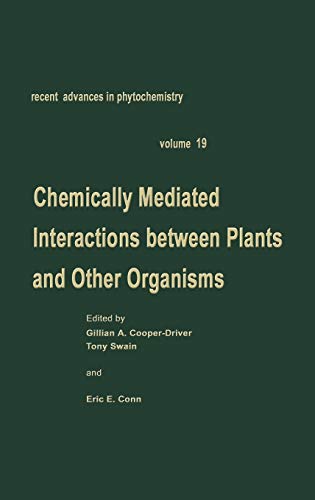
Chemically Mediated Interactions Between Plants and Other Organism (Volume 19)
Anbieter: Anybook.com, Lincoln, Vereinigtes Königreich
Verkäuferbewertung 5 von 5 Sternen

EUR 20,97
EUR 15,42 Versand
Versand von Vereinigtes Königreich nach USAAnzahl: 1 verfügbar
In den WarenkorbZustand: Good. Volume 19. This is an ex-library book and may have the usual library/used-book markings inside.This book has hardback covers. Clean from markings. In good all round condition. No dust jacket. Please note the Image in this listing is a stock photo and may not match the covers of the actual item,600grams, ISBN:0306420066.
-
Chemically Mediated Interactions between Plants and Other Organisms (Recent Advances in Phytochemistry)
Anbieter: Revaluation Books, Exeter, Vereinigtes Königreich
Verkäuferbewertung 5 von 5 Sternen
EUR 148,82
EUR 11,51 Versand
Versand von Vereinigtes Königreich nach USAAnzahl: 2 verfügbar
In den WarenkorbPaperback. Zustand: Brand New. reprint edition. 256 pages. 9.02x5.98x0.59 inches. In Stock.
-
Chemically Mediated Interactions between Plants and Other Organisms
Anbieter: AHA-BUCH GmbH, Einbeck, Deutschland
Verkäuferbewertung 5 von 5 Sternen
Taschenbuch. Zustand: Neu. Druck auf Anfrage Neuware - Printed after ordering - Chemical warfare between plants and their herbivores and pathogens was first brought to our attention by the publication 25 years ago of the paper by Fraenkel in Science. There, he pointed out that most plants have similar nutritional characteristics so that the selection of plants by insect herbivores must depend on the relative toxicity of secondary compounds. This led, rather gradually, to a host of papers on plant-herbivore interactions. More or less at the same time, insect physiologists and ecologists were starting to realise the importance of chemical communi cation systems in determining sexual and other characteristics of insect behaviour. Nine years ago the Phytochemical Society of North America published their Symposium on 'Biochemical Interaction Between Plants and Insects' in which the plant apparency theory was expounded by both Paul Feeny and Rex Cates and David Rhoades. This stated that plants which are apparent usually contain secondary components which reduce digestibility (tannins and lignins) while ephemeral plants have more toxic, and perhaps less costly, compounds such as alkaloids. These papers stimulated much research on biochemical ecology. The recognition of the importance of the biochemical factors in such interactions is not just of scientific interest. It is vitally important in programs for the production of new varieties of cultivated plants, especially in tropical countries where about one-third or more of the crops are lost to predation or disease.
-
Chemically Mediated Interactions between Plants and Other Organisms
Anbieter: AHA-BUCH GmbH, Einbeck, Deutschland
Verkäuferbewertung 5 von 5 Sternen
Buch. Zustand: Neu. Druck auf Anfrage Neuware - Printed after ordering - Chemical warfare between plants and their herbivores and pathogens was first brought to our attention by the publication 25 years ago of the paper by Fraenkel in Science. There, he pointed out that most plants have similar nutritional characteristics so that the selection of plants by insect herbivores must depend on the relative toxicity of secondary compounds. This led, rather gradually, to a host of papers on plant-herbivore interactions. More or less at the same time, insect physiologists and ecologists were starting to realise the importance of chemical communi cation systems in determining sexual and other characteristics of insect behaviour. Nine years ago the Phytochemical Society of North America published their Symposium on 'Biochemical Interaction Between Plants and Insects' in which the plant apparency theory was expounded by both Paul Feeny and Rex Cates and David Rhoades. This stated that plants which are apparent usually contain secondary components which reduce digestibility (tannins and lignins) while ephemeral plants have more toxic, and perhaps less costly, compounds such as alkaloids. These papers stimulated much research on biochemical ecology. The recognition of the importance of the biochemical factors in such interactions is not just of scientific interest. It is vitally important in programs for the production of new varieties of cultivated plants, especially in tropical countries where about one-third or more of the crops are lost to predation or disease.
