Gesamtpreis (1 Artikel Artikel):
Versandziel:

compton arthur holly (18 Ergebnisse)
Direkt zu den wichtigsten Suchergebnissen
Suchfilter
Produktart
- Alle Product Types
- Bücher (17)
- Magazine & Zeitschriften (Keine weiteren Ergebnisse entsprechen dieser Verfeinerung)
- Comics (Keine weiteren Ergebnisse entsprechen dieser Verfeinerung)
- Noten (Keine weiteren Ergebnisse entsprechen dieser Verfeinerung)
- Kunst, Grafik & Poster (Keine weiteren Ergebnisse entsprechen dieser Verfeinerung)
- Fotografien (Keine weiteren Ergebnisse entsprechen dieser Verfeinerung)
- Karten (Keine weiteren Ergebnisse entsprechen dieser Verfeinerung)
- Manuskripte & Papierantiquitäten (1)
Zustand Mehr dazu
- Neu (2)
- Wie Neu, Sehr Gut oder Gut Bis Sehr Gut (4)
- Gut oder Befriedigend (5)
- Ausreichend oder Schlecht (Keine weiteren Ergebnisse entsprechen dieser Verfeinerung)
- Wie beschrieben (7)
Einband
Weitere Eigenschaften
- Erstausgabe (11)
- Signiert (Keine weiteren Ergebnisse entsprechen dieser Verfeinerung)
- Schutzumschlag (4)
- Angebotsfoto (11)
Sprache (2)
Preis
- Beliebiger Preis
- Weniger als EUR 20 (Keine weiteren Ergebnisse entsprechen dieser Verfeinerung)
- EUR 20 bis EUR 40
- Mehr als EUR 40
Gratisversand
Land des Verkäufers
Verkäuferbewertung
-

Scientific Papers of Arthur Holly Compton: X-Ray and Other Studies
Sprache: Englisch
Verlag: University of Chicago Press, 1973
ISBN 10: 0226114309 ISBN 13: 9780226114309
Anbieter: Seagull Books, Hove, Vereinigtes Königreich
Verkäuferbewertung 4 von 5 Sternen

Erstausgabe
EUR 29,24
EUR 11,56 Versand
Versand von Vereinigtes Königreich nach USAAnzahl: 1 verfügbar
In den WarenkorbHardcover. Zustand: Good. 1st Edition. Has some light general reading/shelfwear, with a few nicks to dustjacket and some tanning to page edges - otherwise this is a clean, tight copy. Dispatch within 24hrs from the UK. Book.
-

Scientific Papers of Arthur Holly Compton: X-Ray and Other Studies
Verlag: University of Chicago Press, Chicago, 1973
Anbieter: Argosy Book Store, ABAA, ILAB, New York, NY, USA
Verkäuferbewertung 5 von 5 Sternen

hardcover. Zustand: very good(+). Illustrated. 777 pages. Thick 4to., red cloth boards. Chicago: University of Chicago Press, (1973). A very good(+) copy.
-
The Cosmos of Arthur Holly Compton
Verlag: Alfred A. Knopf, New York, 1967
Anbieter: Ground Zero Books, Ltd., Silver Spring, MD, USA
Verkäuferbewertung 4 von 5 Sternen
Erstausgabe
Zustand: very good, fair to good. First Edition. 483, notes, chronology, bibliography, index, separate erratum sheet, some soiling pp. vi-vii, DJ soiled: sm tears, sm pcs missing sp. Arthur Holly Compton won the Nobel Prize for Physics in 1927 for his work on the particle nature of the photon, and led the field of cosmic-ray researches.
-
The Cosmos of Arthur Holly Compton.
Verlag: New York, Knopf 1967., 1967
Anbieter: Grant's Bookshop, Cheltenham, VIC, Australien
Verkäuferbewertung 4 von 5 Sternen
8vo, d/w; xx, 468pp. A minor stain on upper edge, small mark on ffe, all else near fine. The public papers, both scientific and humanistic.
-
Die Atombombe und ich. Ein persönliches Erlebnis.
Verlag: Nest, Frankfurt, 1958
Anbieter: Bokel - Antik, Bokel, Deutschland
Verkäuferbewertung 5 von 5 Sternen
480 S., OLn., 1. Aufl., 8° guter Zustand. Bücher.
-
The Dedication Of The University Chapel At The University Of Chicago
Sprache: Englisch
Verlag: The University Of Chicago, Chicago, 1928
Anbieter: Arroyo Seco Books, Pasadena, Member IOBA, Pasadena, CA, USA
Verbandsmitglied: IOBA
Verkäuferbewertung 5 von 5 Sternen
Erstausgabe
Soft cover. Zustand: Very Good +. Two Photographs (illustrator). 1st Edition. 32 Pp. Grey Card Covers Printed In Black. Very Good +, Slight Wear. Ownership Signature Of Forrest Alva Kingsbury, Professor Of Psychology.
-

EUR 72,36
EUR 48,99 Versand
Versand von Deutschland nach USAAnzahl: Mehr als 20 verfügbar
In den WarenkorbZustand: New. KlappentextrnrnThis volume is based upon the twelfth series of lectures delivered at Yale University on the Foundation established by the late Dwight H. Terry of Plymouth, Connecticut, through his gift of an endowment fund for the delivery and s.
-
![Bild des Verkäufers für The Cosmos Of Arthur Holly Compton [With Errata Slip] zum Verkauf von Arroyo Seco Books, Pasadena, Member IOBA](https://pictures.abebooks.com/inventory/md/md17317834186.jpg)
The Cosmos Of Arthur Holly Compton [With Errata Slip]
Sprache: Englisch
Verlag: Alfred A. Knopf, New York, 1967
Anbieter: Arroyo Seco Books, Pasadena, Member IOBA, Pasadena, CA, USA
Verbandsmitglied: IOBA
Verkäuferbewertung 5 von 5 Sternen
Erstausgabe
Hardcover. Zustand: Fine. Zustand des Schutzumschlags: Near Fine. 1st Edition. Xxi,468, Xv Pp. Blue Cloth, Gilt. First Printing. With The Two Page Errata Sheet, Actually The Full Note On The Compton Effect Which Should Have Been On P. 430. Fine, No Wear Or Marks Or Stains Or Fading. Dj Lightly Used, Three Short Closed Tears, Not Price-Clipped, Slight Rubbing At Corners.
-

Scientific Papers of Arthur Holly Compton: X-Ray and Other Studies
Sprache: Englisch
Verlag: University of Chicago Press, 1973
ISBN 10: 0226114309 ISBN 13: 9780226114309
Anbieter: Arroyo Seco Books, Pasadena, Member IOBA, Pasadena, CA, USA
Verbandsmitglied: IOBA
Verkäuferbewertung 5 von 5 Sternen
Erstausgabe
Hardcover. Zustand: Fine. Zustand des Schutzumschlags: Near Fine. 1st Edition. Xxix, (Vii), 777 Pop. Red-Brown Cloth, Spine Gilt. Fine, No Marks Or Wear. Dust Jacket With Light Rubbing Mostly To Top And Bottom Edges Of Spine Panel.
-

The Freedom of Man
Sprache: Englisch
Verlag: Yale University Press Mär 2030, 2030
ISBN 10: 030013570X ISBN 13: 9780300135701
Anbieter: AHA-BUCH GmbH, Einbeck, Deutschland
Verkäuferbewertung 5 von 5 Sternen
Buch. Zustand: Neu. Neuware - This volume is based upon the twelfth series of lectures delivered at Yale University on the Foundation established by the late Dwight H. Terry of Plymouth, Connecticut, through his gift of an endowment fund for the delivery and subsequent publication of 'Lectures on Religion in the Light of Science and Philosophy.' The deed of gift declares that 'the object of this Foundation is not the promotion of scientific investigation and discovery, but rather the assimilation and interpretation of that which has been or shall be hereafter discovered, and its application to human welfare, especially by the building of the truths of science and philosophy into the structure of a broadened and purified religion.
-
Symposium Sôbre Raios Cósmicos: Rio de Janeiro Agôsto 4-8 1941
Verlag: Imprensa Nacional/ Academia Brasileira de Ciências, Rio de Janeiro, 1943
Anbieter: Biblioteca de Babel, São Paulo, SP, Brasilien
Verkäuferbewertung 4 von 5 Sternen
Hardcover. Zustand: Very Good. With articles in English and Portuguese. With numerous full-page black and white photographs. Copy on coated paper. Recent binding in false leather, 19x27cm, 180p. Rio de Janeiro, Imprensa Nacional / Academia Brasileira de Ciências, 1943. Original brochure covers preserved, with restorations. First and only edition. Solid and complete copy, in good overall condition, without annotations, underlining, signatures, marks, holes, or loose pages. Very rare copy of these proceedings of the 1941 Cosmic Ray Symposium in Rio, with articles by leading physicists such as Giuseppe Occhialini, Arthur Compton, and several of the patriarchs of science in Brazil, including Gleb Wataghin, Abrahão de Moraes, Mário Schönberg, B. Gross, Carlos Chagas Jr., Marcelo Damy, Paulus Pompeia, F.X. Roser, Ernest O. Wollan, Yolande Monteux, etc. Enviar feedback.
-
Atomic Quest A Personal Narrative
Verlag: E-140
Anbieter: Last Exit Books, Charlottesville, VA, USA
Verkäuferbewertung 5 von 5 Sternen
Erstausgabe
Hardcover. Zustand: Very Good. First Edition; First Printing. Hardcover. 8vo. Published by Oxford University Press, New York, 1956. 370 pgs. Illustrated. First Edition/FIrst Printing. DJ has light shelf-wear present to the DJ extremities. Bound in cloth boards with titles present to the spine and front board. Boards have light shelf-wear present to the extremities. No ownership marks present. Text has remains of penciled notes present. Binding tight and solid. Arthur Holly Compton was an American physicist who won the Nobel Prize in Physics in 1927 for his 1923 discovery of the Compton effect, which demonstrated the particle nature of electromagnetic radiation. At that time, it was a remarkable revelation: while the wave characteristics of light had been convincingly established, the concept that light possessed both wave and particle attributes faced considerable skepticism. ; 8vo 8" - 9" tall.
-
'A Quantum Theory of the Scattering of X-rays by Light Elements,' pp. 483-502 in Physical Review, Second Series, Vol. 25, No. 5, May 1923
Verlag: American Physical Society, Lancaster, PA & Corning, NY, 1923
Anbieter: SOPHIA RARE BOOKS, Koebenhavn V, Dänemark
Verkäuferbewertung 5 von 5 Sternen
Erstausgabe
Hardcover. First edition. DISCOVERY OF THE COMPTON EFFECT. First edition, journal issue in original printed wrappers, of the 'Compton effect,' which demonstrated the existence of quanta of electromagnetic radiation, later called photons. "This discovery 'created a sensation among the physicists of the time.' There were the inevitable controversies surrounding a discovery of such major proportions. Nevertheless, the photon idea was rapidly accepted. Sommerfeld incorporated the Compton effect in his new edition of Atombau und Spektrallinien with the comment, 'It is probably the most important discovery which could have been made in the current state of physics'" (Pais, Subtle is the Lord, p. 414). "Arthur Holly Compton will always be remembered as one of the world's great physicists. His discovery of the Compton effect, so vital in the development of quantum physics, has ensured him a secure place among the great scientists" (DSB). The explanation and measurement of the Compton effect earned Compton a share of the Nobel Prize in physics in 1927. Compton (1892-1962) received his PhD from Princeton in 1916 for research on the intensity distribution of X-rays reflected from crystals. After a period working for the Westinghouse Company he returned to fundamental research in 1919, when he obtained one of the first National Research Council Fellowships (established by Millikan). He used it to spend a year at the Cavendish Laboratory in Cambridge, where he continued his experiments on the scattering of radiation. In 1920 Compton moved to Washington University in St. Louis, where he continued his work on X-ray scattering, using a Bragg spectrometer he had brought from Cambridge. By this time it had become apparent that the scattered radiation had a wavelength longer than that of the primary radiation, and that the shift of wavelength varied with the scattering angle: this became known as the Compton effect. "It was only late in 1922, when considering all data available to him, that Compton saw the necessity for a light quantum with energy and momentum to explain the scattering of X-rays. Compton read a paper entitled 'A quantum theory of the scattering of X-rays by light elements' at a meeting of the American Physical Society in Chicago, which took place on 1 and 2 December 1922. Its abstract begins as follows: 'The hypothesis is suggested that when an X-ray quantum is scattered it spends all its energy and momentum upon some particular electron. The electron in turn scatters the ray to some definite direction. The change in momentum of the X-ray quantum due to the change in direction of its propagation results in a recoil of the scattering electron. The energy in the scattered quantum is thus less than the energy of the primary quantum by the kinetic energy of recoil of the scattering electron.' "The full paper was published a little later [the offered paper]. It contains the calculation of the shift in wavelength between primary and secondary radiation as a function of scattering angle. Compton had data for only one scattering angle, 90 degrees, for which he had measured the spectrum. It was obtained with a primary radiation which was the K? radiation of molybdenum produced by an X-ray tube with a molybdenum anticathode" (Brandt, The Harvest of a Century, Chapter 31). "The Compton effect, aptly characterized by Karl K. Darrow as one of the most superbly lucid processes in nature, is now part of the fabric of physics; and it is of interest to recall its influence on the development of the quantum theory during the years 19231930. "In the first place, it provided conclusive proof that Einstein's concept of a photon as having both energy and directed momentum was essentially correct. Einstein himself brought considerable attention to Compton's discovery by his discussions at the Berlin seminars. Interest was also high at Gottingen, Munich, Zurich, Copenhagen, and other Continental centers where theoretical physics was rapidly developing. "However, the quantitative proof of the photon character of radiation had been established by Compton's use of a Bragg crystal spectrometer, the function of which depended directly on the wave nature of X-rays. Thus a more general synthesis was clearly required, in which both the corpuscular photon and the electromagnetic wave would be included and would continue to play the roles demanded by experiment "The final great synthesis of quantum mechanics and quantum electrodynamics was forced upon physics by the crucial experiments of the Compton effect, electron diffraction, space quantization, and the existence of sharp spectral lines, which could not be brought into line with classical theory. It required the final relativistic form of quantum mechanics, developed by Paul Dirac, to give a completely quantitative explanation of Compton scattering in regard to both intensity and state of polarization by the formula derived by O. Klein and Nishina from the Dirac relativistic theory of the electron" (DSB). For a detailed account of Compton's work, see the Introduction to Scientific Papers of Arthur Holly Compton: X-ray and other studies, University of Chicago Press, 1974. 8vo, pp. 8, 483-584, 9-12. Original printed wrappers. Rare in this condition.
-
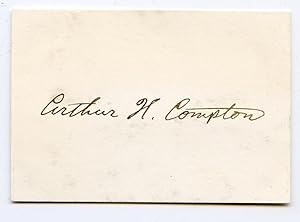
Albumblatt mit eigenh. U. (Arthur H. Compton").
Verlag: O. O. u. D.
Anbieter: Kotte Autographs GmbH, Roßhaupten, Deutschland
Verkäuferbewertung 5 von 5 Sternen
Manuskript / Papierantiquität
1 S. Visitkartenformat. Arthur H. Compton hatte i. J. 1927 einen halben Nobelpreis für Physik erhalten für die Entdeckung des nach ihm genannten Effekts"; die andere Hälfte war an Charles Thomson Rees Wilson ergangen für die Entdeckung der Methode, durch Dampfkondensierung die Bahnen elektrisch geladener Partikel wahrnehmbar zu machen" (Wilsonsche Nebelkammer).
-
X-Rays and Electrons: An Outline of Recent X-Ray Theory
Verlag: D. Van Nostrand Company, New York, 1926
Anbieter: Burnside Rare Books, ABAA, Portland, OR, USA
Verbandsmitglied: ABAA CBA ILAB
Verkäuferbewertung 5 von 5 Sternen
Erstausgabe
Zustand: Near Fine. Zustand des Schutzumschlags: Near Fine. First Edition. First edition, first printing of the Nobel Prize-winning physicist's first book. Bound in publisher's tan buckram stamped in blind with spine lettered in gilt and blocked in black. Near Fine in a Near Fine unclipped dust jacket, slightly nicked.
-
A Quantum Theory of the Scattering of X-rays by Light Elements [in] The Physical Review Second Series, Vol. 25, No. 5, May 1923
Verlag: Published for the American Physical Society, 1923
Anbieter: Burnside Rare Books, ABAA, Portland, OR, USA
Verbandsmitglied: ABAA CBA ILAB
Verkäuferbewertung 5 von 5 Sternen
Erstausgabe
Zustand: Fine. First Edition. First edition of Arthur Compton's Nobel Prize-winning paper on the "Compton Effect." Pp. [483]-584. Complete issue, bound without wraps in green cloth with leather spine lettered in gilt. Pages toned, small bumped to edge of upper boards, else Fine. Contains a paper by Arthur Holly Compton, "A Quantum Theory of Scattering X-rays by Light Elements" on pp. [483]-502. Compton won the 1927 Nobel Prize in Physics for this work in 1923, the Compton Effect, or the scattering of a photon by a charged particle, usually an electron, which results in a decrease in energy (increase in wavelength) of the photon. He would go on to be a key figure in the Manhattan Project.
-
A Quantum Theory of the scattering of X-Rays by Light Elements. - [THE DISCOVERY OF THE COMPTON-EFFECT, NOBEL PRIZE PAPER]
Anbieter: Herman H. J. Lynge & Søn ILAB-ABF, Copenhagen, Dänemark
Verkäuferbewertung 4 von 5 Sternen
Erstausgabe
Lancaster, American Physical Society, 1923. Royal8vo. In the original printed wrappers. In: Physical Review, Second Series, Vol. 25, No. 5, May 1923. With black cloth back-strip. Front wrapper missing top right corner and front wrapper washed/polished. Internally fine and clean. [Compton's paper:] pp. 483-502. [Entire issue:] Pp: 483-584. First printing of this milestone paper in quantum physics in which Compton verifies Planck's quantum postulate and found that some of the X-rays had, in scattering, lenghtened their wavelenght. This phenomena was called the "Compton Effect" in his honour. For this discovery Compton received the Nobel prize in physics in 1927."Compton was able to account for this (lenghtening of wavelenght) by presuming that a photon of light struch an electron, which recoiled, subtracting some energy from the photon and therefore increasing its wavelenght. This made it seem that a photon acted as a particle: thus after more than a century, the particulate natuer of light, as evolved by Newton, was revived. What itamounted to was that Compton brought to fruition the view that electromagnetic radiation had both a wave aspect and a particle aspect, and that the aspect which was most evident depended on how the radiation was tested. De Broglie was, at the same time, showing that this held true also for ordinary particles, such as electrons." (Asimov)Parkinson "Breakthroughs", 1923 P. - Sigmund Brandt "The Harvest of as Century", Episode 31.
-
A Quantum Theory of the scattering of X-Rays by Light Elements.
Anbieter: Herman H. J. Lynge & Søn ILAB-ABF, Copenhagen, Dänemark
Verkäuferbewertung 4 von 5 Sternen
Erstausgabe
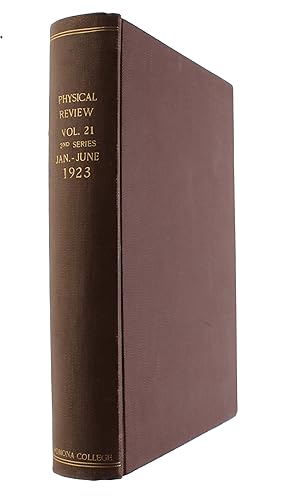
Lancaster, The Physical Review, 1923. Royal8vo. Contemp. full buckram. In:"The Physical Review", Series II, vol. 21. (4),736 pp., Plates and textillustr. (Entire volume offered). A perforated stamp in upper margin on a few leaves. Compton's paper: pp. (483-) 501. First printing of this milestone paper in quantum physics in which Compton verifies Planck's quantum postulate and found that some of the X-rays had, in scattering, lenghtened their wavelenght. This phenomena was called the "Compton Effect" in his honour. For this discovery Compton received the Nobel prize in physics in 1927."Compton was able to account for this (lenghtening of wavelenght) by presuming that a photon of light struch an electron, which recoiled, subtracting some energy from the photon and therefore increasing its wavelenght. This made it seem that a photon acted as a particle: thus after more than a century, the particulate natuer of light, as evolved by Newton, was revived. What itamounted to was that Compton brought to fruition the view that electromagnetic radiation had both a wave aspect and a particle aspect, and that the aspect which was most evident depended on how the radiation was tested. De Broglie was, at the same time, showing that this held true also for ordinary particles, such as electrons." (Asimov)Parkinson "Breakthroughs", 1923 P. - Sigmund Brandt "The Harvest of as Century", Episode 31.


![Bild des Verkäufers für A Quantum Theory of the Scattering of X-rays by Light Elements [in] The Physical Review Second Series, Vol. 25, No. 5, May 1923 zum Verkauf von Burnside Rare Books, ABAA](https://pictures.abebooks.com/inventory/md/md30705686241.jpg)
![Bild des Verkäufers für A Quantum Theory of the scattering of X-Rays by Light Elements. - [THE DISCOVERY OF THE COMPTON-EFFECT, NOBEL PRIZE PAPER] zum Verkauf von Herman H. J. Lynge & Søn ILAB-ABF](https://pictures.abebooks.com/inventory/md/md30317749929.jpg)