Gesamtpreis (1 Artikel Artikel):
Versandziel:

charles samblanx (4 Ergebnisse)
Direkt zu den wichtigsten Suchergebnissen
Suchfilter
Produktart
- Alle Product Types
- Bücher (4)
- Magazine & Zeitschriften (Keine weiteren Ergebnisse entsprechen dieser Verfeinerung)
- Comics (Keine weiteren Ergebnisse entsprechen dieser Verfeinerung)
- Noten (Keine weiteren Ergebnisse entsprechen dieser Verfeinerung)
- Kunst, Grafik & Poster (Keine weiteren Ergebnisse entsprechen dieser Verfeinerung)
- Fotografien (Keine weiteren Ergebnisse entsprechen dieser Verfeinerung)
- Karten (Keine weiteren Ergebnisse entsprechen dieser Verfeinerung)
- Manuskripte & Papierantiquitäten (Keine weiteren Ergebnisse entsprechen dieser Verfeinerung)
Zustand Mehr dazu
- Neu (Keine weiteren Ergebnisse entsprechen dieser Verfeinerung)
- Wie Neu, Sehr Gut oder Gut Bis Sehr Gut (Keine weiteren Ergebnisse entsprechen dieser Verfeinerung)
- Gut oder Befriedigend (Keine weiteren Ergebnisse entsprechen dieser Verfeinerung)
- Ausreichend oder Schlecht (Keine weiteren Ergebnisse entsprechen dieser Verfeinerung)
- Wie beschrieben (4)
Einband
- alle Einbände
- Hardcover (1)
- Softcover (Keine weiteren Ergebnisse entsprechen dieser Verfeinerung)
Weitere Eigenschaften
- Erstausgabe (1)
- Signiert (2)
- Schutzumschlag (Keine weiteren Ergebnisse entsprechen dieser Verfeinerung)
- Angebotsfoto (2)
Sprache (1)
Preis
- Beliebiger Preis
- Weniger als EUR 20 (Keine weiteren Ergebnisse entsprechen dieser Verfeinerung)
- EUR 20 bis EUR 45 (Keine weiteren Ergebnisse entsprechen dieser Verfeinerung)
- Mehr als EUR 45
Gratisversand
- Kostenloser Versand nach USA (Keine weiteren Ergebnisse entsprechen dieser Verfeinerung)
Land des Verkäufers
Verkäuferbewertung
-
LA CATHÉDRALE
Verlag: Collection Éclectique, A. Blaizot - R. Kieffer, Paris, 1909
Anbieter: Phillip J. Pirages Rare Books (ABAA), McMinnville, OR, USA
Verkäuferbewertung 3 von 5 Sternen

290 x 205 mm. (11 1/2 x 8"). 2 p.l., 359, [1] pp. SPLENDID SHELL-PINK MOROCCO, RICHLY GILT AND INLAID IN CATHEDRAL STYLE, BY CHARLES DE SAMBLANX (stamp-signed at foot of spine), covers framed with gothic-arch and rose-window-motifs executed in turquoise blue, petal pink, citron, and celadon morocco and gilt, raised bands, spine compartments with inlaid and gilt rose window centerpiece framed by gothic arches, gilt lettering, MOSAIC MOROCCO DOUBLURES with stained glass window design executed in shell pink, turquoise, and petal pink morocco and much gilt, pale lavender silk endleaves, all edges gilt. Original illustrated paper wrappers bound in. House in a (negligibly chafed) leather-lined, matching morocco trimmed chemise in a (slightly worn) morocco-lipped marbled paper slipcase. With 64 ETCHINGS, as called for, ALL IN THREE STATES (eau-forte pure, before letters, and with letters), consisting of 16 chapter openings (occupying two-thirds to three-quarters of a page) 16 in-text illustrations (one-half to three-quarters of a page), 16 full-page illustrations, and 16 tailpieces (one-half to two thirds of a page), and EXTRA-ILLUSTRATED WITH THREE ORIGINAL SKETCHES, two with artist's notes in French. Verso of front free endpaper with small round monogram ex-libris of "E S E." See: Carteret I, p. 442. Insignificant soiling at very edges of boards and spine top, but A VERY FINE COPY, pristine internally, and in an unworn binding. Highlighted by glorious doublures, this is a strikingly bound "grand luxe" strictly limited edition of a popular French novel celebrating Chartres Cathedral and featuring attractive etchings in three states as well as original artwork. Britannica says the French writer Joris-Karl Huysmans (1848-1907) was known for vividly written "major novels [that] epitomize successive phases of the aesthetic, spiritual, and intellectual life of late 19th-century France." Initially associated with Émile Zola and the naturalist movement, Huysmans eventually converted to Catholicism, and his later works reflect his religious devotion and fascination with mysticism. First published in book form in 1898, "La Cathédrale" follows the character Durtal (Huysmans' semi-autobiographical alter ego) on a spiritual journey centered around Chartres Cathedral. The novel is both a work of religious reflection and an elaborate study of Medieval architecture, symbolism, and Christian art, using the cathedral as a lens to explore faith, beauty, and transcendence. The celebration of the gothic cathedral's art and architecture is vividly felt in the superb etchings by Charles Jouas (1866-1942), who is particularly known for illustrating editions intended for French bibliophiles. Jouas' etchings here paint a portrait of Chartres from sweeping views of the exterior to intimate sketches of hidden recesses--showing the cathedral in ranging vantage points from a gargoyle's to a supplicant's. The artist's strong skills as a draughtsman are apparent in the excellent attention to detail and proportion, while the drama and moodiness of the gothic structure is beautifully captured with intense shadows and hatching effects. Three original sketches by Jouas are included in this work, two of which contain notes by the artist regarding the lines of text that inspired each image. The ultimate triumph of the book is its sumptuous Cathedral-style binding--a natural design choice for this text, and executed by a master who excelled at this type of work. Belgian binder Charles de Samblanx (or Samblancx, 1855-1943) began working in the trade at age 11 as an apprentice to Coppens. He eventually established his own firm, which was known from 1889-1909 as Samblancx-Weckesser, since de Samblancx had taken his gilder Jacques Weckesser into partnership. After 1909, de Samblanx again headed the firm alone. He worked in a variety of period styles, sensitively reproducing the bindings of previous centuries. Many of his bindings are now in the Royal Museum of Mariemont in Belgium. They are unfailingly exemplary in terms of design and execution, and the present example is a notable celebration of this binder's craft. The covers provide a powerful opening statement, and then when the binding is opened, the reader confronts ornate doublures that simulate the exhilarating experience of entering a cathedral full of stained-glass windows. The intensely constrained energy seen in the 32 rigidly controlled large and small panels making up each doublure is greatly memorable. No. 45 of 250 COPIES, this one of 30 on Japanese vellum, with etchings in three states.
-
ALBUM VERSES: WITH A FEW OTHERS
Verlag: Edward Moxon, London, 1830
Anbieter: Phillip J. Pirages Rare Books (ABAA), McMinnville, OR, USA
Verkäuferbewertung 3 von 5 Sternen
Erstausgabe
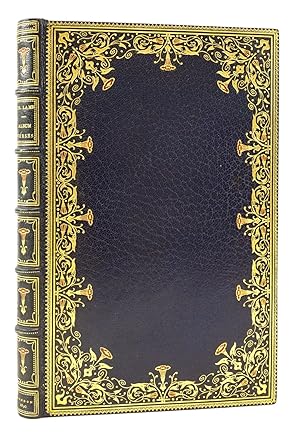
FIRST EDITION. 188 x 118 mm. (7 3/8 x 4 5/8"). vii, [1], 150 pp., [1] leaf (ads). SUPERB NAVY BLUE CRUSHED MOROCCO, GILT AND INLAID, BY DE SAMBLANX-WECKESSER (stamp-signed on front turn-in), covers with intricate gilt frame of trumpet vines bearing 36 inlaid scarlet flowers and buds, raised bands, spine gilt in compartments with inlaid trumpet flower at center, gilt titling, turn-ins framed with gilt vine, navy blue moiré silk endleaves, marbled flyleaves, all edges gilt. In a (slightly worn) marbled paper slipcase. Title page with engraving of a putto composing verses. Front flyleaves with bookplates of Edwin Holden (dated 1894) and John Whipple Frothingham. Wise, Ashley Cat. III, 52; Thomson, p. 76. A hint of rubbing to front joint, occasional mild browning (due to paper quality), but A FINE COPY, clean and fresh internally, and in a lustrous binding. In a lovely Art Nouveau binding by a Belle Époque master, this is a collection of poems assembled by essayist Charles Lamb (1775-1834) to launch the publishing career of his friend and future son-in-law, Edward Moxon (1801-58), to whom he dedicated the work. Composed of rather slight verses composed for the amusement of Lamb's friends and of more substantial works previously printed in periodicals, this first book bearing Moxon's imprint did well enough to attract the business of other prestigious poets, many of them friends of Lamb. Moxon, who married Lamb's adopted daughter Emma Isola in 1833, went on to print the works of Wordsworth, Shelley, Tennyson, and other luminaries of the Victorian era. The graceful binding is by Belgian master craftsman Charles de Samblancx [or Samblanx] (1855-1943), who began his binding career at age 11, as an apprentice to Coppens. He eventually established his own firm (though from 1889-1909 his gilder Jacques Weckesser was in partnership with him). His binding career extended over several decades, and he worked in a variety of period styles, sensitively reproducing the bindings of previous centuries. His work, often involving great complexity of design, is invariably executed with the highest degree of skill. Our copy was once owned by American bibliophile and Grolier Club president Edwin Holden (1861-1906).
-

Les Géorgiques Chrétiennes. Bois originaux gravés par J.B. Vettiner.
Anbieter: Antiquariaat Wim de Goeij, Kalmthout, ANTW, Belgien
Verbandsmitglied: ILAB
Verkäuferbewertung 5 von 5 Sternen

Signiert
16. Paris, Éditions René Kieffer, 1920, in-8°, 26 x 18 cm, 224 pp, tiré à 550 exemplaires, un des 30 exemplaires de tête sur Japon (après 10 exemplaires sur Vieux Japon à la forme), qui contient une suite des bois supplémentaire sur chine. Cette suite est intercalée dans le texte. Sous étui en carton. Reliure plein maroquin rouge, plats encadrés de 4 filets dorés avec dans les coins une ornamentation florale, dos à cinq nerfs , encadrement des caissons, double filets sur les coupes, tranches dorés, bordure intérieure ornée de 4 filets dorés. Reliure signée '' Ch. de Samblanx''. Parfait état.
-
La Frappe en Belgique Occupée.
Anbieter: Antiquariaat Wim de Goeij, Kalmthout, ANTW, Belgien
Verbandsmitglied: ILAB
Verkäuferbewertung 5 von 5 Sternen
Signiert
Bruxelles et Paris, G. Van Oest & Cie, 1923, format grand in-4°, 32 x 24,5 cm, XXVIII pp + 331 pp + 105 planches , avec double frontispice colorié d'Anto Carte (comme prévu pour les souscripteurs). Un des 575 exemplaires sur papier pur Fil Lafuma (après 105 exemplaires sur Papier d'Arches). Reliure: Plein cuir rouge, Décor patriotique sur les deux plats , autour le blason belge au milieu un cadre de 6 fillets avec des dizaines petits lions et étoiles dorés ; dos à 5 nerfs doré avec le même décor des lions et étoiles. Tranche supérieure dorée. Couverture imprimée et dos conservé. Dans un emboitage fait sur mesure. Belle reliure signée C. De Samblanx dans les fillets dorées au contreplats. Qq. petites éraflures 2 nerfs et auxéxtrémités du dos sinon très bel exemplaire, très bien conservé dans son emboitage d'origine. Exemplaire avec une dédicace de l'auteur à Paul Grosjean (non datée) '' Ce volume rappellera à Paul Grosjean la grande Epoque ou les Belges sur leur territoire exaltèrent leurs qualités de race.''.