
Gesamtpreis (1 Artikel Artikel):
Versandziel:

boutoussov mikhail (5 Ergebnisse)
Direkt zu den wichtigsten Suchergebnissen
Suchfilter
Produktart
- Alle Product Types
- Bücher (5)
- Magazine & Zeitschriften (Keine weiteren Ergebnisse entsprechen dieser Verfeinerung)
- Comics (Keine weiteren Ergebnisse entsprechen dieser Verfeinerung)
- Noten (Keine weiteren Ergebnisse entsprechen dieser Verfeinerung)
- Kunst, Grafik & Poster (Keine weiteren Ergebnisse entsprechen dieser Verfeinerung)
- Fotografien (Keine weiteren Ergebnisse entsprechen dieser Verfeinerung)
- Karten (Keine weiteren Ergebnisse entsprechen dieser Verfeinerung)
- Manuskripte & Papierantiquitäten (Keine weiteren Ergebnisse entsprechen dieser Verfeinerung)
Zustand Mehr dazu
- Neu (5)
- Wie Neu, Sehr Gut oder Gut Bis Sehr Gut (Keine weiteren Ergebnisse entsprechen dieser Verfeinerung)
- Gut oder Befriedigend (Keine weiteren Ergebnisse entsprechen dieser Verfeinerung)
- Ausreichend oder Schlecht (Keine weiteren Ergebnisse entsprechen dieser Verfeinerung)
- Wie beschrieben (Keine weiteren Ergebnisse entsprechen dieser Verfeinerung)
Einband
Weitere Eigenschaften
- Erstausgabe (Keine weiteren Ergebnisse entsprechen dieser Verfeinerung)
- Signiert (Keine weiteren Ergebnisse entsprechen dieser Verfeinerung)
- Schutzumschlag (Keine weiteren Ergebnisse entsprechen dieser Verfeinerung)
- Angebotsfoto (3)
Sprache (1)
Preis
- Beliebiger Preis
- Weniger als EUR 20 (Keine weiteren Ergebnisse entsprechen dieser Verfeinerung)
- EUR 20 bis EUR 40 (Keine weiteren Ergebnisse entsprechen dieser Verfeinerung)
- Mehr als EUR 40
Gratisversand
- Kostenloser Versand nach USA (Keine weiteren Ergebnisse entsprechen dieser Verfeinerung)
Land des Verkäufers
Verkäuferbewertung
-

Military Randd After the Cold War: Conversion and Technology Transfer in Eastern and Western Europe (Nato Science Partnership Subseries: 4 (Closed))
Anbieter: Revaluation Books, Exeter, Vereinigtes Königreich
Verkäuferbewertung 5 von 5 Sternen

EUR 148,07
EUR 11,56 Versand
Versand von Vereinigtes Königreich nach USAAnzahl: 2 verfügbar
In den WarenkorbPaperback. Zustand: Brand New. reprint edition. 216 pages. 9.44x6.31x0.49 inches. In Stock.
-

Military R&D after the Cold War
Sprache: Englisch
Verlag: Springer Netherlands, Springer Netherlands Jul 1996, 1996
ISBN 10: 0792341392 ISBN 13: 9780792341390
Anbieter: buchversandmimpf2000, Emtmannsberg, BAYE, Deutschland
Verkäuferbewertung 5 von 5 Sternen
Buch. Zustand: Neu. Neuware -Countries establish defence industries for various reasons. Chief among these are usually a concern with national security, and a desire to be as independent as possible in the supply of the armaments which they believe they need. But defence industries are different from most other industries. Their customer is governments. Their product is intended to safeguard the most vital interests of the state. The effectiveness of these products (in the real, rather than the experimental sense) is not normally tested at the time of purchase. If, or when, it is tested, many other factors (such as the quality of political and military leadership) enter into the equation, so complicating judgments about the quality of the armaments, and about the reliability of the promises made by the manufacturers. All of these features make the defence sector an unusually political industrial sector. This has been true in both the command economies of the former Soviet Union and its satellites, and in the market or mixed economies of the west. In both cases, to speak only a little over-generally, the defence sector has been particularly privileged and particularly protected from the usual economic vicissitudes. In both cases, too, its centrality to the perceived vital interests of the state has given it an unusual degree of political access and support.Springer Verlag GmbH, Tiergartenstr. 17, 69121 Heidelberg 216 pp. Englisch.
-

Military R and D After the Cold War
Sprache: Englisch
Verlag: Kluwer Academic Publishers, 1996
ISBN 10: 0792341392 ISBN 13: 9780792341390
Anbieter: Kennys Bookstore, Olney, MD, USA
Verkäuferbewertung 4 von 5 Sternen

Zustand: New. Proceedings of the NATO Advanced Research Workshop, Budapest, Hungary, 27-31 August 1994 Editor(s): Gummett, Philip; Boutoussov, Mikhail; Farkas, Janos; Rip, Arie. Series: NATO Science Partnership Subseries: 4. Num Pages: 212 pages, biography. BIC Classification: KCLT; KNS. Category: (P) Professional & Vocational; (UP) Postgraduate, Research & Scholarly; (UU) Undergraduate. Dimension: 297 x 210 x 14. Weight in Grams: 482. . 1996. Hardback. . . . . Books ship from the US and Ireland.
-
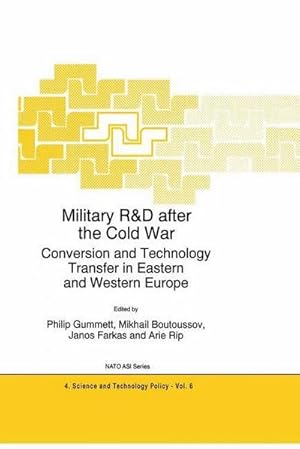
Military R&D after the Cold War : Conversion and Technology Transfer in Eastern and Western Europe
Anbieter: AHA-BUCH GmbH, Einbeck, Deutschland
Verkäuferbewertung 5 von 5 Sternen
Taschenbuch. Zustand: Neu. Druck auf Anfrage Neuware - Printed after ordering - Countries establish defence industries for various reasons. Chief among these are usually a concern with national security, and a desire to be as independent as possible in the supply of the armaments which they believe they need. But defence industries are different from most other industries. Their customer is governments. Their product is intended to safeguard the most vital interests of the state. The effectiveness of these products (in the real, rather than the experimental sense) is not normally tested at the time of purchase. If, or when, it is tested, many other factors (such as the quality of political and military leadership) enter into the equation, so complicating judgments about the quality of the armaments, and about the reliability of the promises made by the manufacturers. All of these features make the defence sector an unusually political industrial sector. This has been true in both the command economies of the former Soviet Union and its satellites, and in the market or mixed economies of the west. In both cases, to speak only a little over-generally, the defence sector has been particularly privileged and particularly protected from the usual economic vicissitudes. In both cases, too, its centrality to the perceived vital interests of the state has given it an unusual degree of political access and support.
-
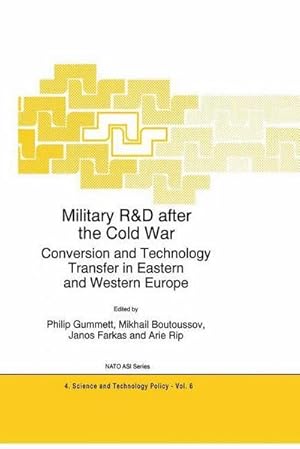
Military R&D after the Cold War : Conversion and Technology Transfer in Eastern and Western Europe
Sprache: Englisch
Verlag: Springer Netherlands, Springer Netherlands, 1996
ISBN 10: 0792341392 ISBN 13: 9780792341390
Anbieter: AHA-BUCH GmbH, Einbeck, Deutschland
Verkäuferbewertung 5 von 5 Sternen
Buch. Zustand: Neu. Druck auf Anfrage Neuware - Printed after ordering - Countries establish defence industries for various reasons. Chief among these are usually a concern with national security, and a desire to be as independent as possible in the supply of the armaments which they believe they need. But defence industries are different from most other industries. Their customer is governments. Their product is intended to safeguard the most vital interests of the state. The effectiveness of these products (in the real, rather than the experimental sense) is not normally tested at the time of purchase. If, or when, it is tested, many other factors (such as the quality of political and military leadership) enter into the equation, so complicating judgments about the quality of the armaments, and about the reliability of the promises made by the manufacturers. All of these features make the defence sector an unusually political industrial sector. This has been true in both the command economies of the former Soviet Union and its satellites, and in the market or mixed economies of the west. In both cases, to speak only a little over-generally, the defence sector has been particularly privileged and particularly protected from the usual economic vicissitudes. In both cases, too, its centrality to the perceived vital interests of the state has given it an unusual degree of political access and support.

