Gesamtpreis (1 Artikel Artikel):
Versandziel:

barry popik (2 Ergebnisse)
Direkt zu den wichtigsten Suchergebnissen
Suchfilter
Produktart
- Alle Product Types
- Bücher (2)
- Magazine & Zeitschriften (Keine weiteren Ergebnisse entsprechen dieser Verfeinerung)
- Comics (Keine weiteren Ergebnisse entsprechen dieser Verfeinerung)
- Noten (Keine weiteren Ergebnisse entsprechen dieser Verfeinerung)
- Kunst, Grafik & Poster (Keine weiteren Ergebnisse entsprechen dieser Verfeinerung)
- Fotografien (Keine weiteren Ergebnisse entsprechen dieser Verfeinerung)
- Karten (Keine weiteren Ergebnisse entsprechen dieser Verfeinerung)
- Manuskripte & Papierantiquitäten (Keine weiteren Ergebnisse entsprechen dieser Verfeinerung)
Zustand Mehr dazu
- Neu (1)
- Wie Neu, Sehr Gut oder Gut Bis Sehr Gut (1)
- Gut oder Befriedigend (Keine weiteren Ergebnisse entsprechen dieser Verfeinerung)
- Ausreichend oder Schlecht (Keine weiteren Ergebnisse entsprechen dieser Verfeinerung)
- Wie beschrieben (Keine weiteren Ergebnisse entsprechen dieser Verfeinerung)
Einband
- alle Einbände
- Hardcover (2)
- Softcover (Keine weiteren Ergebnisse entsprechen dieser Verfeinerung)
Weitere Eigenschaften
- Erstausgabe (1)
- Signiert (Keine weiteren Ergebnisse entsprechen dieser Verfeinerung)
- Schutzumschlag (Keine weiteren Ergebnisse entsprechen dieser Verfeinerung)
- Angebotsfoto (2)
Sprache (1)
Gratisversand
- Kostenloser Versand nach USA (Keine weiteren Ergebnisse entsprechen dieser Verfeinerung)
Land des Verkäufers
Verkäuferbewertung
-
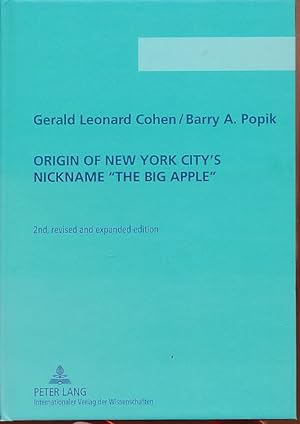
Origin of New York City's nickname "The Big Apple".
Anbieter: Borkert, Schwarz und Zerfaß GbR, Berlin, Deutschland
Verkäuferbewertung 5 von 5 Sternen

Erstausgabe
SonderangebotEUR 11,20
EUR 40,00 Versand
Versand von Deutschland nach USAAnzahl: 2 verfügbar
In den WarenkorbOriginalhardcover. Zustand: Sehr gut. 2., rev. and expanded ed. 175 S. Ein gutes und sauberes Exemplar. - The monograph aims for a comprehensive look at the history of «The Big Apple», incorporating material that has come to light since the first edition of this work was published in 1991. The overall picture now is: Apples, always important, became especially so with the appearance of the Big Red Delicious Apple in Iowa, 1870s. «The Big Apple» therefore came to refer to somebody or something very important. In 1920 an African-American stablehand in New Orleans mentioned in conversation: «Wes goin to the big apple» (NYC racetracks as the big time in horseracing). Turf writer John J. Fitz Gerald overheard this statement and adopted «The Big Apple» (1921ff.) in his columns, popularizing it to refer particularly to the NYC tracks. Secondarily it could refer to big time horseracing in general. In the 1930s «The Big Apple» was picked up by black jazz musicians to designate NYC in general (and Harlem in particular) as the place where the greatest jazz in the world was being played. And in 1971 Charles Gillett revived «The Big Apple» as part of a public-relations campaign on behalf of NYC. Despite the increasingly clear picture of what happened, various incorrect etymologies have arisen about «The Big Apple». The monograph addresses and rejects them in some detail. ISBN 9783631613863 Sprache: Englisch Gewicht in Gramm: 329.
-

Origin of New York City¿s Nickname «The Big Apple» : Second Revised and Expanded Edition
Anbieter: AHA-BUCH GmbH, Einbeck, Deutschland
Verkäuferbewertung 5 von 5 Sternen
Buch. Zustand: Neu. Druck auf Anfrage Neuware - Printed after ordering - The monograph aims for a comprehensive look at the history of 'The Big Apple', incorporating material that has come to light since the first edition of this work was published in 1991. The overall picture now is: Apples, always important, became especially so with the appearance of the Big Red Delicious Apple in Iowa, 1870's. 'The Big Apple' therefore came to refer to somebody or something very important. In 1920 an African-American stablehand in New Orleans mentioned in conversation: 'We's goin' to 'the big apple'' (NYC racetracks as the big time in horseracing). Turf writer John J. Fitz Gerald overheard this statement and adopted 'The Big Apple' (1921ff.) in his columns, popularizing it to refer particularly to the NYC tracks. Secondarily it could refer to big time horseracing in general. In the 1930's 'The Big Apple' was picked up by black jazz musicians to designate NYC in general (and Harlem in particular) as the place where the greatest jazz in the world was being played. And in 1971 Charles Gillett revived 'The Big Apple' as part of a public-relations campaign on behalf of NYC. Despite the increasingly clear picture of what happened, various incorrect etymologies have arisen about 'The Big Apple'. The monograph addresses and rejects them in some detail.