

Gesamtpreis (1 Artikel Artikel):
Versandziel:

barkowsky thomas (18 Ergebnisse)
Direkt zu den wichtigsten Suchergebnissen
Suchfilter
Produktart
- Alle Product Types
- Bücher (18)
- Magazine & Zeitschriften (Keine weiteren Ergebnisse entsprechen dieser Verfeinerung)
- Comics (Keine weiteren Ergebnisse entsprechen dieser Verfeinerung)
- Noten (Keine weiteren Ergebnisse entsprechen dieser Verfeinerung)
- Kunst, Grafik & Poster (Keine weiteren Ergebnisse entsprechen dieser Verfeinerung)
- Fotografien (Keine weiteren Ergebnisse entsprechen dieser Verfeinerung)
- Karten (Keine weiteren Ergebnisse entsprechen dieser Verfeinerung)
- Manuskripte & Papierantiquitäten (Keine weiteren Ergebnisse entsprechen dieser Verfeinerung)
Zustand Mehr dazu
- Neu (16)
- Wie Neu, Sehr Gut oder Gut Bis Sehr Gut (1)
- Gut oder Befriedigend (1)
- Ausreichend oder Schlecht (Keine weiteren Ergebnisse entsprechen dieser Verfeinerung)
- Wie beschrieben (Keine weiteren Ergebnisse entsprechen dieser Verfeinerung)
Einband
Weitere Eigenschaften
- Erstausgabe (Keine weiteren Ergebnisse entsprechen dieser Verfeinerung)
- Signiert (Keine weiteren Ergebnisse entsprechen dieser Verfeinerung)
- Schutzumschlag (Keine weiteren Ergebnisse entsprechen dieser Verfeinerung)
- Angebotsfoto (11)
Sprache (1)
Gratisversand
- Kostenloser Versand nach USA (Keine weiteren Ergebnisse entsprechen dieser Verfeinerung)
Land des Verkäufers
Verkäuferbewertung
-

Spatial Cognition IV : Reasoning, Action, Interaction : International Conference on Spatial Cognition, Frauenchiemsee, Germany, October 11-13, 2004, Revised Selected Papers
Sprache: Englisch
Verlag: Springer- Verlag, New York City, 2005
ISBN 10: 3540250484 ISBN 13: 9783540250487
Anbieter: Doss-Haus Books, Redondo Beach, CA, USA
Verkäuferbewertung 5 von 5 Sternen

Hardcover. Zustand: Very Good. No Jacket. Hardcover 2005 library bound edition. Ex-library book with stamps and labels attached. Binding firm. Pages unmarked and clean. Laminated covers and text in very good to near fine condition. Series: Lecture Notes in Artificial Intelligence ;3343 .[xiii, 517 p. : ill. ; 24 cm].
-

Mental Representation and Processing of Geographic Knowledge: A Computational Approach
Sprache: Englisch
Verlag: Springer-Verlag New York Inc, 2002
ISBN 10: 3540002162 ISBN 13: 9783540002161
Anbieter: Revaluation Books, Exeter, Vereinigtes Königreich
Verkäuferbewertung 5 von 5 Sternen
EUR 77,48
EUR 11,54 Versand
Versand von Vereinigtes Königreich nach USAAnzahl: 2 verfügbar
In den WarenkorbPaperback. Zustand: Brand New. 1st edition. 184 pages. 9.25x6.00x0.25 inches. In Stock.
-

Zustand: New.
-

Spatial Cognition IX: International Conference, Spatial Cognition 2014, Bremen, Germany, September 15-19, 2014. Proceedings
Anbieter: Revaluation Books, Exeter, Vereinigtes Königreich
Verkäuferbewertung 5 von 5 Sternen
EUR 80,74
EUR 14,43 Versand
Versand von Vereinigtes Königreich nach USAAnzahl: 2 verfügbar
In den WarenkorbPaperback. Zustand: Brand New. 2014 edition. 412 pages. 9.30x6.20x0.93 inches. In Stock.
-

Spatial Cognition V: Reasoning, Action, Interaction : International Conference Spatial Cognition 2006 Bremen, Germany, September 24-28, 2006 Revised Selected Papers
Sprache: Englisch
Verlag: Springer-Verlag New York Inc, 2007
ISBN 10: 3540756655 ISBN 13: 9783540756651
Anbieter: Revaluation Books, Exeter, Vereinigtes Königreich
Verkäuferbewertung 5 von 5 Sternen
EUR 82,96
EUR 14,43 Versand
Versand von Vereinigtes Königreich nach USAAnzahl: 2 verfügbar
In den WarenkorbPaperback. Zustand: Brand New. 1st edition. 500 pages. 9.00x6.00x1.00 inches. In Stock.
-
Spatial Cognition X: 13th Biennial Conference, Kogwis 2016, Bremen, Germany, September 2630, 2016, and 10th International Conference, Spatial Cognition 2016, Philadelphia
Sprache: Englisch
Verlag: Springer-Verlag New York Inc, 2017
ISBN 10: 3319681885 ISBN 13: 9783319681887
Anbieter: Revaluation Books, Exeter, Vereinigtes Königreich
Verkäuferbewertung 5 von 5 Sternen
EUR 77,57
EUR 28,85 Versand
Versand von Vereinigtes Königreich nach USAAnzahl: 2 verfügbar
In den WarenkorbPaperback. Zustand: Brand New. revised edition. 212 pages. 9.25x6.10x0.48 inches. In Stock.
-

Mental Representation and Processing of Geographic Knowledge : A Computational Approach
Anbieter: AHA-BUCH GmbH, Einbeck, Deutschland
Verkäuferbewertung 5 von 5 Sternen
Taschenbuch. Zustand: Neu. Druck auf Anfrage Neuware - Printed after ordering - In cognitive science, mental representations of spatial knowledge are metaphorically referred to as cognitive maps. However, investigations in cognitive psychology reveal that the cognitive map metaphor is inadequate and that more suitable conceptions of humanspatial knowledgeprocessing are needed.This book addresses mental processing of knowledge about geographic space from an AI point of view by presenting an experimental computational modeling approach. Results about human memory and visual mental imagery fromcognitive psychology are combinedwith AI techniques of spatial and diagrammatic knowledge processing.The author develops the diagrammatic reasoning architecture MIRAGE as a comprehensive conception of human geographic knowledge processing.
-

Spatial Cognition X : 13th Biennial Conference, KogWis 2016, Bremen, Germany, September 26¿30, 2016, and 10th International Conference, Spatial Cognition 2016, Philadelphia, PA, USA, August 2¿5, 2016, Revised Selected Papers
Sprache: Englisch
Verlag: Springer International Publishing, Springer International Publishing, 2017
ISBN 10: 3319681885 ISBN 13: 9783319681887
Anbieter: AHA-BUCH GmbH, Einbeck, Deutschland
Verkäuferbewertung 5 von 5 Sternen
Taschenbuch. Zustand: Neu. Druck auf Anfrage Neuware - Printed after ordering - This book constitutes the thoroughly refereed proceedings of the 13th Biennial Conference, KogWis 2016, held in Bremen, Germany, in September 2016, and the 10th International Conference, Spatial Cognition 2016, held in Philadelphia, PA, USA, in August 2016.The 11 revised full papers presented in this book were carefully selected and reviewed from 20 submissions. They focus on the following topics: spatial ability; wayfinding and navigation; spatial memory; and systems and simulations.
-
Sonderangebot
EUR 11,52
EUR 105,00 Versand
Versand von Deutschland nach USAAnzahl: 1 verfügbar
In den WarenkorbZustand: Sehr gut. Zustand: Sehr gut | Sprache: Englisch | Produktart: Bücher | In cognitive science, mental representations of spatial knowledge are metaphorically referred to as cognitive maps. However, investigations in cognitive psychology reveal that the cognitive map metaphor is inadequate and that more suitable conceptions of human spatial knowledge processing are needed.This book addresses mental processing of knowledge about geographic space from an AI point of view by presenting an experimental computational modeling approach. Results about human memory and visual mental imagery from cognitive psychology are combined with AI techniques of spatial and diagrammatic knowledge processing. The author develops the diagrammatic reasoning architecture MIRAGE as a comprehensive conception of human geographic knowledge processing.
-

Spatial Cognition X
Sprache: Englisch
Verlag: Springer International Publishing, Springer Nature Switzerland Nov 2017, 2017
ISBN 10: 3319681885 ISBN 13: 9783319681887
Anbieter: buchversandmimpf2000, Emtmannsberg, BAYE, Deutschland
Verkäuferbewertung 5 von 5 Sternen
Taschenbuch. Zustand: Neu. Neuware -This book constitutes the thoroughly refereed proceedings of the 13th Biennial Conference, KogWis 2016, held in Bremen, Germany, in September 2016, and the 10th International Conference, Spatial Cognition 2016, held in Philadelphia, PA, USA, in August 2016.The 11 revised full papers presented in this book were carefully selected and reviewed from 20 submissions. They focus on the following topics: spatial ability; wayfinding and navigation; spatial memory; and systems and simulations.Springer Verlag GmbH, Tiergartenstr. 17, 69121 Heidelberg 212 pp. Englisch.
-

Spatial Cognition V
Sprache: Englisch
Verlag: Springer Berlin Heidelberg, Springer Berlin Heidelberg Nov 2007, 2007
ISBN 10: 3540756655 ISBN 13: 9783540756651
Anbieter: buchversandmimpf2000, Emtmannsberg, BAYE, Deutschland
Verkäuferbewertung 5 von 5 Sternen
Taschenbuch. Zustand: Neu. Neuware -This is the fifth volume in a series of book publications featuring basic interdisciplinary research in spatial cognition. The study of spatial cognition is the study of knowledge about spatial properties of objects and events in the world. Spatial properties include location, size, distance, direction, separation and connection, shape, pattern, and so on. Cognition is about the structures and processes of knowledge: its acquisition, storage, retrieval, manipulation, and use by humans, nonhuman animals, and machines. Broadly construed, cognitive activities include sensation and perception, thinking, attention, imagery, attitudes, memory, learning, language, and reasoning and problem-solving; the interaction of these activities with motoric (body movement) and affective (emotional) processing is recognized as critically important, as well. Cognition is typically considered to make up much of the activity of the mind. But though the mind is an expression of the structures and processes of the brain and nervous system, it is also an expression of an organism or agent with a physical body that typically exists in a physical and socio-cultural world. Researchers study spatial cognition for several reasons. Spatial cognition plays important roles in most of the domains of knowledge and behavior of sentient beings, including activities associated with biological survival, social interaction, cultural practice, and economic exchange. Attempts to describe, predict, and explain the basic components of spatial cognition and their interrelationships stimulate a host of interesting basic questions about how important parts of reality work.Springer Verlag GmbH, Tiergartenstr. 17, 69121 Heidelberg 524 pp. Englisch.
-
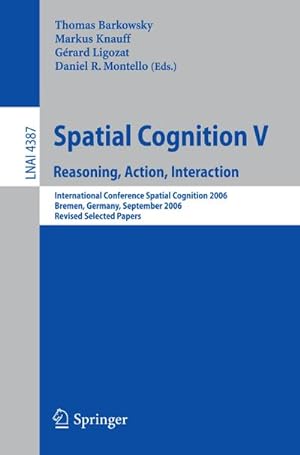
Spatial Cognition V : Reasoning, Action, Interaction
Anbieter: AHA-BUCH GmbH, Einbeck, Deutschland
Verkäuferbewertung 5 von 5 Sternen
Taschenbuch. Zustand: Neu. Druck auf Anfrage Neuware - Printed after ordering - This is the fifth volume in a series of book publications featuring basic interdisciplinary research in spatial cognition. The study of spatial cognition is the study of knowledge about spatial properties of objects and events in the world. Spatial properties include location, size, distance, direction, separation and connection, shape, pattern, and so on. Cognition is about the structures and processes of knowledge: its acquisition, storage, retrieval, manipulation, and use by humans, nonhuman animals, and machines. Broadly construed, cognitive activities include sensation and perception, thinking, attention, imagery, attitudes, memory, learning, language, and reasoning and problem-solving; the interaction of these activities with motoric (body movement) and affective (emotional) processing is recognized as critically important, as well. Cognition is typically considered to make up much of the activity of the mind. But though the mind is an expression of the structures and processes of the brain and nervous system, it is also an expression of an organism or agent with a physical body that typically exists in a physical and socio-cultural world. Researchers study spatial cognition for several reasons. Spatial cognition plays important roles in most of the domains of knowledge and behavior of sentient beings, including activities associated with biological survival, social interaction, cultural practice, and economic exchange. Attempts to describe, predict, and explain the basic components of spatial cognition and their interrelationships stimulate a host of interesting basic questions about how important parts of reality work.
-

Spatial Cognition IX : International Conference, Spatial Cognition 2014, Bremen, Germany, September 15-19, 2014. Proceedings
Sprache: Englisch
Verlag: Springer International Publishing, 2014
ISBN 10: 3319112147 ISBN 13: 9783319112145
Anbieter: AHA-BUCH GmbH, Einbeck, Deutschland
Verkäuferbewertung 5 von 5 Sternen
Taschenbuch. Zustand: Neu. Druck auf Anfrage Neuware - Printed after ordering - This book constitutes the thoroughly refereed proceedings of the 9th International Conference on Spatial Cognition, Spatial Cognition 2014, held in Bremen, Germany, in September 2014. The 27 revised full papers presented in this book were carefully selected and reviewed from 53 submissions. The papers are organized in topical sections on spatial memory; language and communication; wayfinding and navigation; computational models; diagrams and maps; technical approaches; and spatial ability.
-
Taschenbuch. Zustand: Neu. Spatial Cognition IX | International Conference, Spatial Cognition 2014, Bremen, Germany, September 15-19, 2014. Proceedings | Christian Freksa (u. a.) | Taschenbuch | xii | Englisch | 2014 | Springer | EAN 9783319112145 | Verantwortliche Person für die EU: Springer Verlag GmbH, Tiergartenstr. 17, 69121 Heidelberg, juergen[dot]hartmann[at]springer[dot]com | Anbieter: preigu.
-
Taschenbuch. Zustand: Neu. Mental Representation and Processing of Geographic Knowledge | A Computational Approach | Thomas Barkowsky | Taschenbuch | x | Englisch | 2002 | Springer | EAN 9783540002161 | Verantwortliche Person für die EU: Springer Verlag GmbH, Tiergartenstr. 17, 69121 Heidelberg, juergen[dot]hartmann[at]springer[dot]com | Anbieter: preigu.
-
Taschenbuch. Zustand: Neu. Spatial Cognition IV, Reasoning, Action, Interaction | International Spatial Cognition 2004, Frauenchiemsee, Germany, October 11-13, 2004, Revised Selected Papers | Christian Freksa (u. a.) | Taschenbuch | Einband - flex.(Paperback) | Englisch | 2005 | Springer | EAN 9783540250487 | Verantwortliche Person für die EU: Springer-Verlag KG, Sachsenplatz 4-6, 1201 WIEN, ÖSTERREICH, productsafety[at]springernature[dot]com | Anbieter: preigu.
-
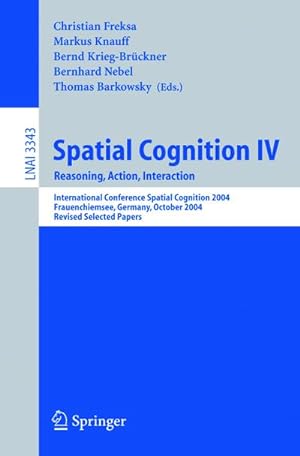
Spatial Cognition IV, Reasoning, Action, Interaction : International Spatial Cognition 2004, Frauenchiemsee, Germany, October 11-13, 2004, Revised Selected Papers
Anbieter: AHA-BUCH GmbH, Einbeck, Deutschland
Verkäuferbewertung 5 von 5 Sternen
Taschenbuch. Zustand: Neu. Druck auf Anfrage Neuware - Printed after ordering - This is the fourth volume in a series of books dedicated to basic research in spatial cognition. Spatial cognition is a field that investigates the connection between the physical spatial world and the mental world. Philosophers and researchers have p- posed various views concerning the relation between the physical and the mental worlds: Plato considered pure concepts of thought as separate from their physical manifestations while Aristotle considered the physical and the mental realms as two aspects of the same substance. Descartes, a dualist, discussed the interaction between body and soul through an interface organ and thus introduced a functional view that presented a challenge for the natural sciences and the humanities. In modern psych- ogy, the relation between the physical and the cognitive space has been investigated using thorough experiments, and in artificial intelligence we have seen views as diverse as 'problems can be solved on a representation of the world' and 'a representation of the world is not necessary. ' Today's spatial cognition work establishes a correspondence between the mental and the physical worlds by studying and exploiting their interaction; it investigates how mental space and spatial 'reality' join together in understanding the world and in interacting with it. The physical and representational aspects are equally important in this work. Almost all topics of cognitive science manifest themselves in spatial cognition.
-

Spatial Cognition IV, Reasoning, Action, Interaction
Sprache: Englisch
Verlag: Springer Berlin Heidelberg, Springer Berlin Heidelberg Mär 2005, 2005
ISBN 10: 3540250484 ISBN 13: 9783540250487
Anbieter: buchversandmimpf2000, Emtmannsberg, BAYE, Deutschland
Verkäuferbewertung 5 von 5 Sternen
Taschenbuch. Zustand: Neu. Neuware -This is the fourth volume in a series of books dedicated to basic research in spatial cognition. Spatial cognition is a field that investigates the connection between the physical spatial world and the mental world. Philosophers and researchers have p- posed various views concerning the relation between the physical and the mental worlds: Plato considered pure concepts of thought as separate from their physical manifestations while Aristotle considered the physical and the mental realms as two aspects of the same substance. Descartes, a dualist, discussed the interaction between body and soul through an interface organ and thus introduced a functional view that presented a challenge for the natural sciences and the humanities. In modern psych- ogy, the relation between the physical and the cognitive space has been investigated using thorough experiments, and in artificial intelligence we have seen views as diverse as ¿problems can be solved on a representation of the world¿ and ¿a representation of the world is not necessary. ¿ Today¿s spatial cognition work establishes a correspondence between the mental and the physical worlds by studying and exploiting their interaction; it investigates how mental space and spatial ¿reality¿ join together in understanding the world and in interacting with it. The physical and representational aspects are equally important in this work. Almost all topics of cognitive science manifest themselves in spatial cognition. 540 pp. Englisch.


