Gesamtpreis (1 Artikel Artikel):
Versandziel:

arnoldi usingen bartholomaeus (7 Ergebnisse)
Direkt zu den wichtigsten Suchergebnissen
Suchfilter
Produktart
- Alle Product Types
- Bücher (7)
- Magazine & Zeitschriften (Keine weiteren Ergebnisse entsprechen dieser Verfeinerung)
- Comics (Keine weiteren Ergebnisse entsprechen dieser Verfeinerung)
- Noten (Keine weiteren Ergebnisse entsprechen dieser Verfeinerung)
- Kunst, Grafik & Poster (Keine weiteren Ergebnisse entsprechen dieser Verfeinerung)
- Fotografien (Keine weiteren Ergebnisse entsprechen dieser Verfeinerung)
- Karten (Keine weiteren Ergebnisse entsprechen dieser Verfeinerung)
- Manuskripte & Papierantiquitäten (Keine weiteren Ergebnisse entsprechen dieser Verfeinerung)
Zustand Mehr dazu
- Neu (2)
- Wie Neu, Sehr Gut oder Gut Bis Sehr Gut (Keine weiteren Ergebnisse entsprechen dieser Verfeinerung)
- Gut oder Befriedigend (2)
- Ausreichend oder Schlecht (Keine weiteren Ergebnisse entsprechen dieser Verfeinerung)
- Wie beschrieben (3)
Einband
Weitere Eigenschaften
- Erstausgabe (Keine weiteren Ergebnisse entsprechen dieser Verfeinerung)
- Signiert (Keine weiteren Ergebnisse entsprechen dieser Verfeinerung)
- Schutzumschlag (Keine weiteren Ergebnisse entsprechen dieser Verfeinerung)
- Angebotsfoto (6)
Sprache (2)
Preis
- Beliebiger Preis
- Weniger als EUR 20 (Keine weiteren Ergebnisse entsprechen dieser Verfeinerung)
- EUR 20 bis EUR 40
- Mehr als EUR 40
Gratisversand
- Kostenloser Versand nach USA (Keine weiteren Ergebnisse entsprechen dieser Verfeinerung)
Land des Verkäufers
Verkäuferbewertung
-

Polemica De S.s. Eucharistiae Sacramento Inter Bartholomaeum Arnoldi De Usingen, O.e.s.a., Ejusque Olim In Universitate Erphurdiana Discipulum Martinu
Sprache: Latein
Verlag: Creative Media Partners, LLC Okt 2022, 2022
ISBN 10: 101877730X ISBN 13: 9781018777306
Anbieter: AHA-BUCH GmbH, Einbeck, Deutschland
Verkäuferbewertung 5 von 5 Sternen

Taschenbuch. Zustand: Neu. Neuware.
-

Polemica De S.s. Eucharistiae Sacramento Inter Bartholomaeum Arnoldi De Usingen, O.e.s.a., Ejusque Olim In Universitate Erphurdiana Discipulum Martinu
Sprache: Latein
Verlag: Creative Media Partners, LLC Okt 2022, 2022
ISBN 10: 1018772588 ISBN 13: 9781018772585
Anbieter: AHA-BUCH GmbH, Einbeck, Deutschland
Verkäuferbewertung 5 von 5 Sternen
Buch. Zustand: Neu. Neuware.
-
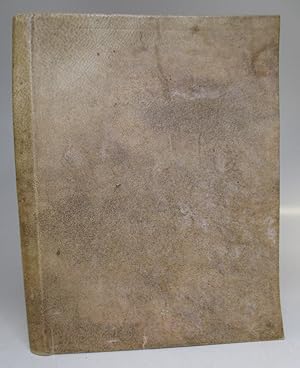
Libellus F. Bartholomei de Usingen Augustiniani de falsis prophetis tam in persona qua[m] doctrina vitandis a fidelibus. De recta et mu[n]da p[re]dicatio[n]e eva[n]gelij et q[ui]bus [con]formiter illud debeat p[re]dicari. De Celibatu sacerdotum Nove legis et de Matrimonio eorum nec non Monachorum exiticiorum. Responsio ad Sermone[m] Langi de Matrimonio sacerdotali que[m] fecit in Nuptijs Culsameri sacerdotis. Co[n]tra factione[m] Luttherana[m]
Verlag: Erfurt, [Matthes Maler], Erfurt, 1525
Anbieter: Libreria Alberto Govi di F. Govi Sas, Modena, MO, Italien
Verkäuferbewertung 5 von 5 Sternen
Zustand: Good. 4to (199x148 mm). [40] leaves. Collation: A-K4. Title page within an architectural border bearing the monogram ?FB? and the date 1521 at the bottom. 20th-century pale suede leather ?à l'antique? with inked title on spine. With a few marginal annotations in a contemporary hand (the note on the final leaf is dated December 1525). Marginal repair to the lower outer corner of l. A3 with no loss of text, slightly uniformly browned, some marginal staining.First edition of this pamphlet attacking Luther's position on the marriage of priests and other reforms proposed by him and his followers. In particular, Arnoldi, who went from being one of Luther's teachers in Erfurt to becoming one of his fiercest opponents, responds to a book on the celibacy of the clergy by the Lutheran theologian Johannes Lang (1487-1548).Bartholomäus Arnoldi (also called Usingen after his birthplace) began his studies at the University of Erfurt in 1484. He became a Bachelor of Arts in 1486 and Master of Arts in 1491. He taught philosophy at Erfurt University for twenty-four years. In 1498, he became a member of the council of the faculty of arts and afterwards was active in several official positions. From 1501 to 1505, he was one of Luther's teachers in philosophy. During 1504 he was dean of the faculty and joined the Augustinian hermits in 1512. Two years later he was promoted Doctor of Theology and became actively involved in the German Counter Reformation and in particular opposed the Wittenberg reformers. In 1522, he became archdeacon. During the Peasant's War in 1525 he was forced to leave Erfurt and ended up in Würzburg, where he stayed at the local Augustinian monastery. During his last years, Arnoldi followed the local bishop, Konrad von Thüngen, in visitations to the monasteries and in the struggle with growing Protestantism. He appeared with him in the Diet of Augsburg, 1530, where he was appointed as a member of the commission to examine the Augsburg Confession and where he contributed to the writing of the Catholic Response. He died in Würzburg in 1532.As a philosopher, Arnoldi belonged to the ?via moderna' school, as did all his colleagues at the Faculty of Philosophy in Erfurt. The ?via moderna' was born in opposition to the ?via antiquata' school. The ?via antiquata' was followed in some universities (as the University of Leipzig) and tended to base their teaching exclusively on a particular tradition, following the method of authors such as Aquinas and Scotus and ignoring some of the more recent authors. Indeed, the philosophers and theologians who represented the ?via moderna' method were committed to respecting other authoritative writers and to adopting some key doctrines. These authorities included, above all, Jean Buridan and William of Ockham, but also authors such as Gregory of Rimini, Peter of Ailly and Gabriel Biel. These doctrines included the use of the principle of parsimony, a moderately nominalist view of universals, and the denial of a real distinction between the powers of the soul as well as between the entities denoted by the Aristotelian categories other than substance and quality. This school opposition appears clear when we note that in the same year, 1499, two short treatises on natural philosophy were published, both written as commentaries on the same text by Peter of Dresden, the Parvulus philosophiae naturalis: one from Erfurt written by Arnoldi and the other by Johannes Peyligk, a Thomist philosopher from the University of Leipzig (cf. R. Bäumer, Bartholomäus von Usingen OESA, in: ?Katholische Theologen der Reformationszeit?, 1985, vol. II, pp. 27-37).Johannes Lang studied in Erfurt from 1500 and entered the Augustinian monastery there in 1506 (shortly after Luther). In 1511, he went with Luther to Wittenberg, where he received his Master of Arts degree in 1512 and his Bachelor of Biblical Studies degree in 1515. In 1516, Luther appointed him prior of the Augustinian monastery in Erfurt. Lang accompanied Luther. Book.
-
Parvulus philosophiae naturalis Figuralis interpretatio in Epitoma philosophiae naturalis in laudatissimo Erffurdiensi gymnasio per Barth. de Usingen liberalium studiorum concinnata [.] Annexa est huic opuscolo Quaestio ardua de Quiditate quantitatis continuae
Verlag: Basel, Jakob Wolff de Pfortzheim 4 December 1511, Basel, 1511
Anbieter: Libreria Alberto Govi di F. Govi Sas, Modena, MO, Italien
Verkäuferbewertung 5 von 5 Sternen
Zustand: Mediocre (Poor). ONE OF LUTHER'S TEACHERS IN PHILOSOPHY AT ERFURT[Bound with] EIUSDEM. Compendium Naturalis philosophiae Opera et studio singulari M. Bartholomei de Usingen In Gymnasio Erphurdiensi Collectam ad laudem Dei et ei publicae litterariae [.] Erfurt, Wolfgang Schenck, [1507].Two works in one volume, 4to (209x153 mm.). CXL [i.e. 130], [1 blank]; [74] ll. Collation: A8 B-C6 D4 E-G8 H12(-1) I6 K-S8 T4; A4 B6 C4 D6 E4 F6 G-H4 J6 K4 Z4 A6 A4 D6 P6 (l. P6 blank). In the first work the l. H12 is not present as in all copies. With a large woodcut on the l. XLVIIIv. The title epigram in the second work is assigned to ?E.H.? (probably Eobanus Hessus) at the l. A1v. Contemporary half blind-tooled pig skin over wooden boards (binding slightly rubbed, round worm holes to the back panel, traces of clasps). On the first title page contemporary ownership entry ?Mann er [?] 1515', in the final index of the first work page numbering added by a contemporary or slightly later hand. With some marginal manuscript annotations. Several worm holes and tracks at the beginning and at the end of the volume, some occasional light browning and staining, first title page soiled, upper margin of the first two leaves frayed, all in all a good copy.Rare third edition (first: Leipzig 1499; second: Cracow 1507) of the Parvulus philosophie naturalis and first edition of the Compendium naturalis philosophiae. Both works are commentaries on Peter of Dresden's (Peter Gerticz) treatise Parvulus philosophiae naturalis, often used as teaching material in the Erfurt schools since the end of the 14th century. Arnoldi's compendia are intended to introduce students into the application of the scholastic nominalistic criteria. It dealsa in particular with the topic of the sensation and perception as exposed in Aristotle's De anima.The Parvulus philosophiae naturalis is a concise compendium, containing overall 56 Quaestiones, each one beginning with ?Utrum', divided into two groups. At the end is furthermore printed the text of a quodlibet disputation which took place at Erfurt in 1497 and in which the leading teachers of the philosophy faculty, Jodocus Trutfetter and Bartlolomaeus Arnoldi, determined the position with respect to certain questions in a programmatic manner, i.e. their explicit adherence to William Ockham's philosophy (here printed under the title Questio annexa de Quiditate Quantitatis continuae).Bartholomaeus Arnoldi (also called Usingen after his birthplace) began his studies at the University of Erfurt in 1484. He became a Bachelor of Arts in 1486 and Master of Arts in 1491. He taught philosophy at Erfurt University for twenty-four years. In 1498, he became a member of the council of the faculty of arts and afterwards was active in several official positions. From 1501 to 1505, he was one of Luther's teachers in philosophy. During 1504 he was dean of the faculty and joined the Augustinian hermits in 1512. Two years later he was promoted Doctor of Theology and became actively involved in the German Counter Reformation and in particular opposed the Wittenberg reformers. In 1522, he became archdeacon. During the Peasant's War in 1525 he was forced to leave Erfurt and ended up in Würzburg, where he stayed at the local Augustinian monastery. During his last years, Arnoldi followed the local bishop, Konrad von Thüngen, in visitations to the monasteries and in the struggle with growing Protestantism. He appeared with him in the Diet of Augsburg, 1530, where he was appointed as a member of the commission to examine the Augsburg Confession and where he contributed to the writing of the Catholic Response. He died in Würzburg in 1532.As a philosopher, Arnoldi belonged to the ?via moderna' school, as did all his colleagues at the Faculty of Philosophy in Erfurt. The ?via moderna' was born in opposition to the ?via antiquata' school. The ?via antiquata' was followed in some universities (as the University of Leipzig) and tended to base their teaching exclusively on a. Book.
-
Libellus In Quo Respondet Confutationi Fratris Egidij
Verlag: Matthes Maler, Erfurt, 1524
Anbieter: Argosy Book Store, ABAA, ILAB, New York, NY, USA
Verkäuferbewertung 5 von 5 Sternen
hardcover. Zustand: very good(+). First. 76 leaves, some browning and pin worm holes, small defect on title page effecting 1 word. Gothic type, title printed within fine woodcut border dated 1521 of cherubs playing music, drawing Mars in a cart, etc. Short slim 4to, plain 19th Century vellum (slightly bowed), all edges red. Erphurdie: [Matthes Maler], 1524. A very good(+) copy. First Edition of this rare Anti-Reformation tract by a fellow Augustinian who initially shared Luther's enthusiasms for change, but, as the movement to reform became more radical, Arnoldi placed religion unity above all other issues and began working against the Protestants. Very much of a personal position statement, this twelve part dialog between the author (speaking in the first person) and Egidius Mechler touches many controversial doctrinal points with a particular strong attack on the marriage of clerics. Some of the asides in the repartee are in German. -- Pegg 138; Hase 528.
-

Zustand: Hervorragend. Zustand: Hervorragend | Seiten: 114 | Sprache: Latein | Produktart: Bücher | Keine Beschreibung verfügbar.
-

Bartholomaei Arnoldi de Usingen OSA responsio contra apologiam Philippi Melanchthonis, quam edendam curavit Primoz Simoniti. (= Cassiciacum, Supplementband VII).
Sprache: Latein
Verlag: Würzburg, Augustinus-Verlag, 1978
ISBN 10: 3761301154 ISBN 13: 9783761301159
Anbieter: Antiquariat An der Vikarie, Grafschaft-Leimersdorf, Deutschland
Verbandsmitglied: GIAQ
Verkäuferbewertung 5 von 5 Sternen
8°., Original-kartoniert, XXIV, 720 S., ehemaliges Bibliotheksexemplar mit Rückenschild und Stempeln ("ausgeschieden"), Einband etwas berieben, ansonsten gut erhaltenes und sauberes Exemplar, Text in Latein mit deutscher Einleitung / ex-library copy with label on spine and stamps, binding slightly rubbed, else good and clean, text in Latin with German introduction, (Melanchthon, Philipp / Reformation), la Gewicht in Gramm: 1100.

![Bild des Verkäufers für Libellus F. Bartholomei de Usingen Augustiniani de falsis prophetis tam in persona qua[m] doctrina vitandis a fidelibus. De recta et mu[n]da p[re]dicatio[n]e eva[n]gelij et q[ui]bus [con]formiter illud debeat p[re]dicari. De Celibatu sacerdotum Nove legis et de Matrimonio eorum nec non Monachorum exiticiorum. Responsio ad Sermone[m] Langi de Matrimonio sacerdotali que[m] fecit in Nuptijs Culsameri sacerdotis. Co[n]tra factione[m] Luttherana[m] zum Verkauf von Libreria Alberto Govi di F. Govi Sas](https://pictures.abebooks.com/inventory/md/md32321435901.jpg)
![Bild des Verkäufers für Parvulus philosophiae naturalis Figuralis interpretatio in Epitoma philosophiae naturalis in laudatissimo Erffurdiensi gymnasio per Barth. de Usingen liberalium studiorum concinnata [.] Annexa est huic opuscolo Quaestio ardua de Quiditate quantitatis continuae zum Verkauf von Libreria Alberto Govi di F. Govi Sas](https://pictures.abebooks.com/inventory/md/md32123934103.jpg)