Gesamtpreis (1 Artikel Artikel):
Versandziel:

alberto vanasco (28 Ergebnisse)
Direkt zu den wichtigsten Suchergebnissen
Suchfilter
Produktart
- Alle Product Types
- Bücher (24)
- Magazine & Zeitschriften (4)
- Comics (Keine weiteren Ergebnisse entsprechen dieser Verfeinerung)
- Noten (Keine weiteren Ergebnisse entsprechen dieser Verfeinerung)
- Kunst, Grafik & Poster (Keine weiteren Ergebnisse entsprechen dieser Verfeinerung)
- Fotografien (Keine weiteren Ergebnisse entsprechen dieser Verfeinerung)
- Karten (Keine weiteren Ergebnisse entsprechen dieser Verfeinerung)
- Manuskripte & Papierantiquitäten (Keine weiteren Ergebnisse entsprechen dieser Verfeinerung)
Zustand Mehr dazu
- Neu (Keine weiteren Ergebnisse entsprechen dieser Verfeinerung)
- Wie Neu, Sehr Gut oder Gut Bis Sehr Gut (6)
- Gut oder Befriedigend (12)
- Ausreichend oder Schlecht (Keine weiteren Ergebnisse entsprechen dieser Verfeinerung)
- Wie beschrieben (10)
Einband
Weitere Eigenschaften
- Erstausgabe (1)
- Signiert (Keine weiteren Ergebnisse entsprechen dieser Verfeinerung)
- Schutzumschlag (6)
- Angebotsfoto (19)
Sprache (2)
Gratisversand
- Kostenloser Versand nach USA (Keine weiteren Ergebnisse entsprechen dieser Verfeinerung)
Land des Verkäufers
Verkäuferbewertung
-

Vida y Obra de Hegel
Anbieter: Librería 7 Colores, Madrid, M, Spanien
Verkäuferbewertung 5 von 5 Sternen

Tapa Blanda. Zustand: Buen estado.
-
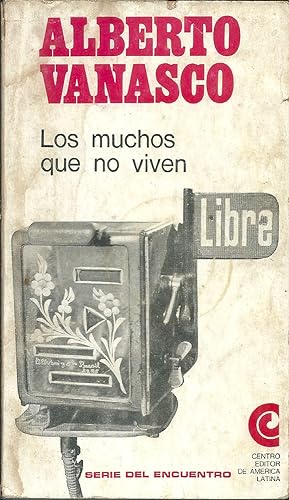
Los muchos que no viven. Novela.
Verlag: Centro Editor de América Latina, 1967, Buenos Aires., 1967
Anbieter: Librería y Editorial Renacimiento, S.A., VALENCINA DE LA CONCEPCIÓN, SE, Spanien
Verbandsmitglied: SEVILLA
Verkäuferbewertung 5 von 5 Sternen
18x10. 124 pgs. (S4405).
-
Otros verán el mar
Verlag: Corregidor Buenos Aires 1977, 1977
Anbieter: Dedalus-Libros, Madrid, M, Spanien
Verkäuferbewertung 3 von 5 Sternen

143 p 18 cm Encuadernación editorial en rústica. Estado de conservación: Bien.
-

tapa blanda. Zustand: Bien. Filosofía y psicología (1 Hegel, Georg Wilhelm Friedrich), Biografías (929 Hegel, Georg Wilhelm Friedrich) Planeta. Barcelona. 1973. 20 cm. 220 p., 1 h. Encuadernación en tapa blanda de editorial ilustrada. Colección 'Biblioteca Universal Planeta, v. 51. Panorama', numero coleccion(9). Vanasco, Alberto 1925-1993. Hegel, Georg Wilhelm Friedrich. 1770-1831 . ISBN: 8432063517 (=3336657=) LE230.
-

Zustand: Bueno. : Las alas de la paloma es una novela de Henry James que narra la historia de Kate Croy, una joven londinense huérfana que se encuentra en una encrucijada. Enamorada de Merton Densher, un periodista sin futuro, Kate debe elegir entre el amor y las expectativas de su tía rica, quien espera casarla con un buen partido. La llegada de Milly Theale, una rica heredera estadounidense, a la alta sociedad londinense, desencadena una serie de intrigas y planes en los que Kate podría verse involucrada. EAN: 9788413297002 Tipo: Libros Categoría: Literatura y Ficción Título: Las alas de la paloma Autor: Henry James| Alberto Vanasco Editorial: RBA Idioma: es-ES Páginas: 477 Formato: tapa dura.
-

Nueva York, Nueva York
Anbieter: SoferBooks, Barcelona, B, Spanien
Verkäuferbewertung 4 von 5 Sternen

blanda. Zustand des Schutzumschlags: Nuevo.
-

Vida y Obra de Hegel
Anbieter: SOSTIENE PEREIRA, GRANADA, GR, Spanien
Verkäuferbewertung 5 von 5 Sternen
Tapa blanda. 220 Filosofía.
-

Lo mejor de la ciencia ficción latinoamericana
Anbieter: Alcaná Libros, Madrid, M, Spanien
Verkäuferbewertung 5 von 5 Sternen
tapa blanda. Zustand: Bien. Literatura española (860(8.03)-321.9"19"(082.2)) Orbis. Barcelona. 1986. 20 cm. 218 p. Encuadernación en tapa blanda de editorial. Colección 'Biblioteca de ciencia ficción', numero coleccion(57). Bernard Goorden, A. E. van Gogt (recopiladores). Novelas de ciencia ficción hispanoamericanas. S. XX. Van Vogt, A. 1912-2000 . ISBN: 847634550X (=3588296=) LI147.
-

24 Sonetos absolutos y 2 intrascendentes
Verlag: Buenos Aires 1945, 1945
Anbieter: Dedalus-Libros, Madrid, M, Spanien
Verkäuferbewertung 3 von 5 Sternen
Sin paginar 17 cm Encuadernación artesanal en cartone. Estado de conservación: Bien.
-

Canto rodado. Poemas.
Verlag: Sudamericana, 1970, Buenos Aires., 1970
Anbieter: Librería y Editorial Renacimiento, S.A., VALENCINA DE LA CONCEPCIÓN, SE, Spanien
Verbandsmitglied: SEVILLA
Verkäuferbewertung 5 von 5 Sternen
20x13. 60 pgs. (Q8888).
-

Los muchos que no viven
Verlag: Centro Editor de América Latina., 1967
Anbieter: Alcaná Libros, Madrid, M, Spanien
Verkäuferbewertung 5 von 5 Sternen
tapa blanda. Zustand: Bien. Literatura.(82) Centro Editor de América Latina. Buenos Aires. 1967. 17 cm. 124 p. Encuadernación en tapa blanda de editorial ilustrada. Cubierta deslucida. (=2928245=) LO149.
-

Los Muchos Que No Viven
Verlag: Centro Editor de America Latina
ISBN 13: 5842803780797
Anbieter: SoferBooks, Barcelona, B, Spanien
Verkäuferbewertung 4 von 5 Sternen
Blanda. Zustand: Buen Estado. Zustand des Schutzumschlags: Buen Estado.
-

Los Muchos Que No Viven
Verlag: Centro Editor de America Latina
ISBN 13: 5842803780797
Anbieter: SoferBooks, Barcelona, B, Spanien
Verkäuferbewertung 4 von 5 Sternen
Blanda. Zustand: Buen Estado. Zustand des Schutzumschlags: Buen Estado.
-

Vida y obra de Hegel
Verlag: Biblioteca Universal Planeta nº 51, Panorama 9, Editorial Planeta, Barcelona, 1973
ISBN 10: 8432063517 ISBN 13: 9788432063510
Anbieter: Librería Ofisierra, Galapagar, M, Spanien
Verkäuferbewertung 5 von 5 Sternen
Tapa blanda. Zustand: Bien. Libro.
-

Vida y obra de Hegel
Anbieter: Librería La Candela, Murcia, MU, Spanien
Verkäuferbewertung 5 von 5 Sternen
.- Barcelona . 1973. Editorial Planeta, S.A. 20x13 cm. 1 tomo. 219 pgs. Ilustrado. rúst. Buen estado. . . ISBN 10: 8432063517. ISBN 13: 9788432063510.
-
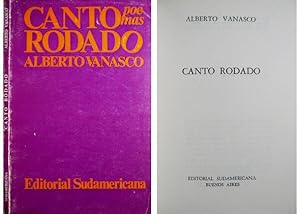
Canto rodado Poemas.
Verlag: Buenos Aires, Editorial Sudamericana, 1970., 1970
Anbieter: Hesperia Libros, Zaragoza, Z, Spanien
Verkäuferbewertung 5 von 5 Sternen
4to.; 60 pp., 1 h. Cubiertas originales.
-
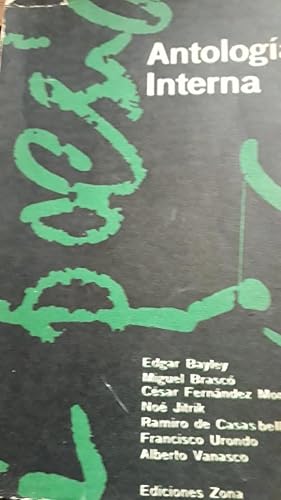
ANTOLOGÍA INTERNA
Verlag: EDICIONES ZONA .ARGENTINA, 1965
Anbieter: DEL SUBURBIO LIBROS- VENTA PARTICULAR, C.A.B.A, Argentinien
Verbandsmitglied: ALADA
Verkäuferbewertung 5 von 5 Sternen
Erstausgabe
Encuadernación de tapa blanda. Zustand: Muy bien. 1ª Edición. Bayley, Edgar - Brascó, Miguel - Fernandez Moreno, César - Jitrik, Noé - De Casasbellas, Ramiro - Urondo, Francisco - Vanasco, Alberto. ANTOLOGÍA INTERNA. EDICIONES ZONA Ediciones Zona, Argentina, 1965. Rústica. Muy Buen estado. Primera edición. 20x13 cm.; 154 pp. Colección de Poesía. Esta antología representa la tarea desarrollada, entre 1950 y 1965 -libros publicados e inéditos- por los siete poetas que integraron la dirección de la Revista Zona. Ordenada por César Fernández Moreno, Noé Jitrik y Francisco Urondo. Joyita literaria. VID.3.2°.
-
CRONICAS DE LA BURGUESIA. Prólogo de Alberto Ciria. Selección y biografÃas de Julia Constenla Ciria Alberto - Lynch Marta - Orgambide Pedro - Guido Beatriz - Castillo Abelardo - Levinson Luisa M
Verlag: Jorge alvarez editor, 1965
Anbieter: crealivres, La fontennelle, Frankreich
Verkäuferbewertung 5 von 5 Sternen
Zustand: Good. Envoi rapide Bon Etat couverture défraîchie intérieur propre. in12. 1965. Broché. CRONICAS DE LA BURGUESIA. Prólogo de Alberto Ciria. Selección y biografÃas de Julia Constenla Ciria Alberto - Lynch Marta - Orgambide Pedro - Guido Beatriz - Castillo Abelardo - Levinson Luisa Mercedes - Vanasco Alberto. Good.
-
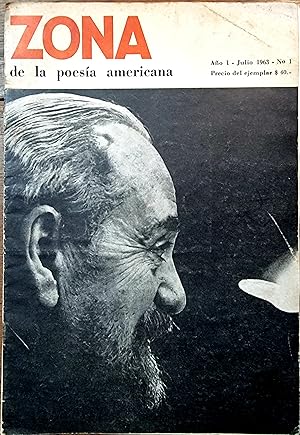
Revista ZONA de la Poesía Americana
Verlag: Buenos Aires Talleres Lumen, 1963
Anbieter: Chaco 4ever Books, Montevideo, MO, Uruguay
Verkäuferbewertung 5 von 5 Sternen
Magazin / Zeitschrift
Encuadernación de tapa blanda. Zustand: Muy bien. In-4. #1 Jul 1963 - #4 Nov 1964. (Lacks #2). Wrappers. Collaborators : Octavio Paz, Enrique Molina, Enrique Lihn, Francisco Madariaga, Noe Jitrik, Francisco "Paco" Urondo, Alberto Girri, Enrique Molina, Alberto Vanasco, Oliverio Girondo, Albero Lores, Among others. Noe Jitrik tells us about the Magazine: It was César Fernández Moreno who had the idea of ??making a poetry magazine. During his life as a lawyer had not stopped writing, a parental mandate had led him to that, but suddenly he felt something like the revelation of boredom, even with regard to his poetry preceding. From the contact with Brascó, in his own studio, but then with the bubbling porteño poetic of those years (Trejo, Vanasco, Urondo, Bayley, Madariaga, Vasco) was discovered "conversational"; poems like "Airports" date back then, "Argentine until death" and many others. His idea, or proposal, also supported by the strong ties of affection that bound everyone those poets, was quickly picked up, in particular by Urondo and myself (who was in Córdoba), as well as by Vanasco and Bayley, although not necessarily around a poetic program since each one went their own way; one could be a poet of "experience" but also inherited-surreal, as well as that each one conserved, without the need for announce it, his own poetics but we all agreed that we should organize each number from proposals. But above all, everyone believed in poetry in their own way. Tarcus p61. F1.
-
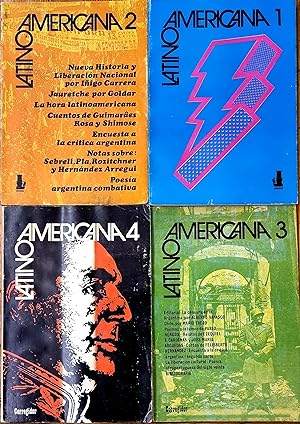
Revista Latinoamericana
Verlag: Buenos Aires El Corregidor, 1972
Anbieter: Chaco 4ever Books, Montevideo, MO, Uruguay
Verkäuferbewertung 5 von 5 Sternen
Magazin / Zeitschrift
Encuadernación de tapa blanda. Zustand: Muy bien. In-8 #1 Dic 1972 - #4 Aug 1974. (Complete set). Wrappers. After directing the literature, art and cinema magazine Macedonio, Alberto Vanasco and Juan Carlos Martini Real embark on a new company: Latinoamericana. The magazine is published in Buenos Aires, with the endorsement of the Ediciones Corregidor label, between the hectic months that go from December 1972 to August 1974. Four numbers were published. The continuity with Macedonio is evident, although with a more political profile, typical of the moment. Ideologically close to revolutionary Peronism, one of the outstanding features of her intervention is that the critical discourse of dependency, the detailed evaluation of the Latin American Boom, the failure of the Chilean socialist experience, the problem of cultural liberation, prevails in its pages. The summary of its editions reproduces literary texts by important Latin American authors like Juan Carlos Onetti, João Guimarães Rosa, José María Arguedas, Felisberto Hernández, Juan Rulfo, Pablo Neruda, among others, along with readings by prominent critics Like Jorge Ruffineli, Augusto Roa Bastos, Ernesto Goldar, Luis Gregorich, Blas Matamoro, Gemán García. Jorge Lafforgue elaborates a survey today classic on Argentine literature and criticism that appears in two installments, following the models of the Survey: literary criticism in Argentina, published in Rosario in 1963, product of Adolfo Prieto's seminar, and the one published in Los Libros, in number 28, in September 1972. Nora Dottori, Aníbal Ford, Luis Gregorich Josefina Ludmer, Beatriz Sarlo, Jorge Rivera, Graciela Maturo, Ángel Núñez and Nicolás Rosa, among others, answered. Tarcus p69. CodZ.
-
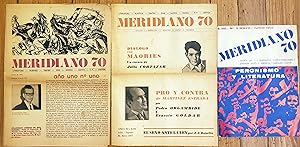
MERIDIANO 70. Literatura, plástica, teatro, cine, música, danza, T.V. y crítica
Verlag: Buenos Aires, 1967
Anbieter: Chaco 4ever Books, Montevideo, MO, Uruguay
Verkäuferbewertung 5 von 5 Sternen
Magazin / Zeitschrift
Encuadernación de tapa blanda. Zustand: Muy bien. Folio. #1 Jan 1967 - #3 June 1968. (Complete set). Wrappers. Collaborators : Julio Cortazar, Haroldo Conti, Pedro Orgambide, Francisco Paco Urondo, Ernesto Goldar, Among Others. Tarcus p57. CodMK.
-
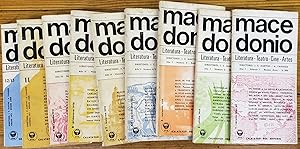
Revista MACEDONIO. Literatura, Teatro, Cine, Artes
Verlag: Buenos Aires Editores Calatayud, 1968
Anbieter: Chaco 4ever Books, Montevideo, MO, Uruguay
Verkäuferbewertung 5 von 5 Sternen
Magazin / Zeitschrift
Encuadernación de tapa blanda. Zustand: Muy bien. In-8º. #1, December 1968 - #13 Summer of 1972 (Complete set). Wrappers. Collaborators : Raúl Gustavo Aguirre, Carlos Astrada, Manuel Bandeira, Edgar Bayley, Antonio Berni, Juana Bignozzi, Haroldo Conti, Julio Cortázar, Marco Denevi, Carlos Drummond de Andrade, Juan Gelman, Raúl González Tuñón, José Agustín Goytisolo, Liliana Heker, Jorge Lafforgue, Francisco Madariaga, Juan José Manauta, Leopoldo Marechal, Enrique Molina, Pablo Neruda, Juan Carlos Onetti, Pedro Orgambide, Olga Orozco, Aldo Pellegrini, Augusto Roa Bastos, Elvio Romero, Hermenegildo Sábat, Dalmiro Sáenz, Francisco Urondo, Bernardo Verbitsky, among others. Macedonio appeared in Buenos Aires between 1968 and 1972. It was one of the most fertile publications in a period of growing political radicalization. Directed by Juan Carlos Martini and Alberto Vanasco, it published thirteen issues in nine installments with four double issues.One of its purposes was to intervene in "historical time", to unite the aesthetic avant-garde with the political avant-garde, art for minorities and art for the majority, theory and praxis, as proclaimed in the editorial of the first issue. , which is also a declaration of principles about the activity of publishing literary magazines: «To do, yes. But at the same time keep thinking of us, as Macedonio surely also meant. The writer always has a deep nostalgia for the action, since he has chosen the activity that least resembles it. One of his actions has always been editing magazines. This wants to be, therefore and within its limitations, the way of acting of some Latin American writers. Act so that the freedom and faculty to discern the truth and make it known and discuss it with everyone, are not diluted or disappear. We want to continue, therefore, thinking of ourselves to know what we have to do. A literary magazine can never be a mere gesture of justification. It demands as a commitment the seriousness and permanence of its men and its ideology. It must comply with the historical time that makes it possible, as one more part of the struggle of its people or of the militancy of its intellectuals.». In number 4-5, corresponding to the summer of 1969-1970, the magazine published a "Brief Manifesto" in which it made six points: «1) That Latin American unity must be declared and sustained in fact, from now on, in all the orders of culture by those who work in it; 2) That there can be no literary vanguard without an ideological vanguard; just as the inverse, the social without the aesthetic, forms an indefensible contradiction; 3) That the change that the artist and the intellectual of our time must strive to produce is the passage from an elite culture to a culture of all, with all the implications that this means, where any of the members of society have the possibility and opportunity to know and to project yourself in what is related to you; 4) That demystifying does not consist only in denouncing and pointing out evils known to all, but in supplying, especially to youth, the capital and essential elements to understand and unravel reality, in order to be able to modify it; 5) That we belong to Western culture and we can do nothing with our backs to it, but that nothing is universal, either, if it is not previously national or local; 6) That youth is nothing more than a transitory state and that it is their rebelliousness that must become a permanent condition, because we must not forget that all the conformists, insensitive, accomplices and sensual who, when passing from one Age to age, they ended up identifying themselves and, what is worse, taking even further the situation of injustice and derision against which they had revolted when they were young. That it is, therefore, that rebellion of youth that must be safeguarded so that it reaches adulthood intact, in which it will be beneficial.». Tarcus p59. W15.
-
ANTOLOGÍA INTERNA.
Anbieter: ABACO LIBROS USADOS, MADRID, M, Spanien
Verkäuferbewertung 5 von 5 Sternen
Zustand: Bueno. Ediciones Zona, 1965. Ordenada por César Fernández Moreno, Noé Jitrik y Francisco Urondo. Pág, 154. Med, 20x13. Rústica. Abr/16/27.
-
Los muchos que no viven.
Verlag: Buenos Aires, Centro Editor de América Latina, Serie del Encuentro,, 1967
Anbieter: Librería Berceo (Libros Antiguos), Madrid, M, Spanien
Verkäuferbewertung 5 von 5 Sternen
-10,5 x 18 cm.- , 124 págs. + 2 hs.
-
Los muchos que no viven
Verlag: Centro Editor de America Latina
Anbieter: SoferBooks, Barcelona, B, Spanien
Verkäuferbewertung 4 von 5 Sternen
Rustica. Zustand: Bueno. Zustand des Schutzumschlags: Usado.
-
Sin embargo Juan vivia
Verlag: Sudamericana
Anbieter: SoferBooks, Barcelona, B, Spanien
Verkäuferbewertung 4 von 5 Sternen
Rustica. Zustand: Muy Bueno. Zustand des Schutzumschlags: Usado.
-
No hay piedad para Hamlet. Tragedia cómica en 3 actos.
Verlag: Ediciones Culturales Argentinas.
Anbieter: ARREBATO LIBROS, Madrid, M, Spanien
Verkäuferbewertung 5 von 5 Sternen
20 x 14 cm. Ediciones culturales argentinas, 1960. Firmado por el autor. Ganador de los premios Florencio Sánchez y Premio Municipal de 1957. Encuadernación rústica sin solapas. 46 páginas. Lomo muy ligeramente deteriorado. Muy buen estado general. Teatro. ENVIO POR CONTRAREEMBOLSO LLEVA UN CARGO ADICIONAL DE 3 EUROS.
-
Nueva York, Nueva York
Verlag: Sudamericana
Anbieter: SoferBooks, Barcelona, B, Spanien
Verkäuferbewertung 4 von 5 Sternen
Rustica. Zustand: Bueno. Zustand des Schutzumschlags: Usado.