Gesamtpreis (1 Artikel Artikel):
Versandziel:

QUELLINUS, HUBERT (5 Ergebnisse)
Direkt zu den wichtigsten Suchergebnissen
Suchfilter
Produktart
- Alle Product Types
- Bücher (5)
- Magazine & Zeitschriften (Keine weiteren Ergebnisse entsprechen dieser Verfeinerung)
- Comics (Keine weiteren Ergebnisse entsprechen dieser Verfeinerung)
- Noten (Keine weiteren Ergebnisse entsprechen dieser Verfeinerung)
- Kunst, Grafik & Poster (Keine weiteren Ergebnisse entsprechen dieser Verfeinerung)
- Fotografien (Keine weiteren Ergebnisse entsprechen dieser Verfeinerung)
- Karten (Keine weiteren Ergebnisse entsprechen dieser Verfeinerung)
- Manuskripte & Papierantiquitäten (Keine weiteren Ergebnisse entsprechen dieser Verfeinerung)
Zustand Mehr dazu
- Neu (Keine weiteren Ergebnisse entsprechen dieser Verfeinerung)
- Wie Neu, Sehr Gut oder Gut Bis Sehr Gut (Keine weiteren Ergebnisse entsprechen dieser Verfeinerung)
- Gut oder Befriedigend (Keine weiteren Ergebnisse entsprechen dieser Verfeinerung)
- Ausreichend oder Schlecht (Keine weiteren Ergebnisse entsprechen dieser Verfeinerung)
- Wie beschrieben (5)
Einband
- alle Einbände
- Hardcover (2)
- Softcover (Keine weiteren Ergebnisse entsprechen dieser Verfeinerung)
Weitere Eigenschaften
- Erstausgabe (2)
- Signiert (Keine weiteren Ergebnisse entsprechen dieser Verfeinerung)
- Schutzumschlag (Keine weiteren Ergebnisse entsprechen dieser Verfeinerung)
- Angebotsfoto (3)
Sprache (1)
Preis
- Beliebiger Preis
- Weniger als EUR 20 (Keine weiteren Ergebnisse entsprechen dieser Verfeinerung)
- EUR 20 bis EUR 45 (Keine weiteren Ergebnisse entsprechen dieser Verfeinerung)
- Mehr als EUR 45
Gratisversand
- Kostenloser Versand nach USA (Keine weiteren Ergebnisse entsprechen dieser Verfeinerung)
Land des Verkäufers
Verkäuferbewertung
-
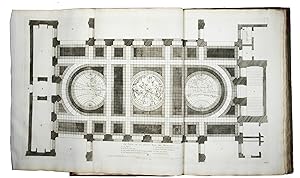
Architecture peinture et sculpture de la maison de ville d'Amsterdam, representée en CIX. Figures en taille-douce.
Verlag: David Mortier,, Amsterdam,, 1719
Anbieter: Antiquariaat FORUM BV, Houten, Niederlande
Verkäuferbewertung 5 von 5 Sternen

Erstausgabe
EUR 1.950,00
EUR 25,00 Versand
Versand von Niederlande nach USAAnzahl: 1 verfügbar
In den WarenkorbFirst French edition of Van Campen's famous description of the Amsterdam City Hall (the present day Royal Palace), with more than a hundred plates of the architectural features and sculptures of the building, including ground plans, elevations, and sections of the interior and exterior. Particularly impressive are the giant plates of the tympana, which are more than 160 cm wide when fully unfolded. The work also includes the famous plate of the extraordinary cartographic mosaic floor of the Burgerzaal, which shows the zodiac signs that were originally painted on the celestial map in the middle, but are now no longer visible on the floor itself due to fading.The City Hall is the most famous and last major work by Jacob van Campen (1595-1657), the greatest Dutch architect of the 17th century. He began work on the design in 1640, and though the building opened in 1655, it was not actually completed until 1665. It was called "the eighth wonder of the world" at the time, and is still considered the most important Dutch monument from the 17th century. It was designed to show off Amsterdam's wealth and magnificence. This is especially visible in the Burgerzaal, the heart of the building, which depicts Amsterdam as the centre of the world. The impressive mosaic floor, with a celestial map in the centre and the two maps of both hemispheres of the world on either side, symbolises that the world was at Amsterdam's feet. These maps are the largest ever made. They show Abel Tasman's then recent discoveries in Australia and Tasmania. Many discoveries from his second voyage remained otherwise unpublished until the end of the 17th century.The present work is the French edition of Van Campen's Afbeelding van 't stadt huys van Amsterdam (1664). The plates were drawn by Hubert Quiellinus (1619-1687), and Danckert Danckertsz. (1634-1666) and his father after drawings by Jacob Vennekool (17th century), and were first published in Quiellinus' Prima [et secunda] pars praecipuarum . curiae Amstelrodamenis (1655-1663) and Afbeelding van 't stadt huys van Amsterdam in dartigh coopere plaaten . geteeckent door Jacob Vennekool (1661). As such, most of the present engravings were published before the building was completed, and may therefore reflect Van Campen's plan more closely than the finished building itself. The edges and corners of the boards are scuffed, the spine has been rubbed, with loss material, old restoration at the head and foot of the spine. The text leaves are lightly browned, the plates are very clean.l BAL 132; Berlin Kat. 2235; STCN 182312917 (5 copies, of which 1 incomplete); cf. Fowler 77 & 274 (1661 Danckerts eds.); for the map, see also: Schilder, Australia Unveiled, map 66; Shirley 423. Contemporary quarter brown sheepskin, sewn on 5 supports with the corresponding raised bands on the spine, the title lettered in gold on the spine, sprinkled paper sides, red sprinkled edges. With a title-page in red and black with an engraved device (a portrait of Erasmus in an elaborate cartouche with allegorical figures), and 124 engraved architectural and sculptural illustrations on 109 numbered plates (6 double-page, 103 full-page). Pages: 22 pp. + 109 plates.
-
Bouw schilder en beeldhouwkonst, van het stadhuis te Amsteldam, vertoont in CIX figuuren: .
Verlag: Johannes Covens, Cornelis Mortier and Johannes Covens junior,, Amsterdam,, 1780
Anbieter: ASHER Rare Books, T Goy Houten, Niederlande
Verkäuferbewertung 5 von 5 Sternen
EUR 5.500,00
EUR 25,00 Versand
Versand von Niederlande nach USAAnzahl: 1 verfügbar
In den WarenkorbA comprehensive collection of plates showing all architectural features and sculpture of the Amsterdam City Hall, since 1808 the Royal Palace, here in the Covens & Mortier firm's rare ca. 1780 issue with the engravings newly printed from the original copper plates from the years 1655 to 1664 and the text reissued from Leonardus Schenk's 1747 Dutch language edition, the whole with a new title-page. ''This version has not been seen'' (BAL). At least most of the plates were engraved for and first published in Jacob van Campen's masterpiece Afbeelding van 't stadt huys van Amsterdam (Amsterdam, Frederick de Wit, 1664), Hubert Quiellinus's Prima [et secunda] pars praecipuarum . curiae Amstelrodamenis (Amsterdam, Frederick de Wit 1655-1663) and Afbeelding van 't stadt huys van Amsterdam in dartigh coopere plaaten . geteeckent door Jacob Vennekool (Amsterdam, Dancker Danckerts, 1661).It includes the famous plate showing the extraordinary cartographic mosaic floor of the Burgerzaal of the Amsterdam City Hall, designed by Jacob van Campen, with a celestial map in the centre and the magnificent map of the world in 2 hemispheres on either side. The engraving was first published in 1661, and the map shows Tasman's recent discoveries in Australia and Tasmania, and depicts California as an island. Many discoveries from his second voyage remained otherwise unpublished until the end of the 17th century. The drawing of the floor was made by Jacob Vennekool who worked closely with Van Campen, and since his drawings were first published even before the building was completed, they may reflect Van Campen's plan more closely than the finished building itself. They also, of course, show it before the alterations made at various times in later years.Binding a little worn, untrimmed, otherwise in good condition. The Amsterdam city hall in full glory with all its architectural features and sculpture.l BAL 132 note (description of 1719 French language ed. but citing Berlin Kat. & Kuyper for unseen "1730" Dutch ed.); Berlin Kat. 2236; Kuyper, Dutch Classicist architecture (Delft, 1980), pp. 212- 215 and note 25 (p. 318); STCN (3 copies); cf. for dating the impressum: Van Egmond, Covens & Mortier (2005), pp. 66, 83-88. Contemporary half red roan (sheepskin), brown sprinkled paper sides. With the title page printed in red and black with J. Covens & C. Mortier's engraved device by Bernard Picart ("JCCM" cypher monogram in a laurel wreath carried by 6 putti, dated 1730); 2 preliminary plates containing portraits of Jacob van Campen [by Lutma] and Arthus Quellinus by Henricus Quellinus; CIX (109) numbered engraved and etched architectural plates (7 folding, 30 double-page and 72 single-page, a few printed from 2 or 3 copper plates, distinguished by arabic numerals) showing plans elevations, tympana, ceilings, floors, statues, festoons and other ornamentation, mostly engraved by Hubertus Quellinus after Arthus Quellinus, but some after "R.V.H." (Rombout Verhulst). All plates have French captions, some with laudatory verses below, and are described in Dutch in the letterpress text (pp. 3-15). Pages: 15 pp.
-

Afbeelding van't Stadt Huys Van Amsterdam, In dartigh Coopere Plaaten geordineert door Jacob van Campen ; en Geteeckent door Iacob Vennekool. ( bound with ) Het Eerste Deel van de voornaemste Statuen ende Ciraten van't konstrijck Stadthuys van Amstelredam.(.this title also in Latin and French) (bound with) Het tweede deel van de voornaemste Statuen ende Cieraten van't konst-rijcke Stadt-huys van Amstelredam 'tmeeste in Marmer gemaeckt door Artus Quellinus.(.this title also in Latin)
Anbieter: Antiquariaat Wim de Goeij, Kalmthout, ANTW, Belgien
Verbandsmitglied: ILAB
Verkäuferbewertung 5 von 5 Sternen
Erstausgabe
Convolute of two richly illustrated and contemporary works on the new Amsterdam townhall (built 1648 - 1655). [1]. Amsterdam, Fredrick De Widt, 1664 , in-folio, 42 x 27 cm, portrait of the architect + engraved title + (16) pp (numbered 1-11) + 29 engraved plates (O being a folding plates on two sheets), collation identical with Fowler N°77, who describes the first edition of 1661. Our edition is the second. [2]. Prima Pars ( first part) Amsterdam, Frederick de Witt, 1665, in-folio, 42 x 27 cm, portrait of A. Quellin + engraved title + engraved plate index + 47 engraved plates ( 4 double page plates and 43 single page, all with blank verso). [2bis] Secunda Pars ( second part), Amsterdam, Frederick de Witt, 16th jan. 1668, engraved title + engraved plate index + 51 engraved plates + 2 double page unmarked plates + 2 large folding plates. First edition , collation identical with Fowler N° 274, who describes the first edition of 1655/1663. Our copy , from the second edition, has therefore the four large plates added at the end. Bound in a fine modern red quarter morocco binding, with double gilt fillets to mark the corners, raised and richly decorated gilt spine, red matching marbled boards and endpapers. The book is generally in very fine condition allthough the first title and portrait have thumbmarks and some dustsoiling. Plate I and K in the first book are slightly trimmed at the head by the binder. Plate R3 in the second work has a few small holes repaired, with some loss at the image. Tear repaired at the second double page plate (after X3 in the second part). The very large folding plates ( 42 x 160 cm !) at the end have some fraying and dustsoiling at the lower margin. The last of these folding plates has also some loss of image at the top (ca. 2 x 6 cm). Campen's impressive record of the architecture and decoration of the Amsterdam Town Hall. It was certainly the most grandiose of all European town halls built in the 17th century and in a way the confirmation of the economic and cultural richness of Holland which had definitely shifted now in the Low Countries from the South to the North; confirmed with the Treaty of Munster, agreed in the same year as the start of the building.
-
Portrait of Artus Quellinus I (1609-1668) in oval, ribbons and laurel descending from knots on the top corners. On the bottom of the oval frame a stylized animal mask. Cartouche on the bottom ends in acantus leaves. Lettered on cartouche: Artus Quellinius Antverpiensis / Curiæ Amstelodamensium statuarius. / Hubertus Quellinius, delin. et sculp. . l Etching on paper; small margins; platemark: 314 x 224 mm, total: 322 x 231 mm; only state. PP01Q (Quellinus).
-

EUR 1.667,50
EUR 31,80 Versand
Versand von Niederlande nach USAAnzahl: 1 verfügbar
In den WarenkorbTwo large triangular prints with reproductions of the architectural details of the Palace on the Dam Square in Amsterdam (in Dutch, known as the Stadhuis van Amsterdam, or the Royal Palace of Amsterdam). The first is an allegory of Amsterdam's victory over the sea. It shows the Amsterdam Virgin, surrounded by mythological sea creatures, such as nereids, hippocampi, tritons, fish, seals, a swan and a crocodile. The second is an allegory of Amsterdam's commerce with the four continents. Centrally, it features the Amsterdam Virgin, with at her feet the river gods of the Amstel and the IJ. She is surrounded by four personifications of the continents America (with feather headdress), Asia (turban, camel and incense burner), Europ (imperial crown and cornucopia) and Africa (sun hat, lions and elephant). Etching and engraving on hand laid paper, printed from three plates on three sheets. Made by Hubert Quellinus after the sculptures made by his brother, Artus Quellinus. Ca. 166 x 44 cm and 175 x 45 cm., dated 1664. Hubert Quellinus (Antwerp 1619 - 1687 Antwerp) was a printmaker, draughtsperson and painter. He was a member of the prominent Quellinus family of artists, and his engravings reproducing the work of his sculptor brother, Artus Quellinus, were very importrant for the spread of the Flemish Baroque style in Europe. Artus Quellinus I (Antwerp 1609 - 1668 Antwerp) was a Flemish sculptor, and older brother of Hubert. He is regarded as the most important Baroque sculptor from the Southern Netherlands. In decent condition, for the sheer size of these sheets. Both are folded multiple times, as issued, but both also have some additional (sometimes sharp) creases. Some of the folds are tearing, into the image, but without paper loss. References: Hollstein Dutch 288: 5. Hollstein gives no states, but at least two different states are recognised by the Prentenkabinet of the Rijksmuseum Amsterdam. Of these, this is the first (the second having additional lettering in the lower margin).