Gesamtpreis (1 Artikel Artikel):
Versandziel:

HARTREE, DOUGLAS (22 Ergebnisse)
Direkt zu den wichtigsten Suchergebnissen
Suchfilter
Produktart
- Alle Product Types
- Bücher (22)
- Magazine & Zeitschriften (Keine weiteren Ergebnisse entsprechen dieser Verfeinerung)
- Comics (Keine weiteren Ergebnisse entsprechen dieser Verfeinerung)
- Noten (Keine weiteren Ergebnisse entsprechen dieser Verfeinerung)
- Kunst, Grafik & Poster (Keine weiteren Ergebnisse entsprechen dieser Verfeinerung)
- Fotografien (Keine weiteren Ergebnisse entsprechen dieser Verfeinerung)
- Karten (Keine weiteren Ergebnisse entsprechen dieser Verfeinerung)
- Manuskripte & Papierantiquitäten (Keine weiteren Ergebnisse entsprechen dieser Verfeinerung)
Zustand Mehr dazu
- Neu (3)
- Wie Neu, Sehr Gut oder Gut Bis Sehr Gut (Keine weiteren Ergebnisse entsprechen dieser Verfeinerung)
- Gut oder Befriedigend (8)
- Ausreichend oder Schlecht (1)
- Wie beschrieben (10)
Einband
Weitere Eigenschaften
- Erstausgabe (9)
- Signiert (Keine weiteren Ergebnisse entsprechen dieser Verfeinerung)
- Schutzumschlag (4)
- Angebotsfoto (7)
Sprache (3)
Gratisversand
Land des Verkäufers
Verkäuferbewertung
-

Calculating Instruments and Machines
Anbieter: Majestic Books, Hounslow, Vereinigtes Königreich
Verkäuferbewertung 4 von 5 Sternen

EUR 13,45
EUR 7,46 Versand
Versand von Vereinigtes Königreich nach USAAnzahl: 4 verfügbar
In den WarenkorbZustand: New. pp. 152.
-
Numerical Analysis.
Verlag: Oxford: Clarendon Press, 1952
Anbieter: Plurabelle Books Ltd, Cambridge, Vereinigtes Königreich
Verbandsmitglied: GIAQ
Verkäuferbewertung 5 von 5 Sternen

EUR 23,65
EUR 9,18 Versand
Versand von Vereinigtes Königreich nach USAAnzahl: 1 verfügbar
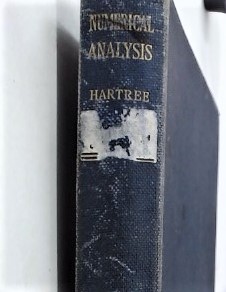
In den WarenkorbHardcover. Zustand: Good. xiv 287p navy hardback, somewhat scuffed and faded boards, spine with old library marks, from a Cambridge college library, text clean with odd light pencil marks, binding still tight, hinges a bit rubbed Language: English.
-

Numerical Analysis.
Verlag: Oxford University Press, 1955
Anbieter: Plurabelle Books Ltd, Cambridge, Vereinigtes Königreich
Verbandsmitglied: GIAQ
Verkäuferbewertung 5 von 5 Sternen
EUR 28,38
EUR 9,18 Versand
Versand von Vereinigtes Königreich nach USAAnzahl: 1 verfügbar
In den WarenkorbHardcover. Zustand: Good. xiv 287p original cloth worn with age and use, with the chapter on Organisation of Calculations for an Automatic Machine, from a Cambridge college library with signs of wear Language: English.
-

Calculating Instruments and Machines
Sprache: Englisch
Verlag: Cambridge University Press, 2012
ISBN 10: 1107630657 ISBN 13: 9781107630659
Anbieter: Revaluation Books, Exeter, Vereinigtes Königreich
Verkäuferbewertung 5 von 5 Sternen
EUR 48,91
EUR 11,48 Versand
Versand von Vereinigtes Königreich nach USAAnzahl: 1 verfügbar
In den WarenkorbPaperback. Zustand: Brand New. reissue edition. 138 pages. 9.50x6.75x0.50 inches. In Stock.
-

Calculating Machines: Recent and Prospective Developments and Their Impact on Mathematical Physics, and Calculating Instruments and Machines
Anbieter: Revaluation Books, Exeter, Vereinigtes Königreich
Verkäuferbewertung 5 von 5 Sternen
EUR 63,24
EUR 14,35 Versand
Versand von Vereinigtes Königreich nach USAAnzahl: 1 verfügbar
In den WarenkorbPaperback. Zustand: Brand New. 154 pages. 8.98x5.98x0.71 inches. In Stock.
-

Numerical Analysis.
Anbieter: Antikvariat Faust, Göteborg, Schweden
Verkäuferbewertung 3 von 5 Sternen

Clarendon Press, Oxford 1955. Second printing. xiv, 287 pp. Publisher's cloth. Bookplate. Fine condition.
-
Numerical Analysis.
Verlag: Oxford: Clarendon Press, 1964
Anbieter: Antiquariat Smock, Freiburg, Deutschland
Verkäuferbewertung 5 von 5 Sternen
Zustand: Akzeptabel. Formateinband: Leinen / gebundene Ausgabe XVI, 302 S. (24,5 cm) Reprint of the 2nd edition; Exemplar aus Institutsbibliothek mit Standortschild am Rücken, Stempel u. kl. Barcodeklebern, mit Klarsichtfolie überzogen; sonst in gutem Zustand. Sprache: Englisch Gewicht in Gramm: 950 [Stichwörter: Numerische Analysis].
-
Numerical Analysis.
Verlag: Oxford University Press, 1955
Anbieter: Plurabelle Books Ltd, Cambridge, Vereinigtes Königreich
Verbandsmitglied: GIAQ
Verkäuferbewertung 5 von 5 Sternen
EUR 54,40
EUR 9,18 Versand
Versand von Vereinigtes Königreich nach USAAnzahl: 1 verfügbar
In den WarenkorbHardcover. Zustand: Very Good. xiv 287p cloth, dustjacket (small tear), with an important chapter on Organisation of Calculations for an Automatic Machine, this copy was formerly owned by Prof Cassells of Cambridge Language: English.
-

Hardcover. Zustand: Good. It's a preowned item in good condition and includes all the pages. It may have some general signs of wear and tear, such as markings, highlighting, slight damage to the cover, minimal wear to the binding, etc., but they will not affect the overall reading experience.
-
Calculating Instruments and Machines.
Sprache: Englisch
Verlag: Cambridge University Press, London, 1950
Anbieter: Antiquariat Silvanus - Inhaber Johannes Schaefer, Ahrbrück, Deutschland
Verkäuferbewertung 4 von 5 Sternen
IX, 138 pp. with a lot of illusrations, Sprache: Englisch Gewicht in Gramm: 510 Groß 8°, Original-Leinen (Hardcover), Bibliotheks-Exemplar (ordnungsgemäß entwidmet), Stempel auf Titel, insgesamt gutes und innen sauberes Exemplar, (library copy in good condition),
-
AN APPROXIMATE WAVE FUNCTION FOR THE NORMAL HELIUM ATOM; A PRACTICAL METHOD FOR THE NUMERICAL SOLUTION OF DIFFERENTIAL EQUATIONS (both articles contained one one complete issue of Memoirs and Proceedings Manchester Society 1932-33)
Erscheinungsdatum: 1933
Anbieter: Xerxes Fine and Rare Books and Documents, Glen Head, NY, USA
Verkäuferbewertung 5 von 5 Sternen
Zustand: Fair. Manchester 1933 first edition. Memoirs and Proceedings of Manchester Literary & Philosophical Society 1932-33. Original pale blue printed wraps. octavo. Hartree articles on pp. 69-90 and 91-107. Hartree's work in numberical analysis contributed to development of calculators and computers. Cover Fair, creased and worn with light chipping; text near Fine, clean and bright. Institute stamp on cover. no other ownership marks.
-
Calculating Instruments & Machines
Verlag: Cambridge at the University Press, London, 1950
Anbieter: Theologia Books, La Charite sur Loire, Frankreich
Verkäuferbewertung 4 von 5 Sternen
Erstausgabe
Hardcover. Zustand: Very Good. Zustand des Schutzumschlags: Good. First Edition. Very good hardback copy in slightly shelfworn dustjacket. ix, 138pp., b/w illustrations Size: 9.75" x 6.5" (25x17cms). Book.
-
Wave functions for negative ions of sodium and potassium.
Verlag: University Press, 1938., In: Proceedings of the Cambridge Philosophical Society, Vol. 34, 1938. Cambridge:, 1938
Anbieter: Jeff Weber Rare Books, Neuchatel, NEUCH, Schweiz
Verkäuferbewertung 5 von 5 Sternen
254 x 181 mm. Tall 8vo. Pages 550-558. [Entire volume: viii, 645, [2] pp.] 4 tables. Quarter navy morocco, morocco corners, raised bands, gilt spine; spine lightly faded. Blind stamp of the Carnegie Institution of Washington, Mount Wilson Observatory. Fine. "Hartree and his collaborators evaluated wave functions for more than twenty-five different atomic species in various states of ionization. Through his stimulus and encouragement many more atoms were investigated by physicists throughout the world. Hartree's equations as generalized by V. Fock proved to be extremely valuable in theoretical calculations in sold state physics." DSB, VI, p. 147.
-
Calculating Instruments and Machines
Verlag: University of Illinois Press, Urbana, 1949
Anbieter: Sekkes Consultants, North Dighton, MA, USA
Verkäuferbewertung 5 von 5 Sternen
Erstausgabe
Hardcover. Zustand: very good. First Edition. This book was based on a short series of lectures given by the author at the University of Illinois in 1948. Intended as a general introduction illustrated by Hartree's personal experiences working with ENIAC and the Harvard Mark I, a pioneering work with calculating instruments and machines. Author's first book. Douglas Rayner Hartree FRS was an English mathematician and physicist most famous for the development of numerical analysis and its application to the Hartree Fock equations of atomic physics and the construction of a differential analyzer using Meccano. Boards with light edge-wear. First Edition. 7" - 10". Book.
-
Numerical analysis.
Verlag: Clarendon Press, 1952., Oxford:, 1952
Anbieter: Jeff Weber Rare Books, Neuchatel, NEUCH, Schweiz
Verkäuferbewertung 5 von 5 Sternen
Erstausgabe
8vo. xiv, 287 pp. 31 figs., bibliog., index. Navy cloth, gilt spine, dust-jacket. Ownership rubber stamps of Robert L. White. Fine. FIRST EDITION. "Calculation originally, and over a long period, meant numerical calculation â" the repertoire of arithmetical operations such as addition, subtraction, multiplication and division, and procedures such as extraction of square roots, which could be applied to arbitrary numbers: integers, fractions, and rational, irrational and transcendental numbers. Subsequent developments of such procedures into powerful methods for the solution of general mathematical problems in numerical terms came to known, in English, as numerical analysis." Ifrah, The universal history of computing, p. 69. DSB, VI, p. 148.
-
The Mechanical Integration of Differential Equations [IN:] The Mathematical Gazette, Vol. XXII, No. 251
Verlag: G. Bell and Sons, London, 1938
Anbieter: Boris Jardine Rare Books, Edinburgh, Vereinigtes Königreich
Verkäuferbewertung 5 von 5 Sternen
Erstausgabe
EUR 236,50
EUR 20,61 Versand
Versand von Vereinigtes Königreich nach USAAnzahl: 1 verfügbar
In den WarenkorbHardcover. Zustand: Very Good. 1st Edition. 8vo; pp. xiii, 528; Hartree pp. 342364 [whole volume offered]. A MECCANO DIFFERENTIAL ANALYZER. Hartree's important account of the 'differential analyser' with photographs of the manchester analyser, and Hartree's pioneering Meccano model. The most comprehensive of the early essays on the differential analyser, with diagrams and photographs illustrating the design, accounts of the use and applications of the machine, and a useful bibliography. The Differential Analyser was invented by Vannevar Bush, and first published in 1931; Bush's invention was the culmination of a line in computer design that goes back to the work of James and William Thomson (Lord Kelvin), most famously the latter's tide-predicting machine. The Differential Analyser was hugely successful, circulating around the world via the unconventional medium of the children's construction-set Meccano. Very good condition in green cloth; clean and unmarked throughout, noting only very faint and very occasional foxing, barely affecting the Hartree essay.
-
Calculating Instruments and Machines
Verlag: University of Illinois Press, Urbana, 1949
Anbieter: Lux Mentis, Booksellers, ABAA/ILAB, Portland, ME, USA
Verbandsmitglied: ABAA ILAB MABA
Verkäuferbewertung 4 von 5 Sternen
Erstausgabe
Hardcover. Zustand: Fine in Near Fine DJ. First Edition. First Edition. Hardcover. "The first comprehensive exposition of electronic digital computing." [OOC 652] "These lectures were intended for a well-informed scientific audience outside the tiny group of professionals then involved with electronic computing. They represented the first comprehensive exposition of electronic digital computing, and this book was one of the first two treatises on the subject. The other book, Edmund Berkeley's Giant Brains or Machines That Think was written for a more popular audience and achieved greater sales. . . . Chapter 8, entitled 'Projects and prospects,' contains the first generally available comprehensive account of the stored-program machines then in development, including EDVAC, ACE, and EDSAC." [OOC 652]. Minimal shelf/edge wear, else tight, bright, and unmarred; DJ shows minor shelf/edge wear, one small closed tear, else bright and clean. Orange cloth boards, black ink lettering. 8vo. 138pp. Illus. (b/w plates).
-
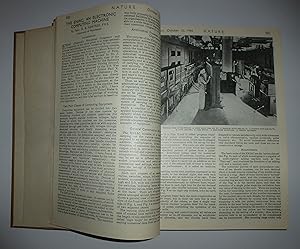
The ENIAC, an Electronic Computing Machine.
Verlag: Macmillan & Co., London, 1946
Anbieter: Sekkes Consultants, North Dighton, MA, USA
Verkäuferbewertung 5 von 5 Sternen
Erstausgabe
Hardcover. Zustand: very good. first edition. First printing of this critical work in the history of computing and a foundational text that launched a circulation through an international scientific journal. In "Nature", Vol 158. October - December, 1946. Entire volume offred with ENIAC [Electronic Numerical Integrator And Computer] article Pp. 500-506. [Entire volume: Pp. 459-956]. Hartree, a British mathematician, first learned of ENIAC in 1945, when he saw the as-yetuncompleted machine during a visit to the Moore School at the University of Pennsylvania. It was here that this first general-purpose Turing complete digital electronic computer, was built between 1943 and 1946. The first computer course was given at the Moore School in Summer 1946, leading to an explosion in computer development all over the world. Hartree was a participant in the lectures, advising on nonmilitary uses of the ENIAC while being the first Englishman to work with the machine. Later, Hartree helped stimulate the development of more powerful computers like Cambridge University's EDSAC. The ENIAC was 10 feet high, and 3 deepand contained 18,000 vacuum tubes, about 70,000 resistors, 10,000 capacitors, and 6,000 switches. It consumed 140 kilowatts, so much power that when operated the lights in a nearbytown dimmed. Royal 8vo bound in contemporary cloth. Provenance: Bookplates stamps on front free end-papers of the University of Oxford. Near fine and clean. 7½" - 10". book.
-

Automatische Rechenmaschinen.
Sprache: Deutsch
Verlag: Ohne Ort, 1951
Anbieter: Antiquariat Gerhard Gruber, Heilbronn, Deutschland
Verkäuferbewertung 5 von 5 Sternen
Erstausgabe
(29,5 x 21 cm). 12 S. Mit 8 Abbildungen. Original-Broschur. (Sonderdruck aus: Zeitschr. für angew. Mathematik und Mechanik). Erste Ausgabe eines Vortrags für die Jahrestagung der Gesellschaft für angewandte Mathematik und Mechanik in Darmstadt. - Es werden u.a. die Rechner Mark I, Eniac und EDSAC beschrieben. - Wohlerhalten. - DSB 6, 147.
-
The ENIAC, an Electronic Computing Machine. [In:] Nature, vol. 158, pp. 500?506,
Verlag: October 12, 1946
Anbieter: Nigel Phillips ABA ILAB, Chilbolton, Vereinigtes Königreich
Verkäuferbewertung 5 von 5 Sternen
EUR 295,63
EUR 51,66 Versand
Versand von Vereinigtes Königreich nach USAAnzahl: 1 verfügbar
In den WarenkorbLarge 8vo, pp. lii, 956. Black buckram, spine lettered in gilt, library bookplate. The whole volume is offered, of which Hartree?s paper occupies pp. 500?506, with 3 photographic illustrations. FIRST EDITION. ?The first paper on an electronic digital computer published in a large-circulation international scientific journal.? Hartree, a British mathematician, first learned of ENIAC in 1945, and the following year became the first Englishman to work with the machine. ?He was the first to bring news of ENIAC to Great Britain, publishing the above article in Nature shortly after his return from the United States.? Hook & Norman, Origins of cyberspace, 648.
-
The ENIAC, an Electronic Computing Machine. - ["FIRST PAPER ON AN ELECTRONIC DIGITAL COMPUTER PUBLISHED IN A LARGE-CIRCULATION"]
Anbieter: Herman H. J. Lynge & Søn ILAB-ABF, Copenhagen, Dänemark
Verkäuferbewertung 4 von 5 Sternen
Erstausgabe
London, Macmillan & Co., 1946. 8vo. Without wrappers. Extracted from "Nature. No. 4015, Saturday, October 12, 1946, Vol. 158". A fine and clean copy. [Hartree:] Pp. 500-6. [Entire offered issue: Pp. 495-528]. First printing of this "first paper on an electronic digital computer published in a large-circulation international scientific journal." (OOC).The ENIAC was the first general-purpose electronic computer. It was a Turing-complete [computationally universal] digital computer capable of being reprogrammed to solve a full range of computing problems."Hartree, a British mathematician, first learned of ENIAC [Electronic Numerical Integrator And Computer] in 1945, when he saw the as-yet uncompleted machine during a visit to the Moore School. In 1946 he returned to the Moore School as a participant in the Moore School lectures, advising on nonmilitary uses of ENIAC" during this time he became the first Englishman to work with the machine. He was the first to bring news of ENIAC to Great Britain, publishing the above article in Nature shourtly after his return from the United States. Although he himself invented no new calculating devices, Hartree's promotion of electronic digital calculating methods in scientific computation helped to stimulate the development of more powerful computers like Cambridge University's EDSAC." (OOC).The ENIAC was compared to today's standard rather large: It was 100 feet long, 10 feet high, and 3 deep and contained 18,000 vacuum tubes, about 70,000 resistors, 10,000 capacitors, and 6,000 switches. It consumed 140 kilowatts of power, so much power that, when operated, the lights in a nearby town dimmed.See: Hook & Norman. Origins of Cyberspace 648.
-
The ENIAC, an electronic computing machine
Erscheinungsdatum: 1946
Anbieter: Jeremy Norman's historyofscience, Novato, CA, USA
Verkäuferbewertung 5 von 5 Sternen
Erstausgabe
Hartree, Douglas R. (1897-1958). The ENIAC, an electronic computing machine. In Nature 158 (October 1946): 500-506. 8vo extract of 495-528pp. Text illustrations. 250 x 170 mm. Disbound. Corner torn from last leaf of number, affecting text, spine splitting. Very good copy. First Edition. The first paper on an electronic digital computer published in a large-circulation international scientific journal. The ENIAC, developed during World War II by Pres Eckert and John Mauchly at the University of Pennsylvania's Moore School of Engineering, was the world's first large-scale general purpose digital computer. Hartree, a British mathematician, first learned of ENIAC in 1945, when he saw the as-yet uncompleted machine during a visit to the Moore School. In 1946 he returned to the Moore School as a participant in the Moore School lectures, advising on nonmilitary uses of ENIAC; during this time he became the first Englishman to work with the machine. He was the first to bring news of ENIAC to Great Britain, publishing the above article in Nature shortly after his return from the United States. Although he himself invented no new calculating devices, Hartree's promotion of electronic digital calculating methods in scientific computation helped to stimulate the development of more powerful computers like Cambridge University's EDSAC. Origins of Cyberspace 648. Randell 1982a, 473. .


![Bild des Verkäufers für The Mechanical Integration of Differential Equations [IN:] The Mathematical Gazette, Vol. XXII, No. 251 zum Verkauf von Boris Jardine Rare Books](https://pictures.abebooks.com/inventory/md/md31891866141.jpg)