Gesamtpreis (1 Artikel Artikel):
Versandziel:

MANUSCRIPT CALENDAR (3 Ergebnisse)
Direkt zu den wichtigsten Suchergebnissen
Suchfilter
Produktart
- Alle Product Types
- Bücher (3)
- Magazine & Zeitschriften (Keine weiteren Ergebnisse entsprechen dieser Verfeinerung)
- Comics (Keine weiteren Ergebnisse entsprechen dieser Verfeinerung)
- Noten (Keine weiteren Ergebnisse entsprechen dieser Verfeinerung)
- Kunst, Grafik & Poster (Keine weiteren Ergebnisse entsprechen dieser Verfeinerung)
- Fotografien (Keine weiteren Ergebnisse entsprechen dieser Verfeinerung)
- Karten (Keine weiteren Ergebnisse entsprechen dieser Verfeinerung)
- Manuskripte & Papierantiquitäten (Keine weiteren Ergebnisse entsprechen dieser Verfeinerung)
Zustand Mehr dazu
- Neu (Keine weiteren Ergebnisse entsprechen dieser Verfeinerung)
- Wie Neu, Sehr Gut oder Gut Bis Sehr Gut (Keine weiteren Ergebnisse entsprechen dieser Verfeinerung)
- Gut oder Befriedigend (Keine weiteren Ergebnisse entsprechen dieser Verfeinerung)
- Ausreichend oder Schlecht (Keine weiteren Ergebnisse entsprechen dieser Verfeinerung)
- Wie beschrieben (3)
Einband
- alle Einbände
- Hardcover (Keine weiteren Ergebnisse entsprechen dieser Verfeinerung)
- Softcover (Keine weiteren Ergebnisse entsprechen dieser Verfeinerung)
Weitere Eigenschaften
- Erstausgabe (Keine weiteren Ergebnisse entsprechen dieser Verfeinerung)
- Signiert (Keine weiteren Ergebnisse entsprechen dieser Verfeinerung)
- Schutzumschlag (Keine weiteren Ergebnisse entsprechen dieser Verfeinerung)
- Angebotsfoto (3)
Sprache (1)
Preis
- Beliebiger Preis
- Weniger als EUR 20 (Keine weiteren Ergebnisse entsprechen dieser Verfeinerung)
- EUR 20 bis EUR 40 (Keine weiteren Ergebnisse entsprechen dieser Verfeinerung)
- Mehr als EUR 40
Gratisversand
- Kostenloser Versand nach USA (Keine weiteren Ergebnisse entsprechen dieser Verfeinerung)
Land des Verkäufers
Verkäuferbewertung
-
TEXT FROM THE MONTH OF AUGUST
Verlag: second half of 15th century, France (probably Rouen)
Anbieter: Phillip J. Pirages Rare Books (ABAA), McMinnville, OR, USA
Verkäuferbewertung 3 von 5 Sternen

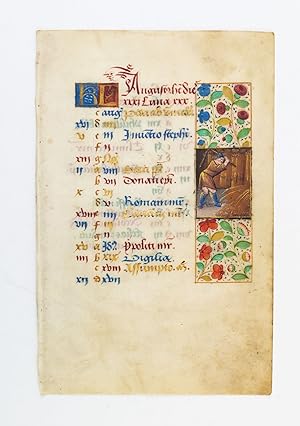
162 x 117 mm. (6 3/8 x 4 5/8"). Single column, 17 ruled lines, text in a bâtarde hand. Text in gold, blue, and red, "KL" in scrolling white letters on a gold ground with small blue and red blossoms, both sides with panel border of acanthus, flowers, small ink dots, and gold bezants, WITH TWO SMALL MINIATURES showing the labor of the month (Threshing) on recto, and the zodiac sign (Virgo) on verso. âSmall wrinkle in lower margin just touching the lower edge of the miniatures, trivial smudging, but IN VERY FINE CONDITION, the vellum especially clean and bright, the paint quite rich, and the miniatures extremely well preserved. With clean, white vellum, small but appealing miniatures, and attractive lettering and decoration, this is a desirable example of a calendar leaf from a high-quality Book of Hours likely made in Rouen. According to Roger Wieck, far fewer than half the Books of Hours of the period contain illustrated calendars, "even in manuscripts with otherwise lavish cycles of miniatures"; when they do appear, they are invariably charming, as is the case here. In the lower margin of the recto is a small miniature depicting the typical labor for August, "Threshing," in which a young layman brings down his grain flail (two hinged pieces of wood, the longer one called a helve, and the other a beater, joined by a thong) in an effort to separate the grain, while neatly stacked unprocessed clumps of straw appear just behind it. On the verso we see a representation of Virgo as a young woman holding, appropriately, a long sheaf of grain in her hand. While most of the feast days that appear in the calendar are typical for the period, the inclusion of St. Sauveur (i.e. Transfiguratio Domini) on 6 August is characteristic of a calendar for the use of Rouen, suggesting that the parent manuscript may have been produced in that place or the region around it.
-
TEXT FROM THE MONTH OF AUGUST
Verlag: ca. 1470, Northern France (probably Rouen), 1470
Anbieter: Phillip J. Pirages Rare Books (ABAA), McMinnville, OR, USA
Verkäuferbewertung 3 von 5 Sternen
180 x 117 mm. (7 x 4 5/8"). Single column, 18 lines, text in a bâtarde hand. Text in red, blue, and gold, two-line "KL" in shell gold on blue and red ground, both sides with panel border composed of flowers and ink dots, WITH TWO SMALL MINIATURES, each centered in the middle of the panel borders, featuring the labor of the month (Threshing) and the zodiac sign (a young woman for Virgo). Vellum a bit soiled and slight wrinkling in margins, small area of rubbing at bottom of the Virgo miniature, but in excellent condition overall, the fine details in the miniatures well preserved. Situated among the flowers of the panel borders here are two small but charming miniatures depicting the labor of the month, "Threshing," and the zodiac sign for August. According to Roger Wieck, far fewer than half the Books of Hours of the period contain illustrated calendars, "even in manuscripts with otherwise lavish cycles of miniatures"; when they do appear, they are invariably charming, as is the case here. In the threshing scene, a young layman brings down his grain flail (two hinged pieces of wood, the longer one called a helve, and the other a beater, joined by a thong) in an effort to separate the grain, while neatly gathered bushels of straw appear just behind him. On the verso we see a representation of Virgo as a young woman holding, appropriately, two long stalks of grain in her hands. The rich palette used in these miniatures allows the delicate gold highlighting on the harvested crop and garments to shine through, adding a fine sense of detail to each image.
-
TEXT FROM THE MONTH OF MARCH
Verlag: mid-15th century, France (possibly Rouen)
Anbieter: Phillip J. Pirages Rare Books (ABAA), McMinnville, OR, USA
Verkäuferbewertung 3 von 5 Sternen
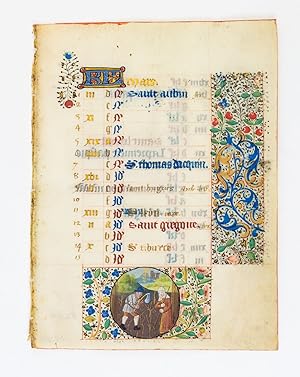
173 x 130 mm. (6 3/4 x 5 1/8"). Single column, 16 ruled lines, text in a gothic book hand. Text in gold, blue, and dark pink, "KL" in blue with white tracery on a gold ground decorated with dark pink baubles and leaves and with a floral spray extension, both sides with panel border composed of densely packed acanthus, flowers, and hairline vines with gold bezants, WITH A SMALL ROUNDEL MINIATURE at the bottom depicting the labor of the month (Pruning) set on a panel of flowers, hairline vines, and gold bezants. With numbering to the left of the golden numbers and a few calendar entries in a later hand. âLight soiling to vellum, a few small smudges in the borders, a little paint transfer affecting a couple lines of text and margins of the verso, but these issues all very minor, and on the whole in fine condition with a particularly well-preserved miniature with rich, uneroded paint. With lovely panel borders and a particularly charming roundel miniature showing the labor of the month, this leaf likely comes from a high-quality manuscript made for a person of means. Though miniatures depicting the labors of the month are often illustrated with just a single person performing the task, here we are treated to two laypeople--a man and a woman--working together to prune and break ground in their field. The man appears to be carrying an axe for trimming branches, while the woman carries a long stick to loosen dirt for spring plantings. The names of several saints have been added to the calendar by a later hand, though it would appear that they were erroneously placed in March: St. Hugh belongs on 9 April, Pope Leo on 11 April, and St. Tiburtius on 14 April. While almost all of these feast days are commonly found in Books of Hours of this period, Hugh (Bishop of Rouen) is slightly unusual, suggesting that the manuscript may have been made in, or at least ended up in, Rouen.