Gesamtpreis (1 Artikel Artikel):
Versandziel:

francis glisson (11 Ergebnisse)
Direkt zu den wichtigsten Suchergebnissen
Suchfilter
Produktart
- Alle Product Types
- Bücher (11)
- Magazine & Zeitschriften (Keine weiteren Ergebnisse entsprechen dieser Verfeinerung)
- Comics (Keine weiteren Ergebnisse entsprechen dieser Verfeinerung)
- Noten (Keine weiteren Ergebnisse entsprechen dieser Verfeinerung)
- Kunst, Grafik & Poster (Keine weiteren Ergebnisse entsprechen dieser Verfeinerung)
- Fotografien (Keine weiteren Ergebnisse entsprechen dieser Verfeinerung)
- Karten (Keine weiteren Ergebnisse entsprechen dieser Verfeinerung)
- Manuskripte & Papierantiquitäten (Keine weiteren Ergebnisse entsprechen dieser Verfeinerung)
Zustand Mehr dazu
- Neu (Keine weiteren Ergebnisse entsprechen dieser Verfeinerung)
- Wie Neu, Sehr Gut oder Gut Bis Sehr Gut (1)
- Gut oder Befriedigend (1)
- Ausreichend oder Schlecht (Keine weiteren Ergebnisse entsprechen dieser Verfeinerung)
- Wie beschrieben (9)
Einband
- alle Einbände
- Hardcover (3)
- Softcover (Keine weiteren Ergebnisse entsprechen dieser Verfeinerung)
Weitere Eigenschaften
- Erstausgabe (4)
- Signiert (Keine weiteren Ergebnisse entsprechen dieser Verfeinerung)
- Schutzumschlag (Keine weiteren Ergebnisse entsprechen dieser Verfeinerung)
- Angebotsfoto (10)
Sprache (1)
Preis
- Beliebiger Preis
- Weniger als EUR 20 (Keine weiteren Ergebnisse entsprechen dieser Verfeinerung)
- EUR 20 bis EUR 45 (Keine weiteren Ergebnisse entsprechen dieser Verfeinerung)
- Mehr als EUR 45
Gratisversand
Land des Verkäufers
Verkäuferbewertung
-
Tractatus de ventriculo et intestinis. Cui praemittitur alius, de partibus continentibus in genere, & in specie, de iis abdominis
Verlag: Jacobum Juniorem, Amsterdam, 1677
Anbieter: Eric Zink Livres anciens, PARIS, Frankreich
Verbandsmitglied: ILAB
Verkäuferbewertung 5 von 5 Sternen

Erstausgabe
Couverture rigide. Zustand: Très bon. Edition originale. plein veau de l'époque, dos à nerfs. Un volume in-12 (135x75 mm), (30)-591 pages et 4 planches hors texte dont le portrait en frontispice. Coiffes et coins abîmés. Edition in-12 publié la même année que l'originale donnée à Londres. References : Garrison-Morton [579: "Glisson introduced the idea of irritability as a specific property of all human tissue, a hypothesis which had no effect upon contemporary physiology, but which was later demonstrated experimentally by Haller "]. ___________________________________________________________________________________ ______________________________ENGLISH_DESCRIPTION : Contemporary full calf, spine with six compartments. 12mo (135x75 mm), (30)-591 pages and 4 plates including the portraict in frontispiece. Caps and corners chipped. Edition published same year as the first published in London. References : Garrison-Morton [579: "Glisson introduced the idea of irritability as a specific property of all human tissue, a hypothesis which had no effect upon contemporary physiology, but which was later demonstrated experimentally by Haller "]. 280g.
-
ANATOMIA HEPATIS
Verlag: Apud Joannem Janssonium à Waesberge & Elizaeum Weyerstraten, Amstelodami [Amsterdam], 1665
Anbieter: Second Story Books, ABAA, Rockville, MD, USA
Verkäuferbewertung 4 von 5 Sternen

Hardcover. Early Edition. 12mo, [46] 423, [19] pages, plus an engraved title page. In Very Good minus condition. Rebound. Half-bound in vellum with blue patterned paper boards. Boards have discoloration to vellum, and light rubbing wear throughout. Textblock has worming to the engraved title page (impacting some text), stain and rubbing wear to the fore edge of title page, splitting to gutter between pages 144-145, minor foxing and soiling throughout, and light age toning. Rebinding has resulted in tight inner margins with occasional loss of text, primarily to pages 186-193. Appears that the engraved title page has been excised and adhered to new page. Text in Latin. Shelved in Room A. 1408618. Special Collections.
-

De rachitide.
Verlag: Driehuysen & Lopez, Leiden, 1671
Anbieter: Jeremy Norman's historyofscience, Novato, CA, USA
Verkäuferbewertung 4 von 5 Sternen
3. 8vo.Engraved title showing rickety child being treated, [18]427,[1]pp.Text woodcuts. 160 x 95mm. Contemporary vellum, a little rubbed, front hinge needs repair. Tear in engraved title repaired & some browning but a good copy. Third edition of the best account of rickets to date and one of the earliest English books in pediatrics. This edition features a handsome engraved title showing treatment of rickets. See G-M 3729. Waller 3590. Not in Wellcome.
-
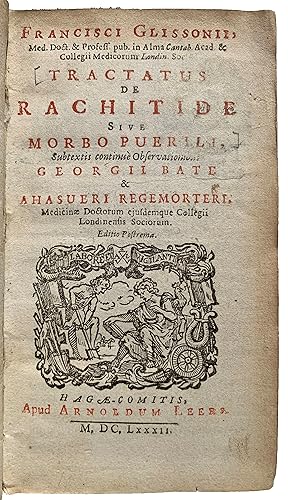
Tractatus de Rachitide sive Morbo Puerili, subtextis continue observationions Georgii Bate & Ahasueri Regemorteri. . . . Editio postrema.
Verlag: Apud Arnoldum Leers, 1682., Hageae-Comitis:, 1682
Anbieter: Jeff Weber Rare Books, Neuchatel, NEUCH, Schweiz
Verkäuferbewertung 4 von 5 Sternen
15 cm. [18], 412 pp. Title printed in red & black, title vignette [depicting ?Labor & Vigilance?* with a man at labor with his shovel; a woman observing & teaching with a book in hand, a rooster next to her shoulder], woodcut figs., woodcut initial letters, head and tail pieces. Lacks engr. frontispiece. Original full vellum; upper cover stained. [*Note: the Tale of the Golden Cockerel, of A.S. Pushkin, the weathervane rotates into the direction from where evil threatens]. Later edition (first issued in 1650). There are two issues of this 1682 issue: some copies have a frontispiece portrait of the author, some other copies do not (this is one). / ?All writers on the diseases of children agree in their admiration of this book. Its 416 pages are full of original observation. The propositions arrived at are stated in a scholastic manner, and some of the accompanying hypotheses are associated with physiological doctrines now forgotten, but these are not mixed up with the observations of patients during life and after death, which make the book a work of permanent value.?? - DNB, VII, p. 1316 [for the 1650 London edition]. / ?It is common knowledge that Dr. Whistler's first description of rickets was eclipsed by Dr. Glisson's scientific contribution of five years later. Francis Glisson (1597â"1677), born and raised in Rampisham, Dorset, published a book on rickets, which was particularly appreciated by both the scientific and public communities. His publication ?De Rachitide Sive Morbo Puerili, qui Vulgo The Rickets dicitur, Tractatus? is dated 1650 [55]. Dr. Glisson received the credit, but in the text more contributing authors were mentioned as well. This report has been recognized as the first official statement from a medical college for both scientific and public audiences using physical evidence and inquiry rather than purely theoretical speculation, emphasizing both clinical and anatomical features of the disease with the help of the morbid anatomy. Glisson's book 'De Rachidite' (1650) was inspiring. Glisson, in addition to being Regius Professor of Physics, Cambridge (1636â"1677), and President of the Royal College of Physicians (1667â"1670), was also one of the first fellows of the Royal Society (1663).? [Mingyong Zhang, Fan Shen, Anna Petryk, Jingfeng Tang, Xingzhen Chen, and Consolato Sergi, ??English Disease?: Historical Notes on Rickets, the Boneâ"Lung Link and Child Neglect Issues,? Nutrients. 2016 Nov; 8(11): 722. / Francis Glisson (1597-1677) ??was a most able clinician as well as anatomist, physiologist, and pathologist, and the present work, first published in London in 1650, gave the first clinical description of rickets with an early note on Barlow's disease (infantile scurvy).? Heirs of Hippocrates. REFERENCES: Grulee 524. See: Garrison-Morton 3729; Major, Classic Descriptions of Disease, p. 597; Still, The History of Paediatrics, pp. 214-27.
-

A Treatise of the Rickets: being a diseas common to children. Wherin (among other things) is shewed, 1. The essence 2. The causes 3. The signs 4. The remedies of the diseas. Published in Latin by Francis Glisson, George Bate, and Ahasuerus Regemorter; doctors in physick, and Fellows of the Colledg of Physitians at London. Translated into English by Phil. Armin.
Verlag: London: Printed by Peter Cole?, 1651
Anbieter: Nigel Phillips ABA ILAB, Chilbolton, Vereinigtes Königreich
Verkäuferbewertung 5 von 5 Sternen
EUR 7.429,73
EUR 51,94 Versand
Versand von Vereinigtes Königreich nach USAAnzahl: 1 verfügbar
In den WarenkorbSmall 8vo, pp. (viii), 283, 294?373, (4). Title within typographical border, a few woodcut illustrations in the text. Woodcut on p. 320 cropped (as usual?, being larger than the text) but several lower margins still uncut, a few paper flaws without loss, paper slightly browned. Contemporary mottled sheep (a few wormholes in the lower cover), competently rebacked in the mid-twentieth century with morocco and with new endpapers, three of the four original endpapers preserved, tips of corners neatly repaired with sheep. Signatures of Henry Chapman, 1656, and Henry Wyles(?) on original front endpaper. FIRST EDITION IN ENGLISH. G&M 3729 and 4297.91 (first edition of the year before). Although preceded by Whistler and Boot, Glisson's was the fullest and most important account of rickets to have appeared. He also described infantile scurvy for the first time. In his clinical descriptions, Glisson was one of the earliest to emphasise the importance of morbid anatomy. He included a detailed study of the biomechanics of deformed bones and joints, and an early study of the pathologic anatomy of scoliosis. He used braces, splints and shoes to straighten bowed legs and curved spines, and advocated exercise and massage to overcome muscular weakness. In attempting to correct the deformities of rickets, Glisson?s work did much to advance the treatment of distortions in general. In 1645 the Royal College of Physicians commissioned a book on rickets, at that time considered a new disease. Having eight contributors, the book was one of the earliest instances of collaborative medical research in England. Glisson, however, was by far the major contributor and editor (and his first book), but his chief collaborators, George Bate and Ahasuerus Regemorter, are also named on the title-page. With the exception of Caius on the sweating sickness, a much less thorough treatise, this was the first monograph on a single disease published in England, and hence one of the earliest published works on deficiency diseases. It was universally acknowledged as a classic account, and Norman Moore in the DNB described it as "one of the glories of English medicine". This English edition is exceedingly rare. Only two copies are recorded as having appeared at auction since 1902 (both with damaged or lacking title-pages). Not in Krivatsy (but the library has an imperfect copy). Wing G860, recording only two copies outside England; even so some of these may be the ?corrected, and very much enlarged edition? also dated 1651, which is not in Wing. See Major, Classic descriptions of disease, pp. 597?600. Still, History of paediatrics, pp. 214?227. Ruhräh pp. 254?284. Bick, Classics of orthopaedics, 63. Bick, Source book, pp. 56?58.
-
De rachitide sive morbo puerili qui vulgo the rickets dicitur.
Verlag: William du Gard for Laurence Sadler and Robert Beaumont, London, 1650
Anbieter: SOPHIA RARE BOOKS, Koebenhavn V, Dänemark
Verkäuferbewertung 5 von 5 Sternen
Erstausgabe
First edition. THE FIRST FULL CLINICAL DESCRIPTION OF RICKETS . First edition, co-author?s copy, of the first full clinical description of rickets, then thought to have appeared only recently in England, and the first description of infantile scurvy. ?In 1645 the Royal College of Physicians assigned to Glisson, Bate and Regemorter the task of writing a book on rickets ? one of the earliest Instances of collaborative medical research in England. Six years later they published De rachitide, which, though not the first, was the fullest and most important account of rickets that had yet appeared [Daniel Whistler?s Leiden 1645 dissertation was the first description of rickets as a definite disease]. Glisson?s investigation of the essential nature of the disease so impressed his fellow workers that they allowed him to draft the entire book, which combined the observations of the three principal investigators with those of five other contributors. Glisson?s account of rickets, his first major publication, occupies chapters 3-14; aside from the clinical material and post-mortem observations on rickets, he deals with such subjects as circulatory regulation, mechanisms of nervous function and the nature of hereditary disease. He denied that rickets was caused by either syphilis or scurvy, and gave the first published description of infantile scurvy? (Norman). ?Glisson emphasised the importance of morbid anatomy in the study of this disease and, indeed, described his post mortem findings before giving a description of the clinical signs and course of the disease. He was the first to appreciate that infantile scurvy was a separate entity, although it might coexist with rickets, whereas the profession generally considered them to be one disease until Barlow?s paper was published 200 years later. Glisson recognised, too, that rickets were neither congenital nor inherited, were not contagious, nor caused by syphilis. The nearest he came to a nutritional cause was to blame excessive feeding with its resulting indigestion, adding: ?and perhaps this may be reputed among the especial causes why this disease doth more frequently invade the cradles of the rich than afflict poor men?s children? ? The discovery of this new disease, rickets, in the middle of the 17th century was probably due to the increasing urbanisation taking place at the time, as well as to misguided practices in infant feeding? (Dunn). The list of contributors on A5v includes the three main authors as well as the physicians R. Wright, T. Sheafe, N. Paget, J. Goddard, and E. Trench, making it ?hard to tell how much of the classic anatomical and clinical descriptions of the disease belongs to Glisson alone. He claimed originality specifically for chapters 3-14. These are concerned mainly with the nature of the disease, which he believed to be a cold and humid distemper? (DSB). Like Glisson?s other works, this one is presented in an archaic, scholastic framework of reasoning. Harvey?s new theory is incorporated in the work ?as a matter of course? (DSB) in a chapter on regulation of the circulation of the blood. ABPC/RBH list five other copies in the last half-century. Provenance: Ahasuerus Regemorter (1614-50), with his signature on p. 416, holograph corrections throughout (following the printed errata list), and a prescription in his hand at the foot of p. 377; Later signature of James Peiree on recto of front paste-down (detached from board); King's College [Columbia University] Medical School (ink stamp on p. 100); Purchased from H. P. Kraus; Haskell F. Norman (bookplate). ?It is exactly three hundred years since Francis Glisson (1597?-1677) published the monograph on rickets which is justly regarded as one of the glories of English medicine. He was the son of William Glisson and was born at Rampisham in Dorset in 1597. He entered Caius College, Cambridge, in 1617, graduated B.A., later proceeded M.A., and became fellow and lecturer in Greek of his college. In 1627 he was incorporated M.A. at Oxford and soon afterwards, at the age of thirty, began the study of medicine. This was a time when interest was beginning to be diverted from the subtleties of metaphysics to physics and scientific method. In 1628 Harvey published his great revolutionary treatise Exercitatio anatomica de motu cordis et sanguinis, and declared that wise men must learn anatomy, not from the decrees of philosophers, but from the fabric of nature herself. Glisson graduated M.D. at Cambridge in 1634, was elected Fellow of the Royal College of Physicians the following year, and in 1636 was appointed Regius Professor of Physic at Cambridge. At the College of Physicians he lectured on anatomy, which included human, comparative and morbid anatomy. In 1640 he delivered the Goulstonian Lecture. In 1642 the great Civil War broke out; Oliver Cromwell defended Cambridge for the Parliamentarians but he was well disposed towards the University, having represented Cambridge in the Long Parliament and having been an undergraduate at Sidney Sussex College. Glisson left Cambridge soon after the outbreak of hostilities, but this could hardly have been due to military interference with his work; he was, moreover, a Presbyterian. He moved to Colchester where he built up a large private practice from a house in the parish of St Mary at the Walls. In the second Civil War the town was held by the Royalists, and in 1648 was besieged by Fairfax. Fifty-three houses were destroyed in the very parish where Glisson resided, and it was he who was chosen to be sent out to seek favourable terms of peace. He failed to obtain any concession even after two interviews with Lord Fairfax, and the defenders thereupon held out until forced to surrender through threat of starvation. After the siege Glisson left Colchester and settled in London. During previous visits he had lodged in a house in Fleet Street but ultimately took a lease of a house in New Street, Shoe Lane, in the parish of St Bride. Here he remained for the re.
-
Bibliotheca anatomica, sive recens in anatomia inventorum thesaurus locupletissimus, in quo integra atque absolutissima totius corporis humani descriptio, ejusdemque oeconomia e praestantissimorum quorumque anatomicorum tractatibus singularibus, tum hactenus in lucem editis, tum etiam ineditis, concinnata exhibetur. Adjecta est partium omnium administratio anatomica, cum variis earundem praeparationibus curiosissimis. (2 vols.)
Verlag: Johan. Anthon. Chouet & Davidis Ritter, Geneva, 1699
Anbieter: William Chrisant & Sons, ABAA, ILAB. IOBA, ABA, Ephemera Society, Fort Lauderdale, FL, USA
Verbandsmitglied: ABAA ESA ILAB
Verkäuferbewertung 5 von 5 Sternen
Zustand: Very Good. Second Edition. Full vellum with titles inked to spines. 6 raised bands. Red speckled edges. Fissure in vellum at front hinges, but quite firm. Wine colored stain to front cover of vol. II near spine. Many foldout plates. Late 17th century compilation of medical specialties. A nice clean copy without previous owners' names or other markings. ; Folio 13" - 23" tall; 1072; 1223 pages; All shipments through USPS insured Priority Mail.
-
Anatomia hepatis
Verlag: Du-Gard for Pullein, London, 1654
Anbieter: Jeremy Norman's historyofscience, Novato, CA, USA
Verkäuferbewertung 4 von 5 Sternen
Erstausgabe
"Glisson's Capsule" GLISSON, Francis (1597?-1677). Anatomia hepatis. Cui praemittuntur quaedam ad rem anatomicam universe spectantia. . . . 8vo. [48] 458 [14]pp. 2 folding engraved plates, engraved text illustration, text woodcuts. London: Du-Gard for Octavian Pulleyn, 1654. 166 x 111 mm. 17th cent. calf, rebacked, endpapers renewed. Marginal dampstaining, lower edge of pp. 301-2 repaired, other lower edges frayed. Early inscriptions on flyleaf and title. First Edition. G-M 972. The first book printed in England to present a detailed account of a single organ based on original research, and the most important book to date on the physiology of the digestive system. Glisson used advanced anatomical methods, such as casts and injection of colored fluids, which enabled him to illustrate the vessels of the liver (portrayed in the two engraved plates). He described the passage of blood from the portal vein to the vena cava, and proved that lymph flows not to the liver, as was then believed, but from it, passing to the recently discovered capsula communis. This fibrous capsule, which Glisson was the first to describe accurately, is now known as "Glisson's capsule." "Educated at Cambridge, where he later served as Regius Professor of Physic, Glisson was part of the extraordinary ferment in medicine and the life sciences that occured in the two English universities in the earlier seventeenth century. Like his influential colleague and friend, William Harvey, Glisson epitomized the English style of biological research: he was theoretically conservative and non-dogmatic; and at the same time he was committed to a rigorous program of experimentation, precise observation, and accurate description. His principal publications, especially the Anatomia hepatis, join an experimental exactitude and direct observation of the particular with a felt concern to preserve basic Aristotelian and Galenic traditions of natural philosophy. . . . Glisson's classic work on the liver . . . was based on dissections that Glisson had done over a decade earlier. It was the first work to recast fundamentally the physiology of the abdominal organs, to delineate the structure and function of the liver, and to identify and describe the fibrous tissue encasing the liver (Glisson's capsule). It also introduced Glisson's important concept of 'irritability,' in which he argued that irritation was the organism's way of recognizing substances to be expelled. The property of irritability was thus basic to the health of the organism" (Grolier Club, 100 Books Famous in Medicine [forthcoming], 29). DSB. Lilly, p. 67. Norman 911. Russell 322. .
-

De rachitide sive morbo puerili tractatus.
Anbieter: Redins antikvariat, Enköping, Schweden
Verkäuferbewertung 5 von 5 Sternen
Opera primo ac Potissimum. Editio tertia, priori adcuratior longe, & emendatior. Leyden, Driehuysen & Lopez 1671. (18),427,(1) pages. Small 8:vo. In contemporary full vellum. Very fine. Frontespiece is missing. [#202634].
-
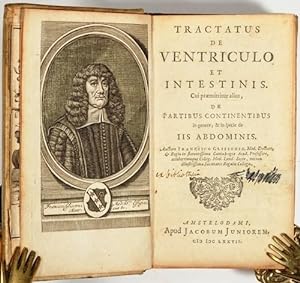
Tractatus de ventriculo et intestinis. Cui praemittitur alius, de partibus continentibus in genere; & in specie, de iis abdominis.
Erscheinungsdatum: 1677
Anbieter: Antiq. F.-D. Söhn - Medicusbooks.Com, Marburg, Deutschland
Verkäuferbewertung 5 von 5 Sternen
Erstausgabe
Amstelodami : Apud Jacobum Juniorem (i.e. Jansson-Waesberge), 1677, 12°, Gestochenes Portrait-Frontispiz, (32), 591, (1) pp., 3 Kupfertafeln, Pergamenteinband der Zeit mit handschriftlichem Rückentitel; Titel kleiner Auschnitt hinterlegt. First edition printed in the European continent of Glisson's rare work on the digestive organs and internal tissues! With Coat of Arm ExLibris " Iacob Reinbold Spielmann", J. Striedbeck. del. et sculp: Argent. Francis Glisson (1597-1677) "introduced the idea of irritability as a specific property of all human tissue, a hypothesis which had no effect upon contemporary physiology, but which was later demonstrated experimentally by Haller". Garrison & Morton "Stimulated by ideas of his friend George Ent, Glisson elaborated a theory which he revised in his last medical work, the Tractatus de ventriculo et intestinis (1677). The theory presented itself as follows: The nerves carry a nutritive juice (succus nutrivus) secreted by the brain between cortex and medulla from particles of the arterial blood. The psychic spirits are the "fixed spirits" of this juice, which serves nutrition rather than the function of body fibers. As a chemical substance, the psychic spirits cannot flow fast enough to assure simultaneity of events in the brain and the peripheral parts. Nerve action is transmitted by a vibration of the nerves (caused by localized contraction of the brain), and the muscle fibers then contract because of irritability, a property which they share with all fibers of the body". Owsei Temkin, p.426 "The doctrine of irritability does not exhaust the content of the Tractatus de Ventriculo et Intestinis, which, apart from the treatise indicated by the title, also contains a treatise on skin, hair, nails, fat, abdominal muscles, peritoneum, and omentum. Together the Anatomia hepatis and the Tractatus de Ventriculo et Intestinis constitute a monumental work on general anatomy and on anatomy and physiology of the digestive organs. Moreover, in the latter treatise [offered here], Glisson goes far beyond the stomach and intestinal tract. Apart from discussing the theory of digestion , Glisson manages to include theories of embryogenesis (in which the relationship to Harvey is particularly interesting)". Owsei Temkin, p.427 Garrison & Morton No. 579 (London 1677); Owsei Temin, DSB V, pp.425-427; Heirs of Hippocrates 475 (citing 1691 edition). Rothschuh, History of Physiology, pp. 86-87; Krivatsy 4829; Waller 3587; Wellcome III, 126.
-
Anatomia Hepatis. Cui praemittuntur ad rem anatomicam universe spectantia et ad calcem operis subjiciuntur nonnula de lymphae - ductibus nuber repertis
Erscheinungsdatum: 1659
Anbieter: Antiq. F.-D. Söhn - Medicusbooks.Com, Marburg, Deutschland
Verkäuferbewertung 5 von 5 Sternen
EUR 1.260,00
EUR 36,45 Versand
Versand von Deutschland nach USAAnzahl: 1 verfügbar
In den WarenkorbAmsterdam, J.Ravesteyn, 1659, 8°, 23 Bl., 552 pp., 6 Bl.Index, Titelkupfer, 1 Kupfer und 9 Holzschnitte im Text, 2 gefalt. KupferTaf., Kalbsledereinband der Zeit; Rücken erneuert, unbedeutender Wasserfleck, ein gut erhaltenes Exemplar. FRANCIS GLISSON 'Anatomia Hepatis' DIE GROSSE LEBERMONOGRAPHIE ZWEIER JAHRHUNDERTE Mani "Glissons 'Anatomia Hepatis' ist die erste große, zusammenfassende Lebermonographie. Sie bildet bis zu Albrecht von Hallers "Elementa Physiologiae" Grundlage und Ausgangspunkt zur gesamten Leberforschung. Glisson beschrieb zum erstmals Struktur und Funktion der Leber im Lichte des Blutkreislaufes und der lymphatischen Resorptionslehre. Die große Leistung Glissons liegt in der Erforschung von Anatomie, Gefäßtopog8raphie und innere Struktur der Leber". Mani II Francis Glisson (1797-1688), Schüler von Harvey, legt hier die erste Beschreibung der Leber und ihrer Funktionen vor! *Second Latin Edition (first published 1654) of this classic work on the liver. It contains 45 chapters on the liver which give an admirable description of the anatomy of the organ and its blood-supply as well as description of the bile duct. Chapter XXXI contains Glisson's report on the discovery of the lymph duct by his friend Joyliffe (1621-1658), a discovery Joyliffe had made independently of Bartholin and Rudbeck. In its time, the Anatomia hepatis was the most important treatise thus far on the physiology of the digestive system. Glisson was regius professor at Cambridge, a founder of the Royal Society and one-time president of the Royal College of Physicians. cf. G.M. 972 & 1098; Mani, Grundlagen d. Leberforschung II, S.109-120. Osler 2759 and Waller 3583 (Both, the Osler and Waller Collection have this 1659 edition in their holdings). ***.