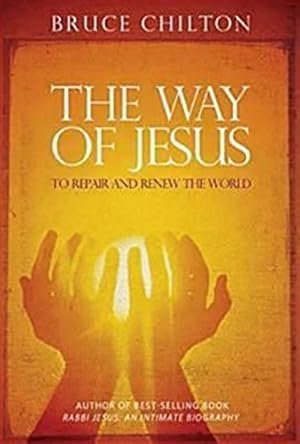
The way of Jesus means that despite our tears and scars, we can become vessels of divine light. A young man loses his wife while their baby escapes without injury. In abject grief he reaches out to a friend for solace. What words of comfort are even possible? How can Jesus repair and renew these lives in this world? Author Bruce Chilton begins in the everyday. He shows how following Jesus not only repairs shattered lives, but renews them. While no broken life is ever simply reassembled and although there is no magic going back to the pristine, repair and renewal will empower us to truly live and love again. But our path requires something from us--mindful practice of Jesus' teachings about the soul, spirit, kingdom, insight, forgiveness, mercy, and glory.
The Way of Jesus
To Repair and Renew the World By Bruce ChiltonAbingdon Press
Copyright © 2010 The United Methodist Publishing House
All right reserved.ISBN: 978-1-4267-0006-4Chapter One
Soul
Each and every one of us is earth.
Earth is not merely the planet we live on, or the environment we live in. Earth's seas flow in our veins, earth's soil nourishes us, and earth's minerals frame our bones. Our species survives by the same organic power and complexity that enables eagles to fly and whales to sing.
Knowing who you are as a living being begins with recognizing two apparently opposite truths at one and the same time. The book of Genesis puts both these truths in poetic, prescientific language. "You are dust," Yahweh says to the first man in the primordial garden, "and to dust you shall return" (Genesis 3:19). But when Yahweh formed this man from dust and water, Genesis also says that "He breathed into his nostrils breath of life, and the man became a living soul" (Genesis 2:6-7). Dust we are, but dust that has been watered, shaped, and animated by a power larger than any that is known from human experience.
Genesis understands humanity as a torn condition, limitation paired with an inkling of immortality. Knowing that we are limited comes with the awareness of a force deeper, stronger, and more enduring than we can aspire to be.
Contradictions are not easy to live with.
Holding in balance the two truths of the Soul, its limitation and its sense of immortality, is among the greatest challenges a human being can face. It is easy, and a frequent human failing, to try to pass oneself off as more powerful than is truly the case, to evade the truth of limitation. From the worst tyrants of human history to the petty bullies who have ruined the lives of countless families, the drive to pretend to more control than one can really exert is typically and tragically human.
Equally typical is the opposite response: the despair that expects nothing but the short life one has been allotted until the inevitable death comes. This advice is explored in the book of Ecclesiastes, one of the most challenging works in the Bible, "I have seen all the works done under the sun, and look—all are vanity and chasing after wind" (Ecclesiastes 1:14). A similar attitude is expressed by Jean-Paul Sartre, the twentieth-century Existentialist: "When you live alone you no longer know what it is to tell something: the plausible disappears at the same time as the friends. You let events flow past; suddenly you see people pop up who speak and who go away, you plunge into stories without beginning or end."
Both the desire to dominate events and bleak despair arise in the emotional lives of many people and are woven into the events of human history. If human capacities were infinite, domination might seem plausible; even then, what would happen when two infinitely capable human beings disagreed with one another? If all we had to say about life, on the other hand, is that it is difficult and then ends, then despair would have to be recommended.
Western philosophers have made careers out of attempting to reduce the ambivalence of the human Soul to one alternative or the other. Between Friedrich Nietzsche's ideal of the superman and Sartre's recommendation of living with a sense of emptiness, there seems little to choose. But other thinkers, especially from the ancient world, have understood that the Soul is ambivalent by its nature. Authentic wisdom involves coming to terms with both human mortality and the human aspiration to eternity.
The term "soul" in Hebrew (nephesh) can also be translated as "breath" or "life" or "self," depending upon the context involved. The word takes its root, as do the analogous terms in other ancient languages, in the fact that we breathe. In the myth of Genesis, Yahweh infuses breath into Adam's being. People instinctively know that breathing is an absolute requirement of their lives, yet what we breathe in and breathe out is both inside us and outside us, beyond our control. The very act of breathing is both an unconscious and a conscious action, a response that volition can only partially control.
The dichotomy of the Soul, as both a limited identity and yet brushing up against what is eternal, is like the paradox of breath, which involves a small sack of air in a sea of comparatively limitless atmosphere. No wonder human beings, who are capable of self-awareness, desire logical answers to the question of who they are. How can we be finite while we have a sense of what is infinite and eternal?
Sometimes people attempt to choose either limitation within the world or superiority over the world as the true root of the complexity of their lives. Logic naturally wants to reduce events and problems to simple causes. Yet sometimes simplicity distorts more than it explains, and experience shows that seeing people on only one side of the dichotomy between limitation and eternity is a deceptive distortion. To be human includes living with the paradox of being both limited and transcendent, unpredictably vulnerable and strong at one and the same time.
Perhaps the greatest sage of the human Soul was Lao Tsu, a sixth-century B.C.E. Chinese mystic who taught of what he called the "Tao," or the path of life. He said:
The universe is everlasting.
The reason the universe is everlasting
Is that it does not live for Self.
Therefore it can long endure.
Therefore the Sage puts himself last,
And finds himself in the foremost place;
Regards his body as accidental,
And his body is thereby preserved.
Is it not because he does not live for Self
That his Self is realized?
In this case as in many others, the genius of Lao Tsu lies not in his inventiveness but in his capacity to distill the wisdom of many centuries and cultures into a single, clear insight. What he says represents the wisdom of the ancient world in aggregate. Although the specific view of the Soul or self varied from culture to culture (and within each culture), the wonderful fragility of human being in its pilgrimage toward eternity remains a staple of ancient religious inheritance.
Jesus knew about this primordial inheritance principally through the Judaism of his own culture. But his native Galilee was also shaped by powerful influences outside of Judaism. The Roman occupation of Galilee, begun during the first century B.C.E., brought Greco-Roman culture to Jesus' world. Centuries before that, conquest by the imperial powers of the Assyrians, the Babylonians, and the successors of Alexander the Great, as well as trade with cities as far away as India and China, made Galilee a crucible of religious ideas. At the same time Galilean Jews resorted to their Judaic inheritance—in oral form, since they were illiterate for the most part—in order to withstand absorption by Rome.
In his thinking about the Soul, naphsha' in the Galilean Aramaic of his period, Jesus assumed the inherited wealth of ancient religious wisdom. At no point does he offer a basic definition of what naphsha' is, because his disciples already understood that. We need to know what they knew about the Soul to appreciate Jesus' teaching.
Jesus presented his own, acute version of the wisdom of Lao Tsu, insisting...