Verkäufer
ThriftBooks-Dallas, Dallas, TX, USA
Verkäuferbewertung 5 von 5 Sternen
AbeBooks-Verkäufer seit 2. Juli 2009
Pages can have notes/highlighting. Spine may show signs of wear. ~ ThriftBooks: Read More, Spend Less. Bestandsnummer des Verkäufers G0596005652I3N00
In order to thoroughly understand what makes Linux tick and why it works so well on a wide variety of systems, you need to delve deep into the heart of the kernel. The kernel handles all interactions between the CPU and the external world, and determines which programs will share processor time, in what order. It manages limited memory so well that hundreds of processes can share the system efficiently, and expertly organizes data transfers so that the CPU isn't kept waiting any longer than necessary for the relatively slow disks.
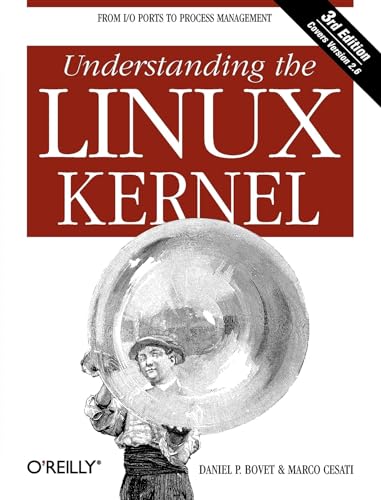
The third edition of Understanding the Linux Kernel takes you on a guided tour of the most significant data structures, algorithms, and programming tricks used in the kernel. Probing beyond superficial features, the authors offer valuable insights to people who want to know how things really work inside their machine. Important Intel-specific features are discussed. Relevant segments of code are dissected line by line. But the book covers more than just the functioning of the code; it explains the theoretical underpinnings of why Linux does things the way it does.
This edition of the book covers Version 2.6, which has seen significant changes to nearly every kernel subsystem, particularly in the areas of memory management and block devices. The book focuses on the following topics:
Understanding the Linux Kernel will acquaint you with all the inner workings of Linux, but it's more than just an academic exercise. You'll learn what conditions bring out Linux's best performance, and you'll see how it meets the challenge of providing good system response during process scheduling, file access, and memory management in a wide variety of environments. This book will help you make the most of your Linux system.
Über die Autorin bzw. den Autor: Daniel P. Bovet got a Ph.D. in computer science at UCLA in 1968 and is now full Professor at the University of Rome, "Tor Vergata," Italy. He had to wait over 25 years before being able to teach an operating system course in a proper manner because of the lack of source code for modern, well-designed systems. Now, thanks to cheap PCs and to Linux, Marco and Dan are able to cover all the facets of an operating system from booting to tuning and are able to hand out tough, satisfying homework to their students. (These young guys working at home on their PCs are really spoiled; they never had to fight with punched cards.) In fact, Dan was so fascinated by the accomplishments of Linus Torvalds and his followers that he spent the last few years trying to unravel some of Linux's mysteries. It seemed natural, after all that work, to write a book about what he found. . Marco Cesati received a degree in mathematics in 1992 and a Ph.D. in computer science (University of Rome, "La Sapienza") in 1995. He is now a research assistant in the computer science department of the School of Engineering (University of Rome, "Tor Vergata"). In the past, he served as system administrator and Unix programmer for the university (as a Ph.D. student) and for several institutions (as a consultant)
Titel: Understanding the Linux Kernel: From I/O ...
Verlag: O'Reilly Media
Erscheinungsdatum: 2005
Einband: Paperback
Zustand: Good
Zustand des Schutzumschlags: No Jacket
Auflage: 3. Auflage
Anbieter: medimops, Berlin, Deutschland
Zustand: good. Befriedigend/Good: Durchschnittlich erhaltenes Buch bzw. Schutzumschlag mit Gebrauchsspuren, aber vollständigen Seiten. / Describes the average WORN book or dust jacket that has all the pages present. Artikel-Nr. M00596005652-G
Anzahl: 4 verfügbar
Anbieter: Speedyhen, London, Vereinigtes Königreich
Zustand: NEW. Artikel-Nr. NW9780596005658
Anzahl: 2 verfügbar
Anbieter: WorldofBooks, Goring-By-Sea, WS, Vereinigtes Königreich
Paperback. Zustand: Very Good. In order to thoroughly understand what makes Linux tick and why it works so well on a wide variety of systems, you need to delve deep into the heart of the kernel. The kernel handles all interactions between the CPU and the external world, and determines which programs will share processor time, in what order. It manages limited memory so well that hundreds of processes can share the system efficiently, and expertly organizes data transfers so that the CPU isn't kept waiting any longer than necessary for the relatively slow disks. The third edition of Understanding the Linux Kernel takes you on a guided tour of the most significant data structures, algorithms, and programming tricks used in the kernel. Probing beyond superficial features, the authors offer valuable insights to people who want to know how things really work inside their machine. Important Intel-specific features are discussed. Relevant segments of code are dissected line by line. But the book covers more than just the functioning of the code; it explains the theoretical underpinnings of why Linux does things the way it does. This edition of the book covers Version 2.6 , which has seen significant changes to nearly every kernel subsystem, particularly in the areas of memory management and block devices. The book focuses on the following topics: * Memory management, including file buffering, process swapping, and Direct memory Access (DMA) * The Virtual Filesystem layer and the Second and Third Extended Filesystems * Process creation and scheduling * Signals, interrupts, and the essential interfaces to device drivers * Timing * Synchronization within the kernel * Interprocess Communication (IPC) * Program execution Understanding the Linux Kernel will acquaint you with all the inner workings of Linux, but it's more than just an academic exercise. You'll learn what conditions bring out Linux's best performance, and you'll see how it meets the challenge of providing good system response during process scheduling, file access, and memory management in a wide variety of environments. This book will help you make the most of your Linux system. The book has been read, but is in excellent condition. Pages are intact and not marred by notes or highlighting. The spine remains undamaged. Artikel-Nr. GOR003056878
Anzahl: 1 verfügbar
Anbieter: moluna, Greven, Deutschland
Kartoniert / Broschiert. Zustand: New. Covers Version 2.6 of the Linux kernel, which has seen significant changes to nearly every kernel subsystem, particularly in the areas of memory management and block devices. This book provides a guided tour of the code that forms the core of all Linux oper. Artikel-Nr. 5940295
Anzahl: 2 verfügbar
Anbieter: preigu, Osnabrück, Deutschland
Taschenbuch. Zustand: Neu. Understanding the Linux Kernel | Daniel P. Bovet (u. a.) | Taschenbuch | XVI | Englisch | 2005 | O'Reilly Media | EAN 9780596005658 | Verantwortliche Person für die EU: dpunkt.verlag GmbH, Vanessa Niethammer, Wieblinger Weg 17, 69123 Heidelberg, hallo[at]dpunkt[dot]de | Anbieter: preigu. Artikel-Nr. 102273133
Anzahl: 1 verfügbar
Anbieter: Kennys Bookstore, Olney, MD, USA
Zustand: New. 2005. 3rd Edition. Paperback. Covers Version 2.6 of the Linux kernel, which has seen significant changes to nearly every kernel subsystem, particularly in the areas of memory management and block devices. This book provides a guided tour of the code that forms the core of all Linux operating systems. Num Pages: 944 pages, 1, black & white illustrations. BIC Classification: ULL; UM. Category: (G) General (US: Trade). Dimension: 230 x 184 x 48. Weight in Grams: 1602. . . . . . Books ship from the US and Ireland. Artikel-Nr. V9780596005658
Anzahl: 2 verfügbar
Anbieter: buchversandmimpf2000, Emtmannsberg, BAYE, Deutschland
Taschenbuch. Zustand: Neu. Neuware -In order to thoroughly understand what makes Linux tick and why it works so well on a wide variety of systems, you need to delve deep into the heart of the kernel. The kernel handles all interactions between the CPU and the external world, and determines which programs will share processor time, in what order. It manages limited memory so well that hundreds of processes can share the system efficiently, and expertly organizes data transfers so that the CPU isn't kept waiting any longer than necessary for the relatively slow disks.The third edition of Understanding the Linux Kernel takes you on a guided tour of the most significant data structures, algorithms, and programming tricks used in the kernel. Probing beyond superficial features, the authors offer valuable insights to people who want to know how things really work inside their machine. Important Intel-specific features are discussed. Relevant segments of code are dissected line by line. But the book covers more than just the functioning of the code; it explains the theoretical underpinnings of why Linux does things the way it does.This edition of the book covers Version 2.6, which has seen significant changes to nearly every kernel subsystem, particularly in the areas of memory management and block devices. The book focuses on the following topics:\* Memory management, including file buffering, process swapping, and Direct memory Access (DMA)\* The Virtual Filesystem layer and the Second and Third Extended Filesystems\* Process creation and scheduling\* Signals, interrupts, and the essential interfaces to device drivers\* Timing\* Synchronization within the kernel\* Interprocess Communication (IPC)\* Program executionUnderstanding the Linux Kernel will acquaint you with all the inner workings of Linux, but it's more than just an academic exercise. You'll learn what conditions bring out Linux's best performance, and you'll see how it meets the challenge of providing good system response during process scheduling, file access, and memory management in a wide variety of environments. This book will help you make the most of your Linux system.Libri GmbH, Europaallee 1, 36244 Bad Hersfeld 923 pp. Englisch. Artikel-Nr. 9780596005658
Anzahl: 1 verfügbar
Anbieter: AHA-BUCH GmbH, Einbeck, Deutschland
Taschenbuch. Zustand: Neu. Neuware - In order to thoroughly understand what makes Linux tick and why it works so well on a wide variety of systems, you need to delve deep into the heart of the kernel. The kernel handles all interactions between the CPU and the external world, and determines which programs will share processor time, in what order. It manages limited memory so well that hundreds of processes can share the system efficiently, and expertly organizes data transfers so that the CPU isn't kept waiting any longer than necessary for the relatively slow disks.This edition of Understanding the Linux Kernel takes you on a guided tour of the most significant data structures, algorithms, and programming tricks used in the kernel. Probing beyond superficial features, the authors offer valuable insights to people who want to know how things really work inside their machine. Important Intel-specific features are discussed. Relevant segments of code are dissected line by line. But the book covers more than just the functioning of the code; it explains the theoretical underpinnings of why Linux does things the way it does.This edition of the book covers Version 2.6, which has seen significant changes to nearly every kernel subsystem, particularly in the areas of memory management and block devices. You'll learn what conditions bring out Linux's best performance, and you'll see how it meets the challenge of providing good system response during process scheduling, file access, and memory management in a wide variety of environments. This book will help you make the most of your Linux system. Artikel-Nr. 9780596005658
Anzahl: 1 verfügbar
Anbieter: Majestic Books, Hounslow, Vereinigtes Königreich
Zustand: New. pp. 923 Illus. Artikel-Nr. 8122005
Anzahl: 3 verfügbar
Anbieter: Revaluation Books, Exeter, Vereinigtes Königreich
Paperback. Zustand: Brand New. 3rd edition. 923 pages. 9.25x7.00x1.75 inches. In Stock. Artikel-Nr. x-0596005652
Anzahl: 2 verfügbar