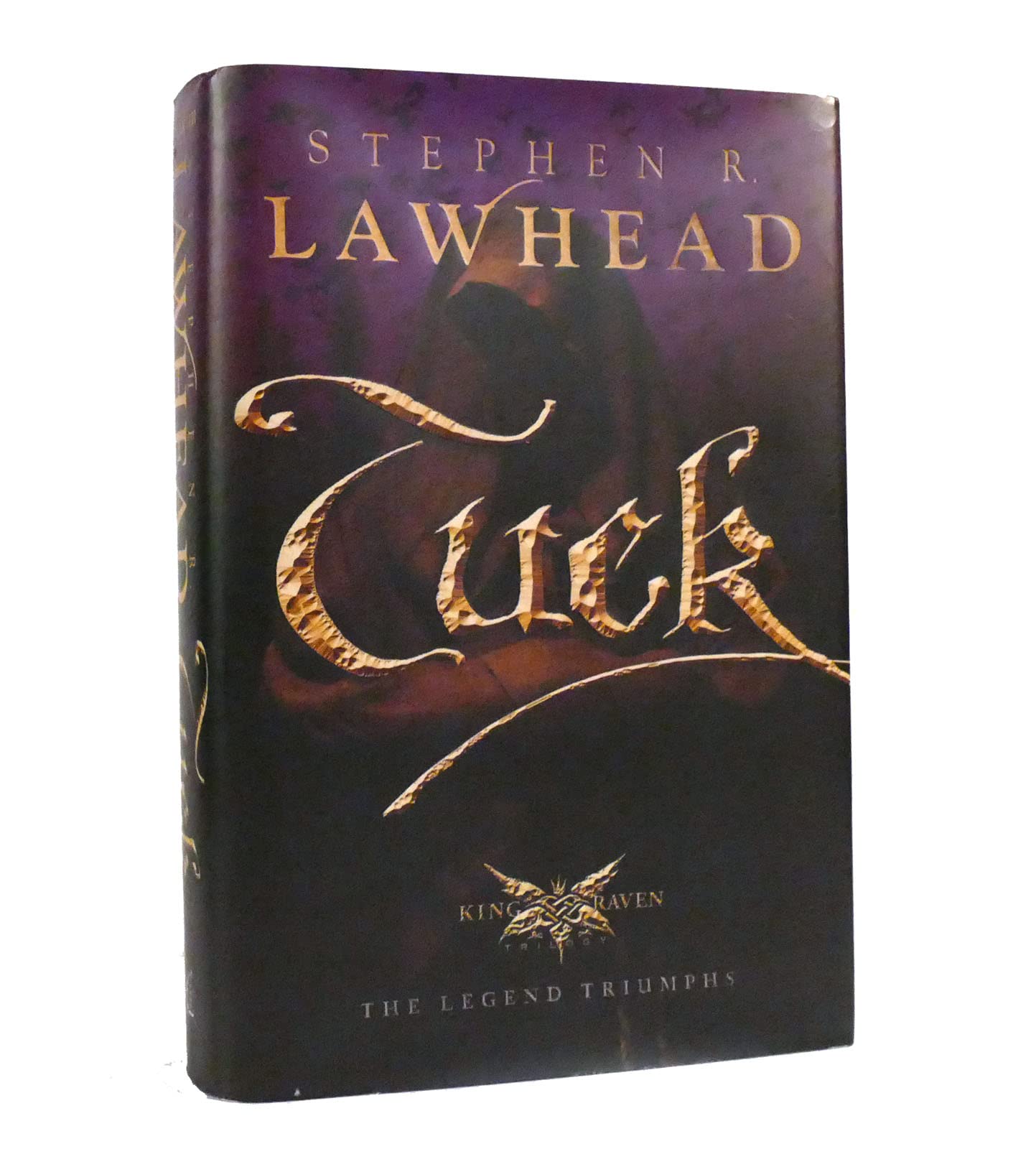
"Pray God our aim is true and each arrow finds its mark."
King Raven has brought hope to the oppressed people of Wales--and fear to their Norman overlords. Deceived by the self-serving King William and hunted by the treacherous Abbot Hugo and Sheriff de Glanville, Rhi Bran is forced again to take matters into his own hands as King Raven.
Along the way Friar Tuck has been the stalwart supporter of the man behind the legend--bringing Rhi Bran much-needed guidance, wit, and faithful companionship.
Aided by Tuck and his small but determined band of forest-dwelling outlaws, Rhi Bran ignites a rebellion that spreads through the Welsh valleys, forcing the wily monarch to marshal his army and march against little Elfael.
This epic trilogy dares to shatter everything you thought you knew about Robin Hood as Stephen R. Lawhead conjures an ancient past while holding a mirror to contemporary realities. Filled with unforgettable characters, breathtaking suspense, and rousing battle scenes, Stephen R. Lawhead's masterful retelling of the Robin Hood legend reaches its stunning conclusion in Tuck.
Tuck
King Raven: Book 3By STEPHEN R. LAWHEADThomas Nelson
Copyright © 2009 Stephen R. Lawhead
All right reserved.ISBN: 978-1-59554-087-4Chapter One
Tuck shook the dust of Caer Wintan off his feet and prepared for the long walk back to the forest. It was a fine, warm day, and all too soon the friar was sweltering in his heavy robe. He paused now and then to wipe the sweat from his face, falling farther and farther behind his travelling companions. "These legs of mine are sturdy stumps," he sighed to himself, "but fast they en't."
He had just stopped to catch his breath a little when, on sudden impulse, he spun around quickly and caught a glimpse of movement on the road behind-a blur in the shimmering distance, and then gone. So quick he might have imagined it. Only it was not the first time since leaving the Royal Lodge that Tuck had entertained the queer feeling that someone or something was following them. He had it again now, and decided to alert the others and let them make of it what they would.
Squinting into the distance, he saw Bran far ahead of the Grellon, striding steadily, shoulders hunched against the sun and the gross injustice so lately suffered at the hands of the king in whom he had trusted. The main body of travellers, unable to keep up with their lord, was becoming an ever-lengthening line as heat and distance mounted. They trudged along in small clumps of two or three, heads down, talking in low, sombre voices. How like sheep, thought Tuck, following their impetuous and headstrong shepherd.
A more melancholy man might himself have succumbed to the oppressive gloom hanging low over the Cymry, dragging at their feet, pressing their spirits low. Though summer still blazed in meadow, field, and flower, it seemed to Tuck that they all walked in winter's drear and dismal shadows. Rhi Bran and his Grellon had marched into Caer Wintan full of hope-they had come singing, had they not?-eager to stand before King William to receive the judgement and reward that had been promised in Rouen all those months ago. Now, here they were, slinking back to the greenwood in doleful silence, mourning the bright hope that had been crushed and lost.
No, not lost. They would never let it out of their grasp, not for an instant. It had been stolen-snatched away by the same hand that had offered it in the first place: the grasping, deceitful hand of a most perfidious king.
Tuck felt no less wounded than the next man, but when he considered how Bran and the others had risked their lives to bring Red William word of the conspiracy against him, it fair made his priestly blood boil. The king had promised justice. The Grellon had every right to expect that Elfael's lawful king would be restored. Instead, William had merely banished Baron de Braose and his milksop nephew Count Falkes, sending them back to France to live in luxury on the baron's extensive estates. Elfael, that small bone of contention, had instead become property of the crown and placed under the protection of Abbot Hugo and Sheriff de Glanville. Well, that was putting wolves in charge of the fold, was it not?
Where was the justice? A throne for a throne, Bran had declared that day in Rouen. William's had been saved-at considerable cost and risk to the Cymry-but where was Bran's throne?
S'truth, thought Tuck, wait upon a Norman to do the right thing and you'll be waiting until your hair grows white and your teeth fall out.
"How long, O Lord? How long must your servants suffer?" he muttered. "And, Lord, does it have to be so blasted hot?"
He paused to wipe the sweat from his face. Running a hand over his round Saxon head, he felt the sun's fiery heat on the bare spot of his tonsure; sweat ran in rivulets down the sides of his neck and dripped from his jowls. Drawing a deep breath, he tightened his belt, hitched up the skirts of his robe, and started off again with quickened steps. Soon his shoes were slapping up the dust around his ankles, and he began to overtake the rearmost members of the group: thirty souls in all, women and children included, for Bran had determined that his entire forest clan-save for those left behind to guard the settlement and a few others for whom the long journey on foot would have been far too arduous-should be seen by the king to share in the glad day.
The friar picked up his pace and soon drew even with Siarles: slim as a willow wand, but hard and knotty as an old hickory root. The forester walked with his eyes downcast, chin outthrust, his mouth a tight, grim line. Every line of him bristled with fury like a riled porcupine. Tuck knew to leave well enough alone and hurried on without speaking.
Next, he passed Will Scatlocke-or Scarlet, as he preferred. The craggy forester limped along slightly as he carried his newly acquired daughter, Nia. Against every expectation, Will had endured a spear wound, the abbot's prison, and the threat of the sheriff's rope ... and survived. His pretty dark-eyed wife, Non, walked resolutely beside him. The pair had made a good match, and it tore at his heart that the newly married couple should have to endure a dark hovel in the forest when the entire realm begged for just such a family to settle and sink solid roots deep into the land-another small outrage to be added to the ever-growing mountain of injustices weighing on Elfael.
A few more steps brought him up even with Odo, the Norman monk who had befriended Will Scarlet in prison. At Scarlet's bidding, the young scribe had abandoned Abbot Hugo to join them. Odo walked with his head down, his whole body drooping-whether with heat or the awful realization of what he had done, Tuck could not tell.
A few steps more and he came up even with Iwan-the great, hulking warrior would crawl on hands and knees through fire for his lord. It was from Iwan that the friar had received his current christening when the effort of wrapping his untrained tongue around the simple Saxon name Aethelfrith proved beyond him. "Fat little bag of vittles that he is, I will call him Tuck," the champion had said. "Friar Tuck to you, boyo," the priest had responded, and the name had stuck. God bless you, Little John, thought Tuck, and keep your arm strong, and your heart stronger.
Next to Iwan strode Mrian, just as fierce in her devotion to Bran as the champion beside her. Oh, but shrewd with it; she was smarter than the others and more cunning-which always came as something of a shock to anyone who did not know better, because one rarely expected it from a lady so fair of face and form. But the impression of innocence beguiled. In the time Tuck had come to know her, she had shown herself to be every inch as canny and capable as any monarch who ever claimed an English crown.
Mrian held lightly to the bridle strap of the horse that carried their wise hudolion, who was, so far as Tuck could tell, surely the last Banfith of Britain: Angharad, ancient and ageless. There was no telling how old she was, yet despite her age, whatever it might be, she sat her saddle smartly and with the ease of a practiced rider. Her quick dark eyes were trained on the road ahead, but Tuck could tell that her sight was turned inward, her mind wrapped in a veil of deepest thought. Her wrinkled face might have been carved of dark Welsh slate for all it revealed of her contemplations.
Mrian glanced around as the priest passed, and called out, but the friar had Bran in his eye, and he hurried on until he was within hailing distance. "My lord, wait!" he shouted. "I must speak to you!"...