Verkäufer
ThriftBooks-Reno, Reno, NV, USA
Verkäuferbewertung 5 von 5 Sternen
AbeBooks-Verkäufer seit 25. Mai 2012
May have limited writing in cover pages. Pages are unmarked. ~ ThriftBooks: Read More, Spend Less. Bestandsnummer des Verkäufers G0618758623I4N00
Auszug. © Genehmigter Nachdruck. Alle Rechte vorbehalten.:
On Audubon and Those Confusing Warblers
Several of my friends have taken me to task for giving two of the color plates
in my eastern field guide the title "Confusing Fall Warblers." They are not
confusing, they insist. Perhaps not to them, but the little greeny-brown jobs
remain confusing to 95 percent of the bird watching crowd—or at least to
those who do not consider themselves "hard-core."
Even Audubon was confused. Of the thirty-eight species of wood
warblers found normally in eastern North America he eventually knew all but
one. In attempting to sort them out, he was relatively late on the scene. Early
on, Linnaeus, the creator of the Systema Naturae, and his successor,
Johann Georg Gmelin, as well as a number of other workers, had already
named and described twenty-five species of North American warblers. That
was before Alexander Wilson published his American Ornithology, wherein
he described another ten. By the time Audubon came on the scene, twenty
years later, he was able to add only two new ones: Swainson's warbler and
the now nearly extinct Bachman's warbler, both furtive southerners first
discovered by his friend the Reverend Bachman of Charleston. After
Audubon, only one species, Kirtland's warbler, a rarity restricted to the pine
barrens of Michigan, remained to be described.
But Audubon tried hard; he named and illustrated ten or eleven
species that did not exist—variants or obscure plumages of already well-
known species.
Many birders have found that the sumptuous showcase of
Audubon's prints published by Abbeville Press—The Baby Elephant Folio—
was beyond their pocketbooks. But if they did purchase the book, they may
have looked only at the pictures, ignoring the text prepared after considerable
research by my wife, Ginny, and me. Inasmuch as the tome weighs eighteen
pounds, it is not exactly a field guide or bedtime reading. For the benefit of a
wider audience, I have pulled things together and adapted from the book the
following capsule accounts of the eleven "species" of warblers that led
Audubon astray:
"Children's Warbler" (Yellow Warbler)
When Audubon painted two little yellowish birds at Oakley Plantation in
Louisiana, he tentatively inscribed his drawing "Louisiana Warbler," Sylvia
ludoviciana. Later, feeling quite certain that they represented something new,
he crossed out the scientific name and inked in Sylvia childreni, naming
it "children's warbler" in honor of the secretary of the Royal Society, John
George Children, who managed his affairs in London. He had drawn not a
new species but a female and immature yellow warbler. Obviously he
became aware of this at a later date, because it was omitted in his octavo
Birds of America.
It is understandable that Audubon, having virtually no books,
should be confused by obscure plumages of certain warblers. Any modern
field guide would have informed him that with the exception of the
unmistakable female redstart, the yellow warbler is the only warbler with
yellow (not white) spots in its tail. Had he known this simple fact, he would
have been spared two major errors in the original Elephant Folio.
"Rathbone's Warbler" (Yellow Warbler)
This is another instance in which Audubon mistook two juvenile yellow
warblers for something new. He wrote:
Kind reader, you are now presented with a new and beautiful little species of
Warbler, which I have honored with the name of a family that must ever be
dear to me. . . . I trust that future naturalists, regardful of the feelings which
have guided me in naming this species, will continue to [give] it the name of
Rathbone's Wood-Warbler. I met with the species . . . only once. They were
actively engaged in searching for food amongst the blossoms and leaves of
the bignonia.
Audubon's good intentions toward the Rathbones went for naught.
He did not state where he collected these young yellow warblers, but his
original pastel was inscribed July 1, 1808, at the "Falls of the Ohio." Later, in
1825, it was used as a basis for the color plate that was inscribed with the
same date as the pastel. Curiously, he defines the bird's range in his Birds of
America as "Mississippi—only one pair seen."
"Pine Swamp Warbler" (Black-throated Blue Warbler)
When Audubon painted these birds in the Great Pine Swamp of Pennsylvania
on August 11, 1829, he took Alexander Wilson as his authority, as did his
contemporary, [Thomas] Nuttall, in his own manual. Audubon wrote that this
bird "delights in the dark humid parts of thick underwood, by the sides of
small streams." Several years later, in his octavo edition, he corrected this
error, putting the blame on Wilson:
The birds represented in Plate 48 of my large edition as Sylvia sphagnosa,
are the young of the Black-throated Blue Warbler, the female of which
resembles them so much that I looked upon it as a species distinct from the
male. I have no doubt that this error originated with Wilson who has been
followed by all our writers. Now, however, the Sylvia or Sylvicola sphagnosa
of Bonaparte which he altered from Wilson's S. pusilla, must be erased from
our fauna.
We must remember that Wilson, Audubon, and their
contemporaries were at the very frontiers of ornithology and that such
misconceptions were inevitable. In presenting the new plate in the
miniaturized version, Audubon combined the figure of the upper bird, a
female, with that of the male, which in the original plate was shown alone on
a spray of columbine.
"Blue-Green Warbler" (Cerulean Warbler)
When Audubon painted this bird in Louisiana, in August 1821, he again
believed he had found something new. He named it the "bluegreen warbler,"
Sylvia rara. Later he realized that it was simply a female or possibly a young
male cerulean warbler. In his octavo Birds of America, published several
years later, he combined his original color plate of the cerulean warbler with
this one. He dropped out the lower bird of the earlier version; it apparently had
been copied by Havell the engraver from a drawing by Wilson.
Knowledge of birds was growing rapidly at that time, and
Audubon's own revisions were extensive. His critics pointed out certain errors
and discrepancies in the text of his Ornithological Biography, and thus he
was able to make corrections when he published the smaller octavo version.
"Hemlock Warbler"(Blackburnian Warbler)
Here again Audubon was misled by Wilson into cataloging a female warbler
as a distinct species. He wrote:
It is to the persevering industry of Wilson that we are indebted for the
discovery of this bird. He has briefly described the male [actually the female]
of which he had obtained but a single specimen. Never having met with it until
I visited the Great Pine Forest where that ornithologist found it, I followed his
track in my rambles there, and had not spent a week among the gigantic
hemlocks which ornament that interesting part of our country before I
procured upwards of twenty specimens.
Audubon never did correct this mistake in his octavo edition,
which was prepared several years later, even though he correctly added a
female to his original plate of the male Blackburnian. Of this
supposed "species" he wrote:
The tallest of the hemlock pines are the favorite haunts of this species. It
appears first among the highest branches early in May, breeds there, and
departs in the beginning of September. Like the blue yellow-back warbler
[parula warbler] its station is ever amidst the thickest foliage of the trees, and
with...
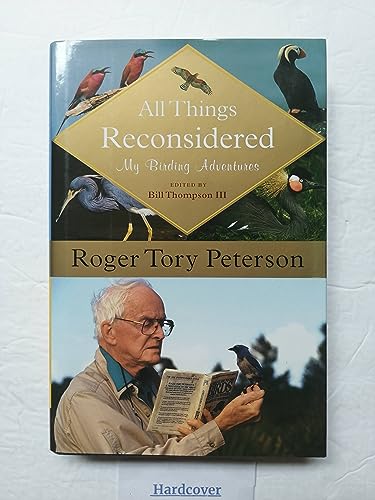
Titel: All Things Reconsidered: My Birding ...
Verlag: Houghton Mifflin Harcourt
Erscheinungsdatum: 2006
Einband: Hardcover
Zustand: Very Good
Zustand des Schutzumschlags: No Jacket
Anbieter: World of Books (was SecondSale), Montgomery, IL, USA
Zustand: Good. Item in good condition. Textbooks may not include supplemental items i.e. CDs, access codes etc. Artikel-Nr. 00087191253
Anzahl: 3 verfügbar
Anbieter: ThriftBooks-Dallas, Dallas, TX, USA
Hardcover. Zustand: Very Good. No Jacket. May have limited writing in cover pages. Pages are unmarked. ~ ThriftBooks: Read More, Spend Less. Artikel-Nr. G0618758623I4N00
Anzahl: 3 verfügbar
Anbieter: Better World Books, Mishawaka, IN, USA
Zustand: Very Good. 1st Edition. Former library copy. Pages intact with possible writing/highlighting. Binding strong with minor wear. Dust jackets/supplements may not be included. Includes library markings. Stock photo provided. Product includes identifying sticker. Better World Books: Buy Books. Do Good. Artikel-Nr. 3362030-75
Anzahl: 1 verfügbar
Anbieter: Better World Books: West, Reno, NV, USA
Zustand: Fine. 1st Edition. Used book that is in almost brand-new condition. May contain a remainder mark. Better World Books: Buy Books. Do Good. Artikel-Nr. 14854124-75
Anzahl: 1 verfügbar
Anbieter: Abacus Bookshop, Pittsford, NY, USA
hardcover. Zustand: Fine copy in fine dust jacket. Well-illustrated (illustrator). 1st. 8vo, 354 pp., Edited by Bill Thompson III. Artikel-Nr. 047083
Anzahl: 1 verfügbar
Anbieter: Better World Books Ltd, Dunfermline, Vereinigtes Königreich
Zustand: Good. 1st Edition. Pages intact with minimal writing/highlighting. The binding may be loose and creased. Dust jackets/supplements are not included. Stock photo provided. Product includes identifying sticker. Better World Books: Buy Books. Do Good. Artikel-Nr. 6466738-75
Anzahl: 1 verfügbar