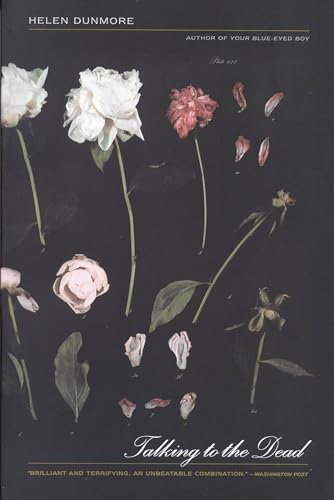
Praised by critics on both sides of the Atlantic for its elegant and sensuous prose, "Talking to the Dead" tells the story of two sisters whose lives are bound by the hidden and surprising truth about the long-ago death of their infant brother.
Talking to the Dead
A Novel Tag: Winner of the Orange PrizeBy Helen DunmoreBack Bay Books
Copyright © 1998 Helen Dunmore
All right reserved.ISBN: 9780316196451
Chapter One
prologue
The newer graves lie full in the sun, beyond the shadow of the church and yew tree. Two of them are covered in plastic-wrapped flowers and raw earth; these graves won't have stones for a while yet, because they must wait for the earth to settle.
There are a lot of things you need to learn when someone dies, and you have to learn fast, from people who are paid to teach you. They come up with hushed, serious faces and ask questions. If you don't say anything right away, they just wait. It's their job. There were two of them standing there, noting down the requirements. One glanced at the other, and they gleamed with satisfaction at phrasing it all so well. But they were much too professional to smile.
And then the food. After a funeral you have to eat, to prove you're still alive. There are foods that are suitable, and foods that are not. The suitable ones turn out to be ham, or cold chicken. Quiche is very popular, and Australian wines. I can remember staring at a big glazed ham, its rind scored into squares and glistening with syrup. I thought of how it would be sliced and fed to us after your burial. Someone was asking me if I would like fresh pineapple to garnish the ham, or tinned.
"Will you want the coffin open, or closed?"
"Some people," one of them whispered, "some people find it a great comfort actually to have seen. Not to have to imagine. It can be a great comfort."
"A great comfort," I say aloud now, taking the words out like stones from my pocket, tossing them into the quiet air.
It's beautiful here, where you are. Tall brick-and-flint walls enclose the churchyard, but we're high up, and the air moves freely. It's hot and dry, and the earth smells like a body stretched out to bake in the sun. Bees have swarmed on the other side of the church. I went round just now, and saw them hanging there in a dark cluster under the roof.Stray bees zinged through the air toward the swarm, and their sound was dangerous, like water in a kettle that has nearly boiled dry. I came away lightly, scarcely breathing.
You are out in the sun, away from the yew tree. Your stone stands firm. I know without looking exactly how many letters there are in the inscription. There is just your full name, the name you've kept since childhood, even after you married, and under your name, the dates of your birth and your death. No message, no reflection on your life. No clues at all. The only thing that might make anyone stop isthe shortness of the time between the first date and the last. Someone might count up how long you'd lived, and wonder, and start to make up a story for you out of nothing.
People idling through graveyards always stop by the graves of the young. Hundreds of miles from here is another grave with the same surname on it as yours, a tiny grave in a steep cemetery above the sea. There's a path through the cemetery that tourists use as a shortcut down to the beach. They stop, read the inscription, the name and dates and the two lines of poetry. Often there's a jam jar of flowers left on the grave. If the tourists have children with them, they'll grasp their hands tightly as they walk on. I haven't been there for years. Did you go? Did you leave flowers there, and then stand looking down for a long time, thinking thoughts it's too late to uncover now?
I can almost see you. If I turn my head to the black splash of shade under the yew, now, quickly, I'm certain I'll see you. It's noon, the white hour when ghosts walk, leaving no shadow. But I don't turn my head. I still can't believe that you are here, near enough to touch if you weren't covered. I can't believe that if I dug down I would find first the quilting of earth, then the box, then you, yourself
I lie down. I shut my eyes. I am in bed with you, warm with the warmth of night. I feel your long slender legs curled up behind me, your knees digging into my back.
"Go to sleep."
"I am asleep."
"How can you be asleep when you're talking to me?"
And then silence. We are both asleep, tipping into the valley of the big double bed. None of this has happened yet.
I am on your grave, the warm mound of it shaped to me like a body. But though I listen and listen, there's no heartbeat. Your silence begins to soothe me. The air is warm. If I lie here long enough I'll begin to feel the earth turning beneath me, carrying everything away so that it can bring it back. Nothing can separate us.
I take a breath, and it comes out in your name. Isabel. You always answered. When I had a nightmare I would scream out your name. You'd kneel up beside me in your nightdress. "It's all right, Neen. I'm here."
"Isabel," I would say, "I had a bad dream ..."
The soft breeze flutters in the grass. All the questions I am desperate to ask you float off, as the world floats off just before sleep.
chapter one
I should have let the taxi take me all the way up to the house. I've packed more than usual, because I don't know how long I'll be staying, and the weather might change. I've brought some work stuff too--sketch pads, pencils, charcoal, inks. But only one camera. It feels strange to travel without my camera bag, the one I don't dare let out of my sight for a second. In London, at home, I haul it between the sweaty filth of the Underground and the heat of flats, shops, and offices. For weeks now it's been the hottest summer I can remember.
I like the early mornings and the smell when the pavement is being hosed down outside cafes. I drink coffee at six and I'm out by seven, when the sun's fresh on my arms, water drips from petunias in lamppost baskets, and vans whiz about full of new bread and newspapers with the print still damp on them. Then I know why I live in London. I'm on my way to meet someone for breakfast and what might just be a new, exciting piece of work. But by eleven the city's used up and sweaty, and the new project's turned out to be photographing someone's day care scheme for a community newspaper. I'm pushing at invisible barriers all the time, never quite getting the work I really want. What is it my pictures don't do?
No need to think about that now. I shift my bag to the other hand and keep on up the rough track. It's getting dark, and all the white things look whiter still: the tall stiff flowers in the hedge, the moths, and my skirt. The air smells unnaturally sweet. There are owls here, but I haven't seen one. Isabel knows about them. A pair of barn owls is nesting this year.
In a way it's lucky I've got so much to carry, or I'd be running, and then I'd arrive just the way I don't want to arrive, hot and out of breath and anxious. And then Richard would be angry. Isabel can't cope with other people's emotions just now, he said. She's not supposed to know he told me to come. She won't like it; she'll say it's interrupting my life and making me lose commissions, when I've worked so hard to build things up. As if I would want to be anywhere else but with her.
I was in the bath when the phone rang. I heard his voice cutting through my recorded message: "Nina, if you're there, pick up the phone. It's Richard, it's important." He knew I often left the answering machine on while I was working. I jumped out of the bath andgrabbed the phone and a towel, and covered myself even though he couldn't see me.
"What's the...