Inhaltsangabe
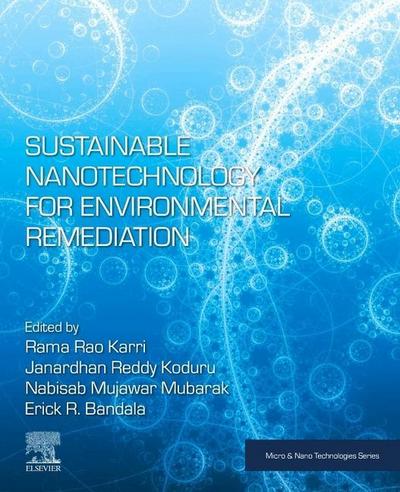
Sustainable Nanotechnology for Environmental Remediation provides a single-source solution to researchers working in environmental, wastewater management, biological and composite nanomaterials applications. It addresses the potential environmental risks and uncertainties surrounding the use of nanomaterials for environmental remediation, giving an understanding of their impact on ecological receptors in addition to their potential benefits. Users will find comprehensive information on the application of state-of-the-art processes currently available to synthesize advanced green nanocomposite materials and biogenic nanomaterials.
Other sections explore a wide range of promising approaches for green nanotechnologies and nanocomposites preparations. Case study chapters connect materials engineering and technology to the social context for a sustainable environment. Applications and different case studies provide solutions to the challenges faced by industry, thus minimizing negative social impacts.
Über die Autorinnen und Autoren
Dr. Rama Rao Karri is a Professor (Sr. Asst) in the Faculty of Engineering, Universiti Teknologi Brunei, Brunei Darussalam. He has a Ph.D. from the Indian Institute of Technology (IIT) Delhi, Master’s from IIT Kanpur in Chemical Engineering. He has worked as a Post-Doctoral research fellow at NUS, Singapore for about six years and has over 18 years of working experience in Academics, Industry, and Research. He has experience of working in multidisciplinary fields and has expertise in various evolutionary optimization techniques and process modelling. He has published 150+ research articles in reputed journals, book chapters, and conference proceedings with a combined Impact factor of 611.43 and has an h-index of 28 (Scopus - citations: 2600+) and 27 (Google Scholar -citations: 3000+). He is an editorial board member in 10 renowned journals and a peer-review member for more than 93 reputed journals and has peer-reviewed more than 410 articles. Also, he handled 112 articles as an editor. He also has the distinction of being listed in the top 2% of the world’s most influential scientists in the area of environmental sciences and chemicals for the Years 2021 & 2022. The List of the Top 2% of Scientists in the World compiled and published by Stanford University is based on their international scientific publications, the number of scientific citations for research, and participation in the review and editing of scientific research. He held a position as Editor-in-Chief (2019-2021) in the International Journal of Chemoinformatics and Chemical Engineering, IGI Global, USA. He is also an Associate editor in Scientific Reports, Springer Nature & International Journal of Energy and Water Resources (IJEWR), Springer Inc. He is also a Managing Guest editor for Spl. Issues: 1) “Magnetic nanocomposites and emerging applications", in Journal of Environmental Chemical Engineering (IF: 5.909), 2) “Novel CoronaVirus (COVID-19) in Environmental Engineering Perspective", in Journal of Environmental Science and Pollution Research (IF: 4.223), Springer. 3) “Nanocomposites for the Sustainable Environment”, in Applied Sciences Journal (IF: 2.679), MDPI. He along with his mentor, Prof. Venkateswarlu is authoring an Elsevier book, “Optimal state estimation for process monitoring, diagnosis, and control”. He is also co-editor and managing editor for 8 Elsevier, 1 Springer and 1 CRC edited books. Elsevier: 1) Sustainable Nanotechnology for Environmental Remediation, 2) Soft computing techniques in solid waste and wastewater management, 3) Green technologies for the defluoridation of water, 4) Environmental and health management of novel coronavirus disease (COVID-19), 5) Pesticides remediation technologies from water and wastewater: Health effects and environmental remediation, 6) Hybrid Nanomaterials for Sustainable Applications, 7) Sustainable materials for sensing and remediation of noxious pollutants. Springer: 1) Industrial wastewater treatment using emerging technologies for sustainability. CRC: 1) Recent Trends in Advanced Oxidation Processes (AOPs) for micro-pollutant removal.
Dr Janardhan Reddy Koduru is an Associate Professor, in the Department of Environmental Engineering, Kwangwoon University, Seoul, South Korea. His research interests are as follows: Development of low-toxic nanomaterials or nanocomposites by synthetic chemistry and green routes and were utilized for energy and environmental applications. Synthesis of graphene oxide-based nanocomposites and nano-metal oxides impregnated bio-sorbents by advanced green ways for sustainable environmental remediation (water remediation). Management of waste biomaterials and re-use for environmental remediation.
Dr. Nabisab Mujawar Mubarak is an Associate Professor in the Department
of Chemical Engineering, College of Engineering, Imam Mohammad Ibn Saud Islamic University (IMSIU), Riyadh 11432, Saudi Arabia.He is a scientific reviewer for numerous Chemical Engineering
andNanotechnology journals. In research, Dr.Mubarak has published
over 450 journal papers and 40 conference proceedings, authored 85
book chapters, and has an H-index of 87. His areas of interest include
the synthesis of carbon nanomaterials, the production of magnetic
biochar using microwaves, and wastewater treatment utilizing advanced
materials. He received the Curtin Malaysia Most Productive Research Award, the Outstanding Faculty of Chemical Engineering Award, the Best Scientific Research Award in London, and the Exceptional ScientistAward in publication and citation by
i-Proclaim, Malaysia. Since 2020, he has also been listed among the top 2% of the world’s most influential scientists in the fields of chemistry and energy. The List of the Top 2% of Scientists in
the World, compiled and published by Stanford University, is based on international scientific
publications, the number of scientific citations for research, and participation in the review and
editing of scientific research. Dr. Mubarak is a Fellow Member of the Institution of Engineers
Australia, a Chartered Professional Engineer of The Institution of Engineers Australia, and a
Chartered Chemical Engineer of the Institute of Chemical Engineering, UK. He has published
11 books and is coeditor for ongoing Elsevier-edited books: 1) Nanomaterials for Carbon
Capture and Conversion Technique, 2) Advanced Nanomaterials and Nanocomposites for Bioelectrochemical Systems, 3) Water Treatment Using Engineered Carbon Nanotubes,4)
Hybrid Nanomaterials for Sustainable Applications: Case Studies and Applications, 5), Sustainable
Nanotechnology for Environmental Remediation, 6) Nanotechnology for Biomedical
Applications,7) Nanotechnology for Electronic Applications, 8) Application of Bio-Additives
for the Food Industry, 9) Contemporary Nanomaterials inMaterial Engineering Applications,
10)Fundamentals of Biomaterials: ASupplementary Textbook, 11) EmergingWater Pollutants:
Concerns and Remediation Technologies.
Erick,R Bandala is an Assistant Research Professor in the Division of Hydrologic Sciences, at the Desert Research Institute. Las Vegas, USA. His research is in water quality, water treatment and site restoration. His major experience is in developing countries on the generation and adaptation of technology for the generation of safe drinking water and proper sanitation. Specific research interest includes solar driven advanced oxidation processes, assessing the effect of climate change on water quality, developing adaptive technologies for sustainable water quality management, water chemistry, stormwater quality and treatment.
„Über diesen Titel“ kann sich auf eine andere Ausgabe dieses Titels beziehen.