
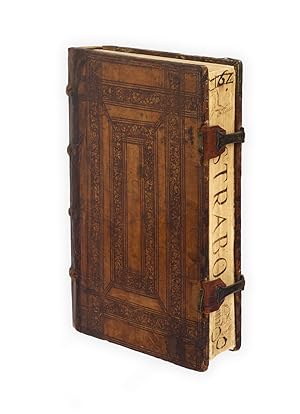
Strabonis geographicorum lib. XVII . iam denuo a Conrado Heresbachio … ad fidem Graeci exemplaris, authorumque … recogniti, ac plerisque locis deintegro versi. Item, epitomae eorundem decem et septem de geographia librorum.
STRABO.
Verlag: Basel, Johann Walder, 1539., 1539
Gebraucht
Hardcover
Verkäufer
Bernard Quaritch Ltd ABA ILAB, London, Vereinigtes Königreich
Verkäuferbewertung 4 von 5 Sternen

Heritage Bookseller
AbeBooks-Mitglied seit 1996
Dieses Exemplar ist nicht mehr verfügbar. Hier sind die ähnlichsten Treffer für Strabonis geographicorum lib. XVII . iam denuo a Conrado Heresbachio … ad fidem Graeci exemplaris, authorumque … recogniti, ac plerisque locis deintegro versi. Item, epitomae eorundem decem et septem de geographia librorum. von STRABO..
Beschreibung
Beschreibung:
Folio, pp.[lxxxviii], 549, [27]; text printed in Latin and Greek, title within woodcut architectural border, large woodcut initials and ornaments, woodcut printer's devices to title and final page; neat repairs to outer margins of quire a and to inner margins of quires a b, marginal paper flaw with old repair to p.25, some light foxing and toning, occasional marks; overall a very good copy in contemporary Swiss calf over wooden boards, boards roll-tooled in blind to a panel design, two brass catches and clasps to fore-edge (leather renewed), small brass strips to corners (of which three lacking), fore-edge elegantly lettered 'Strabo' in ink in an early Spanish hand with shelf marks and 2 ink sketches (one of a stag, the other of a plumed jousting helm); sympathetically rebacked in calf, first and last quires resewn and pastedowns renewed, a little wear to extremities and a few marks to boards; inscription to title (washed) 'De la libreria de S. Franco. de [?]?.Second edition of Strabo's masterful Geographica in the Latin translation of the German Humanist and friend of Erasmus, Konrad Heresbach (1496 1576), here found with the first Latin translation of an epitome of Strabo's work by the Basel professor of physic and logic, Hieronymus Gemusaeus (1505 1543). Likely completed in the early first century AD, Strabo's work was the first attempt at a geographical encyclopaedia embracing the sum of physical, mathematical, political, and historical knowledge. The book is a description of the countries of the Roman Empire, the Middle East, and India, based both on Strabo's own travels and earlier Greek authorities. It contains many interesting ethnological observations: on the Hanging Gardens of Babylon, for instance, and the whales of the Persian Gulf; how the Indians capture elephants and long-tailed apes, how the Egyptians feed their sacred crocodiles, and how the Arabs get fresh water out of the sea.Having studied at Cologne, Heresbach worked as a corrector for Johann Froben in Basel before moving to the University of Freiburg to teach Greek. It was here that he undertook his edition of Strabo, first published at Basel by Valentin Curio in 1523, and here published by Johann Walder, who married Curio's widow. Erasmus did much to advance Heresbach's career and they remained in correspondence until the former's death. Heresbach also produced Latin editions of Herodotus and Thucydides.Adams S1904; VD16 S9347. Language: Latin. Bestandsnummer des Verkäufers C3626
Bibliografische Details
Titel: Strabonis geographicorum lib. XVII . iam ...
Verlag: Basel, Johann Walder, 1539.
Erscheinungsdatum: 1539
Einband: Hardcover
Beste Suchergebnisse beim ZVAB

Foto des Verkäufers
Strabonis Geographicorum lib. XVII. Olim, ut putatur, a Guarino Veronensi ac Gregorio Trifernate latinitate donati, iam denuo a Conrado Heresbachio LL. doctore, Principisque Iuliacensis consiliario ad fidem Graeci exemplaris authorumque, qui huc facere videbantur, recogniti, ac plerisque locis deintegro versi. Item Epitomae eorundem decem & septem de Geographia librorum, nunc primum de Graeco sermone in Latinum conversae, Hieronymo Gemusaeo [.].
Verlag:
Basel, Johann Walder, 1539., 1539
Gebraucht
Erstausgabe
Anbieter: Versandantiquariat Wolfgang Friebes, Graz, Österreich
Verkäuferbewertung 4 von 5 Sternen
Zustand: 0. Erste Ausgabe der Bearbeitung Conrad Heresbachs, der der Übersetzung des Werkes Strabos in der Fassung von 1523 neu eine eigene Übersetzung einer bis dahin ungedruckten, alten griechischen Epitome, einer Kurzfassung der 17 Bücher vorangestellt" hat (Hieronymus). - Einband berieben, bestoßen u. etw. fleckig. Ecken u. Rückendeckel m. (Bezugs-)Fehlstellen. Rückenkanten angebrochen. Eine Schließe fehlt, eine defekt. Innendeckel m. altem Eintrag u. mont. Katalogausschnitt. Vorderes Vorsatzblatt fehlt. Titel m. zwei Besitzvermerken. Zu Beginn u. gegen Ende m. Randläsuren u. Wurmspuren. Vereinzelt alte Unterstreichungen. Mod. Exlibris a. der weißen Vorderseite des letzten Blattes. Vereinzelt (nur Titel etw. stärker) fleckig. - VD16, S 9347; Schweiger I, 304; Hieronymus 288; Adams S 1904; Griechischer Geist aus Basler Pressen, 288; Hoffmann III,457f.; Ebert 21826. la Gewicht in Gramm: 4000 Fol. Titel m. Holzschn.-Bordüre u. -Druckermarke. Mit tlw. figürl. Holzschn.-Vignetten u. -Initialen (Kinderalphabet). Das letzte Blatt m. einer Holzschn.-Druckermarke (Papagei mit Olivenzweig). 44 Bll., 549 S., 13 Bll., Blindgepr. Schweinsldr.-Bd. d. Zt. a. 4 Bünden. Artikel-Nr. 54326
Gebraucht kaufen
EUR 1.500,00
EUR 72,50 shipping
Versand von Österreich nach USA
Versand von Österreich nach USA
Anzahl: 1 verfügbar
Strabonis Geographicorum lib. XVII. Olim, ut putatur, a Guarino Veronensi ac Gregorio Trifernate latinitate donati, iam denuo a Conrado Heresbachio LL. doctore, Principisque Iuliacensis consiliario ad fidem Graeci exemplaris authorumque, qui huc facere videbantur, recogniti, ac plerisque locis deintegro versi. Item Epitomae eorundem decem & septem de Geographia librorum, nunc primum de Graeco sermone in Latinum conversae, Hieronymo Gemusaeo, D. medico & philosopho interprete.
Verlag:
Basel (Basileae), Apud Ioan. Vualder, 1539., 1539
Gebraucht
Anbieter: Antiquariaat Fragmenta Selecta, AMSTERDAM, Niederlande
Verkäuferbewertung 5 von 5 Sternen

Folio. (LXXXVIII),549,(1 blank),(26 index) p. Calf 33 cm (Ref: VD16 S9347; Griechischer Geist aus Basler Pressen, 288; USTC 694729; Hoffmann 3,457/58; Ebert 21826; Adams S-1904; Graesse 6/1,506; Schweiger 1,304) (Details: Latin translation only. Recently and expertly rebacked antique style: back with 6 raised bands & a morocco shield. Title with engraved architectural borders. Johann Walder's printer's mark on the title, it depicts a parrot sitting on an olive branch. On the verso of the last leaf a second version of this printer's mark, but bigger. Big woodcut initials at the beginning of the books) (Condition: Boards scratched and showing some small inkspots. Corners bumped & abraded. A few small wormholes in the leather of the upper board. A small stain on the title. Small wormhole in the blank outer margin of the first 24 leaves. 3 very small ink annotations. First & last leaves with a slight fold lengthwise. Woodcut bookplate the front pastedown. Old inscription on the verso of the front flyleaf) (Note: The Greek historian and geographer Strabo of Amaseia, 63 BC - ca. 20 AD, was like his example Polybius, an admirer of the Romans and their empire. He lived for some time in Rome and travelled over a great part of the known world. His historical work is lost. The greater part of his 17 books on geography however survived. He showed little interest in purely scientific matters, and more in moral lessons. The following table of content is borrowed from the OCD 2nd ed. p. 1017: 'Books 1-2: introductory. 1. Homer; Eratosthenes criticized. 2. Mathematical geography; criticism of Eratosthenes and Polybius, examination of Posidonius (especially zones); Eudoxus' voyages. Strabo's opinions on the earth; cartography on sphere and plane. 3. Spain, Isles of Sicily. 4. Gaul, Britain etc. 5-6. Italy, Sicily; the Roman empire. 7. North and East Europe, north Balkans (some is lost). 8-10. Greece (very antiquarian and mythological). 11. Euxine-Caspian etc., Taurus, Armenia. 12-14. Asia Minor (some mythology and history). 15. India, Persia. 16. Mesopotamia, Palestine, Ethiopian coasts, Arabia, 17. Egypt, Ethiopia, north Africa'. § The 'editio princeps' of the Greek text was published in 1516 by the Venetian printer Aldus Manutius. The first Latin translation, from the press of Schweynheym and Pannartz, dates from much earlier, from 1469. There was apparantly much demand for a Latin translation in the Renaissance. 'Griechischer Geist aus Basler Pressen' records 12 editions of Latin translations till 1539. 1523 saw a new Latin translation made by the German humanist and politician Konrad Heresbach, which was published in Basel. Konrad Heresbach, 1496-1576, was for a short time (1521) thanks to the mediation of his friend Erasmus professor of Greek of the University at Freiburg. Erasmus declared that he had never met a young man with such perfect knowledge of both Greek and Latin. (Basler Geist, p. 55) From 1523 onward Heresbach was involved in the politics of the Duchy of Cleve and Westphalia. From the title we learn, that Heresbach was the 'Geheimrat' of the 'princeps' of the Duchy of 'Juliacensis', and we should add 'Clivensis et Montensis' (Jülich, Kleve, Berg). In politics he tried, like Erasmus, to avoid a schism between the catholics and the protestants, and to reconcile the opposing parties. In his younger years Heresbach produced editions of several Greek authors, among them this translation of Strabo. In the preface of 1523, repeated in this edition of 1539, Heresbach declares that the translators of the earlier published translations were not Guarino Veronensis and Gregorio Trifernate, but that that translation tasted of (resipiscere) the Byzantine refugee scholar Theodorus Gazaeus. This 1539 reissue of the Latin translation of Heresbach is preceded by a Latin translation of a not yet published summary of the 17 books of Strabo, the 'Strabonis Geographicorum Epitomae'. These 'epitomae' were translated by a scholar/medic (medicus et philosophus) from Basel, Hieronymus Gemusaeus, 1505-1543. He was well versed in Greek. In 1534 he was appointed professor of physics of the University at Basel, and from 1537 he was professor of Aristotelian logic. He translated several works of Aristotle, and produced also a commentary on his 'Analytica Posteriora'. (NDB 8,606)) (Provenance: This book has an interesting provenance, the keyword is 'Ducatus Juliacensis', or Duchy of Jülich, a city halfway Cologne and Maastricht. Heresbach, the translator of Strabo, is advertised on the title as being the 'consiliarius' of the 'princeps Juliacensis', that is 'Geheimer Rat' of the Duke of Jülich. He held this office of Councillor from 1535. It is possible that Heresbach gave a copy (this copy?) of his Strabo to the Duke? Now, we find on the verso of the front flyleaf the following inscription: 'Ihro Excellence U. Hofcanzler, Franz Melchior Herr von Wisser, 1703'. The noble family Von Wiser entered into the service of the Duke Palatine of the Pfalz Neuburg in the 17th century. Franz Melchior, born ca. 1645, who was elevated to Imperial Count (Reichsgraf) in 1702, was 'Excellence U. Hofcanzler', i.e. 'Geheimrat und Präsident' of Johann Wilhelm, the Duke Palatine of the Pfalz Neuburg. During the 'Jülich-Klevischen Erbfolgestreit' at the beginning of the 17th century, the region Jülich, Kleve, Berg came into the possession of the Duke Palatine (Pfalzgraf) of Neuburg. Not only the region, but of course also the court library of the princes/dukes of Jülich. Thus this book written by Heresbach, the 'Geheimrat' of the duke of Jülich, may have become the property of the 'Geheimrat' Franz Melchior von Wiser, chancelor of the Duke Palatine of Neuburg, who was also the ruler of Jülich. § On the front pastedown the oval woodcut armorial bookplate of the next owner, the son of Franz Melchior: 'Ferdinand Andreas S(acri) R(omani) I(mperii) Comes de Wiser'. Ferdinand Andreas, 1677-1755, inherited this book, but also the title of 'Reichs. Artikel-Nr. 98204
Gebraucht kaufen
EUR 1.900,00
EUR 24,00 shipping
Versand von Niederlande nach USA
Versand von Niederlande nach USA
Anzahl: 1 verfügbar
Strabonis Geographicorum Lib. XVII. Olim, ut putatur, à Guarino Veronensi ac Gregorio Trifernate Latinitate donati, iam denuo à Conrado Heresbachio LL. doctore, Principisque Iuliacensis Consiliario ad fidem Graeci exemplaris authorumque, qui huc facere videbantur, recogniti, ac plerisque locis deintegro versi. Item EPITOMAE eorundem decem & septem de Geographia librorum, nunc primum de Graeco sermone in Latinum conversae, Hieronymo Gemusaeo, D. Medico & Ohilosopho interprete. [Text Lateinisch mit griechischen Zitaten]. Mit einer in Holzschnitt ausgeführten Titelbordüre, 2 Druckermarken, Vignetten und Initialen.
Verlag:
Johannes Walder, Basel, 1539
Gebraucht
Hardcover
Erstausgabe
Anbieter: Versandantiquariat Bürck (VDA / ILAB), Berlin, Deutschland
Verkäuferbewertung 5 von 5 Sternen
Hardcover. Zustand: Ausreichend. Quart, 32 x 22,5 cm 44 Blatt, 549 Seiten, 15 Blatt. Pergamentband der Zeit mit handschriftlichem Rückentitel "Strabonis Geographia". (Einband etwas bestoßen und fleckig, Bindebänder fehlen, kleine Sur von Insektenfraß im Bug, vorderer Innenfalz gerissen, kleine Wachsflecken und zeitgenössischer Besitzvermerk auf Titelblatt, innen mit leichten Feuchtigkeitsspuren und wenig gebräunt, im G). Erste Ausgabe der Bearbeitung durch den deutschen Humanisten und Freund von Erasmus von Rotterdam Conrad Heresbach (1496 - 1576), der dem Werk Strabos in der Fassung von 1523 eine eigene Übersetzung einer bis dahin ungedruckten alten griechischen Epitome, einer Kurzfassung der 17 Bücher vorangestellt hat. Neuer Herausgeber ist der Basler Arzt Hieronymus Gemusaeus. Der aus Zürich stammende Johannes Walder übernahm die Druckerei von Valentin Curio auf dem Heuberg. Seine hübsche Druckermarke zeigt einen Papagei mit Olivenzweig, er war Spezialist für griechische Drucke mit hoher Textqualität. Auch im vorliegenden Werk ist der Druck von bestechender Qualität. Der Holschnittrahmen des Titels stammt vermutlich aus der Werkstatt des Strassburgers Hans Wechtelin. Die Initialen zu den 17 Büchern zeigen ein Kinderalphabet, das möglicherweisse von Hans Holbein d.J. stammt. - Strabon (geb. etwa 63 v. Chr. in Amaseia in Pontos, heute Amasya in der Türkei; gest. um 20 n. Chr.) war ein antiker griechischer Geschichtsschreiber und Geograph. Strabon hat mit seiner Geographie eines der heute historisch bedeutsamsten Werke verfasst, die aus der Zeitenwende erhalten geblieben sind. Durch seine Reisen in viele der vom damaligen Römischen Reich beherrschten Länder und Gebiete liefert er heutigen Historikern wertvolle Informationen über Orte, Menschen und Kulturen seiner Zeit. (Wikipedia). - VD16: ZV 24753; Griechischer Geist aus Basler Pressen. Artikel-Nr. 950784
Gebraucht kaufen
EUR 1.930,00
EUR 12,00 shipping
Versand von Deutschland nach USA
Versand von Deutschland nach USA
Anzahl: 1 verfügbar