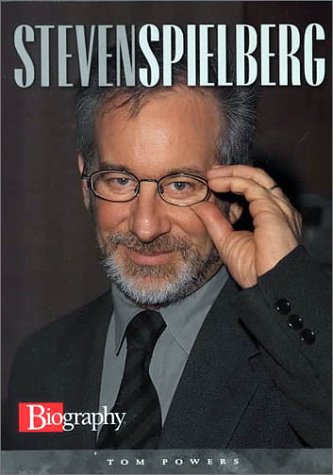
Discusses the personal life and professional career of the successful motion picture producer and director.
Steven Spielberg
By Tom PowersLerner Publications
Copyright © 2000 Tom Powers
All right reserved.ISBN: 9780822596943
Chapter One
THE WEIRD SKINNY KID
Steven Spielberg made his first movie about fighting Nazis when he was thirteen years old. Steven filmed it with a small, 8-millimeter camera that his mother had given his father for Father's Day.
The star of Battle Squad was a large boy who liked to beat up Steven and let the air out of his bicycle tires. Steven had nightmares about the bully. He decided that if he could not fight the boy, he would try to win him over.
Steven told the bully that he was making a film about soldiers fighting the Nazis in World War II, and he wanted him to play the hero. The boy laughed in Spielberg's face. Steven was persistent, however, and finally the bully agreed. Steven dressed his new fourteen-year-old star in a helmet, backpack, and military fatigues, trying to make him look like movie star John Wayne. By the time they finished shooting Battle Squad, the former bully had become Spielberg's best friend.
From the age of thirteen on, Spielberg knew that he wanted to be a filmmaker. He realized that the movie camera could be his "golden shield," his protection against bullies at school, against trouble at home, against every fear, real or imagined.
Steven Spielberg was born December 18, 1946, in Cincinnati, Ohio, the oldest of four children born to Arnold and Leah Spielberg. Because his father's job required frequent moves, Steven grew up in several places: Cincinnati; Haddonfield, New Jersey; Scottsdale, Arizona; and Saratoga, California. It seemed to Steven that every time he got comfortable with a new town, his family moved someplace else.
Steven's father was an electrical engineer who helped design the first computers. Arnold Spielberg shared his love of science and astronomy with his son, hoping Steven would pursue a career in science. Once, when Steven was six years old, his father woke him up late at night. Together they drove into the countryside to watch a meteor shower. Steven cherished that moment.
Arnold Spielberg encouraged his son to work hard at his math and science classes. Steven, however, was more inclined to follow in his mother's footsteps. From his father Spielberg inherited a love of science fiction, but not the desire to become a scientist.
His mother is probably the person who influenced Steven to become an artist. Leah Spielberg was trained as a classical pianist. She often invited other female musicians to come to the house and play classical music. Steven's father was frequently away on business. "I was raised in a world of women," Spielberg said. "Even the dog was female."
Spielberg's father had little interest in classical music. His passion was computers, and he spent long hours at his job. Leah Spielberg was much more carefree and playful than her husband. Over the years, Arnold and Leah Spielberg grew apart. They had few interests in common. Only their love for their children held the marriage together. As an adult looking back on his childhood, Steven praised his parents for doing such a good job raising him and his sisters even as their marriage was failing.
Besides their oldest child, Steven, the Spielbergs had three daughters, Sue, Anne, and Nancy. Steven loved to torment his sisters. Once he locked them inside a closet, where he had rigged a ghostly skeleton with a light glowing in its eye socket. Another time, he cut off the head of his sister Nancy's favorite doll. Then he placed it on a bed of lettuce, surrounded it with tomato slices, and served it to her on a platter. Steven himself was frightened by dark closets and spooky trees and bathtubs with feet. He learned, however, that he could overcome his own fears by making his sisters even more frightened than he was.
As a boy, Steven was enchanted by movies and television. To make sure that his son was not watching too much television, Arnold Spielberg placed a hair over the television power switch. Steven always found the hair, removed it carefully, then replaced it in the same position when he finished watching television.
Walt Disney films were Steven's favorites, and Disney probably influenced Spielberg more than any other filmmaker. Spielberg has said that he was more frightened by the "Night on Bald Mountain" sequence in Fantasia than by anything else he ever saw in the movies.
A lot of other things frightened Steven when he was a little boy. A television documentary on snakes made him cry. The death of Bambi's mother left him shaken. When the wicked queen in Disney's Snow White turned into a skeleton and crumbled into pieces, Steven covered his eyes and burst into tears. He was even afraid of the dark. "The first scary thing I learned to do as a child," he said, "was turn off the light!"
Spielberg did not give in to his fears, though. He may have gone to bed afraid, but he woke up brave. "In the morning I was the bravest guy--there was little seven-year-old Steven walking around the closet, saying `I'm not afraid of you.' Or talking to the trees and clouds, saying `I'm not afraid of you.' But once night fell, all bets were off."
Years later, Spielberg made use of his childhood fears in directing his movies. Most of his films contain powerful, scary figures: a killer truck, a giant shark, a raging forest fire, wicked pirates, evil Nazis. Spielberg shares his fears with audiences. "I like to feel my skin crawling under my shirt trying to get up to my jugular vein," he said. "I'm diabolical in that sense. I get perverse pleasure in making people sweat in their underwear. It doesn't make me the nicest guy in the world but I sure enjoy it."
Always, however, there is a "little guy" in Spielberg'sfilms who triumphs over fear and evil. Sometimes the"little guy" is an ordinary man or woman. Sometimes itis a child, a boy or girl who must conquer fear and takeaction, just like young Steven Spielberg.
Steven spent the greatest part of his childhood inScottsdale, Arizona, a suburb of Phoenix. In school, otherstudents thought Spielberg was a "wimp." "I was theweird skinny kid with acne," he says. He was poor atsports and games. When he was told to dissect a frog inbiology class, he threw up. Steven's father allowed him tostart making family movies because he wanted his son to become more self-confident.
Steven soon took over the house with his moviemaking. He turned the family living room into a movie studio, strewn with electrical cables and floodlights. He overwhelmed the other family members with his eagerness to make movies. According to Spielberg's mother, her son did not understandthe meaning of the word no.
Spielberg recruited his mother and sisters and friends to act in his films. Spielberg's mother was happy to contribute. She helped him make costumes for his films. She drove him into the Arizona desert when he wanted to film "on location." She exploded thirty cans of cherries in a pressure cooker so that he could film the blood-red glop for scary special effects. Spielberg has said that his mother was like a "big kid," full of fun and enthusiasm for his projects.
At Arcadia High School in Phoenix, Steven joined the theater arts program. He discovered that there were options besides being a popular athlete or a weird skinny kid. When he was fifteen, he made his most ambitious film, a two-and-a-half-hour science fiction epic called Firelight. The film cost five hundred dollars and took a year to make, mainly because Steven could only film on weekends. To raise money for the film, he worked...