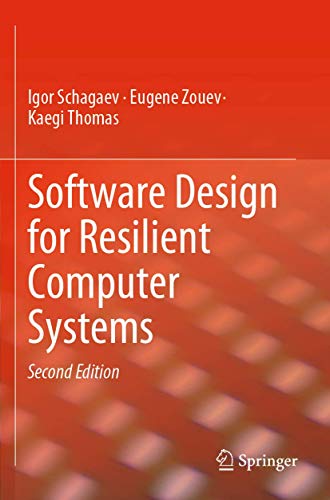
Software Design for Resilient Computer Systems
Schagaev, Igor/ Zouev, Eugene/ Thomas, Kaegi
ISBN 10: 3030212467 ISBN 13: 9783030212469
Verlag: Springer Nature, 2020
Neu
Paperback
Verkäufer
Revaluation Books, Exeter, Vereinigtes Königreich
Verkäuferbewertung 5 von 5 Sternen

AbeBooks-Verkäufer seit 6. Januar 2003
Dieses Exemplar ist nicht mehr verfügbar. Hier sind die ähnlichsten Treffer für Software Design for Resilient Computer Systems.
Beschreibung
Beschreibung:
2nd edition. 328 pages. 9.25x6.10x0.63 inches. In Stock. Bestandsnummer des Verkäufers x-3030212467
Inhaltsangabe:
This book addresses the question of how system software should be designed to account for faults, and which fault tolerance features it should provide for highest reliability. With this second edition of Software Design for Resilient Computer Systems the book is thoroughly updated to contain the newest advice regarding software resilience. With additional chapters on computer system performance and system resilience, as well as online resources, the new edition is ideal for researchers and industry professionals.
The authors first show how the system software interacts with the hardware to tolerate faults. They analyze and further develop the theory of fault tolerance to understand the different ways to increase the reliability of a system, with special attention on the role of system software in this process. They further develop the general algorithm of fault tolerance (GAFT) with its three main processes: hardware checking, preparation for recovery, andthe recovery procedure. For each of the three processes, they analyze the requirements and properties theoretically and give possible implementation scenarios and system software support required. Based on the theoretical results, the authors derive an Oberon-based programming language with direct support of the three processes of GAFT. In the last part of this book, they introduce a simulator, using it as a proof of concept implementation of a novel fault tolerant processor architecture (ERRIC) and its newly developed runtime system feature-wise and performance-wise. Due to the wide reaching nature of the content, this book applies to a host of industries and research areas, including military, aviation, intensive health care, industrial control, and space exploration.Über die Autorin bzw. den Autor: Dr. Igor Schagaev is a Professor and Director of IT-ACS Ltd (UK). He is a Fellow of the Institute of Analyst and Programmers (UK), Fellow of British Computer Society (UK). His career has started as an Electromechanical Engineer at the Smolensk aviation factory, USSR, a Senior Programmer and Design Engineer at the Institute of Advanced Computations, Central Bureau, Smolensk Branch, and a Senior Design Engineer and System Programmer for Avionics. Completed PhD in Russian Academy of Science (Institute of Control Science) and involvement in projects of hardware and software for submarines, satellites and aircrafts enables Igor to absorb an experience which he share with Boeing in 98-99. In 1994 Igor has established ATLAB Ltd Bristol now transformed into IT-ACS Ltd. He has published 7 books in three languages, over 60 papers, since 2006 holds international patent on New Active System Control and supportive mathematical models. ProfessorSchagaev has been honoured with several industry awards, achievements, and grants.
Prof Eugene Zouev is currently a professor in Innopolis University, Russia. Eugene has graduated and defended his PhD in Moscow State University (1976 and 1999, respectively). He was involved in many research and industrial projects in system software, programming languages and their compilers.
Among his achievements were full ISO-compliant C++ compiler (2000, Moscow, Russia), Zonnon language compiler for .NET (ETH Zurich 2000-2006) with and under supervision of Prof Niklaus Wirth (Turing Award) and Prof J. Gutknecht, and many other projects. His involvement in EU funded project (ONBASS 2004-09) became a next step in research and development summarised to some extent in this book.
Dr. Thomas Kaegi-Trachsel received his PhD in 2012 in ETH Zurich in the area of system software for embedded systems (under supervision of Prof. Schagaev). He is currently a Senior Researcher atErgon Informatics, Switzerland.
„Über diesen Titel“ kann sich auf eine andere Ausgabe dieses Titels beziehen.
Bibliografische Details
Titel: Software Design for Resilient Computer ...
Verlag: Springer Nature
Erscheinungsdatum: 2020
Einband: Paperback
Zustand: Brand New
Auflage: 2. Auflage
Beste Suchergebnisse beim ZVAB

Beispielbild für diese ISBN
Software Design for Resilient Computer Systems.
Verlag:
Cham, Springer International Publishing., 2020
ISBN 10: 3030212432
ISBN 13: 9783030212438
Gebraucht
Hardcover
Anbieter: Universitätsbuchhandlung Herta Hold GmbH, Berlin, Deutschland
Verkäuferbewertung 5 von 5 Sternen
2nd ed. 2020. XVIII, 308 p. Hardcover. Einband bestoßen, daher Mängelexemplar gestempelt, sonst sehr guter Zustand. Imperfect copy due to slightly bumped cover, apart from this in very good condition. Stamped. Sprache: Englisch. Artikel-Nr. 13219DB
Gebraucht kaufen
EUR 19,00
EUR 30,00 shipping
Versand von Deutschland nach USA
Versand von Deutschland nach USA
Anzahl: 1 verfügbar
Beispielbild für diese ISBN
Software Design for Resilient Computer Systems
Anbieter: Majestic Books, Hounslow, Vereinigtes Königreich
Verkäuferbewertung 4 von 5 Sternen

Zustand: New. pp. 214. Artikel-Nr. 372075437
Neu kaufen
EUR 101,20
EUR 7,43 shipping
Versand von Vereinigtes Königreich nach USA
Versand von Vereinigtes Königreich nach USA
Anzahl: 1 verfügbar
Foto des Verkäufers
Software Design for Resilient Computer Systems
Anbieter: preigu, Osnabrück, Deutschland
Verkäuferbewertung 5 von 5 Sternen
Taschenbuch. Zustand: Neu. Software Design for Resilient Computer Systems | Igor Schagaev (u. a.) | Taschenbuch | xxi | Englisch | 2025 | Springer | EAN 9783031551413 | Verantwortliche Person für die EU: Springer Verlag GmbH, Tiergartenstr. 17, 69121 Heidelberg, juergen[dot]hartmann[at]springer[dot]com | Anbieter: preigu. Artikel-Nr. 133693268
Neu kaufen
EUR 102,30
EUR 70,00 shipping
Versand von Deutschland nach USA
Versand von Deutschland nach USA
Anzahl: 5 verfügbar
Foto des Verkäufers
Software Design for Resilient Computer Systems
ISBN 10: 3031551419
ISBN 13: 9783031551413
Neu
Taschenbuch
Anbieter: AHA-BUCH GmbH, Einbeck, Deutschland
Verkäuferbewertung 5 von 5 Sternen
Taschenbuch. Zustand: Neu. Druck auf Anfrage Neuware - Printed after ordering - This book addresses the question of how system software should be designed to account for faults, and which fault tolerance features should provide for highest reliability. With this third edition of Software Design for Resilient Computer Systems, the book is thoroughly updated to contain the newest advice regarding software resilience. With a new introductory chapter, the new edition is ideal for researchers and industry professionals.In the book, the authors first show how system software interacts with the hardware to tolerate faults. They analyze and further develop the theory of fault tolerance to understand the diverse ways to increase the reliability of a system, with special attention on the role of system software in this process. They introduce the theory of redundancy and its use for construction of a subsystem through generalised algorithm of fault tolerance (GAFT) and apply it to distributed systems. The book's approach is applied to various hardware subsystems: different structures of RAM and processor cores and demonstrates exceptional performance reliability and energy efficiency. This third edition devotes substantial attention to system software for modern computers, including run time systems, supporting algorithms of recovery and their analysis, language aspects and ways to improve reconfigurable and parallel computing.Due to the wide-reaching nature of the content, this book applies to a host of industries and research areas, including military, aviation, intensive health care, industrial control, and space exploration. Artikel-Nr. 9783031551413
Neu kaufen
EUR 117,69
EUR 63,23 shipping
Versand von Deutschland nach USA
Versand von Deutschland nach USA
Anzahl: 1 verfügbar
Foto des Verkäufers
Software Design for Resilient Computer Systems
ISBN 10: 3319805797
ISBN 13: 9783319805795
Neu
Taschenbuch
Anbieter: AHA-BUCH GmbH, Einbeck, Deutschland
Verkäuferbewertung 5 von 5 Sternen
Taschenbuch. Zustand: Neu. Druck auf Anfrage Neuware - Printed after ordering - This book addresses the question of how system software should be designed to account for faults, and which fault tolerance features it should provide for highest reliability. The authors first show how the system software interacts with the hardware to tolerate faults. They analyze and further develop the theory of fault tolerance to understand the different ways to increase the reliability of a system, with special attention on the role of system software in this process. They further develop the general algorithm of fault tolerance (GAFT) with its three main processes: hardware checking, preparation for recovery, and the recovery procedure. For each of the three processes, they analyze the requirements and properties theoretically and give possible implementation scenarios and system software support required. Based on the theoretical results, the authors derive an Oberon-based programming language with direct support of the three processes of GAFT. In the last part of this book, they introduce a simulator, using it as a proof of concept implementation of a novel fault tolerant processor architecture (ERRIC) and its newly developed runtime system feature-wise and performance-wise. The content applies to industries such as military, aviation, intensive health care, industrial control, space exploration, etc. Artikel-Nr. 9783319805795
Neu kaufen
EUR 128,39
EUR 61,77 shipping
Versand von Deutschland nach USA
Versand von Deutschland nach USA
Anzahl: 1 verfügbar
Foto des Verkäufers
Software Design for Resilient Computer Systems
ISBN 10: 3319805797
ISBN 13: 9783319805795
Neu
Taschenbuch
Anbieter: buchversandmimpf2000, Emtmannsberg, BAYE, Deutschland
Verkäuferbewertung 5 von 5 Sternen
Taschenbuch. Zustand: Neu. Neuware -This book addresses the question of how system software should be designed to account for faults, and which fault tolerance features it should provide for highest reliability. The authors first show how the system software interacts with the hardware to tolerate faults. They analyze and further develop the theory of fault tolerance to understand the different ways to increase the reliability of a system, with special attention on the role of system software in this process. They further develop the general algorithm of fault tolerance (GAFT) with its three main processes: hardware checking, preparation for recovery, and the recovery procedure. For each of the three processes, they analyze the requirements and properties theoretically and give possible implementation scenarios and system software support required. Based on the theoretical results, the authors derive an Oberon-based programming language with direct support of the three processes of GAFT. In the last part of this book, they introduce a simulator, using it as a proof of concept implementation of a novel fault tolerant processor architecture (ERRIC) and its newly developed runtime system feature-wise and performance-wise. The content applies to industries such as military, aviation, intensive health care, industrial control, space exploration, etc.Springer Verlag GmbH, Tiergartenstr. 17, 69121 Heidelberg 228 pp. Englisch. Artikel-Nr. 9783319805795
Neu kaufen
EUR 128,39
EUR 60,00 shipping
Versand von Deutschland nach USA
Versand von Deutschland nach USA
Anzahl: 2 verfügbar
Beispielbild für diese ISBN
Software Design for Resilient Computer Systems
Anbieter: Majestic Books, Hounslow, Vereinigtes Königreich
Verkäuferbewertung 4 von 5 Sternen
Zustand: New. Artikel-Nr. 398114303
Neu kaufen
EUR 129,32
EUR 7,43 shipping
Versand von Vereinigtes Königreich nach USA
Versand von Vereinigtes Königreich nach USA
Anzahl: 1 verfügbar
Foto des Verkäufers
Software Design for Resilient Computer Systems
Verlag:
Springer International Publishing, 2024
ISBN 10: 3031551389
ISBN 13: 9783031551383
Neu
Hardcover
Anbieter: AHA-BUCH GmbH, Einbeck, Deutschland
Verkäuferbewertung 5 von 5 Sternen
Buch. Zustand: Neu. Druck auf Anfrage Neuware - Printed after ordering - This book addresses the question of how system software should be designed to account for faults, and which fault tolerance features should provide for highest reliability. With this third edition of Software Design for Resilient Computer Systems, the book is thoroughly updated to contain the newest advice regarding software resilience. With a new introductory chapter, the new edition is ideal for researchers and industry professionals.In the book, the authors first show how system software interacts with the hardware to tolerate faults. They analyze and further develop the theory of fault tolerance to understand the diverse ways to increase the reliability of a system, with special attention on the role of system software in this process. They introduce the theory of redundancy and its use for construction of a subsystem through generalised algorithm of fault tolerance (GAFT) and apply it to distributed systems. The book's approach is applied to various hardware subsystems: different structures of RAM and processor cores and demonstrates exceptional performance reliability and energy efficiency. This third edition devotes substantial attention to system software for modern computers, including run time systems, supporting algorithms of recovery and their analysis, language aspects and ways to improve reconfigurable and parallel computing.Due to the wide-reaching nature of the content, this book applies to a host of industries and research areas, including military, aviation, intensive health care, industrial control, and space exploration. Artikel-Nr. 9783031551383
Neu kaufen
EUR 160,49
EUR 64,03 shipping
Versand von Deutschland nach USA
Versand von Deutschland nach USA
Anzahl: 1 verfügbar
Foto des Verkäufers
Software Design for Resilient Computer Systems
ISBN 10: 3031551389
ISBN 13: 9783031551383
Neu
Hardcover
Anbieter: buchversandmimpf2000, Emtmannsberg, BAYE, Deutschland
Verkäuferbewertung 5 von 5 Sternen
Buch. Zustand: Neu. Neuware -This book addresses the question of how system software should be designed to account for faults, and which fault tolerance features should provide for highest reliability. With this third edition of Software Design for Resilient Computer Systems, the book is thoroughly updated to contain the newest advice regarding software resilience. With a new introductory chapter, the new edition is ideal for researchers and industry professionals.In the book, the authors first show how system software interacts with the hardware to tolerate faults. They analyze and further develop the theory of fault tolerance to understand the diverse ways to increase the reliability of a system, with special attention on the role of system software in this process. They introduce the theory of redundancy and its use for construction of a subsystem through generalised algorithm of fault tolerance (GAFT) and apply it to distributed systems. The book¿s approach is applied to various hardware subsystems: different structures of RAM and processor cores and demonstrates exceptional performance reliability and energy efficiency. This third edition devotes substantial attention to system software for modern computers, including run time systems, supporting algorithms of recovery and their analysis, language aspects and ways to improve reconfigurable and parallel computing.Due to the wide-reaching nature of the content, this book applies to a host of industries and research areas, including military, aviation, intensive health care, industrial control, and space exploration.Springer Verlag GmbH, Tiergartenstr. 17, 69121 Heidelberg 428 pp. Englisch. Artikel-Nr. 9783031551383
Neu kaufen
EUR 160,49
EUR 60,00 shipping
Versand von Deutschland nach USA
Versand von Deutschland nach USA
Anzahl: 2 verfügbar
Beispielbild für diese ISBN
Software Design for Resilient Computer Systems
Anbieter: Buchpark, Trebbin, Deutschland
Verkäuferbewertung 5 von 5 Sternen
Zustand: Sehr gut. Zustand: Sehr gut | Sprache: Englisch | Produktart: Bücher | Keine Beschreibung verfügbar. Artikel-Nr. 26406104/12
Gebraucht kaufen
EUR 161,78
EUR 105,00 shipping
Versand von Deutschland nach USA
Versand von Deutschland nach USA
Anzahl: 1 verfügbar