
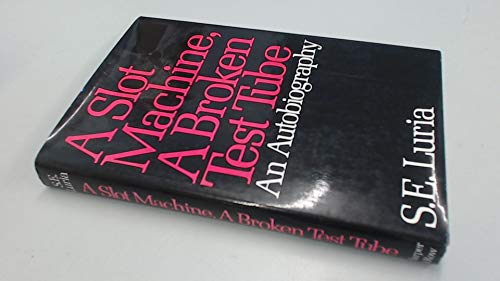
A Slot Machine, a Broken Test Tube: An Autobiography
Salvador Edward Luria
ISBN 10: 0060152605 ISBN 13: 9780060152604
Verlag: Harpercollins, 1984
Gebraucht
Hardcover
Verkäufer
Ammareal, Morangis, Frankreich
Verkäuferbewertung 5 von 5 Sternen

AbeBooks-Verkäufer seit 29. August 2016
Dieser Artikel ist nicht mehr verfügbar.
Beschreibung
Beschreibung:
Ancien livre de bibliothèque avec équipements. Edition 1984. Ammareal reverse jusqu'à 15% du prix net de cet article à des organisations caritatives. ENGLISH DESCRIPTION Book Condition: Used, Good. Former library book. Edition 1984. Ammareal gives back up to 15% of this item's net price to charity organizations. Bestandsnummer des Verkäufers H-114-180
Inhaltsangabe:
The Nobel Prize-winning microbiologist describes his major scientific work, recalls the colleagues and students of his long career, and reflects on his triumphs, failings, doubts, and beliefs
„Über diesen Titel“ kann sich auf eine andere Ausgabe dieses Titels beziehen.
Bibliografische Details
Titel: A Slot Machine, a Broken Test Tube: An ...
Verlag: Harpercollins
Erscheinungsdatum: 1984
Einband: Hardcover
Zustand: Bon
Beste Suchergebnisse beim ZVAB

Beispielbild für diese ISBN
A Slot Machine, a Broken Test Tube
Verlag:
HarperCollins Publishers, 1984
ISBN 10: 0060152605
ISBN 13: 9780060152604
Gebraucht
Hardcover
Erstausgabe
Anbieter: Better World Books, Mishawaka, IN, USA
Verkäuferbewertung 5 von 5 Sternen
Zustand: Good. 1st Edition. Former library copy. Pages intact with minimal writing/highlighting. The binding may be loose and creased. Dust jackets/supplements are not included. Includes library markings. Stock photo provided. Product includes identifying sticker. Better World Books: Buy Books. Do Good. Artikel-Nr. 218394-6
Gebraucht kaufen
EUR 7,90
Versand gratis
Versand innerhalb von USA
Versand innerhalb von USA
Anzahl: 3 verfügbar
Beispielbild für diese ISBN
A Slot Machine, a Broken Test Tube: An Autobiography
Anbieter: ThriftBooks-Dallas, Dallas, TX, USA
Verkäuferbewertung 5 von 5 Sternen
Hardcover. Zustand: Fair. No Jacket. Readable copy. Pages may have considerable notes/highlighting. ~ ThriftBooks: Read More, Spend Less. Artikel-Nr. G0060152605I5N00
Gebraucht kaufen
EUR 8,79
Versand gratis
Versand innerhalb von USA
Versand innerhalb von USA
Anzahl: 1 verfügbar
Beispielbild für diese ISBN
A Slot Machine, a Broken Test Tube: An Autobiography
Anbieter: ThriftBooks-Atlanta, AUSTELL, GA, USA
Verkäuferbewertung 5 von 5 Sternen
Hardcover. Zustand: Good. No Jacket. Pages can have notes/highlighting. Spine may show signs of wear. ~ ThriftBooks: Read More, Spend Less. Artikel-Nr. G0060152605I3N00
Gebraucht kaufen
EUR 8,79
Versand gratis
Versand innerhalb von USA
Versand innerhalb von USA
Anzahl: 1 verfügbar
Foto des Verkäufers
A Slot Machine, a Broken Test Tube: An Autobiography (Alfred P. Sloan Foundation series)
Verlag:
Harper & Row, 1984
ISBN 10: 0060152605
ISBN 13: 9780060152604
Gebraucht
Hardcover
Erstausgabe
Anbieter: Arroyo Seco Books, Pasadena, Member IOBA, Pasadena, CA, USA
Verkäuferbewertung 5 von 5 Sternen
Hardcover. Zustand: Fine. Zustand des Schutzumschlags: Fine. 1st Edition. X, 229 Pp. Black Cloth, Gilt. First Printing Indicated. Fine In Fine Dust Jacket Priced $17.95. Artikel-Nr. 051226
Gebraucht kaufen
EUR 74,86
EUR 6,84 Versand
Versand innerhalb von USA
Versand innerhalb von USA
Anzahl: 1 verfügbar
Beispielbild für diese ISBN
A Slot Machine, A Broken Test Tube; An Autobiography
Verlag:
Harper & Row, New York, 1984
ISBN 10: 0060152605
ISBN 13: 9780060152604
Gebraucht
Hardcover
Erstausgabe
Anbieter: Ground Zero Books, Ltd., Silver Spring, MD, USA
Verkäuferbewertung 4 von 5 Sternen

Hardcover. Zustand: Very good. Zustand des Schutzumschlags: Very good. Jerry Bauer (Author's photograph) (illustrator). x, 228, [2] pages. Preface to the Series [Alfred P. Sloan Series]. Index. The Nobel Prize-winning microbiologist describes his major scientific work, recalls the colleagues and students of his long career, and reflects on his triumphs, failings, doubts, and beliefs. Salvador Edward Luria (born Salvatore Luria; August 13, 1912 - February 6, 1991) was an Italian microbiologist, later a naturalized U.S. citizen. He won the Nobel Prize in Physiology or Medicine in 1969, with Max Delbrück and Alfred Hershey, for their discoveries on the replication mechanism and the genetic structure of viruses. Salvador Luria also showed that bacterial resistance to viruses (phages) is genetically inherited. In 1959, he became chair of Microbiology at the Massachusetts Institute of Technology (MIT). At MIT, he switched his research focus from phages to cell membranes and bacteriocins. His lab discovered that bacteriocins achieve this impairment by forming holes in the cell membrane, allowing ions to flow through and destroy the electrochemical gradient of cells. In 1972, he became chair of The Center for Cancer Research at MIT. In addition to the Nobel Prize, Luria received a number of awards. He was elected to the American Academy of Arts and Sciences in 1959. He was named a member of the National Academy of Sciences in 1960. In 1964, he was elected to the American Philosophical Society. In 1969, he was awarded the Louisa Gross Horwitz Prize from Columbia University with Max Delbrück, co-winner with Luria of the Nobel Prize in Physiology or Medicine in 1969. He received the National Medal of Science in 1991. Derived from a Kirkus review: S. E. Luria's autobiography adds another gem to the Sloan Foundation series. The molecular biologist and Nobel laureate writes with a crispness and concision that mirrors his outlook and his work. He is proud of "reductionist" science; he is committed to a life of reason and political action. Early on, he confides also, he committed himself to acquiring a musical education and, later, to learning and appreciating "modern" poets. All this is told in chapters that compartmentalize the life: the developing years as a Jew in a modest Turin household in pre-fascist Italy; the scientific achievements; the teaching career; the marriage, emotional life, political activities. Luria set out to study medicine, but a fascination with physics led to Fermi in Rome, and then to a stint at the Pasteur Institute and the study of genes as molecules--a fanciful idea in the Thirties. World War II found him in New York and subsequently at Bloomington, Indiana. The slot machine and the broken test tube of the title were both scientific turning points. In the first instance, Luria made an intuitive leap while watching a slot machine at a college dance. He had been speculating about a problem dividing biologists: did the viruses that infected bacteria ("phages") induce some bacteria to become resistant, or was resistance the result of a random bacterial mutation? If the latter, then an experiment could be set up that would show certain cultures of bacteria infected by phage to be "jackpots" with numerous resistant colonies, while others would be duds. So it was. The broken test tube was indeed an accident, but one that resolved yet another mystifying question: why did some bacteria infected by phage die, without phage progeny showing up in the culture dish? (The bacteria produced enzymes, it turned out, that attacked the phage DNA: the bacteria were still killed, but the phage would not reproduce in that bacteria or in related strains. When Luria's test tube broke, he borrowed a colleague's that contained bacteria of an unrelated strain; the enzyme-modified phage grew happily in this strain--thus demonstrating the new phenomena of "restriction" and "modification.") Luria's chapters on molecular biology and its shapers are fine additions to the genre; the fascination of the book, however, is in the man. He presents himself with forthright honesty and integrity--unexpectedly disclosing, at the end, that he suffered years of depressive episodes prior to drug treatment. A remarkable life, abundant in courage and conviction. First Edition [Stated], First Printing [Stated]. Artikel-Nr. 87970
Gebraucht kaufen
EUR 77,06
EUR 4,28 Versand
Versand innerhalb von USA
Versand innerhalb von USA
Anzahl: 1 verfügbar