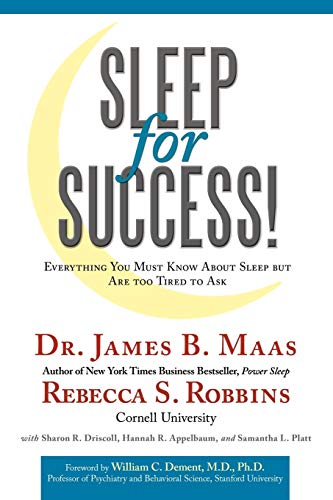
Given the present, stress-inducing state of the economy and the world, there has never been a better time to provide a wake-up call on how to relax, get centered, get 8 hours of sleep and be happier and more successful. Recent research has shown us that when we get enough sleep, we are able to accomplish more in less time and with less stress and greater health. We don't need a 26-hour day. With more efficient and effective sleep habits, in our book, 24 hours is more than adequate. Our proposition is simple and compelling. Do you want to be healthier, more productive, energetic, creative, organized, efficient, and constantly expanding your potential? Do you want to be less stressed, happier, have a better relationship with yourself and others, and a deeper sense of well-being? What if you could take a few small steps every day that would enable you to eventually achieve all these things? You can. In fact, it's easy. Sleep for Success, a convincing, psychological approach to changing attitudes and behaviors, is written for anyone who wants to get a great night's sleep, feel wide-awake and be a peak performer all day. It pertains to executives, students, parents, athletes, children and senior citizens. If you're human, chances are that you are at least somewhat sleep deprived. Sleep for Success! can change your life - literally overnight.
SLEEP for SUCCESS!
Everything You Must Know About Sleep but Are too Tired to AskBy James B. Maas Rebecca S. RobbinsAuthorHouse
Copyright © 2010 Dr. James B. Maas
All right reserved.ISBN: 978-1-4520-3775-2 Contents
Acknowledgements.............................................................................................ixForward—Dr. William C. Dement..........................................................................xiiiIntroduction—What's So "Macho" About Not Sleeping?.....................................................xvPart One—Everything You Must Know About Your Sleep Habits but Are Too Tired to Ask.....................1Chapter 1—The Sleep Meter: Think You're Alert? Find Out Here...........................................3Chapter 2—New Findings on Sleep Deprivation: The Silent Killer.........................................11Part Two—New Discoveries in the Science of Sleep.......................................................25Chapter 3—The Architecture of a Good Night's Sleep.....................................................27Chapter 4—Sleep, Learning, and Memory..................................................................32Chapter 5—Dreaming.....................................................................................41Part Three—A New Look on How to Get a Great Eight Hours of Sleep.......................................47Chapter 6—The Four Essential Keys to Sleeping Well.....................................................49Chapter 7—Sure-Fire Strategies to Sleep for Success!...................................................58Chapter 8—What's your Naptitude?.......................................................................82Part Four—New Research that Provides Helpful Solutions to Common Sleep Challenges......................89Chapter 9—Sleep from Birth through Childhood...........................................................91Chapter 10—Teenage Walking Zombies.....................................................................110Chapter 11—Challenges for the Elderly..................................................................122Chapter 12—Women & Sleep...............................................................................130Chapter 13—Managing Time for Better Sleep..............................................................137Chapter 14—Surviving Shift Work........................................................................146Chapter 15—Sleep Tips for the Traveler.................................................................155Chapter 16—Sleep, Exercise, and the Athlete............................................................171Part Five—An Up-to-Date Look at Sleep Disorders and Their Treatment....................................183Chapter 17—Understanding and Treating the Most Common Sleep Disorders..................................185Chapter 18—Knock Yourself Out: Sleep Drugs.............................................................204Chapter 19—Personal Observations.......................................................................215A. Sleep for Success Performance Log.........................................................................223B. Suggested Readings and Videotapes on Sleep................................................................229C. Internet Resources........................................................................................237
Chapter One
The Sleep Meter: Think You're Alert? Find Out Here
• Do you fall asleep as soon as your head hits the pillow?
• Do you need an alarm clock to wake up?
• Do you sleep extra hours on weekends?
If you answered yes to these questions (and to others we're about to ask you), you're sleepier than you should be. You might feel alert enough to get through the day, but you're probably performing well below your potential.
Most people don't value sleep and have no idea how tired they really are. There are various elaborate and expensive laboratory tests that objectively measure sleepiness, but we can make a pretty thorough assessment based on how you respond to the following two questionnaires. Don't worry; they're short, easy, and fun—a cinch compared to any high school math exam.
The first self-test is the Maas Robbins Alertness Questionnaire (MRAQ ). We've used this to assess Cornell University students as well as Fortune 500 executives. The twenty statements help differentiate between well-rested and sleep-deprived individuals. The second self test is the Epworth Sleepiness Scale. It measures daytime sleepiness and helps diagnose disorders such as sleep apnea and narcolepsy. Ready?
The Maas Robbins Alertness Questionnaire (MRAQ)
2010 Dr. James B. Maas and Rebecca S. Robbins
Please indicate true or false for the following statements:
True False
T F 1. I often need an alarm clock in order to wake up at the appropriate time.
T F 2. It's often a struggle for me to get out of bed in the morning.
T F 3. Weekday mornings I often hit the snooze bar several times.
T F 4. I often feel tired and stressed out during the week.
T F 5. I often feel moody and irritable, and little things upset me.
T F 6. I often have trouble concentrating and remembering.
T F 7. I often feel slow with critical thinking, problem solving, and being creative. T F 8. I need caffeine to get going in the morning or make it through the afternoon.
T F 9. I often wake up craving junk food, sugars, and carbohydrates.
T F 10. I often fall asleep watching TV.
T F 11. I often fall asleep in boring meetings or lectures or in warm rooms.
T F 12. I often fall asleep after heavy meals or after a low dose of alcohol.
T F 13. I often fall asleep while relaxing after dinner.
T F 14. I often fall asleep within five minutes of getting into bed.
T F 15. I often feel drowsy while driving.
T F 16. I often sleep extra hours on the weekends. T F 17. I often need a nap to get through the day.
T F 18. I have dark circles around my eyes.
T F 19. I fall asleep easily when watching a movie
T F 20. I rely on energy drinks or over-the-counter medications to keep me awake.
If you answered "True" to four or more of these statements, consider yourself seriously sleep-deprived.
Epworth Sleepiness Scale
(Designed by Dr. Murray Johns of Australia) M.W. Johns 1990&#ndash;1997
Use the "Doze Scale" to respond to each situation.
0 = no chance of dozing
1 = slight chance of dozing
2 = moderate chance of dozing
3 = high chance of dozing
Situation Chance of Dozing
Sitting and reading _________
Watching TV _________
Sitting inactive in a public...