The quest for answers—and ultimate survival—hinges on finding the cosmic link between the Skin Map, the Shadow Lamp, and the Spirit Well.
The search for the map of blue symbols began in a rainy alley in London but has since expanded through space and time and includes more seekers.
Kit, Mina, Gianni, Cass, Haven, and Giles have gathered in Mina’s 16th-century coffee house and are united in their determination to find a path back to the Spirit Well. Yet, with their shadow lamps destroyed and key pieces of the map still missing, the journey will be far more difficult than they imagine. And when one of their own disappears with Sir Henry’s cryptic Green Book, they no longer know who to trust.
At the same time, the Zetetic Society has uncovered a terrifying secret which, if proven, will rock the very foundations of Creation. The quest for answers is no longer limited to recovering an unknown treasure. The fate of the universe depends on unraveling the riddle of the Skin Map.
“Anything but ordinary . . . Dynamic settings are mixed with unpredictable adventures [and] parallel worlds.” —BookPage review of The Skin Map
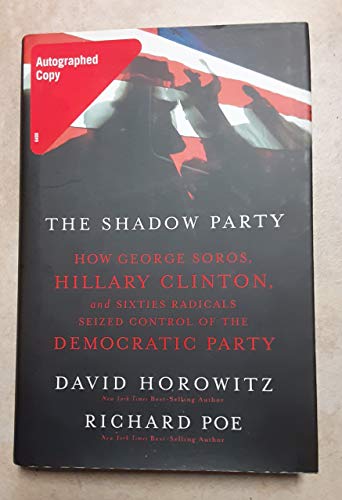
THE SHADOW PARTY
HOW GEORGE SOROS, HILLARY CLINTON, and SIXTIES RADICALS SEIZED CONTROL OF THE DEMOCRATIC PARTYBy DAVID HOROWITZ RICHARD POENELSON CURRENT
Copyright © 2007 David Horowitz and Richard Poe
All right reserved.ISBN: 978-1-59555-044-6Contents
Introduction......................................ix1. The Shadow Party's Lenin.......................12. How Soros Works................................193. Boring from Within.............................354. Soros and Hillary..............................515. Inside Soros...................................656. Strategy for Regime Change.....................997. Marching Orders................................1178. Opening the Door...............................1299. The Connection.................................15510. The Shadow Party..............................17311. Going Global..................................21312. Velvet Revolutions............................229Acknowledgments...................................245Notes.............................................247Index.............................................277
Chapter One
THE SHADOW PARTY'S LENIN
The architect and guiding genius of the Shadow Party, its Lenin-if one is careful with the analogy-is billionaire activist George Soros. Like Lenin, Soros excels at waging revolution from "above"-through manipulation of economic and political forces at the highest levels. However, Soros also resembles Lenin in his diligent cultivation of insurgent forces from "below."
Like the Shadow Party he created, Soros has many layers. On the surface, he is a well-known public figure, a philanthropist and financier who is frequently in the news. Yet another George Soros remains cryptic and elusive, his goals and activities obscured by a smokescreen of denial and calculated misdirection.
Soros denies that he plays any special role in the Shadow Party he has created. He claims that he is just one of its many financial contributors. In fact, as we will show in these pages, Soros founded and organized the Shadow Party personally, and exercises a degree of authority over its operations not unlike that of a corporate president over a company.
Americans need to become better acquainted with Soros and his radical perspective. They also need to familiarize themselves with the sophisticated mechanism he has built for getting his way.
George Soros is one of the most powerful men on earth. A New York hedge fund manager, he has amassed a personal fortune estimated at about $7.2 billion. His management company controls billions more in investor assets. Since 1979, his foundation network has dispensed an estimated $5 billion. Soros claims that his Open Society Institute donates up to $425 million annually to various causes.
For all his wealth, Soros' greatest influence comes not from spending his own money, but from inducing other people to spend theirs. This is most obvious in his approach to the financial markets. Soros' reputation as a financial prognosticator is such that legions of investors hang on his word, and buy or sell at his signal. An op-ed piece by Soros published in the Wall Street Journal or an interview broadcast on Bloomberg or CNBC can move vast sums of money in the financial markets, which far exceed Soros' personal spending power. As the New York Times once put it, "When Soros speaks, world markets listen."
Through the years, Soros has matched his strength more than once against the economic power of nations, and emerged victorious. He famously shorted the British pound in 1992, wagering $10 billion on a drop in its value. In a desperate bid to keep its currency afloat, the Bank of England tried to buy up pounds as fast as Soros could dump them. However, as more and more investors followed Soros' lead and joined his efforts, the Bank of England eventually gave up. The British pound was devalued, launching a tsunami of financial turmoil from Tokyo to Rome. When it was over, millions of hardworking Britons confronted their diminished savings, while Soros counted his gains. He had personally made nearly $2 billion on the catastrophe, and was henceforth known as "the man who broke the Bank of England."
Breaking the pound sterling was a formidable undertaking. Soros had to risk $10 billion in order to accomplish it. On other occasions, he has wreaked similar havoc by investing nothing more than the time it takes to compose a letter. On 9 June 1993, Soros sent a letter to the Times of London suggesting that the German mark was weak. "I expect the mark to fall against all major currencies," he wrote. The statement triggered twenty-four hours of panic selling, which sent the Deutschmark into a tailspin. Soros repeated the feat on 14 July 1998, this time with far more destructive consequences, when he suggested in the Financial Times of London that the Russian government ought to devalue the ruble by 15 to 25 percent. Panic selling again ensued, plunging Russia into a deep depression.
Few private individuals in the history of finance have possessed the power to break currencies with a single utterance. Soros is one of those few. He likens his influence to the magic of alchemy. In his 1995 book Soros on Soros, he wrote, "The alchemists made a big mistake trying to turn base metals into gold by incantation. With chemical elements, alchemy doesn't work. But it does work in the financial markets, because incantations can influence the decisions of the people who shape the course of events."
The possibility that Soros might one day deploy his market alchemy to the disadvantage of the United States has long been a topic of anxious discussion among America's financial watchdogs. Democrat Congressman Henry Gonzalez of Texas-then chairman of the House Banking Committee-expressed this concern in a speech to the Congress on 8 June 1993. "Recent press accounts state that Mr. George Soros, the manager of the Quantum Fund, made over $1 billion betting against the British pound. I am interested in ... the U.S. bank exposure to Mr. Soros' fund." Gonzalez said.
What Gonzalez feared has come to pass. "I have to disclose that I now have a short position against the dollar." Soros announced on CNN in May 2003. At a time when the US dollar had fallen to a four-year low against the euro, Soros now helped push it lower by informing the world that he had begun cashing in dollars in exchange for euros and other foreign currencies. Soros knows better than most that, when currencies fall, governments often fall with them. His attack on the dollar is an attack on George Bush and on the war Bush is waging in Iraq. Regrettably, it is not the first time Soros has used his financial might to thwart America's War on Terror.
On 26 February 1993, Muslim jihadists struck the World Trade Center the first time, in what was then the most ambitious terror attack ever attempted. Their plan was to knock over the Trade Center's north tower, causing it to fall against the south tower, killing hundreds of thousands of people. To this end, they planted an enormous truck bomb in an underground garage beneath the north tower. The bomb contained more than half a ton of urea nitrate, with a nitroglycerine detonator. It also contained hydrogen cyanide, which the bombers hoped would envelop the blast zone in a cloud of poison gas.
Fortunately, the bomb failed to perform as intended. The cyanide burnt up harmlessly in the blast. The bomb blew a hole six stories deep beneath the Tower,...