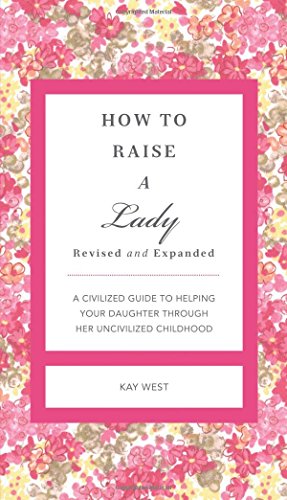
How to Raise a Lady is an invaluable resource for parents who hopetheir little girls will grow up to be the kind of women who know which fork touse, how to treat others, and will generally make their parents proud.
How to Raise a Lady focuses on real-life topics such as sleepovers;sex, religion, and politics; and saying "please" and "thankyou." The book includes:
- Personal stories pertaining to each topic
- Suggestions for the age at which parents should introduce a child to certain rules
- Helpful ideas in easy-to-remember phrases
- And suggestions that parents can follow to "teach by example"
HOW TO RAISE A Lady
A CIVILIZED GUIDE TO HELPING YOUR DAUGHTER THROUGH HER UNCIVILIZED CHILDHOODBy KAY WESTThomas Nelson
Copyright © 2012 Kay West
All right reserved.ISBN: 978-1-55853-941-9Contents
Introduction...........................................................................................ixLeading the Way to Good Manners........................................................................xiiiChapter One Please, Thank You, Excuse Me, and Other Early Social Interventions.........................1Chapter Two Yes Sir, No Sir, and Other Regional Divides................................................9Chapter Three Introductions, Greetings, and Leavings...................................................17Chapter Four Shopping, Offices, and Waiting Rooms......................................................25Chapter Five Playgrounds, Playdates, and Playing Well with Others......................................33Chapter Six Sleepovers: Friends and Relatives..........................................................43Chapter Seven Party Manners............................................................................51Chapter Eight Dining In and Out........................................................................59Chapter Nine Cultural Affairs: the Theater, Movies, Sports, Museums, and Libraries.....................69Chapter Ten Traveling Manners..........................................................................79Chapter Eleven Bathroom Habits, Beauty Products, and Personal Grooming.................................91Chapter Twelve Modesty, Boundaries, and Appropriate Attire.............................................101Chapter Thirteen Temper Temper.........................................................................109Chapter Fourteen Religion, Politics, and Santa Claus...................................................119Chapter Fifteen Telephone Manners......................................................................127Chapter Sixteen Computers, the Internet, and Social Media..............................................137Chapter Seventeen Staring and Differences..............................................................147Chapter Eighteen Preachers and Teachers; Church and School.............................................155Chapter Nineteen Mean Girls and Bullying...............................................................165Chapter Twenty Good Sportsmanship......................................................................173Chapter Twenty-one Written Correspondence..............................................................183Chapter Twenty-two Giving and Receiving................................................................191About the Author.......................................................................................195Index..................................................................................................197
Chapter One
PLEASE, THANK YOU, EXCUSE ME, AND OTHER EARLY SOCIAL INTERVENTIONS
The first year of your daughter's life is chock-full of milestones: the first time she sleeps through the night, the first time she rolls over, sits up, crawls, pulls herself up, and the first step. Each of those achievements is easily documented. The first word, however, is a bit more intangible. Parents straining to hear their little girl's primitive attempts at spoken communication will eagerly interpret the most garbled babbling as "Mama" and "Dada." It is nothing less than joyful music to their ears. Slightly less harmonious will be the next addition to her teensy lexicon: "no." In its earliest and most experimental stages, it typically does not indicate rudeness, but a simpler way to communicate displeasure than crying and screaming. It is also an easier word for tiny mouths to form than the more agreeable and pleasant "yes." Though it will be some time before she includes verbs, adverbs, adjectives, and protocol in her conversations, that doesn't mean she isn't soaking up the patterns of speech used by the adults and older siblings in her home.
The best way to introduce and promote mannerly conduct is by example. Children want to emulate the adults in their lives and fit in with the rest of the family. If the words "please" and "thank you" are used without exception in your home, your budding young lady will follow suit. Using "please" and "thank you" yourself is also an opportunity to reward and promote other courteous behavior.
Except in the case of an emergency, encourage the use of the word "please" by not responding to a request until the word is employed. Don't expect a three-year-old to deliver lengthy sentences such as "May I please have a glass of juice?" but help her see the difference between a request and a demand. "Juice!" is a demand that grates on the nerves and will go unheeded; "Juice, please?" is a request, so pleasing to the adult ear it is likely to be met with the cheerful bestowal of the coveted item.
When your daughter's request is granted, she then responds, "Thank you." Adults should, in turn, respond to this simple display of gratitude with a modest expression of approval, "You're welcome," with a smile or quick hug. Rewards are not necessary for behavior that is eventually expected to be a matter of course, with the possible exception of potty training. In that taxing endeavor, the reward system is encouraged. Reserve your applause for accomplishments that deserve it, like an excellent report card or a soccer goal.
It is one small but impressive step from "please" and "thank you" to "yes, please" and "no, thank you," but one not to be expected until the child has mastered the former and uses them as habit. At that point, "Would you like a glass of juice?" has two appropriate responses: "Yes, please" or "No, thank you."
The next phrase to be added to a young lady's socially correct vocabulary is "excuse me." The opportunities for its use will present themselves again and again:
If a young lady inadvertently burps aloud, she says, "Excuse me."
* * *
If a young lady accidentally bumps into someone or steps on toes, the appropriate way to make amends is simply by saying "Excuse me."
* * *
A young lady does not interrupt adults when they are engaged in conversation. If the conversation is a lengthy one, and she has a pressing need that must be promptly attended to, then she might say, "Excuse me, Mommy. I really need to go to the bathroom now!" An attentive mommy will cease her discussion of the novel her book club is reading, and attend to her daughter's request.
* * *
Should a young lady need to have something repeated to her because it was unclear, or she was unable to hear, she says "Excuse me?" She does not say "What?" or even worse, "Huh?"
Your Daughter Is Becoming a Young Lady If ...
She uses...