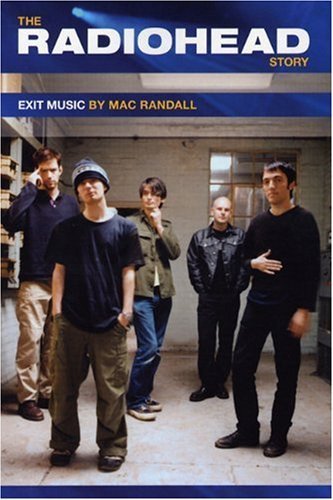
Radiohead may be one of the worlds most famous bands, but the 5 members give away little about themselves, until now.
Exit Music
The Radiohead StoryBy Mac RandallOmnibus Press
Copyright © 2004 Mac Randall
All right reserved.ISBN: 9781844491834
Excerpt
The day was Monday, June 9, 1997, and a concert was about to begin near New YorkCity's Union Square. Over the weekend that had just ended, thousands of musicfans had made pilgrimages much farther uptown, to Downing Stadium on RandallsIsland in the East River between Manhattan, the Bronx, and Queens, to witnessthe second annual two-day Tibetan Freedom Concert. An all-star event organizedby New York's own hip-hop kings the Beastie Boys, the concert would attempt tofocus world attention on Tibet's plight under harsh Chinese rule and would raisemoney for the cause of Tibetan independence. Performers had included such rockluminaries as U2, Patti Smith, Michael Stipe and Mike Mills from R.E.M., AlanisMorissette, and the Beastie Boys themselves.
Another band in that distinguished lineup was set to play again on this evening,in the far cozier confines of Irving Plaza (capacity approximately 1000 people).Their Tibetan Freedom performance had been one of the festival's highlights.Their name was being mentioned more and more often in the same breath as thoseof rock's most lauded superstars. And whereas over the weekend they had played ashort set, sharing the stage with several other artists, tonight would be theirsalone, without even an opening act. They were a quintet from Oxford, England,and they were called Radiohead.
Earlier in the year, the band?made up of singer and guitarist Thom Yorke,guitarist and keyboardist Jonny Greenwood, guitarist Ed O'Brien, bassist ColinGreenwood, and drummer Phil Selway?had put the finishing touches on its thirdalbum, OK Computer. The album wouldn't be released in the United States untilJuly, almost a month after the Irving Plaza show, but many of the music-industrytypes in the audience had heard advance copies; some were already using wordslike masterpiece to describe it. And nearly everyone in attendance had eitherheard the album's leadoff single, a six-and-a-half-minute, three-part epiccalled "Paranoid Android," or seen its quirky animated video on MTV. That Junenight, Radiohead planned to air several songs off the new album. They may nothave been fully conscious of it, but they were also preparing to join the ranksof the rock aristocracy.
The VIP section of Irving Plaza, on the right side of the balcony above thestage, was roped off to prevent anyone without a special pass from entering. Itoverflowed with some of the most respected and successful people in popularmusic. Michael Stipe and Mike Mills hobnobbed with Bono, the Edge, and AdamClayton from U2. Oasis' Noel Gallagher quietly sipped his beer while his brotherLiam pranced goonishly through the crowd. Blur's Damon Albarn sat sulkily by thebar, at a distance from his bandmate Alex James.
Most of these artists, like Radiohead, had performed at the Tibetan FreedomConcert and had stayed over into the following week. But many other celebritieswho hadn't played during the weekend had caught wind of this particularevening's mega-event and had gotten their names on the guest list too. Madonnashowed up; so did Courtney Love. Lenny Kravitz made it, along with MarilynManson. Sheryl Crow was supposed to have been on the VIP list but wasn't forsome reason or other, and when she got to the club she was nearly turned away atthe door before somebody recognized her and let her pass. Ben Folds, all fourmembers of Teenage Fanclub . . . it seemed everyone who was anyone wanted in onthis party. Of the less distinguished crowd standing on the floor downstairs,quite a few spent more time during the show ogling the celebs in the balconythan watching the band onstage. As Ed O'Brien later cracked, "If a bomb had beenlet off in that building, we'd have seen the resurrection of Jim Kerr fromSimple Minds."
Of course, the five members of Radiohead had known in advance about all thespecial people who'd be watching them that night. And the most special of themall was Ed O'Brien's mother. "It was the first time she'd seen us in fouryears," Ed says. "Before the doors opened, I went round looking at the VIPsection, as it were. Madonna had the best table in the house and my mum's tablewas way in the back. I thought, 'I'm not having this,' so I swapped my mum's andMadonna's tables around. So," he continues with a giggle, "Madonna was at theback, and my mum had the best table in the house, sandwiched in between U2 andR.E.M. And that's exactly how it should be?I'm sure Madonna would have doneexactly the same. You know, it's great that all those people are there, but ifyour mum is there, your mum is the most important thing."
Now that the real priorities had been straightened out, it was time forRadiohead to take the stage. Although the prospect of playing in front of such agroup of people (including at least two bands?U2 and R.E.M.?that the fivesomehad idolized in younger days) was incredibly intimidating, the band weren'tabout to let on anything of the sort. "We were nervous," O'Brien admits. "Butthere was also a sense of, like, we're still the underdogs. There was this kindof rock 'n' roll hierarchy there?U2 and R.E.M. and Lenny Kravitz and Madonna,et cetera, et cetera?and there were Oasis as well, our peers, but they'reobviously bigger than us. And we knew beforehand that if we were able to getinto it, relax a little bit and do a good gig, we could give everyone a good runfor their money."
As the lights in the house darkened, a computer voice boomed through the P.A.speakers, dispassionately intoning what seemed to be random phrases andobservations, by turns ambiguous, ironic, and disturbed: "Fitter, happier, moreproductive . . . getting on better with your associate employee contemporaries .. . no longer afraid of the dark or midday shadows . . . at a better pace . . .no chance of escape. . . ." Tall, lanky Ed O'Brien took his place on the leftside of the stage and began scraping the strings above the nut of his FenderStratocaster, summoning the ghostly sonic atmosphere that opens "Lucky," thefirst song recorded for OK Computer. On the opposite side of the stage, JonnyGreenwood hunched over his Telecaster, his chiseled cheekbones hidden by acurtain of jet-black hair. Behind those two, Phil Selway, head newly shaven,manned the drumkit with consummate cool, while Colin Greenwood, Jonny's olderbrother, held down a subdued yet warm bassline, bobbing slowly back and forthbut never moving out of the drummer's sight for long.
In the center stood Thom Yorke, diminutive, spiky-haired, intense, a FenderJazzmaster loosely slung over his shoulder. Eyes nearly closed, he sang, quietlyat first, words that seemed beyond optimism, hinting at a mysterious change ofluck and at the same time conjuring up images of aircrashes and bodies at thebottoms of lakes. When the band paused between the chorus and the verse, Yorkeraised his right hand and waved it three times. The gesture kept the rhythmiccount steady in the absence of drums, but it also resembled the last hopelesswave of a drowning victim. As the song progressed, Yorke's singing graduallygained momentum. On the climactic line, "It's gonna be a glorious day," hisvoice swelled up and out before spiraling gracefully down, achieving an almostoperatic grandeur. The band's playing matched the mood perfectly, their deepminor chords echoing across vast spaces.
Continues...
Excerpted from Exit Musicby Mac Randall Copyright © 2004 by Mac Randall. Excerpted by permission.
All rights...