
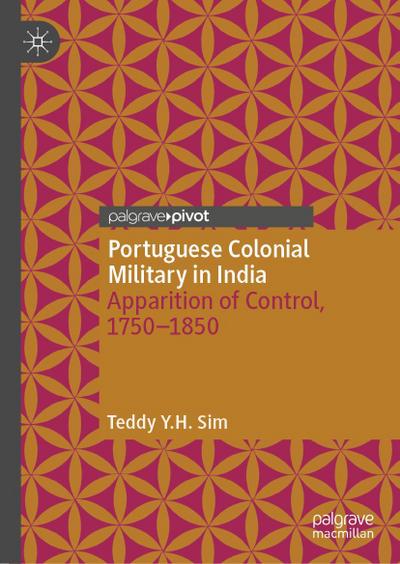

Portuguese Colonial Military in India
Teddy Y. H. Sim
ISBN 10: 9811962936 ISBN 13: 9789811962936
Verlag: Springer Dez 2022, 2022
Neu
Buch
Verkäufer
buchversandmimpf2000, Emtmannsberg, BAYE, Deutschland
Verkäuferbewertung 5 von 5 Sternen

AbeBooks-Verkäufer seit 23. Januar 2017
Dieser Artikel ist nicht mehr verfügbar.
Beschreibung
Beschreibung:
This item is printed on demand - Print on Demand Titel. Neuware -This book explores and analyzes developments in the military institution, military engagements as well as the larger security environment of (including non-war violence and maritime regions linking to) the Portuguese Empire in India. These developments occurred under the onslaught of the early modern globalization. The research shows that far from being dilapidated or archaic, the Portuguese colonial military there kept up with some developments in technology and organization in a competitive environment. Although the colonial military was not the most important reason in accounting for the survival of the Portuguese Estado da Índia, nor was the military profession the most lucrative occupation, the Portuguese experience gave indication of how a colonial state and society was able to survive against coalescing threats from the position of weakness. Located in the period and geographical region of the wax and waning of the Mughal and Maratha empires, Portuguese India was not necessarilya more violent place than the surrounding territories although resistance to and uprising against the Portuguese was usually underestimated. Beginning from the attempt at political and military centralization (and standardization) in the eighteenth century, the abolition of the army of the Estado da Índia in the nineteenth marked nominally the end of an era that may have a reverberation on the pacifist perception of Goa today.Springer-Verlag GmbH, Tiergartenstr. 17, 69121 Heidelberg 216 pp. Englisch. Bestandsnummer des Verkäufers 9789811962936
Inhaltsangabe:
This book explores and analyzes developments in the military institution, military engagements as well as the larger security environment of (including non-war violence and maritime regions linking to) the Portuguese Empire in India. These developments occurred under the onslaught of the early modern globalization. The research shows that far from being dilapidated or archaic, the Portuguese colonial military there kept up with some developments in technology and organization in a competitive environment. Although the colonial military was not the most important reason in accounting for the survival of the Portuguese Estado da Índia, nor was the military profession the most lucrative occupation, the Portuguese experience gave indication of how a colonial state and society was able to survive against coalescing threats from the position of weakness. Located in the period and geographical region of the wax and waning of the Mughal and Maratha empires, Portuguese India was not necessarilya more violent place than the surrounding territories although resistance to and uprising against the Portuguese was usually underestimated. Beginning from the attempt at political and military centralization (and standardization) in the eighteenth century, the abolition of the army of the Estado da Índia in the nineteenth marked nominally the end of an era that may have a reverberation on the pacifist perception of Goa today.
Über die Autorin bzw. den Autor:
Teddy Sim is involved in research extending from the doctoral work he does on the Portuguese enterprise in the East centering on colonial India in the eighteenth century, of which he has published related papers and the book Portuguese Enterprise in the East: Survival in the Years 1707–57 (2011). He is also the editor of Piracy and surreptitious activities in Malay Archipelago and adjacent regions (2014), and Maritime Defense of China: Ming General Qi Jiguang (2017).
„Über diesen Titel“ kann sich auf eine andere Ausgabe dieses Titels beziehen.
Bibliografische Details
Titel: Portuguese Colonial Military in India
Verlag: Springer Dez 2022
Erscheinungsdatum: 2022
Einband: Buch
Zustand: Neu
Beste Suchergebnisse beim ZVAB

Beispielbild für diese ISBN
Portuguese Colonial Military in India : Apparition of Control, 1750--1850
Verlag:
Springer Nature Singapore, 2022
ISBN 10: 9811962936
ISBN 13: 9789811962936
Gebraucht
Hardcover
Anbieter: Buchpark, Trebbin, Deutschland
Verkäuferbewertung 5 von 5 Sternen
Zustand: Hervorragend. Zustand: Hervorragend | Sprache: Englisch | Produktart: Bücher | This book explores and analyzes developments in the military institution, military engagements as well as the larger security environment of (including non-war violence and maritime regions linking to) the Portuguese Empire in India. These developments occurred under the onslaught of the early modern globalization. The research shows that far from being dilapidated or archaic, the Portuguese colonial military there kept up with some developments in technology and organization in a competitive environment. Although the colonial military was not the most important reason in accounting for the survival of the Portuguese Estado da Índia, nor was the military profession the most lucrative occupation, the Portuguese experience gave indication of how a colonial state and society was able to survive against coalescing threats from the position of weakness. Located in the period and geographical region of the wax and waning of the Mughal and Maratha empires, Portuguese India was not necessarilya more violent place than the surrounding territories although resistance to and uprising against the Portuguese was usually underestimated. Beginning from the attempt at political and military centralization (and standardization) in the eighteenth century, the abolition of the army of the Estado da Índia in the nineteenth marked nominally the end of an era that may have a reverberation on the pacifist perception of Goa today. Artikel-Nr. 40521419/1
Gebraucht kaufen
EUR 34,13
EUR 105,00 Versand
Versand von Deutschland nach USA
Versand von Deutschland nach USA
Anzahl: 5 verfügbar
Beispielbild für diese ISBN
Portuguese Colonial Military in India: Apparition of Control, 1750--1850
Anbieter: Ria Christie Collections, Uxbridge, Vereinigtes Königreich
Verkäuferbewertung 5 von 5 Sternen
Zustand: New. In. Artikel-Nr. ria9789811962936_new
Neu kaufen
EUR 48,32
EUR 13,86 Versand
Versand von Vereinigtes Königreich nach USA
Versand von Vereinigtes Königreich nach USA
Anzahl: Mehr als 20 verfügbar
Foto des Verkäufers
Portuguese Colonial Military in India : Apparition of Control, 1750--1850
Anbieter: AHA-BUCH GmbH, Einbeck, Deutschland
Verkäuferbewertung 5 von 5 Sternen
Buch. Zustand: Neu. Druck auf Anfrage Neuware - Printed after ordering - This book explores and analyzes developments in the military institution, military engagements as well as the larger security environment of (including non-war violence and maritime regions linking to) the Portuguese Empire in India. These developments occurred under the onslaught of the early modern globalization. The research shows that far from being dilapidated or archaic, the Portuguese colonial military there kept up with some developments in technology and organization in a competitive environment. Although the colonial military was not the most important reason in accounting for the survival of the Portuguese Estado da Índia, nor was the military profession the most lucrative occupation, the Portuguese experience gave indication of how a colonial state and society was able to survive against coalescing threats from the position of weakness. Located in the period and geographical region of the wax and waning of the Mughal and Maratha empires, Portuguese India was not necessarilya more violent place than the surrounding territories although resistance to and uprising against the Portuguese was usually underestimated. Beginning from the attempt at political and military centralization (and standardization) in the eighteenth century, the abolition of the army of the Estado da Índia in the nineteenth marked nominally the end of an era that may have a reverberation on the pacifist perception of Goa today. Artikel-Nr. 9789811962936
Neu kaufen
EUR 52,32
EUR 61,99 Versand
Versand von Deutschland nach USA
Versand von Deutschland nach USA
Anzahl: 1 verfügbar
Beispielbild für diese ISBN
Portuguese Colonial Military in India: Apparition of Control, 1750--1850
Anbieter: Majestic Books, Hounslow, Vereinigtes Königreich
Verkäuferbewertung 4 von 5 Sternen

Zustand: New. Artikel-Nr. 401112822
Neu kaufen
EUR 58,45
EUR 7,52 Versand
Versand von Vereinigtes Königreich nach USA
Versand von Vereinigtes Königreich nach USA
Anzahl: 1 verfügbar
Beispielbild für diese ISBN
Portuguese Colonial Military in India: Apparition of Control, 1750--1850
Anbieter: Revaluation Books, Exeter, Vereinigtes Königreich
Verkäuferbewertung 5 von 5 Sternen
Hardcover. Zustand: Brand New. 215 pages. 8.27x5.83x0.71 inches. In Stock. Artikel-Nr. x-9811962936
Neu kaufen
EUR 72,30
EUR 11,57 Versand
Versand von Vereinigtes Königreich nach USA
Versand von Vereinigtes Königreich nach USA
Anzahl: 2 verfügbar
Beispielbild für diese ISBN
Portuguese Colonial Military in India: Apparition of Control, 1750--1850
Anbieter: Kennys Bookstore, Olney, MD, USA
Verkäuferbewertung 5 von 5 Sternen
Zustand: New. 2022. 1st ed. 2022. Hardcover. . . . . . Books ship from the US and Ireland. Artikel-Nr. V9789811962936
Neu kaufen
EUR 78,34
EUR 9,11 Versand
Versand innerhalb von USA
Versand innerhalb von USA
Anzahl: Mehr als 20 verfügbar