
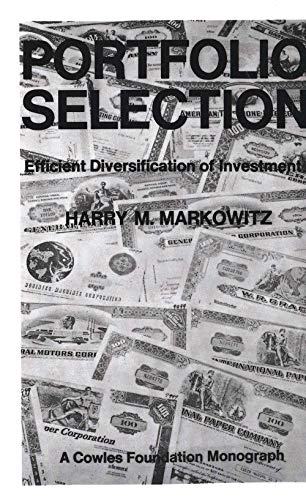
Portfolio Selection: Efficient Diversification of Investments (Cowles Foundation Monograph: No. 16)
Markowitz, Harry M.
ISBN 10: 0300013728 ISBN 13: 9780300013726
Verlag: Yale University Press, 1971
Gebraucht
Softcover
Verkäufer
medimops, Berlin, Deutschland
Verkäuferbewertung 5 von 5 Sternen

AbeBooks-Verkäufer seit 10. Mai 2010
Dieser Artikel ist nicht mehr verfügbar.
Beschreibung
Beschreibung:
Gut/Very good: Buch bzw. Schutzumschlag mit wenigen Gebrauchsspuren an Einband, Schutzumschlag oder Seiten. / Describes a book or dust jacket that does show some signs of wear on either the binding, dust jacket or pages. Bestandsnummer des Verkäufers M00300013728-V
Inhaltsangabe:
Applies modern techniques of analysis and computation to the problem of finding combinations of securities that best meet the needs of the private institutional investor. Written primarily with the nonmathematician in mind, although it contains mathematical development of the subject in appendixes.
Auszug. © Genehmigter Nachdruck. Alle Rechte vorbehalten.:
Portfolio Selection
EFFICIENT DIVERSIFICATION OF INVESTMENTS
By Harry M. MarkowitzYale UNIVERSITY PRESS
Copyright © 1959 Cowles Foundation for Research in Economics at Yale University
All rights reserved.
ISBN: 978-0-300-01372-6All rights reserved.
Contents
| PART I. INTRODUCTION AND ILLUSTRATIONS..................................... | |
| 1. Introduction............................................................ | 3 |
| 2. Illustrative Portfolio Analyses......................................... | 8 |
| PART II. RELATIONSHIPS BETWEEN SECURITIES AND PORTFOLIOS................... | |
| 3. Averages and Expected Values............................................ | 37 |
| 4. Standard Deviations and Variances....................................... | 72 |
| 5. Investment in Large Numbers Of Securities............................... | 102 |
| 6. Return in the Long Run.................................................. | 116 |
| PART III. EFFICIENT PORTFOLIOS............................................. | |
| 7. Geometric Analysis of Efficient Sets.................................... | 129 |
| 8. Derivation of E, V Efficient Portfolios................................. | 154 |
| 9. The Semi-Variance....................................................... | 188 |
| PART IV. RATIONAL CHOICE UNDER UNCERTAINTY................................. | |
| 10. The Expected Utility Maxim............................................. | 205 |
| 11. Utility Analysis Over Time............................................. | 243 |
| 12. Probability Beliefs.................................................... | 257 |
| 13. Applications to Portfolio Selection.................................... | 274 |
| BIBLIOGRAPHY............................................................... | 305 |
| APPENDIX................................................................... | |
| A. The Computation of Efficient Sets....................................... | 316 |
| B. A Simplex Method for Portfolio Selection................................ | 337 |
| C. Alternative Axiom Systems for Expected Utility.......................... | 340 |
| INDEX...................................................................... | 349 |
CHAPTER 1
INTRODUCTION
The Analysis of Portfolios
This monograph is concerned with the analysis of portfolios containinglarge numbers of securities. Throughout we speak of "portfolio selection"rather than "security selection." A good portfolio is more than a longlist of good stocks and bonds. It is a balanced whole, providing theinvestor with protections and opportunities with respect to a wide range ofcontingencies. The investor should build toward an integrated portfoliowhich best suits his needs. This monograph presents techniques ofPortfolio Analysis directed toward determining a most suitable portfoliofor the large private or institutional investor.
A portfolio analysis starts with information concerning individualsecurities. It ends with conclusions concerning portfolios as a whole.The purpose of the analysis is to find portfolios which best meet theobjectives of the investor.
Various types of information concerning securities can be used as theraw material of a portfolio analysis. One source of information is thepast performance of individual securities. A second source of informationis the beliefs of one or more security analysts concerning future performances.When past performances of securities are used as inputs, theoutputs of the analysis are portfolios which performed particularly well inthe past. When beliefs of security analysts are used as inputs, the outputsof the analysis are the implications of these beliefs for better and worseportfolios.
This introductory chapter discusses broad principles upon which thetechniques of portfolio analysis are based. The next chapter discusses theinputs, outputs, and objectives of illustrative portfolio analyses. Subsequentparts of the monograph go more deeply into the techniques by whichinformation concerning securities is transformed into conclusions concerningportfolios.
The Uncertainty of Security Returns
Uncertainty is a salient feature of security investment. Economicforces are not understood well enough for predictions to be beyond doubtor error. Even if the consequences of economic conditions were understoodperfectly, non-economic influences can change the course of generalprosperity, the level of the market, or the success of a particular security.The health of the President, changes in international tensions, increases ordecreases in military spending, an extremely dry summer, the success of aninvention, the miscalculation of a business management—all can affect thecapital gains or dividends of one or many securities.
We are expecting too much if we require the security analyst to predictwith certainty whether a typical security will increase or decrease in value.Even if he could assemble all information, including information availableonly to the managers of the corporation and information available only toits competitors, the security analyst might still be forced to conclusionssuch as:
This security may be expected to do well if securities in general do well. Itmust be expected to do poorly if securities in general do poorly. Even thisfollowing of the market is not certain. There are weaknesses which may causeit to do poorly even though securities in general are performing well: Thepossibility of a labor dispute or of an aggressive competitor cannot be ignored.On the other hand, there are potentialities which may bring success greater thaneven the corporation management dares hope. The new styling of the product,the (not inexpensive) advertising campaign, and the expansion of productionfacilities may prove to be a magic combination, fulfilling all expectationsfor it.
Only the clairvoyant could hope to predict with certainty. Clairvoyantanalysts have no need for the techniques of this monograph.
The existence of uncertainty does not mean that careful security analysesare valueless. The security analyst may be expected to arrive at reasonableopinions to the effect that:
The return (including capital gains and dividends) on security A is lessuncertain than that on security B; the return on security C is more closelyconnected to the course of the general market than is that on security D; thegrowth of security E is more certain but has less potential than that of securityF; only if the demand for their industry's product continues to expand (as itis likely, but not certain, to do) will the return on securities G and H besatisfactory.
Carefully and expertly formed judgments concerning the potentialities andweaknesses of securities form the best basis upon which to analyze portfolios.
Correlation among Security Returns
A second salient feature of security investment is the correlation amongsecurity returns. Like most economic quantities, the returns on securitiestend to move up and down together. This correlation is not perfect:individual securities and entire industries have at times moved against thegeneral flow of prosperity. On the whole, however, economic good andill...
„Über diesen Titel“ kann sich auf eine andere Ausgabe dieses Titels beziehen.
Bibliografische Details
Titel: Portfolio Selection: Efficient ...
Verlag: Yale University Press
Erscheinungsdatum: 1971
Einband: Softcover
Zustand: very good