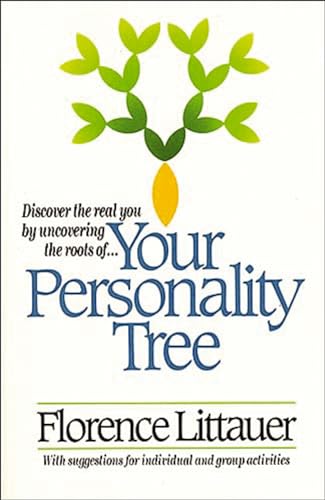
Many honest Christians are playing roles and wearing masks they don't know how to remove. In this book, Florence Littauer shows how readers can understand their own personality trees and use that knowledge to build understanding and better family relationships.
Your Personality Tree
With suggestions for individual and group activitiesBy FLORENCE LITTAUERThomas Nelson
Copyright © 1986 Florence Littauer
All right reserved.ISBN: 978-0-8499-3169-7Contents
Foreword....................................................................9Introduction................................................................11PART I. DISCOVER the Real You and Aim to Heal You...........................131. Were You Born Like This?.................................................152. What Is Your Personality?................................................273. What Are Your Desires and Underlying Needs?..............................394. What Leads You into Temptation?..........................................615. What Gets You Depressed?.................................................706. Are You Wearing a Mask?..................................................877. What Is a Personality Tree?..............................................1218. What Are Your Children's Personalities?..................................1539. How Can You Bend the Twigs As They Should Go?............................174PART III. RECOVER the Past with a Future That Will Last.....................19110. What about the Bruised Fruit?...........................................19311. How Can You Dig Up the Old Roots?.......................................20012. Have You a Song to Sing in the Spring?..................................210Notes.......................................................................217Personality Profile.........................................................220Personality Test Word Definitions...........................................221Personality Scoring Sheet...................................................232Personality Strengths and Weaknesses........................................233Personality Comparison Chart and Sources....................................235
Chapter One
Were You Born Like This?
The question "Who am I?" has been around since Adam wondered what dust he'd come from and the Serpent told Ere to eat the fruit of the tree of life so her eyes would be opened and she'd know who she really was.
Throughout the centuries people have been searching for a sense of identity and a feeling of worth. As a nation we went through the pangs of new birth and the struggle to come out an independent personality. With liberty and justice for all, we attracted people from around the globe to a land where they would live happily ever after; but somehow in our dream of fairy* tale endings, we lost the sense of who we were as individuals. As we grew up and began to look at ourselves, we didn't like the confusion we saw. The sixties brought an unpopular war and the beginnings of a national sense of self-examination. Who are we and how did we get ourselves into these problems?
Sociologists named the seventies the Decade of Depression, a discouraging and defeated time when the ME generation realized that in spite of their quest to find themselves, to do their own thing, and to search for their inner consciousness on a higher plane, they still didn't know who in the world they were. Months of mystical meditation didn't seem to stir up a life-changing thought, peace marches had not produced peace, and the flower children had lost their petals. President Carter, looking downhearted himself, declared we were in a "national malaise" and that announcement depressed the rest of us.
As the eighties crept in we began to wonder if we ever would find ourselves and so we rushed out to sign up for courses in self-help, self-improvement, and self-actualization. We bought life-long memberships in health spas, held hands in sensitivity groups, and gyrated around gypsy gurus. Surely the ME generation who had dragged through the Decade of Depression deserved a break today; but in spite of exercise and bean sprouts, we kept getting older, the sensitivity sisters showed little sensitivity beyond themselves, and the gurus were packed up and deported, What if we never got a grip on ourselves? What if we couldn't create heaven on earth? Fear gripped us, phobias replaced depression as the nation's number one mental health problem, and the decade was dubbed the Age of Anxiety.
What about you and me? We may not have drowned in depression or worried through our weeks, yet we tend to pick up the malaise and insecurities of others. We may be certain of life everlasting, but do we know who we are today? As I have taught leadership classes, I have found that education, money, prestige or a big house do not insure a feeling of worth. Even though we may have memorized Law One, "God loves you and has a wonderful plan for your life," few of us seem to believe it.
Yet it is true: God does love us and he has created us for a purpose. As David wrote to God in Psalm 139, "When I was woven together in the depths of the earth, your eyes saw my unformed body. All the days ordained for me were written in your book before one of them came to be" (vv. 15–16, NIV).
Yes, God knows us and he wants us to understand ourselves—not to be worried, confused, or depressed. He has made each one of us as a unique individual, and he uses our talents, personalities and gifts for his good purpose.
In the Bible Joseph was intelligent, charming, well-dressed, and had a gift for interpreting dreams, yet his brothers were envious of his abilities and they sold him as a slave. Because Joseph believed that God had an ultimate plan for him, he was able to stay optimistic even in difficult times and people saw that "the Lord was with him and that the Lord gave him success in everything he did" (Gen. 39:3, NIV).
Even when falsely accused and put in jail, Joseph kept his faith and behaved in such a manner that he rose to the prison's top position and cheered up those who were depressed. Later, those same personality traits that had disturbed his brothers were what found favor with Pharoah, and his gift of interpreting dreams saved the land. When his brothers came before him he wept, forgave them, and relieved their fears. He told them not to feel guilty because what they had meant for evil, God had turned into good.
God took Joseph's inborn traits, his personality and talents, and used him to save an entire nation and his own family.
Esther was an exceptionally beautiful Jewish woman who was both exiled and orphaned. King Xerxes chose her to become his queen without knowing her heritage. Because of her godly behavior she became a virtuous example to the other women and was dearly loved by her husband. When an order went out to kill all the Jews, she was used by God to persuade the king to change his mind. Her Uncle Mordecai stated wisely, "Who knows but that you have come to royal position for such a time as this" (Esther 4:14, NIV).
God used Esther, when she was willing and obedient, to save the exiled Jewish race and her own family also.
In the days of the New Testament when God was ready to evangelize the world, he needed someone who was a Jewish Christian, who spoke and wrote Greek, and who understood Roman law. He chose Paul who, while he had never taken any charm courses or self-improvement seminars, fit the job description. He was raised in a Jewish home, was educated as a Hebrew scholar, and was both a Pharisee and a member of the Sanhedrin. He spoke and wrote Greek, understood the classical intellect and had studied philosophy. Because the people of Tarsus had been cooperative with the conquering Pompey, he had granted them Roman citizenship, thus making Paul a citizen with an understanding of...