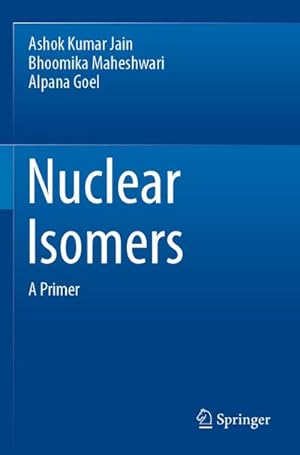
Nuclear Isomers : A Primer
Ashok Kumar Jain
Verkauft von AHA-BUCH GmbH, Einbeck, Deutschland
AbeBooks-Verkäufer seit 14. August 2006
Neu - Softcover
Zustand: Neu
Versand von Deutschland nach USA
Anzahl: 1 verfügbar
In den Warenkorb legenVerkauft von AHA-BUCH GmbH, Einbeck, Deutschland
AbeBooks-Verkäufer seit 14. August 2006
Zustand: Neu
Anzahl: 1 verfügbar
In den Warenkorb legenDruck auf Anfrage Neuware - Printed after ordering - Nuclear isomers are the long-lived excited states of nuclei. Therefore, they constitute the meta-stable landscape of nuclei. The first isomer was probably identified as early as1921. Since then, the number of isomers has been growing steadily picking up pace in recent times.Interest in nuclear isomers has grown in recent years for many reasons. The experimental capabilities to observe isomers have been expanding to cover a wider time scale. This has opened up new windows to observe and decipher the underlyingnuclearstructure and interactions. Further, the isomers are beginning to be seen as potential energy storage devicesand nuclear clockswith a host of applications. Possible discovery of a gamma ray laser has also ignited many researches in this area.Isomers now cover the full nuclear landscape with structural peculiarities specific to each region of the nuclear chart. Exploring the nuclear isomers, therefore, provides a novel insight into the nuclear structure properties of that region. There could be many different reasons for the long lives of excited nuclear states, which lead to the classification of isomers.Isomers are broadly classified in to four classes: Spin isomers, shape isomers, fission isomers and K-isomers. Seniority isomers have also been identified which are often clubbed with the spin isomers. We discuss this classification and the underlying causes in detail. Many examples are considered to highlight the large variety of isomers. The range of half-lives covered by the isomers varies from billions of years to nano-seconds and even small. To understand this vast variation is a fascinating endeavor in itself. The angular momentum couplings, nuclear shapes, pairing etc. conspire together to give this vast range of half-lives. We go through these aspects in detail, highlighting the various selection rules at work.It is interesting that the nuclearshapes play an important role in many types of isomers. The spin isomers, which occur in spherical or, near-spherical nuclei, aregenerallyconfined to the magic numbers. Seniority isomers are largely found in semi-magic nuclei and should be explored in conjunction with the spin isomers. New developments in seniority and generalized seniority isomers are discussed in detail. As the nuclei deform; the nature of isomers changes. We take a close look into the decay properties of isomers in deformed nuclei, particularly the K isomers, the shape isomers and the fission isomers. While doing so, the theoretical and experimental developments of isomers are also addressed. A number of open questions are posed for possible new experiments and better understanding of the isomers.
Bestandsnummer des Verkäufers 9783030786779
Nuclear isomers are the long-lived excited states of nuclei. Therefore, they constitute the meta-stable landscape of nuclei. The first isomer was probably identified as early as 1921. Since then, the number of isomers has been growing steadily picking up pace in recent times.
Interest in nuclear isomers has grown in recent years for many reasons. The experimental capabilities to observe isomers have been expanding to cover a wider time scale. This has opened up new windows to observe and decipher the underlying nuclear structure and interactions. Further, the isomers are beginning to be seen as potential energy storage devices and nuclear clocks with a host of applications. Possible discovery of a gamma ray laser has also ignited many researches in this area.
Isomers now cover the full nuclear landscape with structural peculiarities specific to each region of the nuclear chart. Exploring the nuclear isomers, therefore, provides a novel insight into the nuclear structure properties of that region. There could be many different reasons for the long lives of excited nuclear states, which lead to the classification of isomers.
Isomers are broadly classified in to four classes: Spin isomers, shape isomers, fission isomers and K-isomers. Seniority isomers have also been identified which are often clubbed with the spin isomers. We discuss this classification and the underlying causes in detail. Many examples are considered to highlight the large variety of isomers. The range of half-lives covered by the isomers varies from billions of years to nano-seconds and even small. To understand this vast variation is a fascinating endeavor in itself. The angular momentum couplings, nuclear shapes, pairing etc. conspire together to give this vast range of half-lives. We go through these aspects in detail, highlighting the various selection rules at work.
It is interesting that the nuclearshapes play an important role in many types of isomers. The spin isomers, which occur in spherical or, near-spherical nuclei, are generally confined to the magic numbers. Seniority isomers are largely found in semi-magic nuclei and should be explored in conjunction with the spin isomers. New developments in seniority and generalized seniority isomers are discussed in detail. As the nuclei deform; the nature of isomers changes. We take a close look into the decay properties of isomers in deformed nuclei, particularly the K isomers, the shape isomers and the fission isomers. While doing so, the theoretical and experimental developments of isomers are also addressed. A number of open questions are posed for possible new experiments and better understanding of the isomers.
Interest in nuclear isomers has grown in recent years for many reasons. The experimental capabilities to observe isomers have been expanding to cover a wider time scale. This has opened up new windows to observe and decipher the underlying nuclear structure and interactions. Further, the isomers are beginning to be seen as potential energy storage devices and nuclear clocks with a host of applications. Possible discovery of a gamma ray laser has also ignited many researches in this area.
Isomers now cover the full nuclear landscape with structural peculiarities specific to each region of the nuclear chart. Exploring the nuclear isomers, therefore, provides a novel insight into the nuclear structure properties of that region. There could be many different reasons for the long lives of excited nuclear states, which lead to the classification of isomers.
Isomers are broadly classified in to four classes: Spin isomers, shape isomers, fission isomers and K-isomers. Seniority isomers have also been identified which are often clubbed with the spin isomers. We discuss this classification and the underlying causes in detail. Many examples are considered to highlight the large variety of isomers. The range of half-lives covered by the isomers varies from billions of years to nano-seconds and even small. To understand this vast variation is a fascinating endeavor in itself. The angular momentum couplings, nuclear shapes, pairing etc. conspire together to give this vast range of half-lives. We go through these aspects in detail, highlighting the various selection rules at work.
It is interesting that the nuclear shapesplay an important role in many types of isomers. The spin isomers, which occur in spherical or, near-spherical nuclei, are generally confined to the magic numbers. Seniority isomers are largely found in semi-magic nuclei and should be explored in conjunction with the spin isomers. New developments in seniority and generalized seniority isomers are discussed in detail. As the nuclei deform; the nature of isomers changes. We take a close look into the decay properties of isomers in deformed nuclei, particularly the K isomers, the shape isomers and the fission isomers. While doing so, the theoretical and experimental developments of isomers are also addressed. A number of open questions are posed for possible new experiments and better understanding of the isomers.
„Über diesen Titel“ kann sich auf eine andere Ausgabe dieses Titels beziehen.
Allgemeine Geschäftsbedingungen und Kundeninformationen / Datenschutzerklärung
I. Allgemeine Geschäftsbedingungen
§ 1 Grundlegende Bestimmungen
(1) Die nachstehenden Geschäftsbedingungen gelten für alle Verträge, die Sie mit uns als Anbieter (AHA-BUCH GmbH) über die Internetplattformen AbeBooks und/oder ZVAB schließen. Soweit nicht anders vereinbart, wird der Einbeziehung gegebenenfalls von Ihnen verwendeter eigener Bedingungen widersprochen.
(2) Verbraucher im Sinne der nachstehenden Regelungen...
Wenn Sie Verbraucher sind, können Sie gemäß den folgenden Bestimmungen vom Vertrag zurücktreten. Verbraucher ist jede natürliche Person, die zu Zwecken handelt, die nicht ihrer kaufmännischen, gewerblichen, künstlerischen oder beruflichen Tätigkeit zugerechnet werden können.
Informationen zum Widerrufsrecht
Gesetzliches Widerrufsrecht
Sie haben das Recht, den Vertrag innerhalb von 14 Tagen ohne Angabe von Gründen zu widerrufen.
Die Widerrufsfrist beträgt 14 Tage ab dem Tag, an dem Sie oder ein von Ihnen benannter Dritter, der nicht der Transporteur ist, die letzte Ware oder den letzten Posten oder das letzte Exemplar in Besitz genommen hat.
Um das Widerrufsrecht auszuüben, füllen Sie auf unserer Website unter „Meine Einkäufe" in „Mein Nutzerkonto" eine eindeutige Erklärung elektronisch aus und senden Sie sie ab. Wir werden Ihnen unverzüglich eine Bestätigung über den Eingang eines solchen Widerrufs auf einem dauerhaften Datenträger (z. B. per E-Mail) übermitteln.
Um die Widerrufsfrist einzuhalten, reicht es aus, dass Sie Ihre Mitteilung über die Ausübung des Widerrufsrechts vor Ablauf der Widerrufsfrist absenden.
Auswirkungen des Widerrufs
Wenn Sie diesen Vertrag widerrufen, erstatten wir Ihnen alle Zahlungen, die wir von Ihnen erhalten haben, einschließlich der Lieferkosten (mit Ausnahme der zusätzlichen Kosten, die entstehen, wenn Sie eine andere Art der Lieferung als die von uns angebotene günstigste Standardlieferung gewählt haben).
Wir können einen Abzug von der Rückerstattung für den Wertverlust der gelieferten Waren vornehmen, wenn der Verlust auf eine unnötige Behandlung durch Sie zurückzuführen ist.
Wir werden die Rückerstattung unverzüglich und nicht später als 14 Tage nach dem Tag vornehmen, an dem wir über Ihre Entscheidung, diesen Vertrag zu widerrufen, informiert wurden.
Für die Rückerstattung verwenden wir dasselbe Zahlungsmittel, das Sie für die ursprüngliche Transaktion verwendet haben, es sei denn, Sie haben ausdrücklich etwas anderes vereinbart; in keinem Fall werden Ihnen aufgrund einer solchen Rückerstattung Gebühren berechnet.
Wir können die Rückzahlung verweigern, bis wir die Waren wieder zurückerhalten haben oder Sie den Nachweis erbracht haben, dass Sie die Waren zurückgesandt haben, je nachdem, was eher eintritt.
Sie müssen die Waren unverzüglich und in jedem Fall spätestens 14 Tage ab dem Tag, an dem Sie uns über den Widerruf dieses Vertrags unterrichten, an AHA-BUCH GmbH, Einbeck, Germany, zurücksenden oder übergeben. Die Frist ist eingehalten, wenn Sie die Ware vor Ablauf der Frist von 14 Tagen zurücksenden. Sie müssen die direkten Kosten der Rücksendung der Waren tragen. Sie haften nur für einen etwaigen Wertverlust der Waren, der auf eine Behandlung zurückzuführen ist, die nicht zur Prüfung der Art, Eigenschaften und Funktionsweise der Waren erforderlich ist.
Ausnahmen vom Widerrufsrecht
Das Widerrufsrecht gilt nicht für:
Wir liefern Lagerartikel innerhalb von 24 Stunden nach Erhalt der Bestellung aus.
Barsortimentsartikel, die wir über Nacht geliefert bekommen, am darauffolgenden Werktag.
Unser Ziel ist es Ihnen die Artikel in der ökonomischten und effizientesten Weise zu senden.
| Bestellmenge | 30 bis 40 Werktage | 7 bis 14 Werktage |
|---|---|---|
| Erster Artikel | EUR 61.27 | EUR 71.27 |
Die Versandzeiten werden von den Verkäuferinnen und Verkäufern festgelegt. Sie variieren je nach Versanddienstleister und Standort. Sendungen, die den Zoll passieren, können Verzögerungen unterliegen. Eventuell anfallende Abgaben oder Gebühren sind von der Käuferin bzw. dem Käufer zu tragen. Die Verkäuferin bzw. der Verkäufer kann Sie bezüglich zusätzlicher Versandkosten kontaktieren, um einen möglichen Anstieg der Versandkosten für Ihre Artikel auszugleichen.