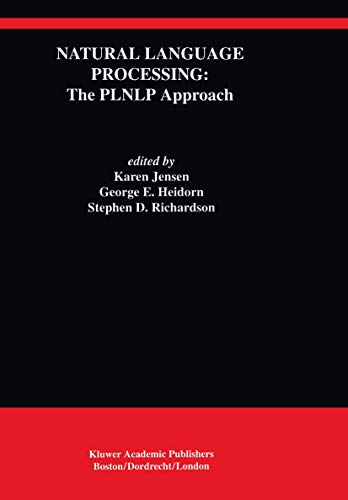
Natural Language Processing: the PLNLP Approach
. Ed(s): Jensen, Karen; Heidorn, George E.; Richardson, Stephen D.
ISBN 10: 1461363896 ISBN 13: 9781461363897
Verlag: Springer-Verlag New York Inc., 2013
Neu
Softcover
Verkäufer
Kennys Bookstore, Olney, MD, USA
Verkäuferbewertung 4 von 5 Sternen

AbeBooks-Verkäufer seit 9. Oktober 2009
Dieser Artikel ist nicht mehr verfügbar.
Beschreibung
Beschreibung:
Editor(s): Jensen, Karen; Heidorn, George E.; Richardson, Stephen D. Series: The Springer International Series in Engineering and Computer Science. Num Pages: 324 pages, 2 black & white illustrations, biography. BIC Classification: CFX; UYQ; UYQL. Category: (P) Professional & Vocational. Dimension: 244 x 170 x 18. Weight in Grams: 600. . 2013. Softcover reprint of the original 1st ed. 1993. Paperback. . . . . Books ship from the US and Ireland. Bestandsnummer des Verkäufers V9781461363897
Inhaltsangabe:
Natural language is easy for people and hard for machines. For two generations, the tantalizing goal has been to get computers to handle human languages in ways that will be compelling and useful to people. Obstacles are many and legendary.
Natural Language Processing: The PLNLP Approach describes one group's decade of research in pursuit of that goal. A very broad coverage NLP system, including a programming language (PLNLP) development tools, and analysis and synthesis components, was developed and incorporated into a variety of well-known practical applications, ranging from text critiquing (CRITIQUE) to machine translation (e.g. SHALT). This books represents the first published collection of papers describing the system and how it has been used. Twenty-six authors from nine countries contributed to this volume.
Natural language analysis, in the PLNLP approach, is done is six stages that move smoothly from syntax through semantics into discourse. The initial syntactic sketch is provided by an Augmented Phrase Structure Grammar (APSG) that uses exclusively binary rules and aims to produce some reasonable analysis for any input string. Its `approximate' analysis passes to the reassignment component, which takes the default syntactic attachments and adjusts them, using semantic information obtained by parsing definitions and example sentences from machine-readable dictionaries. This technique is an example of one facet of the PLNLP approach: the use of natural language itself as a knowledge representation language -- an innovation that permits a wide variety of online text materials to be exploited as sources of semantic information.
The next stage computes the intrasential argument structure and resolves all references, both NP- and VP-anaphora, that can be treated at this point in the processing. Subsequently, additional components, currently not so well developed as the earlier ones, handle the further disambiguation of word senses, the normalization of paraphrases, and the construction of a paragraph (discourse) model by joining sentential semantic graphs.
Natural Language Processing: The PLNLP Approach acquaints the reader with the theory and application of a working, real-world, domain-free NLP system, and attempts to bridge the gap between computational and theoretical models of linguistic structure. It provides a valuable resource for students, teachers, and researchers in the areas of computational linguistics, natural processing, artificial intelligence, and information science.
„Über diesen Titel“ kann sich auf eine andere Ausgabe dieses Titels beziehen.
Bibliografische Details
Titel: Natural Language Processing: the PLNLP ...
Verlag: Springer-Verlag New York Inc.
Erscheinungsdatum: 2013
Einband: Softcover
Zustand: New
Beste Suchergebnisse beim ZVAB

Foto des Verkäufers
Natural Language Processing: The PLNLP Approach
Anbieter: AHA-BUCH GmbH, Einbeck, Deutschland
Verkäuferbewertung 5 von 5 Sternen

Taschenbuch. Zustand: Neu. Druck auf Anfrage Neuware - Printed after ordering - Natural language is easy for people and hard for machines. For two generations, the tantalizing goal has been to get computers to handle human languages in ways that will be compelling and useful to people. Obstacles are many and legendary. Natural Language Processing: The PLNLP Approach describes one group's decade of research in pursuit of that goal. A very broad coverage NLP system, including a programming language (PLNLP) development tools, and analysis and synthesis components, was developed and incorporated into a variety of well-known practical applications, ranging from text critiquing (CRITIQUE) to machine translation (e.g. SHALT). This books represents the first published collection of papers describing the system and how it has been used. Twenty-six authors from nine countries contributed to this volume. Natural language analysis, in the PLNLP approach, is done is six stages that move smoothly from syntax through semantics into discourse. The initial syntactic sketch is provided by an Augmented Phrase Structure Grammar (APSG) that uses exclusively binary rules and aims to produce some reasonable analysis for any input string. Its `approximate' analysis passes to the reassignment component, which takes the default syntactic attachments and adjusts them, using semantic information obtained by parsing definitions and example sentences from machine-readable dictionaries. This technique is an example of one facet of the PLNLP approach: the use of natural language itself as a knowledge representation language -- an innovation that permits a wide variety of online text materials to be exploited as sources of semantic information. The next stage computes the intrasential argument structure and resolves all references, both NP- and VP-anaphora, that can be treated at this point in the processing. Subsequently, additional components, currently not so well developed as the earlier ones, handle the further disambiguation of word senses, the normalization of paraphrases, and the construction of a paragraph (discourse) model by joining sentential semantic graphs. Natural Language Processing: The PLNLP Approach acquaints the reader with the theory and application of a working, real-world, domain-free NLP system, and attempts to bridge the gap between computational and theoretical models of linguistic structure. It provides a valuable resource for students, teachers, and researchers in the areas of computational linguistics, natural processing, artificial intelligence, and information science. Artikel-Nr. 9781461363897
Neu kaufen
EUR 59,97
EUR 63,01 Versand
Versand von Deutschland nach USA
Versand von Deutschland nach USA
Anzahl: 1 verfügbar
Beispielbild für diese ISBN
Natural Language Processing: The PLNLP Approach (The Springer International Series in Engineering and Computer Science)
Anbieter: Revaluation Books, Exeter, Vereinigtes Königreich
Verkäuferbewertung 5 von 5 Sternen
Paperback. Zustand: Brand New. 341 pages. 9.60x6.69x0.79 inches. In Stock. Artikel-Nr. x-1461363896
Neu kaufen
EUR 79,65
EUR 14,42 Versand
Versand von Vereinigtes Königreich nach USA
Versand von Vereinigtes Königreich nach USA
Anzahl: 2 verfügbar