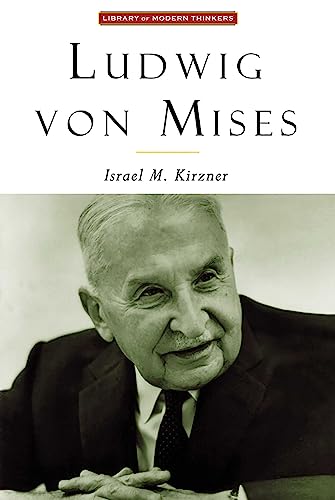
Israel Kirzner, a former student of Ludwig von Mises, looks at the influences of the economic debates in Europe on von Mises' thought, traces his theories as they developed in his writings, and discusses both critical and supportive commentators on von Mises.
Ludwig von Mises
The Man and His EconomicsBy Israel M. KiznerISI Books
Copyright © 2007 Israel M. Kizner
All right reserved.ISBN: 978-1-882926-68-8Chapter One
LUDWIG VON MISES, 1881-1973
The purpose of this short work is to provide a picture of Ludwig von Mises, the economist and social thinker. Such a picture must consist primarily of lines and brush strokes representing Mises' ideas, and explaining how these ideas differed importantly from those of his contemporaries. The subsequent chapters offer such accounts and explanations. But a picture consists of more than lines and strokes; it includes the canvas upon which these are imposed. The story of Mises, the intellectual and the scholar, cannot be appreciated unless it also includes brief attention to the human and historical context within which Mises' intellectual contributions emerged. This chapter seeks to give a brief survey of this human and historical context, a survey that will be brief not only because of space limitations, but also because many of the details of Mises' life, interesting though they may be for a full-length biography, are not, in fact, directly relevant to an appreciation of his intellectual stature. Iinclude in this chapter only those salient features of his biography (and of its historical background) which seem necessary in order for the development of Mises' economic and social ideas to be rendered coherent and understandable.
Vienna: The Early Years
Ludwig von Mises was born on September 29, 1881, in the city of Lemberg in the Austro-Hungarian empire. His mother was Adele (Landau) von Mises; his father, Arthur Edler von Mises, a construction engineer in government service to the Ministry of Railroads, died at the age of forty-six (after a gall bladder operation) when Ludwig was a twenty-two-year-old university student. (Ludwig's only sibling to survive into adulthood was his younger brother Richard, who was to become a noted mathematician, Harvard professor, and probability theorist.) Although his birthplace was hundreds of miles away from the imperial capital, Mises was to spend some forty years of his life in Vienna. From the age of eleven he spent about eight years attending the Academic Gymnasium in Vienna, after which he became a student in the Faculty of Law and Political Sciences at the University of Vienna. With an interruption of about one year's military service (at the conclusion of which he received his commission as lieutenant in a reserve artillery regiment), Mises spent about five years at the university, winning high university honors in the areas of juridical studies, social sciences, and history of law, and being awarded the degree of Doctor of Laws in 1906.
The bulk of Mises' work in economics up to this time was under the influence of teachers imbued directly or indirectly with the ideas of the German Historical School (about which more will be said in subsequent chapters), and Mises had, by the time he received his doctorate, already published several scholarly works in historical economics research. Mises was, however, already Beginning to rebel against the methodological and ideological tenets of that school, presumably partly as a result of his reading Carl Menger's Grundstze at the end of 1903-an experience which, he later described, made an "economist" of him (NR, 33). It was apparently after receiving his doctorate that Mises came under the powerful personal influence of Eugen von Bhm-Bawerk (who, after retiring from prestigious service as Minister of Finance of the Austro-Hungarian empire, began to conduct his famous seminar at the University of Vienna in 1905.) Mises attended Bhm-Bawerk's seminar for a number of years until he was himself admitted to the (unsalaried) rank of privatdozent, permitting him to lecture at the university, in 1913. It was during this period that his own systematic understanding of economics developed, along the lines pioneered by Menger (with whom he had extensive personal discussions (NR, 35) and Bhm-Bawerk, culminating in Mises' own pathbreaking 1912 work on monetary theory. This book established Mises as an important economic theorist in his own right, and was the foundation of his subsequent fame as a leading exponent of the "Austrian School."
After several years of engagement in various professional economic responsibilities, Mises obtained a position in 1909 at the Austrian Chamber of Commerce (a quasi-governmental body directly concerned with national commercial and industrial policy). It was his work in this capacity which, especially after the end of World War I, thrust Mises squarely into the controversial public issues of his time and brought him into contact with many of the leading Austrian political, industrial, and financial personalities. Mises' career as economist thus developed, from the very beginning, as one combining academic research and university teaching with the very practical work of an economic public policy specialist at the center of ferocious political and policy debates.
The state of academic economics in Austria (and the rest of the continent) will be outlined in the chapter following this one. And it is not difficult to recognize the obvious relevance of Mises' earlier work in monetary economics for the public policy issues which reached the crisis point in the hyperinflations of the early twenties. Here we simply note the fact that Mises' early years as doctoral student, university lecturer, and public policy economist were years of social and political change and turmoil. The old courtly world of Imperial Vienna, center of the vast but crumbling Austro-Hungarian Empire, was giving way to a postwar milieu in which entirely new economic and political winds were to blow with an unprecedented ferocity.
Mises was himself, in his old age, to write about the political and ideological currents already at work in continental Europe around the turn of the century. There is no doubt that the views he expressed reflect his youthful impressions of the social context within which his lifelong convictions were forged. Mises saw the controversies that raged between the dominant German intellectuals in social science and the Austrian economists led by Menger, and subsequently Bhm-Bawerk, as having a significance extending far beyond the substance or methodology of economic theory. Most of the German professors, Mises wrote, "more or less eagerly made propaganda in their writings and in their courses for the policies of the Imperial Government: authoritarian conservatism, Sozialpolitik, protectionism, huge armaments, and aggressive nationalism" (HSAS, 23 f). Mises saw the Mengerian School as the champion of liberalism, as the last intellectual source of hope for the preservation of freedom and civilization in the face of the dangers posed by statism and by Marxism. From his perspective at the outset of the last third of the twentieth century, Mises saw, in fact, a "straight line that leads from the work of the Historical School to Nazism," from "Schmoller's glorification of the Hohenzollern Electors and Kings, to Sombart's canonization of Adolf Hitler" (HSAS, 33-34). In memoirs written several decades earlier (1940), Mises also traced the cataclysmic twentieth-century events for which Marxism and Nazism have been responsible to the teachings of the German Historical School. He reports that Menger had (apparently well before the turn of the century) foreseen that the policies pursued by the European powers would "lead to a...