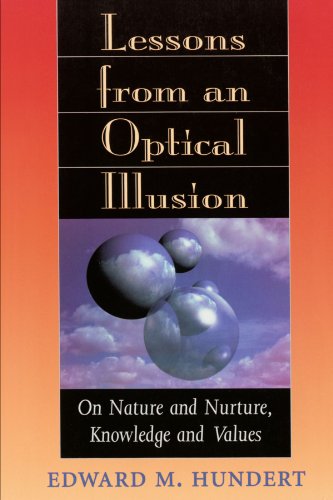
Lessons from an Optical Illusion: On Nature and Nurture, Knowledge and Values
Hundert, Edward M.
ISBN 10: 0674525418 ISBN 13: 9780674525412
Verlag: Harvard University Press, 1997
Gebraucht
Paperback
Verkäufer
ThriftBooks-Dallas, Dallas, TX, USA
Verkäuferbewertung 5 von 5 Sternen

AbeBooks-Verkäufer seit 2. Juli 2009
Dieser Artikel ist nicht mehr verfügbar.
Beschreibung
Beschreibung:
Pages can have notes/highlighting. Spine may show signs of wear. ~ ThriftBooks: Read More, Spend Less 0.85. Bestandsnummer des Verkäufers G0674525418I3N00
Inhaltsangabe:
Facts are facts, we often say with certainty; but values--well, they're relative. But every day we are confronted with situations where these simple distinctions begin to blur--whether our concerns are the roots of crime and violence, the measure of intelligence, the causes of disease, the threat and promise of genetic engineering. Where do our "facts" end and our "values" begin? Recent developments in neuroscience have begun to shed light on this confusion, by radically revising our notions of where human nature ends and human nurture begins. As Edward Hundert-a philosopher, psychiatrist, and award-winning educator--makes clear in this eloquent interdisciplinary work, the newly emerging model for the interactions of brain and environment has enormous implications for our understanding of who we are, how we know, and what we value. Lessons from an Optical Illusion is a bold modern recasting of the age-old nature-nurture debate, informed by revolutionary insights from brain science, artificial intelligence, psychiatry, linguistics, evolutionary biology, child development, ethics, and even cosmology. As this radical new synthesis unfolds, we are introduced to characters ranging from Immanuel Kant to Gerald Edelman, from Charles Darwin to Sigmund Freud, from Jean Piaget to Stephen Hawking, from Socrates to Jonas Salk. Traversing the nature-nurture terrain, we encounter simulated robots, optical illusions, game theory, the anthropic principle, the prisoner's dilemma, and the language instinct. In the course of Hundert's wide-ranging exploration, the comfortable dichotomies that once made sense (objectivity-subjectivity, heredity-environment, fact-value) break down under sharp analysis, as he reveals the startling degree to which facts are our creations and values are woven into the fabric of the world. Armed with an updated understanding of how we became who we are and how we know what we know, readers are challenged
Über die Autorin bzw. den Autor: Edward M. Hundert, M.D., is Dean for Medical Education and Daniel D. Federman, M.D., Professor in Residence of Global Health and Social Medicine and Medical Education, Harvard Medical School.
„Über diesen Titel“ kann sich auf eine andere Ausgabe dieses Titels beziehen.
Bibliografische Details
Titel: Lessons from an Optical Illusion: On Nature ...
Verlag: Harvard University Press
Erscheinungsdatum: 1997
Einband: Paperback
Zustand: Good
Zustand des Schutzumschlags: No Jacket
Beste Suchergebnisse beim ZVAB

Beispielbild für diese ISBN
Lessons from an Optical Illusion : On Nature and Nurture, Knowledge and Values
Verlag:
Harvard University Press, 1997
ISBN 10: 0674525418
ISBN 13: 9780674525412
Gebraucht
Softcover
Anbieter: Better World Books: West, Reno, NV, USA
Verkäuferbewertung 5 von 5 Sternen
Zustand: Good. Former library book; may include library markings. Used book that is in clean, average condition without any missing pages. Artikel-Nr. 18953902-75
Gebraucht kaufen
EUR 8,34
Versand gratis
Versand innerhalb von USA
Versand innerhalb von USA
Anzahl: 1 verfügbar
Beispielbild für diese ISBN
Lessons from an Optical Illusion: On Nature and Nurture, Knowledge and Values
Verlag:
Harvard University Press, 1995
ISBN 10: 0674525418
ISBN 13: 9780674525412
Gebraucht
Softcover
Anbieter: Kennys Bookshop and Art Galleries Ltd., Galway, GY, Irland
Verkäuferbewertung 5 von 5 Sternen
Zustand: Very Good. 1995. paperback. Good clean copy with minor shelfwear, remains very good. . . . . Artikel-Nr. KSK0000528
Gebraucht kaufen
EUR 12,22
EUR 10,50 shipping
Versand von Irland nach USA
Versand von Irland nach USA
Anzahl: 1 verfügbar
Beispielbild für diese ISBN
Lessons from an Optical Illusion: On Nature and Nurture, Knowledge and Values
Verlag:
Harvard University Press, 1997
ISBN 10: 0674525418
ISBN 13: 9780674525412
Gebraucht
Softcover
Anbieter: Kennys Bookstore, Olney, MD, USA
Verkäuferbewertung 5 von 5 Sternen
Zustand: Very Good. 1995. paperback. Good clean copy with minor shelfwear, remains very good. . . . . Books ship from the US and Ireland. Artikel-Nr. KSK0000528
Gebraucht kaufen
EUR 12,64
EUR 8,96 shipping
Versand innerhalb von USA
Versand innerhalb von USA
Anzahl: 1 verfügbar
Lessons from an Optical Illusion: On Nature and Nurture, Knowledge and Values
Verlag:
Harvard University Press, 1995
ISBN 10: 0674525418
ISBN 13: 9780674525412
Gebraucht
Paperback
Erstausgabe
Anbieter: Southampton Books, Sag Harbor, NY, USA
Verkäuferbewertung 5 von 5 Sternen
Paperback. Zustand: Like New. First Edition. First Edition, First Printing. Not price-clipped. Published by Harvard University Press, 1995. Octavo. Paperback. Book is like new with very light shelf wear. 100% positive feedback. 30 day money back guarantee. NEXT DAY SHIPPING! Excellent customer service. Please email with any questions. All books packed carefully and ship with free delivery confirmation/tracking. All books come with free bookmarks. Ships from Sag Harbor, New York. Artikel-Nr. 366686
Gebraucht kaufen
EUR 17,59
EUR 3,41 shipping
Versand innerhalb von USA
Versand innerhalb von USA
Anzahl: 1 verfügbar
Foto des Verkäufers
LESSONS FROM AN OPTICAL ILLUSI
Verlag:
HARVARD UNIV PR, 1997
ISBN 10: 0674525418
ISBN 13: 9780674525412
Neu
Kartoniert / Broschiert
Anbieter: moluna, Greven, Deutschland
Verkäuferbewertung 4 von 5 Sternen

Kartoniert / Broschiert. Zustand: New. This book is a bold, modern recasting of the age-old nature-nurture debate, informed by revolutionary insights from brain science, artificial intelligence, psychiatry, linguistics, evolutionary biology, child development, ethics, and even cosmology. Artikel-Nr. 594875884
Neu kaufen
EUR 54,73
EUR 48,99 shipping
Versand von Deutschland nach USA
Versand von Deutschland nach USA
Anzahl: Mehr als 20 verfügbar
Beispielbild für diese ISBN
Lessons from an Optical Illusion On Nature & Nuture, Knowledge & Values (Paper)
Anbieter: Revaluation Books, Exeter, Vereinigtes Königreich
Verkäuferbewertung 5 von 5 Sternen
Paperback. Zustand: Brand New. 264 pages. 9.00x5.75x1.00 inches. In Stock. Artikel-Nr. x-0674525418
Neu kaufen
EUR 64,75
EUR 11,42 shipping
Versand von Vereinigtes Königreich nach USA
Versand von Vereinigtes Königreich nach USA
Anzahl: 2 verfügbar
Foto des Verkäufers
Lessons from an Optical Illusion : On Nature and Nurture, Knowledge and Values
Verlag:
Harvard University Press Mär 1997, 1997
ISBN 10: 0674525418
ISBN 13: 9780674525412
Neu
Taschenbuch
Anbieter: AHA-BUCH GmbH, Einbeck, Deutschland
Verkäuferbewertung 5 von 5 Sternen
Taschenbuch. Zustand: Neu. Neuware - Facts are facts, we often say with certainty; but values--well, they're relative. But every day we are confronted with situations where these simple distinctions begin to blur--whether our concerns are the roots of crime and violence, the measure of intelligence, the causes of disease, the threat and promise of genetic engineering. Where do our 'facts' end and our 'values' begin Recent developments in neuroscience have begun to shed light on this confusion, by radically revising our notions of where human nature ends and human nurture begins. As Edward Hundert--a philosopher, psychiatrist, and award-winning educator--makes clear in this eloquent interdisciplinary work, the newly emerging model for the interactions of brain and environment has enormous implications for our understanding of who we are, how we know, and what we value.Lessons from an Optical Illusion is a bold modern recasting of the age-old nature-nurture debate, informed by revolutionary insights from brain science, artificial intelligence, psychiatry, linguistics, evolutionary biology, child development, ethics, and even cosmology. As this radical new synthesis unfolds, we are introduced to characters ranging from Immanuel Kant to Gerald Edelman, from Charles Darwin to Sigmund Freud, from Jean Piaget to Stephen Hawking, from Socrates to Jonas Salk. Traversing the nature-nurture terrain, we encounter simulated robots, optical illusions, game theory, the anthropic principle, the prisoner's dilemma, and the language instinct. In the course of Hundert's wide-ranging exploration, the comfortable dichotomies that once made sense (objectivity-subjectivity, heredity-environment, fact-value) break down under sharp analysis, as he reveals the startling degree to which facts are our creations and values are woven into the fabric of the world. Armed with an updated understanding of how we became who we are and how we know what we know, readers are challenged to confront anew the eternal question of what it means to live a moral life. Artikel-Nr. 9780674525412
Neu kaufen
EUR 71,85
EUR 61,86 shipping
Versand von Deutschland nach USA
Versand von Deutschland nach USA
Anzahl: 1 verfügbar