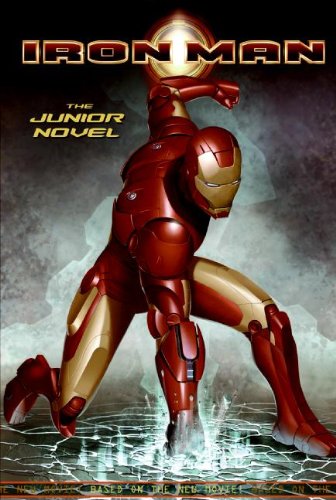
Iron Man: The Junior Novel
By Stephen SullivanHarperCollins Publishers, Inc.
Copyright © 2008 Stephen Sullivan
All right reserved.ISBN: 9780060821975Chapter One
Lieutenant Colonel James Rhodes, Tony Stark's best friend, stood at the podium and narrated as a film about Tony's life played on a huge conference screen. The film showed Tony's privileged childhood, his first-class schooling, and his amazing ability to design and build machines.
"Since inheriting Stark Industries from his father," Rhodey said, "Tony has worked on innovative high-tech projects. He designed the experimental ARK Reactor and has created many of the new smart weapons systems that help keep all of us safe. Today, Tony Stark's ingenuity continues to protect freedom and American interests around the world."
As Rhodes wrapped up his speech, an inspiring shot of the American flag, waving dramatically, filled the screen. The show ended and the lights came up.
"Ladies and gentlemen," Rhodey said, "this year's Apogee Award winner . . . Mr. Tony Stark."
The crowd in the auditorium broke into thunderous applause. A spotlight moved across the stage and landed on . . . an empty chair. The applause quickly faded into surprised murmurings.
Rhodey gritted his teeth as Obadiah Stane, Stark Industries's second-in-command, strode out onto the stage and took the podium.
"Thank you," Stane said. "I, uh, I'm not Tony Stark. But if I were, I'd tell you how honored I am and . . . what a joy it is to receive this award." He took a deep breath and forced a grin. "The best thing about Tony is also the worst thing—he's always working."
But Tony was not working. In a nearby Las Vegas casino he sat at a gaming table, betting enormous amounts of money. He paused and threw the dice, turning up another winner. The crowd around the table cheered.
Just then, Tony spotted Rhodey striding toward him across the casino floor.
"Rhodey!" Tony exclaimed. "What are you doing here? They roped you into this awards thing, too?"
Rhodey scowled at him. "Yeah. They said you'd be deeply honored if I presented the award."
Tony stood up and straightened his tie. "Okay," he said. "Let's do it."
Rhodey plopped the Apogee Award down on the gaming table. Tony stared at it, surprised.
"That was quick," Tony said. "I thought there'd be more of a ceremony or something." He picked up the dice, shook them, and rolled—but they came up losers. The crowd around the table sighed and glared at Rhodey, as though he had brought Tony bad luck.
"My chaperone has just arrived," Tony announced to the crowd. "I must now take my leave—along with a generous helping of the casino's money."
He collected a huge stack of chips from the table and headed for the door. As Tony passed, people gawked and took pictures of him with their cell phones.
"A lot of people would kill to have their name on that award," Rhodey said angrily.
"It belongs to my old man," Tony replied. "They should have given it to him."
Rhodey glared at his friend. "What's wrong with you? A thousand people came here tonight to honor you, and you didn't even show up. This award means something, Tony, it's bigger than you. It's—"
"Hold that thought," Tony said, meandering over to a roulette wheel. He set down his mountain of chips.
"Put it all on black," he told the operator.
The uniformed woman spun the wheel. The ball circled several times, bouncing off numerous numbers and colors before finally ending on . . . red.
Rhodey gawked. "You just blew three million dollars!"
"Yeah," Tony replied. "I don't know which was more exciting: winning it, or the fact that I don't care that I just lost it."
Rhodey was furious. "We've got a long day ahead of us tomorrow," he said. "Can we get out of here now?"
"One more stop," Tony insisted, and strode toward the restroom. Once inside, he splashed water on his face.
"This is no joke," Rhodey said, following him. You're going into a war zone tomorrow just to show off some crazy equipment. We should be doing that here in Nevada."
Tony sighed. "This system has to be demonstrated under true field conditions."
Just then, the door to the restroom swung open and an attractive redhead in her late twenties walked in. Rhodey recognized Virginia "Pepper" Potts, Tony's executive assistant. She wasn't the kind of person who let a men's room sign get in the way of doing her job.
"Tony, it's the president," she said. She tossed him a cell phone, turned, and walked back out.
Tony put the phone to his ear. "Jim," he said, "how're the trout running?" On his way out of the restroom, Tony dumped his Apogee statue in the attendant's tip basket.
Pepper joined Tony and Rhodey as they headed for the casino's front door. "Tony, you're leaving the country for a week," she said. "I just need five minutes of your time."
"Okay," Tony said. "Shoot."
She tapped the screen of her PDA. "The board meeting is on the eleventh. Should I tell them you'll be there?"
Before Tony could answer, an attractive young woman holding a digital voice recorder pushed her way through the crowd. "Mr. Stark!" she called. "Christine Everhart, journalist. Can I ask you a few questions?"
"Can I ask you a few back?" Tony replied, slowing down to talk.
"You've been described as the da Vinci of our times," Ms. Everhart said. "What do you say to that?"
"Ridiculous," Tony said. "I don't paint."
"And what do you have to say about your other nickname: the Merchant of Death?"
Tony rubbed his chin. "That's not bad," he began flippantly, but an icy stare from the reporter stopped him.
"Look," he said, "it's an imperfect world. I assure you, the day that weapons are no longer needed to keep the peace, I'll start manufacturing bricks and beams to make hospitals."
"Rehearse that line much, Mr. Stark?" Ms. Everhart asked.
"Every night in front of the mirror. But call me Tony."
She frowned. "I'm sorry, Tony, I was hoping for a serious answer."
"Here's serious," he said. "My old man had a philosophy: Peace means having a bigger stick than the other guy."
"Good line," she replied, "coming from the guy selling the sticks."
The remark stung. "My father helped defeat Hitler," Tony said, his teeth gritted. "A lot of people—including your magazine bosses—might call that being a hero."
"Others might call it war profiteering."
Tony chuckled. "Tell me, Christine Everhart," he said, "how do you plan to report on the millions of people we've saved by advancing medical technology? Or the millions more we've kept from starving with our intelli-crops? All those breakthroughs were spawned by our military projects."
Without waiting for a reply, he turned and left the casino.
Continues...Excerpted from Iron Man: The Junior Novelby Stephen Sullivan Copyright © 2008 by Stephen Sullivan. Excerpted by permission.
All rights reserved. No part of this excerpt may be reproduced or reprinted without permission in writing from the publisher.
Excerpts are provided by Dial-A-Book Inc. solely for the personal use of visitors to this web site.