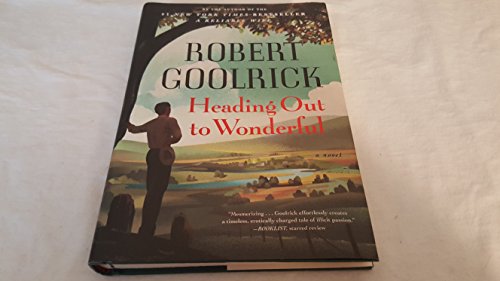
Heading Out to Wonderful
A NOVELBy ROBERT GOOLRICKALGONQUIN BOOKS OF CHAPEL HILL
Copyright © 2012 Robert Goolrick
All right reserved.ISBN: 978-1-56512-923-8Chapter One
The thing is, all memory is fiction. You have to remember that. Of course, there are things that actually, certifiably happened, things where you can pinpoint the day, the hour, and the minute. When you think about it, though, those things mostly seem to happen to other people.
This story actually happened, and it happened pretty much the way I'm going to tell it to you. It's a true story, as much as six decades of remembering and telling can allow it to be true. Time changes things, and you don't always get everything right. You remember a little thing clear as a bell, the weather, say, or the splash of light on the river's ripples as the sun was going down into the black pines, things not even connected to anything in particular, while other things, big things even, come completely disconnected and no longer have any shape or sound. The little things seem more real than some of the big things.
People still ask me about it to this day, about what happened and why I think it happened, as if I knew even now after all this time, when everything's been over for decades except the talk and the myth, I don't know what else you'd call it. I'm not young any more, so sometimes I can't tell what things are the things I remember and what things are just things that other people told me. They tell me things I did, and a lot of them I don't remember, but most people around here aren't liars, so I just go on and believe them, until it seems that I actually do remember the things they say.
But I still ask myself sometimes late at night about what happened, how it all turned out, about the life I've led, you know, every thing. I ask myself the same questions they ask me, these people who've only heard about it, who weren't even around when it all took place. What happened and why did it have to happen in the way it did?
Was I damaged by it, they want to know, wounded in some way? And I always say no. I don't think I was hurt by it. But I was changed, changed deeply and forever in ways I realize more and more every day. Anyway, it's too late now to go back, to take that rock out of the river, the one that changed the course of the water's flow.
The story began this way. And it began here, more than sixty years ago.
This was a town where no crime had ever been committed. Disasters had happened, of course, natural disasters had occurred in the course of things, barn fires, floods, house fires, terrible illnesses. So many fine young men from the town who didn't come back from the war, or came back from France and Germany bruised and wounded and shy and scared of sharp bright electric sounds in the dark. And sin. Envy and greed and covetousness and pride, there was terrible pride. But no crime. Not in this town.
Brownsburg, Virginia, 1948, the kind of town that existed in the years right after the war, where the terrible American wanting hadn't touched yet, where most people lived a simple life without yearning for things they couldn't have, where the general store had tin Merita bread signs as door handles, and, inside, slabs of bacon and loaves of thin-sliced bread and canned vegetables and flour and flannel shirts and yard goods and movie magazines for the dreamers and penny candies in glass jars on the counter for the children. Cokes and brightly colored Nehi pop nestled in a metal box that was filled with iced water, and you got your drink by sliding it out of the metal slots through the icy water, dope, my mother called it, sometimes saying to my father, "Let's go down to the store and get a dope." She was a teacher, Latin to unruly and unwilling boys and girls, but she longed for another time. She liked the way it had been before the war a whole lot better. She saw everything that way, as though change were not happening faster than her heart could beat.
The general store stood in the middle of a thin short row of others like it, a butcher, a barber, a bank, a hardware store with bins of nails and screws and simple tools and wiring, and lumber in the back, but everything else you had to drive to Lexington to get, twelve miles of two-lane twist away. It was a town where people expected to live calmly and die and go to heaven in due time.
On a hill behind the town there was a school that went all the way from first grade to graduation, the ones who made it that far, with a small, thinly stocked library built alongside it. That's where my mother taught the stories of the wars and the gods. Arma virumque cano / Troiae qui primus ab oris. The school was heated by wood stoves, and sometimes it was so cold in the winter that the children got the day off, even if it wasn't snowing, and school let out in early May so the children could help with the planting.
There weren't any stoplights. The streets, the few of them that there were, were straight and smooth and didn't go very far. Nobody drove fast, except the occasional stranger who drove through town, lost on his way from someplace to someplace else that wasn't Brownsburg.
There were two advertising billboards, one at each end of the town. Crudely painted, they said, identically, charlie carter cleans chimneys, and underneath, Recaps, Liners, Repairs. That's all. No phone number, no address, so unless you knew who Charlie was and where he lived, there was no way in hell you were going to get your chimney relined, if you needed that. But Charlie Carter lived right behind one of the signs, anyway, so the few people who had need of his services didn't have much trouble.
The people here then, they believed in God and The Book. They believed that the Word was made flesh and dwelt among us, that the Word was truth—no, that it was fact, as it was given to the prophets and the saints. The faith of their fathers passed through them mother to son, son to daughter and son, until it peopled the towns they made.
They hoped for their own salvation, and they feared for their neighbor's perdition.
They didn't divorce. There was not one divorce in the whole town, never had been. The church preached against it, and custom didn't allow it.
The houses in Brownsburg sat with straight and honest faces toward the street, brick mostly or clapboard, built within a twenty-five-year span of one another about a hundred years before. They had shallow yards running along the street, and bigger yards to the back. These yards became a kind of unspoken, amicable battleground between neighbors, in every house gardeners, and every gardener seeing who could make the best show, flowers on the street side, vegetables behind, the women and girls to the front, the men and boys out back, victories measured out in continuous, radiant bloom, and in the number of jars of vegetables put up on hot summer days, to be eaten in the dead of winter.
In the evenings, the mothers and fathers would sit on the porches, drinking iced tea and talking in soft voices about the day's events, while the girls sat on the lawns making chains out of dandelions, and the boys made lonesome bleating whistles with blades of grass squeezed between their thumbs. They listened to the radio, in the evenings, but since there was only one station anybody could get, the town became, for that hour or two, like a stereophonic symphony.
There were five hundred and thirty-eight people here, then, and it rarely changed, the number of births pretty much keeping pace with the number of deaths.
No doors were ever locked. No dogs were walked on...