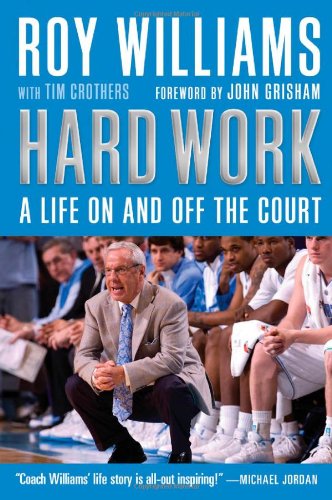
Now in paperback, updated with an afterword and new photos.
One of the most respected and successful basketball coaches in the nation, Coach Roy Williams has traveled an unlikely path. In Hard Work¸ he tells the story of his life, from his turbulent childhood through a coaching career with the highest of highs and the lowest of lows. With his new afterword, Williams takes us past the two NCAA championship titles to the subsequent 2010 season, its shake-up losses, the unexpected departure of key players, and on to a new season of coaching some of the most dazzling young players in the country—and a surprising ACC championship.
Williams recounts his rough early years; his long tenure as head coach at the University of Kansas; how he recruits, teaches, and motivates his players; how he’s shepherded teams through some of the most nail-biting games at both Kansas and UNC; and how he suffered through one of the roughest seasons of his tenure and came out on the other side to be awarded 2011 ACC Coach of the Year.
HARD WORK
A LIFE ON AND OFF THE COURTBy ROY WILLIAMS TIM CROTHERSAlgonquin Books of Chapel Hill
Copyright © 2009 Roy Williams and Tim Crothers
All right reserved.ISBN: 978-1-56512-959-7Contents
FOREWORD by John Grisham...............................................ixINTRODUCTION...........................................................xiii1 Stress...............................................................12 Angels and Demons....................................................113 Home Games...........................................................244 A Small Fish.........................................................385 Being Like Buddy Baldwin.............................................546 The Best Dadgum Calendar Salesman There Ever Was.....................677 Big-time Ballcoachin'................................................898 Decision, Decision...................................................1279 Winning the Whole Blessed Thing......................................14610 Philosophy..........................................................16511 Stealing Brownies...................................................19812 Stress Relief.......................................................22113 The 19th Hole.......................................................23614 Look Homeward, Angel................................................253Acknowledgments........................................................261Appendix A.............................................................265Appendix B.............................................................269Appendix C.............................................................270Index..................................................................275
Chapter One
Stress
One October night it got so bad that I woke up at 4 a.m. and went for a walk in the neighborhood. It was a little spooky, and I wondered if anybody else was awake and if they were thinking, "Who is that guy walking around at this hour?" So I didn't walk on the sidewalk. I walked right down the middle of the street, because I didn't want anybody to think I was a burglar and shoot my rear end.
I just couldn't sleep.
I never sleep very well in the preseason, but I got less sleep during the 2009 preseason than any year I have ever coached. From the start of practice, an average night's sleep for me was about four hours. So many things were running through my mind. I keep a little notepad and pen on my nightstand and a lot of times I come up with an idea and turn the light on and write it down and then try to go back to sleep. But during the '09 preseason there was never any going back to sleep. In all my years of coaching I have never felt more pressure.
It was all because of what I wanted for one kid. I so badly wanted Tyler Hansbrough to reach his dream. This was his last chance to win a national championship. I can never remember wanting something so much for one of my players.
I think part of it was because Tyler didn't come back for his senior year at North Carolina to improve his stock for the NBA draft. He came back because he enjoyed college and he wanted to win a national title. A very physical, no-nonsense kid from Poplar Bluff, Missouri, who had been the centerpiece of our team for three seasons, Tyler had received so many individual awards, but he never cared about any of them. All he ever really wanted was the big team prize. It felt like Tyler was carrying all of what is good about college basketball on his shoulders. I know it sounds corny, but I really felt it was only right for him to win a national championship.
During the preseason, I had tried to tell Tyler not to let a championship be his only goal, because odds were that it was not going to happen. He looked me square in the eye. "Coach," he said, "I want to win it so bad."
I remember it was the very end of August when I first heard that Tyler had a problem with his shin. He told the trainers he thought he got kicked, and they put some ice on it. When our preseason conditioning started in the middle of September, his leg was still bothering him, and it hurt more and more as we got closer to the start of the season. So we did an MRI and a bone scan and the problem was diagnosed as a stress reaction condition. The bone was weakened, leading to the possibility of a stress fracture or worse.
It's the kind of injury where nobody really knows what's going to happen next. Our doctors told me that in two weeks we might see some improvement or we might not. At four weeks we might see some improvement or we might not. I could let him have six weeks off and then he could come back to practice for five minutes and break his leg. Tyler was worried he might miss the whole season. I told our doctors, "You know what they call the guy who finished last in medical school? Doctor. You know what they call the guy who finishes last in coaching? Ex-coach." Every day I jokingly threatened to fire them, but I wanted them to understand how serious this really was.
I had no choice but to let Tyler sit out as long as he needed to, which was hard because he was the returning National Player of the Year and a guy that's going to get 20 points and 10 rebounds every game. That's a pretty big security blanket for a coach.
Tyler sat out of practice for two weeks and then we started working him back in a little bit at a time. That was the toughest part. We'd be doing a drill that was 12 minutes long and I planned to let Tyler do half of that, but we'd get nearly through half and I'd think, "Gosh, I wonder if I should take him out?" I always knew that if I let him go one more play, he could possibly hurt himself. Every time he jumped, I worried that he might come down and snap his leg. I was thinking every play could be his last. Every day at practice before I went out on the court, I'd say a little prayer: "Let this team play well. Let me help this team and let no one get hurt, especially Tyler." In every drill, instead of coaching my team, I was peeking at Tyler with one eye and my watch with the other, wondering if I should pull him out. I finished every practice with a splitting headache. I was so worried I might end the guy's career.
On top of all that were the expectations. While Tyler had never seriously considered leaving UNC early for the NBA, three other underclassmen-Ty Lawson, our lightning-quick point guard; Wayne Ellington, our deadly outside shooter; and Danny Green, an excellent all-around player on the wing-had all submitted their names for the NBA draft. In June, when those three guys opted to pull their names out of the draft to improve their stock with another college season, I read a story in the newspaper that said North Carolina could have one of the greatest teams ever. Then, in the summertime when I was recruiting, other coaches would say to me, "The good news is you're going to have a great team. The bad news is that everybody's going to expect you to win a national title. And if you don't win it, everybody will say your season wasn't a success." As much as I hated to admit it, I knew what they were saying was true.
The Associated Press preseason poll came out and we were unanimously voted No. 1. The Sporting News printed a story titled "They Just Can't Lose" and said that we might be the best college team in 30 years, with a chance to be the first undefeated team since 1976, when Bobby Knight did it with Indiana. What scared me was reading that and knowing my players were hearing about it and, even more, that their...