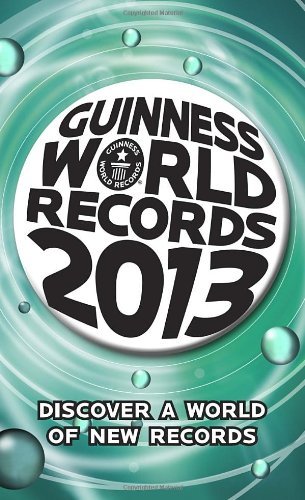
Guinness World Records 2013
ISBN 10: 034554711X ISBN 13: 9780345547118
Verlag: Bantam, 2013
Gebraucht
Softcover
Verkäufer
Better World Books, Mishawaka, IN, USA
Verkäuferbewertung 5 von 5 Sternen

AbeBooks-Verkäufer seit 3. August 2006
Dieser Artikel ist nicht mehr verfügbar.
Beschreibung
Beschreibung:
Former library book; may include library markings. Used book that is in clean, average condition without any missing pages. Bestandsnummer des Verkäufers 2285617-6
Inhaltsangabe:
From the highest jump on a pogo stick to the fastest dash in clogs, from the longest dog tail to the largest fuzzy dice—the most astonishing records from around the world can be found here!
Guinness World Records™ 2013 presents the most amazing, inspiring, and wild record-breakers ever. Filled with don’t-try-this-at-home human exploits, natural and technological wonders, incredible achievements in sports and entertainment, and much more, this fully updated edition introduces thrilling new records and incredible facts that will fascinate young and old alike. Did you know . . .
• Takeru Kobayashi of Japan appeared on The Wendy Williams Show on January 23, 2012, and devoured 14 Twinkies in one minute?
• Over a short distance, the cheetah can maintain a steady maximum speed of approximately 62 mph, making it the fastest mammal on land?
• As of February 17, 2012, Axel Rosales from Villa María, Argentina, had the most facial piercings with the grand total of 280 from forehead to neck?
And that’s just a hint of what you’ll find inside this addictive book, including new photos and spreads, as well as a handy guide on how to become a record-breaker yourself, and compelling sections leading off popular categories that explore the question: How far can a record be pushed?
Auszug. © Genehmigter Nachdruck. Alle Rechte vorbehalten.:
SPACE
how far will we explore?
What are the limits to space travel?
The distances between the stars are vast and are measured using a unit called “light-years.” One light-year is the distance traveled by light in one year. The speed of light is 671 million mph (299,792,458 m/s), so one light-year is the same as 5,878,625,373,183.608 miles (9,460,730,472,580.8 km)!
Our Sun is 8.3 “light-minutes” away (i.e., it takes 8.3 minutes for sunlight to reach Earth), and the Moon—the farthest place humans have ever visited—just 1.3 “light-seconds” away. So when we consider that our next nearest star is 4.2 light-years away, what chances have we got of ever reaching it? Even if we consider light as our theoretical speed limit, how far can we expect to travel from Earth? Our journey starts at bottom left of the page . . .
With current conventional rocket technology, a trip to the nearest star is out of the question. Even if we could develop an interstellar spacecraft (artist’s impression, top right), Albert Einstein has taught us that as this theoretical spacecraft approached the speed of light, it would appear to gain mass, making it increasingly difficult to accelerate.
More advanced rocket technology, such as nuclear thermal or nuclear pulse, could theoretically send a manned mission to the nearest stars at a significant fraction of the speed of light—albeit at a great cost—within a century. If anyone manages to invent sci-fi technology, such as a warp drive, it could happen much sooner!
venus
Largest planet without a moon Of the eight major planets of the solar system, only Mercury and Venus have no natural satellite. It is possible that Venus once had a moon, which crashed into the surface. With a 7,520.8-mile (12,103.6-km) diameter, Venus is similar in size to Earth.
Largest impact crater on Venus Mead crater, north of a highland area called Aphrodite Terra, has a diameter of around 174 miles (280 km). Mead is shallow, suggesting it may have been filled by lava or impact melt after its formation.
Planet with the longest day Venus has the longest rotation period (day) of all the major planets in the solar system. While Earth takes 23 hr. 56 min. 4 sec. to complete one rotation, Venus takes 243.16 “Earth days” to spin once through 360 degrees. Because it is closer to the Sun, the length of Venus’s year is shorter than Earth’s, lasting 224.7 days, so a day on Venus is actually longer than its year!
Brightest planet seen from Earth Seen from Earth, the brightest of the five planets usually visible to the naked eye (Jupiter, Mars, Mercury, Saturn, and Venus) is Venus, with a maximum magnitude of -4.4. Venus appears so bright because around 80% of the sunlight that reaches the planet is bounced back by its reflective cloud cover (see below). At maximum elongation, it is visible for some time before and after sunrise and sunset.
Thickest planetary atmosphere Often referred to as the closest place to hell in the solar system, Venus’s atmosphere is the thickest of any planet, with a pressure nearly 100 times that of Earth’s atmospheric pressure at sea level. The gases in the thick atmosphere cause a greenhouse effect, which means the temperature on the surface reaches 896°F (480°C). Europe’s Venus Express spacecraft is currently performing the most intensive study of Venus’s atmosphere ever made (see p. zzz).
Most acidic rain in the solar system The highly reflective white clouds of Venus, which prevent direct viewing of the surface from space, are due to a layer of sulfuric acid 30–36 miles (48–58 km) above the surface. Rain of almost pure sulfuric acid falls from these clouds but never reaches the surface. At an altitude of around 18.5 miles (30 km), the rain evaporates; it is recycled into the Venusian clouds.
First successful interplanetary mission Mariner 2 (U.S.A.) performed a flyby of Venus on December 14, 1962, within 35,000 km (21,750 miles) of the planet’s surface. Results from the flyby revealed the extremely hot nature of the planet’s surface. Mariner 2, now without power, is still in orbit around the Sun.
Largest highland region on Venus Close to Venus’s equator lies Aphrodite Terra, one of two major highland “continents” on the planet. First mapped in detail by the Soviet Venera 15 and 16 orbiters in 1984, it covers an area of around 30 million km2 (11.6 million miles2), which is approximately the same size as Africa. The fractured appearance of Aphrodite suggests it has been subject to huge forces of compression in its geological history.
Tallest mountain on Venus Maxwell Montes, on the Ishtar Terra plateau, is the highest point on Venus, up to 6.8 miles (11 km) above the average surface level of the planet.
First detection of lightning on Venus On October 26, 1975, the spectrometer onboard the Soviet Venera 9 spacecraft detected optical flashes—consistent with lightning—in the Venusian atmosphere on the dark side of the planet. This represents the only time lightning has been witnessed optically by a spacecraft in the atmosphere of Venus.
On December 25, 1978, in its descent to Venus’s surface, the USSR’s Venera 11 lander picked up a sound that scientists believe to be the first thunder heard on another planet.
Longest channel in the solar system Baltis Vallis on Venus is around 4,300 miles (7,000 km) in length and has an average width of around 1 mile (1.6 km). It was discovered by the Magellan radar mapper, which orbited Venus from August 1990 to October 1994. Experts believe that the channel was originally formed by molten lava.
the sun
Fastest wind in the Solar System The solar wind is a steady stream of (mostly) electrons and protons that is emitted from the Sun in all directions. The fastest component of the solar wind travels outward at around 470 miles/sec (750 km/sec) and is thought to originate from areas of open magnetic field lines around the Sun’s poles.
Largest object in the Solar System The Sun dominates the Solar System. With a mass of 1.98 x 1030 kg, or 332,900 times that of Earth, and a diameter of 865,000 miles (1,392,000 km), it accounts for some 99.86% of the mass of the Solar System.
Largest explosions in the Solar System Coronal mass ejections are often, although not always, associated with solar flares. They are huge bubbles of plasma threaded with magnetic field lines, which erupt from the Sun over a period of several hours. They can contain up to 220.5 billion lb. (100 billion kg) of matter moving at 620 miles/sec (1,000 km/sec), with the equivalent energy of a billion hydrogen bombs. The next solar maximum, in 2013, could see several of these erupt from the Sun every day.
Largest magnetic structure in the Solar System The magnetic field of the Sun is contorted into a vast spiral shape by the Sun’s rotation and motion of the solar wind. Resembling the shape of a spinning ballerina’s skirt, and known as the “Parker spiral,” it extends all the way to the edge of the Solar System, into a region known as the “heliosheath.” The magnetic structure of the Parker spiral is approximately 160–200 AU across, or 15–18 billion miles (24–30 billion km).
Strongest magnetic fields on the Sun’s surface Sunspots can have magnetic field strengths of up to 0.4 tesla, around 1,000 times that of their surrounding areas and...
„Über diesen Titel“ kann sich auf eine andere Ausgabe dieses Titels beziehen.
Bibliografische Details
Titel: Guinness World Records 2013
Verlag: Bantam
Erscheinungsdatum: 2013
Einband: Softcover
Zustand: Good
Beste Suchergebnisse beim ZVAB

Beispielbild für diese ISBN
Guinness World Records 2013
Verlag:
Bantam (edition Reissue), 2013
ISBN 10: 034554711X
ISBN 13: 9780345547118
Gebraucht
Mass Market Paperback
Anbieter: BooksRun, Philadelphia, PA, USA
Verkäuferbewertung 5 von 5 Sternen
Mass Market Paperback. Zustand: Good. Reissue. It's a preowned item in good condition and includes all the pages. It may have some general signs of wear and tear, such as markings, highlighting, slight damage to the cover, minimal wear to the binding, etc., but they will not affect the overall reading experience. Artikel-Nr. 034554711X-11-1
Gebraucht kaufen
EUR 5,42
Versand gratis
Versand innerhalb von USA
Versand innerhalb von USA
Anzahl: 1 verfügbar
Beispielbild für diese ISBN
Guinness World Records 2013
Anbieter: ThriftBooks-Atlanta, AUSTELL, GA, USA
Verkäuferbewertung 5 von 5 Sternen
Unknown. Zustand: Fair. No Jacket. Readable copy. Pages may have considerable notes/highlighting. ~ ThriftBooks: Read More, Spend Less. Artikel-Nr. G034554711XI5N00
Gebraucht kaufen
EUR 5,59
Versand gratis
Versand innerhalb von USA
Versand innerhalb von USA
Anzahl: 1 verfügbar
Beispielbild für diese ISBN
Guinness World Records 2013
Anbieter: WorldofBooks, Goring-By-Sea, WS, Vereinigtes Königreich
Verkäuferbewertung 5 von 5 Sternen
Paperback. Zustand: Very Good. The book has been read, but is in excellent condition. Pages are intact and not marred by notes or highlighting. The spine remains undamaged. Artikel-Nr. GOR007063817
Gebraucht kaufen
EUR 5,88
EUR 6,47 Versand
Versand von Vereinigtes Königreich nach USA
Versand von Vereinigtes Königreich nach USA
Anzahl: 2 verfügbar
Beispielbild für diese ISBN
Guinness World Records 2013
Anbieter: WorldofBooks, Goring-By-Sea, WS, Vereinigtes Königreich
Verkäuferbewertung 5 von 5 Sternen
Paperback. Zustand: Fair. A readable copy of the book which may include some defects such as highlighting and notes. Cover and pages may be creased and show discolouration. Artikel-Nr. GOR010361968
Gebraucht kaufen
EUR 5,88
EUR 6,47 Versand
Versand von Vereinigtes Königreich nach USA
Versand von Vereinigtes Königreich nach USA
Anzahl: 1 verfügbar
Beispielbild für diese ISBN
Guinness World Records 2013
Anbieter: Better World Books, Mishawaka, IN, USA
Verkäuferbewertung 5 von 5 Sternen
Zustand: Good. Pages intact with minimal writing/highlighting. The binding may be loose and creased. Dust jackets/supplements are not included. Stock photo provided. Product includes identifying sticker. Better World Books: Buy Books. Do Good. Artikel-Nr. 2285616-75
Gebraucht kaufen
EUR 8,69
Versand gratis
Versand innerhalb von USA
Versand innerhalb von USA
Anzahl: 2 verfügbar
Beispielbild für diese ISBN
Guinness World Records 2013
Anbieter: Robinson Street Books, IOBA, Binghamton, NY, USA
Verkäuferbewertung 4 von 5 Sternen

Mass Market Pa. Zustand: Used: Good. Prompt Shipment, shipped in Boxes, Tracking PROVIDEDGood, mass market paperback minor, crease and nicks, bumped tips, prompt shipping with tracking. Artikel-Nr. boiler95IB183
Gebraucht kaufen
EUR 11,73
EUR 8,01 Versand
Versand innerhalb von USA
Versand innerhalb von USA
Anzahl: 1 verfügbar