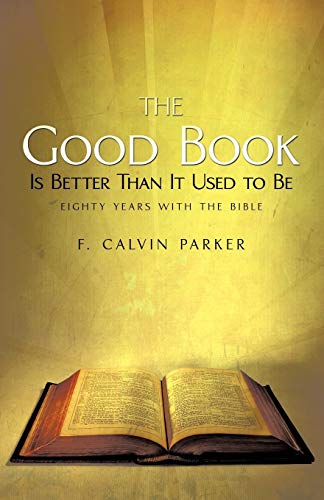
F. Calvin Parker attended his first Vacation Bible School when he was four years old, and he consumed more scripture than Kool-Aid or cookies. There was much to thrill a young mind. He heard the amazing stories of Noah in the zoo-like ark and Daniel in the lions' den, along with proverbs and psalms that nourished his soul his entire life. He remained a devoted student of scripture, listening to the radio sermons of Charles E. Fuller and reading John R. Rice. While in the Army, he joined Calvary Baptist Church in New York, which was led by preacher William Ward Ayer, a fundamentalist stalwart. Parker and his wife Harriett went to Japan in 1951 as Southern Baptist missionaries. Reading the Bible in Japanese, which differs sharply from English, allowed him to rediscover its teachings and led to a personal transformation. The scriptures began to excite and challenge him as never before. Join Parker as he breaks free from oppressive teachings and shares what he's learned over eighty years of studying the Bible in The Good Book Is Better Than It Used to Be.
The Good Book Is Better Than It Used to Be
Eighty Years with the BibleBy F. Calvin ParkeriUniverse, Inc.
Copyright © 2009 F. Calvin Parker
All right reserved.ISBN: 978-1-4401-6012-7Contents
Foreword by Linda McKinnish Bridges......................................viiPreface..................................................................ix1. More Awesome: The Meaning Deepens with the Years.....................12. More Authentic: King Truth Dethrones King James......................123. More Personal: The Chapters and Verses Are Mine......................284. More Human: The Writers Mirror Our Flaws.............................455. More Diverse: We Have Many Choices...................................616. More Religious: Readers Will Answer to God...........................777. More Liberating: Noah's Curse is Broken..............................938. More Egalitarian: Women Can Preach to Men............................1089. More Accepting: Gays and Lesbians Are Welcome........................12110. More Pacifist: Christ's Sword Is His Word............................13511. More Complete: The Canon Keeps on Growing............................14812. More Supportive: My Deepest Needs Are Satisfied......................161Notes....................................................................174
Chapter One
More Awesome: The Meaning Deepens with the Years
Nobody ever outgrows Scripture; the book widens and deepens with our years. -Charles H. Spurgeon, English Baptist preacher
Climb aboard the time machine, courtesy of H. G. Wells, for a jaunt back to my early childhood in Tampa, Florida. We disembark at the intersection of Hillsborough and Nebraska Avenues and step inside the white clapboard building labeled Seminole Heights Baptist Church. I'm attending my first Vacation Bible School, an annual two-week event for children and youth three to sixteen years of age. Like all normal four-year-olds, I'm highly teachable. My spongy mind absorbs the amazing stories of Noah in the zoo-like ark and Daniel in the lions' den, along with proverbs and psalms that will ever nourish my soul. I consume more Bible than Kool-Aid and cookies.
Each morning, before dividing into age groups for lessons, crafts, and games, we all gather in the church's auditorium for opening ceremonies. Three pupils march down the two aisles, one holding aloft the American flag, another bearing the Christian flag, and the third cradling an open Bible in his hands. The girl with the American flag hoists it too high and pokes the top of the flagstaff into a whirling ceiling fan. The clash jars me, as though a thunderclap. I turn to see a wooden fan blade fly through the air and alight on a vacant pew. The piano music stops, our teachers restore order, and the flag- and Bible-bearers take their usual positions at the front. We recite the standard pledges of allegiance to the two flags, then pay tribute to the special book that gave Vacation Bible School its name. We say in unison:
I pledge allegiance to the Bible, God's Holy Word, and will make it a lamp unto my feet, and a light unto my path, and will hide its words in my heart that I might not sin against God.
Immediately afterward we belt out a hymn:
Thy Word is a lamp to my feet, A light to my path alway, To guide and to save me from sin, And show me the heav'nly way.
Some days we sing this hymn instead:
Holy Bible, Book divine, Precious treasure, thou art mine: Mine to tell me whence I came; Mine to teach me what I am.
Whichever the hymn, its emotional impact reinforces the pledge I've made to the Bible. I recite this pledge as many as ten times each summer for the next dozen years. Saluting a black-covered book seems no different from saluting a colorful flag. As a hymn writer declares:
The scripture is a banner before God's host unfurled; It is a shining beacon above the darkling world.
Like the American and Christian flags, the Bible arouses my emotions and stirs me to action. It represents powerful ideas and ideals. And unlike the flags, it spells out those ideas and ideals. The Bible can be opened, read, studied, and applied to our lives. I pledge to use it that way. I vow to follow it as a guiding light, to obey it as a book divine.
In Love with God's Word
A Chinese philosopher was said to ride his mule backward so he could reflect on where he had been without being distracted by where he was headed. Likewise, I have tried to recall the first stages of my life's journey without being influenced by where the journey has led. However faulty my memory, there is ample evidence that the Bible and I bonded as though we were Jonathan and David. "Jonathan made a covenant with David," we are told, "because he loved him as himself" (1 Sam. 18:3). I loved the Bible as myself. We were bound together as tightly as its printed pages.
During my growing-up years I often had a Fishers of Men New Testament tucked in my shirt pocket. This bantam Bible, a descendant of the Soldier's Pocket Bible carried by Oliver Cromwell's troops in the English Civil War, served me well when I shinnied up an oak tree to read it in private. I memorized passages such as the third chapter of John while perched on a moss-laden branch. That chapter tells the story of Nicodemus, who came to Jesus at night and heard him say, "You must be born again" (v. 7). It includes the "gospel in a nutshell": "For God so loved the world that he gave his one and only Son ..." (v. 16).
At home and at church, especially in Sunday school classes, I used a complete Bible with both Old and New Testaments. Sad to say, my childhood Bibles have gone the way of my toys and roller skates, but two remain from my high-school years. One is a tattered Scofield Reference Bible, a Bible so popular that Oxford University Press has produced ten million copies. It contains maps, explanatory notes, and-except for the Psalms-dates on each page running from BC 4004 to AD 96. The other is a Thompson Chain Reference Bible, a pricey edition bound in Alaska seal and as flexible as the Bible I have often seen in Billy Graham's gesturing hand. A gift from cherished friends, it includes a concordance, charts, character studies, book analyses, and one hundred thousand linked references. Both Scofield and Thompson helped me craft my maiden sermons.
Like others in my family, I did the daily Bible readings specified in the Baptist Training Union quarterly study guides. The Training Union met every Sunday prior to the evening preaching service. One of its features was an eight-point record system, a more rigorous standard than the six-point system used in Sunday school. At Training Union each week, the group captains handed each member of their group a little slip of paper with eight boxes to check:
Present (10 percent) On Time (10 percent) Studied Lesson (15 percent) On Program (15 percent) Study Course (10 percent) Daily Bible Reading (15 percent) Attending Preaching (10 percent) Giving to Church (15 percent).
Determined to be a model Christian "who does not need to be ashamed" (2 Tim. 2:15), I strove to be 100 percent every Sunday. To claim credit for Daily Bible Reading, I had to do the readings specified in my quarterly without missing a single day. No exceptions were allowed. Missing a day reduced not only my individual grade but that of my group. A...