
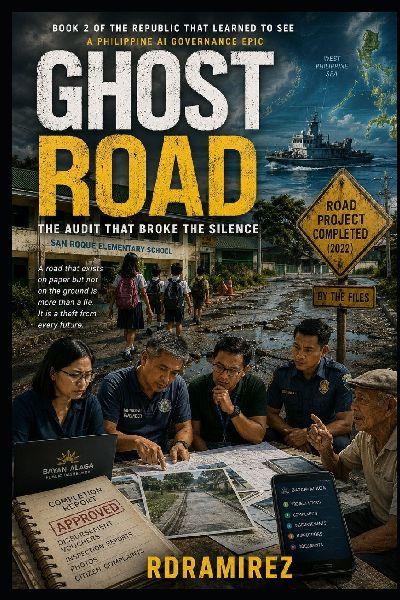
In Barangay San Roque, the first book began with a woman whom the government record had declared dead while she was still alive. Book 2 begins with another kind of ghost, not a person this time, but a road.
The road beside San Roque Elementary is cracked, muddy, dangerous, and familiar. Parents complain about it. Children avoid it. Tricycle drivers slow down beside it. Everyone knows the road is unsafe, but for years it has remained part of ordinary life.
Then Mika Reyes, a Grade Four pupil, nearly loses her shoe in the mud beside the school gate. What begins as a small accident becomes a civic question when the Bayan-Alaga system reveals a disturbing note attached to the road’s public record: PROJECT COMPLETED.
According to the file, the road had already been repaired, inspected, certified, and paid for three years earlier. The documents look finished. The ground does not.
Barangay secretary Renea Medina, Engineer Juan Erlano, Richard Lim, Captain Nicolas Reyes, Councilor Chona Doringo, Jesusa Patasin, Aling Marites Mendoza, Mang Samson, and the parents of San Roque begin following the audit trail. They examine procurement files, inspection reports, completion photos, voucher chains, access logs, school letters, parent testimonies, and engineering measurements. The deeper they look, the more the road becomes a test of public courage.
The contractor is not a stranger. George San Joaquin-De Mesa is respected, connected, generous, and close to the town’s most powerful political family. Mayor Roger San Joaquin must now face a difficult question: can public accountability survive when the record points toward family, loyalty, favors, and reputation?
As the ghost road exposes the uneasy relationship between paperwork and concrete, San Roque learns that public service is not measured by speeches alone. It is measured by roads children can cross, drains that actually work, records that can be verified, and officials who are willing to let truth stand even when it embarrasses power.
GHOST ROAD: The Audit That Broke the Silence is a dialogue-driven Philippine civic fiction novel about AI-assisted public accountability, infrastructure audit, procurement, political families, civic literacy, engineering truth, and the ordinary citizens who refuse to let silence remain official policy.