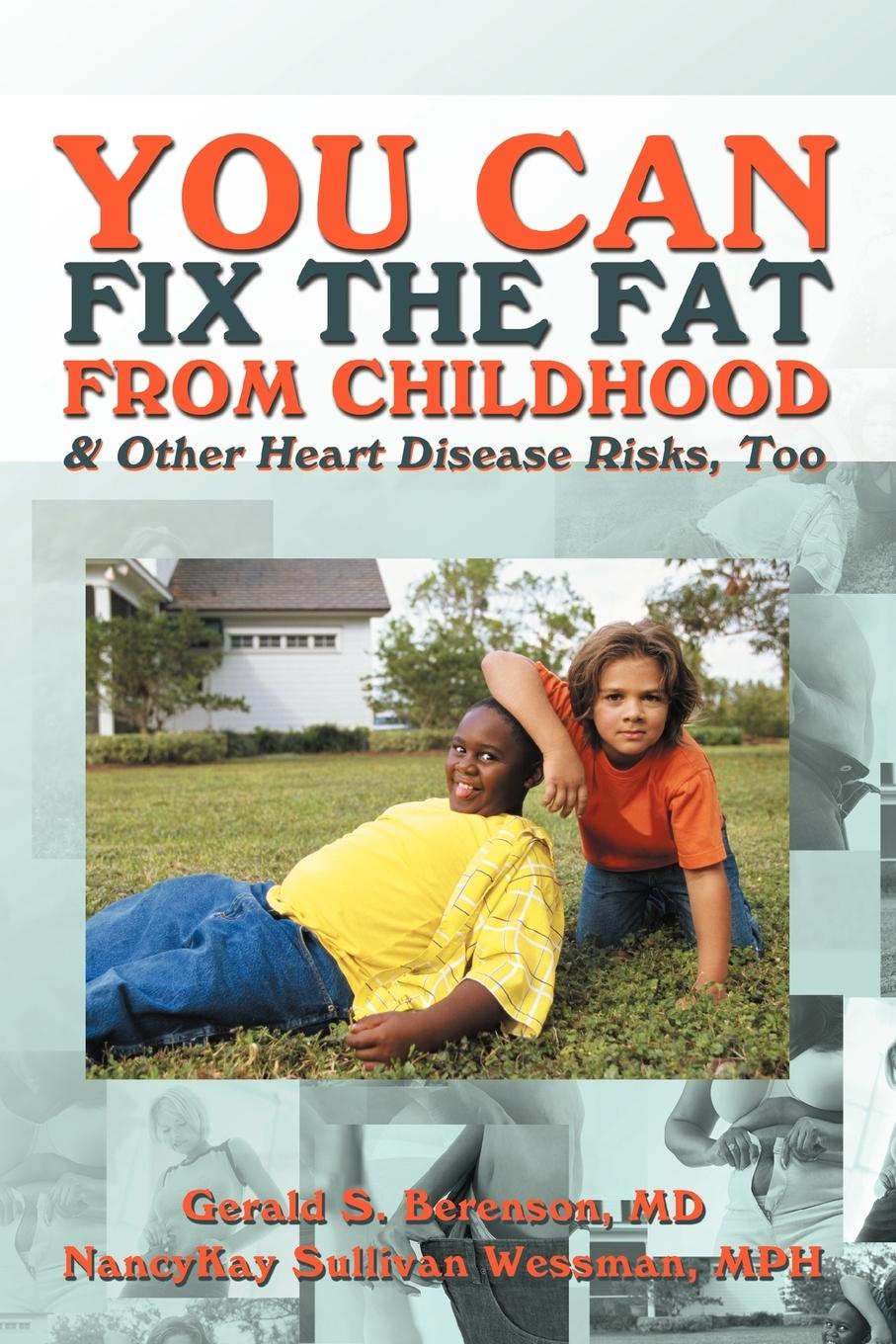
You Can Fix The Fat From Childhood promotes family-focused comprehensive knowledge and behaviors with an eye toward preventing early disability and death from heart disease. Heart disease risk factors "show" in early childhood. Learning to adopt healthy lifestyles - that's prevention! Health doesn't come in a bottle, and you cannot buy it in a drug store or at the supermarket! You have to work at it. Slim, trim, toned, and fit - desired "look" not easy but achievable! Decide to tackle the fat: prevent it, control it, exercise it. We can fix the fat! Dr. Shiriki Kumanyika, associate dean at University of Pennsylvania School of Medicine, said on the acclaimed HBO special, "The weight of the nation is out of control, but we can fix that"
YOU CAN FIX THE FAT FROM CHILDHOOD & Other Heart Disease Risks, Too
By Gerald S. Berenson NancyKay Sullivan WessmanAuthorHouse
Copyright © 2012 Gerald S. Berenson, MD
All right reserved.ISBN: 978-1-4772-5785-2Contents
Preface............................................................................xiiiIntroduction.......................................................................xvChapter One The Bogalusa Heart Study..............................................1Chapter Two Heart disease starts in childhood – really!.....................7Chapter Three What we know about risk factors.....................................16Chapter Four Obstacles to achieving good health...................................39Chapter Five Your roadmap to better health........................................45Chapter Six Positive choices pay big rewards......................................57Chapter Seven Feasting on nutritious food – or not..........................63Chapter Eight Kid Fit: Engage and enjoy physical activity.........................76Chapter Nine How to cope, like yourself, manage stress............................86Chapter Ten Arnold's story: learn from him........................................93Chapter Eleven Pitfalls can hamper good intent, behavior..........................99Conclusion.........................................................................103Appendix About Health Ahead/Heart Smart...........................................105About the authors..................................................................127Glossary...........................................................................131Resources..........................................................................135
Chapter One
The Bogalusa Heart Study
In 1972, the Bogalusa Heart Study (BHS, Bogalusa, Louisiana) was identified at Louisiana State University (LSU) Medical Center as a national Specialized Center of Research (SCOR). The United States Congress had mandated the National Institutes of Health to establish SCORs to investigate major causes of cardiovascular disease: atherosclerosis — a generic term for heart and vascular changes, hypertension, pulmonary disease, strokes, and thrombosis.
Bogalusa Heart Study is the only long-term, cardiovascular, community research program in the world in which both African-American and Caucasian individuals have consistently participated from early childhood through adulthood and middle life. The Study encompassed clinical, epidemiologic, and experimental programs on atherosclerosis, essential hypertension, and diabetes as they related to later coronary and hypertensive heart diseases – and also how these begin in childhood. Before, no comprehensive examination of all children in a total biracial (black and white) community had been undertaken with this detail.
Louisiana and Washington Parish
The Study – which began at LSU School of Medicine in 1972 and moved to become the flagship Tulane University Center for Cardiovascular Health, Disease, and Prevention in 1991 – brought together a highly skilled and trained, multi-disciplinary team of anthropologists, biochemists, cardiologists, epidemiologists, geneticists, nurses, nutritionists, psychologists, sociologists, statisticians, and – finally – school teachers. They worked together to study hereditary and environmental aspects of early coronary artery disease (CAD), hypertension, and diabetes. Funding for the research came from the National Heart, Lung, and Blood Institute, the National Institute for Child Health and Human Development, the National Institute of Aging, and the American Heart Association – basically from taxpayers like you and volunteers.
The Bogalusa Heart Study focus was to understand the early natural history of coronary artery disease (atherosclerosis or hardening of the arteries), essential hypertension (high blood pressure), and diabetes mellitus (abnormally high glucose levels in the blood). Our researchers aimed to address these questions in designing and beginning the Study of children five to 17 years. As time allowed in the research, the ages were extended to both and recently to 45 years of age to look at aging and longevity. More information is available at www.tulane.edu/som/ cardiohealth.
Researchers had four fundamental questions that guided the beginning of the BHS.
• What is the distribution and prevalence of cardiovascular risk factors in children? How are risk factors defined in childhood? What levels of risk factor variables in children are abnormal? We now know a lot about the normal and abnormal levels, how they are measured, and how they produce a life-long burden on the cardiovascular system, importantly beginning in childhood.
• What are the interrelationships of risk factors during childhood? Are the relationships similar to those in adults – for example, does obesity relate to hypertension? How do the risk factor observations relate to a child's family history? We now know the risk factors interrelate; obesity is the main culprit, and a family history is very important, as are lifestyles and health behaviors. As you will see, this interrelation is the basis of the metabolic syndrome – the apple, poor body configuration.
• What are the time-course changes of risk factors in children? What are trends during children's growth phases? Are the risk factor levels during childhood predictive of future levels? First of all, risk factors in children do predict those in adulthood; they "track" – high and low levels tend to persist, and they change with growth periods of early childhood, at puberty and adolescence, and in adulthood. Thus, we look at percentiles at different ages and for boys and girls – like the 5th percentile or 95th percentile, which can be abnormal. "Cut points," specific or selected high or low levels from adult heart disease studies, don't apply to growing children. Now we are looking at aging and longevity, and some of our children (500) have died.
• What determines risk factors in children? Simply, why do some children have high levels of risk factors while others have low levels? What is the extent of genetic and environmental determinants? We suffer through or are gratified by having a good genetic (familial) background, but we all have to relate to our environment and respond by lifestyles we choose.
The basis of our Study is genetics versus environment – read on.
The BHS took a look at increasing obesity and "superobesity" (morbid obesity) among youngsters in the early 1980s – two decades before most people observed the bulge. Even then, America's children were growing fatter, not fitter.
Now CDC calls the problem "common, serious, and costly," about $150 million a year by 2010. That's a hefty price to pay – a huge part of the country's public health and medical dollars going to a human difficulty that can be both predicted and prevented.
We know – we have observed and we have proved in the BHS – that obesity and other major causes of adult heart disease begin in childhood. And we know from a Dutch philosopher's proclamation some 500 years ago and restated by Benjamin Franklin in the 18th century that prevention costs less than cure.
Think back to your own child's earliest days – or infants in general.
Do you remember your child's birth – how absolutely amazed you were to hold such a tiny creature, complete with 10 fingers and 10 toes? Suddenly, the rest of...