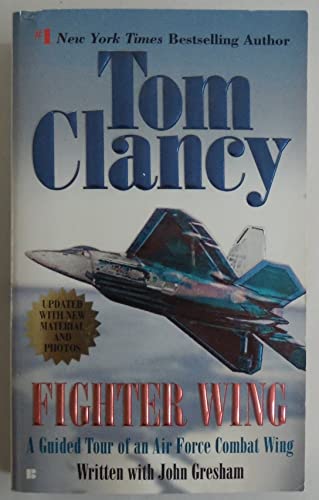
Presents an insider's look at the planes, technology, and people involved in an Air Force combat wing, capturing the thrill of a takeoff, the drama of a dogfight, and the constant dangers faced daily by pilots. Reprint.
In August 1914, a British aviator patrolling the skies above Mons, in Belgium, spotted the advance of von Kluck's German army toward the British Expeditionary Force. Interviewed for TV five decades later, the pilot recalled the reaction of senior officers when he reported the news . . . they didn't believe him. Pilots soon took cameras with them to give proof of their sightings to skeptical general officers whose vision was limited to the view from the ground.
Before long, both sides were flying reconnaissance missions, and hostile aviators were firing pistols at one another. Then machine guns. And soon after that, aircraft were designed as aerial killers -- the first fighters. They were delicate, unstable constructs of wood and wire, usually underpowered by inefficient engines. But they could fly. And the learning curve was steep back then. One day, someone asked, "If you can hang one engine on an airframe, why not two, or even more? If you can see to shoot, you can see to drop a weapon, can't you?" Thus began the age of the bomber.
It was the Germans at Verdun, in the bitter weather of February 1916, who first made actual the concept we now call airpower -- the systematic application of tactical aircraft to control a battlefield (the definition will change and develop). The objective was to seal off the battlefield from French aviation, denying the enemy the ranging eyes needed to see behind the German trench lines; and as it turned out, the plan didn't work terribly well. Still, others saw what the Germans tried, and recognized that it could be made to work. By the end of the war, aircraft were attacking infantry on the ground. And for the first time soldiers knew what field mice had long understood: The target of an aerial predator feels as much psychological burden as physical danger.
Between the wars, a handful of visionary officers in Britain, Italy, Germany, Japan, Russia, and the United States grappled with the theory of airpower . . . and with its practical applications in the next, inevitable war. The most famous of these, the Italian Guilo Douhet, proposed the first great "philosophy" of airpower: Bomber and attack aircraft can reach far into the enemy's rear to attack the factories that make the weapons and the railroads and roads and bridges that transport them to the fighting front. It was Douhet's view that airpower alone -- without armies or navies -- could bring victory in war. In other words, if you smash enough factories, railroads, roads, and bridges, you'll bring your enemy to the point where he will lie down and wave the white flag.
Douhet was too optimistic. An air force is remarkable not only for what it can do, but for what it cannot. The unchanging truth of warfare is that only infantry can conquer an enemy -- infantry is people, and only people can occupy and hold ground. Tanks can roll across ground. Artillery can punish and neutralize ground. And airpower -- which is at heart longer-range artillery -- can punish and neutralize over long distances. But only people can take up residency there.
Yet airpower can have a powerful effect, and this fact was not lost on the German General Staff. In May 1940, when another German attack violated French soil at a place called Sedan, French soldiers excused their rapid departure from the battlefield by saying, "But mon lieutenant, bombs were falling."
The second global conflict announced the importance of airpower in terms that no one could ignore. Now, huge fleets of aircraft attacked everything they could reach -- and that reach was ever growing, for aviation science advanced rapidly. Engineering talent tends to follow the excitement of discovery and possibility. Engineers who had once devoted their skills to developing steam engines for ships or railroad locomotives found more exciting work. The great breakthroughs in engine power came first, and those drove improvements in airframe design.
By the beginning of the Second World War, Daimler-Benz and Rolls-Royce had both developed water-cooled in-line engines exceeding a thousand horsepower. In America, Allison did the same, and Pratt & Whitney began production of their monster, two-thousand-horsepower R-2800 radial engine in East Hartford, Connecticut. More efficiently cooled, simpler, and capable of absorbing catastrophic battle damage, the Double-Wasp and its close relatives would power a variety of successful tactical aircraft (F-6F Hellcat, F-4U Corsair, TBF/TBM Avenger, P-47 Thunderbolt, etc.), plus numerous types of bombers and transport aircraft.
The Republic P-47 Thunderbolt, called "the Jug" by its pilots for its brutal and decidedly ungraceful lines, was originally designed by Alexander Cartvelli as a high-altitude interceptor, and it would distinguish itself as an escort fighter for the bomber fleets of the 8th Air Force over Germany. But the Thunderbolt carried a total of eight heavy .50-caliber machine guns, and could also carry bombs and rockets. Its rugged construction and immense armament rapidly led pilots to experiment with other forms of hunting. Soon Jug drivers were flying low on missions they sometimes called Rodeos, for their wild and woolly character: If it moved, it was fair game. Such missions inspired the German Army to coin a new word, Jabo-short for Jagdbomber, literally "hunting bomber," spoken with alarm and respect.
But the P-47 was more than that. Other countries had aircraft with similar missions. The Russian Il-2 was a dedicated low-level attack bird with an evil reputation among those whom it hunted, but it required a fighter escort. The Thunderbolt was something else. It could hold its own in a swarm of enemy and friendly fighters -- now called a "furball" -- and go low to make life miserable for the people on the ground. And that -- though hardly recognized at the time -- was a revolution of sorts. Using a single aircraft for more than one mission was so logical that the Jug's ability to do more than one mission well seems to have been overlooked. Alexander Cartvelli accidentally invented the multi-role aircraft. Today, the name of the game is multi-role aircraft.
So just what can airpower do? It can make life thoroughly miserable for an enemy -- especially if you can hit exactly what you want to hit. Toward this goal, America continues to lead the world. "If you can see it, you can hit it," goes the saying. Following this usually comes, "If you can hit it, you can kill it." That way of thinking shaped American air doctrine. Dive bombing and close air support were first systematized by the United States Marine Corps in Nicaragua during their early interventions there. In the late 1930s, the Army Air Corps (later the Army Air Force) adopted the ultra-secret Norden bombsight to bring systematic accuracy to high-altitude bombing. In World War Two, the AAF experimented successfully with the "Razon" and "Mazon" TV-guided bombs. And the Germans conducted similar experiments, sinking an Italian battleship with their radio command guided Fritz-X bombs.
Such weapons have been improved over the years. Most of us can remember watching "the luckiest guy in Iraq" on CNN. During the Gulf War, his car was perhaps two hundred yards from the impact point of a two-thousand-pound guided bomb on an Iraqi bridge. Bridges are always worth destroying. So are factories, aircraft on the ground, radio and TV towers, and microwave relays. So too, especially, are the places which generate signals and commands . . . because commanders are there, and killing commanders is ever the quickest way of disrupting an army. Or a whole nation. Using precision-guided munitions can be likened to sniping with bombs. All warfare is cruel and ugly, but such munitions are less cruel and ugly than the alternatives.
With the recent advent of precision-guided munitions to attack the command centers of the enemy nation with great selectivity and deadly accuracy, the promise of airpower is finally being...