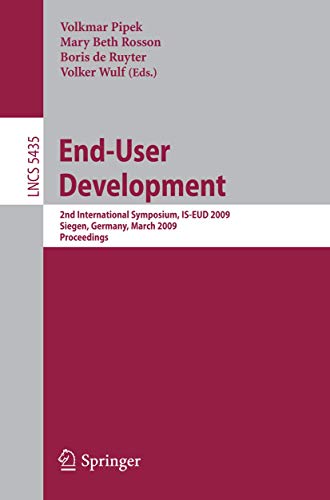
End-User Development: 2nd International Symposium, IS-EUD 2009, Siegen, Germany, March 2-4, 2009, Proceedings (Lecture Notes in Computer Science, 5435)
Wulf Volker Rosson Mary-Beth Pipek Volkmar
ISBN 10: 3642004253 ISBN 13: 9783642004254
Verlag: Springer, 2009
Neu
Softcover
Verkäufer
Biblios, Frankfurt am main, HESSE, Deutschland
Verkäuferbewertung 4 von 5 Sternen

AbeBooks-Verkäufer seit 10. September 2024
Dieser Artikel ist nicht mehr verfügbar.
Beschreibung
Beschreibung:
PRINT ON DEMAND pp. x + 285. Bestandsnummer des Verkäufers 18465361
Inhaltsangabe:
Work practices and organizational processes vary widely and evolve constantly. The technological infrastructure has to follow, allowing or even supporting these changes. Traditional approaches to software engineering reach their limits whenever the full spectrum of user requirements cannot be anticipated or the frequency of changes makes software reengineering cycles too clumsy to address all the needs of a specific field of application. Moreover, the increasing importance of ‘infrastructural’ aspects, particularly the mutual dependencies between technologies, usages, and domain competencies, calls for a differentiation of roles beyond the classical user–designer dichotomy. End user development (EUD) addresses these issues by offering lightweight, use-time support which allows users to configure, adapt, and evolve their software by themselves. EUD is understood as a set of methods, techniques, and tools that allow users of software systems who are acting as non-professional software developers to 1 create, modify, or extend a software artifact. While programming activities by non-professional actors are an essential focus, EUD also investigates related activities such as collective understanding and sense-making of use problems and solutions, the interaction among end users with regard to the introduction and diffusion of new configurations, or delegation patterns that may also partly involve professional designers.
Von der hinteren Coverseite:
This book constitutes the refereed proceedings of the 2nd International Symposium on End User Development, IS-EUD 2009, held in Siegen, Germany in March 2009.
The 12 revised full papers presented together with 2 invited talks and 2 refereed notes were carefully reviewed and selected. The papers report latest advances in the field of "End User Development" (EUD) such as collective understanding and sense-making of use problems and solutions, the interaction among end users with regard to the introduction and diffusion of new configurations, or delegation patterns that may also partly involve professional designers.
„Über diesen Titel“ kann sich auf eine andere Ausgabe dieses Titels beziehen.
Bibliografische Details
Titel: End-User Development: 2nd International ...
Verlag: Springer
Erscheinungsdatum: 2009
Einband: Softcover
Zustand: New
Beste Suchergebnisse beim ZVAB

Foto des Verkäufers
End-User Development | 2nd International Symposium, IS-EUD 2009, Siegen, Germany, March 2-4, 2009. Proceedings
Anbieter: preigu, Osnabrück, Deutschland
Verkäuferbewertung 5 von 5 Sternen

Taschenbuch. Zustand: Neu. End-User Development | 2nd International Symposium, IS-EUD 2009, Siegen, Germany, March 2-4, 2009. Proceedings | Volkmar Pipek (u. a.) | Taschenbuch | x | Englisch | 2009 | Springer | EAN 9783642004254 | Verantwortliche Person für die EU: Springer Verlag GmbH, Tiergartenstr. 17, 69121 Heidelberg, juergen[dot]hartmann[at]springer[dot]com | Anbieter: preigu. Artikel-Nr. 101634209
Neu kaufen
EUR 49,75
EUR 70,00 Versand
Versand von Deutschland nach USA
Versand von Deutschland nach USA
Anzahl: 5 verfügbar
Foto des Verkäufers
End-User Development : 2nd International Symposium, IS-EUD 2009, Siegen, Germany, March 2-4, 2009. Proceedings
Verlag:
Springer, Berlin, Springer Berlin Heidelberg, Springer, 2009
ISBN 10: 3642004253
ISBN 13: 9783642004254
Neu
Taschenbuch
Anbieter: AHA-BUCH GmbH, Einbeck, Deutschland
Verkäuferbewertung 5 von 5 Sternen
Taschenbuch. Zustand: Neu. Druck auf Anfrage Neuware - Printed after ordering - Work practices and organizational processes vary widely and evolve constantly. The technological infrastructure has to follow, allowing or even supporting these changes. Traditional approaches to software engineering reach their limits whenever the full spectrum of user requirements cannot be anticipated or the frequency of changes makes software reengineering cycles too clumsy to address all the needs of a specific field of application. Moreover, the increasing importance of 'infrastructural' aspects, particularly the mutual dependencies between technologies, usages, and domain competencies, calls for a differentiation of roles beyond the classical user-designer dichotomy. End user development (EUD) addresses these issues by offering lightweight, use-time support which allows users to configure, adapt, and evolve their software by themselves. EUD is understood as a set of methods, techniques, and tools that allow users of software systems who are acting as non-professional software developers to 1 create, modify, or extend a software artifact. While programming activities by non-professional actors are an essential focus, EUD also investigates related activities such as collective understanding and sense-making of use problems and solutions, the interaction among end users with regard to the introduction and diffusion of new configurations, or delegation patterns that may also partly involve professional designers. Artikel-Nr. 9783642004254
Neu kaufen
EUR 59,27
EUR 62,27 Versand
Versand von Deutschland nach USA
Versand von Deutschland nach USA
Anzahl: 2 verfügbar