
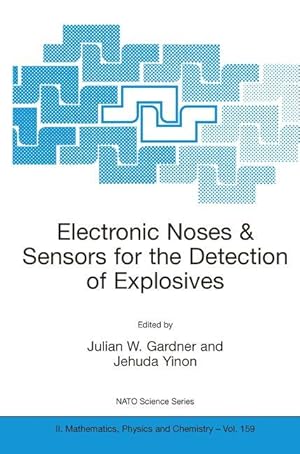
Electronic Noses & Sensors for the Detection of Explosives
Gardner, Julian W.|Yinon, Jehuda
ISBN 10: 1402023189 ISBN 13: 9781402023187
Verlag: Springer Netherlands, 2004
Neu
Softcover
Verkäufer
moluna, Greven, Deutschland
Verkäuferbewertung 4 von 5 Sternen

AbeBooks-Verkäufer seit 9. Juli 2020
Dieser Artikel ist nicht mehr verfügbar.
Beschreibung
Beschreibung:
Dieser Artikel ist ein Print on Demand Artikel und wird nach Ihrer Bestellung fuer Sie gedruckt. Proceedings of the NATO Advanced Research Workshop, held in Warwick, Coventry, U.K., 30 September-3 October 2003 This book examines both the potential application of electronic nose technology, and the current state of development of chemical sensors. Bestandsnummer des Verkäufers 4092968
Inhaltsangabe:
This book examines both the potential application of electronic nose technology, and the current state of development of chemical sensors for the detection of vapours from explosives, such as those used in landmines. The two fields have developed, somewhat in parallel, over the past decade and so one of the purposes of this workshop, on which the book is based, was to bring together scientists from the two fields in order to challenge the two communities and, mutually, stimulate both fields.
It begins with a review of the basic principles of an electronic nose and explores possible ways in which the detection limit of conventional electronic nose technology can be reduced to the level required for the trace levels observed for many explosive materials. Next are reviews of the use of several different types of solid-state chemical sensors: polymer-based sensors, i.e. chemiluminescent, fluorescent and optical, to detect explosive materials; metal oxide semiconducting resistive sensors; and then electrochemical sensors. Next, different pattern recognition techniques are presented to enhance the performance of chemical sensors. Then biological systems are considered as a possible blue-print for chemical sensing. The biology can be employed either to understand the way insects locate odorant sources, or to understand the signal processing neural pathways. Next is a discussion of some of the new types of electronic noses; namely, a fast GC column with a SAW detector and a micromechanical sensor. Finally, the important issues of sampling technologies and the design of the microfluidic systems are considered. In particular, the use of pre-concentrators and solid phase micro extractors to boost the vapour concentration before it is introduced to the chemical sensor or electronic nose.
Reseña del editor:
This book examines both the potential application of electronic nose technology, and the current state of development of chemical sensors for the detection of vapours from explosives, such as those used in landmines. The two fields have developed, somewhat in parallel, over the past decade and so one of the purposes of this workshop, on which the book is based, was to bring together scientists from the two fields in order to challenge the two communities and, mutually, stimulate both fields.
It begins with a review of the basic principles of an electronic nose and explores possible ways in which the detection limit of conventional electronic nose technology can be reduced to the level required for the trace levels observed for many explosive materials. Next are reviews of the use of several different types of solid-state chemical sensors: polymer-based sensors, i.e. chemiluminescent, fluorescent and optical, to detect explosive materials; metal oxide semiconducting resistive sensors; and then electrochemical sensors. Next, different pattern recognition techniques are presented to enhance the performance of chemical sensors. Then biological systems are considered as a possible blue-print for chemical sensing. The biology can be employed either to understand the way insects locate odorant sources, or to understand the signal processing neural pathways. Next is a discussion of some of the new types of electronic noses; namely, a fast GC column with a SAW detector and a micromechanical sensor. Finally, the important issues of sampling technologies and the design of the microfluidic systems are considered. In particular, the use of pre-concentrators and solid phase micro extractors to boost the vapour concentration before it is introduced to the chemical sensor or electronic nose.
„Über diesen Titel“ kann sich auf eine andere Ausgabe dieses Titels beziehen.
Bibliografische Details
Titel: Electronic Noses & Sensors for the Detection...
Verlag: Springer Netherlands
Erscheinungsdatum: 2004
Einband: Softcover
Zustand: New
Beste Suchergebnisse beim ZVAB

Foto des Verkäufers
Electronic Noses & Sensors for the Detection of Explosives
Verlag:
Springer Netherlands, Springer Netherlands, 2004
ISBN 10: 1402023189
ISBN 13: 9781402023187
Neu
Taschenbuch
Anbieter: AHA-BUCH GmbH, Einbeck, Deutschland
Verkäuferbewertung 5 von 5 Sternen

Taschenbuch. Zustand: Neu. Druck auf Anfrage Neuware - Printed after ordering - This book examines both the potential application of electronic nose technology, and the current state of development of chemical sensors for the detection of vapours from explosives, such as those used in landmines. The two fields have developed, somewhat in parallel, over the past decade and so one of the purposes of this workshop, on which the book is based, was to bring together scientists from the two fields in order to challenge the two communities and, mutually, stimulate both fields.It begins with a review of the basic principles of an electronic nose and explores possible ways in which the detection limit of conventional electronic nose technology can be reduced to the level required for the trace levels observed for many explosive materials. Next are reviews of the use of several different types of solid-state chemical sensors: polymer-based sensors, i.e. chemiluminescent, fluorescent and optical, to detect explosive materials; metal oxide semiconducting resistive sensors; and then electrochemical sensors. Next, different pattern recognition techniques are presented to enhance the performance of chemical sensors. Then biological systems are considered as a possible blue-print for chemical sensing. The biology can be employed either to understand the way insects locate odorant sources, or to understand the signal processing neural pathways. Next is a discussion of some of the new types of electronic noses; namely, a fast GC column with a SAW detector and a micromechanical sensor. Finally, the important issues of sampling technologies and the design of the microfluidic systems are considered. In particular, the use of pre-concentrators and solid phase micro extractors to boost the vapour concentration before it is introduced to the chemical sensor or electronic nose. Artikel-Nr. 9781402023187
Neu kaufen
EUR 331,86
EUR 62,50 shipping
Versand von Deutschland nach USA
Versand von Deutschland nach USA
Anzahl: 1 verfügbar